CBSE Special Exam Date Sheet 2026 Released! Check Class 12 subject-wise exam dates and timings - Education Times
Get a complete breakdown of the CBSE board exam, from the exam pattern and syllabus to preparation strategies for JEE/NEET aspirants and understanding your results.
21 min read
Your Ultimate Guide to the CBSE Board Exam
Remember that scene in 3 Idiots where Professor Viru Sahasrabuddhe, or 'Virus', talks about the race of life? He says, "Life is a race. If you don't run fast, you'll be like a broken 'anda' (egg)." For millions of students across India, the Class 12 board exams feel exactly like that final lap of the race. The pressure is immense. The stakes feel incredibly high. And everything seems to lead up to this one moment.
This is especially true if you're a JEE or NEET aspirant. You're juggling coaching classes, mock tests, and the massive syllabus for competitive exams. On top of it all, you have the looming CBSE board exam. It's easy to feel overwhelmed, confused, and unsure of how to balance it all. Many students wonder if they should focus only on competitive exams and just scrape by in boards. That's a huge mistake.
Your board exam results are more than just a piece of paper. They are a testament to your understanding of fundamental concepts, a crucial eligibility criterion for many colleges, and for many, a source of pride. They matter. And preparing for them doesn't have to be a battle against your JEE or NEET prep. In fact, it can be a powerful supplement.
This guide is here to be your 'Ranchoddas Chanchad', to tell you that you can excel without the stress. We will break down everything you need to know about the CBSE board exams. From understanding the exam pattern and mastering the syllabus to smart preparation strategies that align with your competitive exam goals, we've got you covered. Let's get started.
What is the CBSE Board Exam? The Big Picture

Before we dive into preparation strategies, let's zoom out. What exactly is this CBSE board exam everyone talks about? For many, it's just 'the boards', a yearly ritual of stress. But understanding the system you're a part of can give you a strategic advantage.
CBSE stands for the Central Board of Secondary Education. It's a national-level board of education for public and private schools, managed by the Government of India. Unlike state boards, CBSE has a more uniform curriculum across the country, which is why it's the preferred board for students whose parents have transferable jobs.
But the CBSE Class 12 exam isn't just another school test. It's a standardized, national-level examination that certifies your completion of secondary education. Think of it as a final stamp of approval on 12 years of schooling. The score you get on this exam is used by universities across India for admissions. It's your ticket to the next stage of your academic life.
For science students, the significance is even greater. The core syllabus for competitive exams like JEE Main and NEET is largely based on the CBSE curriculum for Classes 11 and 12. This means that a strong foundation in your board subjects is the first and most critical step towards cracking these entrance exams. They are not two different paths; they are two lanes on the same highway.
So, when you're studying for your boards, you're not taking a detour from your competitive exam prep. You are building the very foundation that will hold up your rank. This shift in perspective is the first step to a smarter, more integrated preparation plan.
Decoding the CBSE Exam Pattern and Marking Scheme
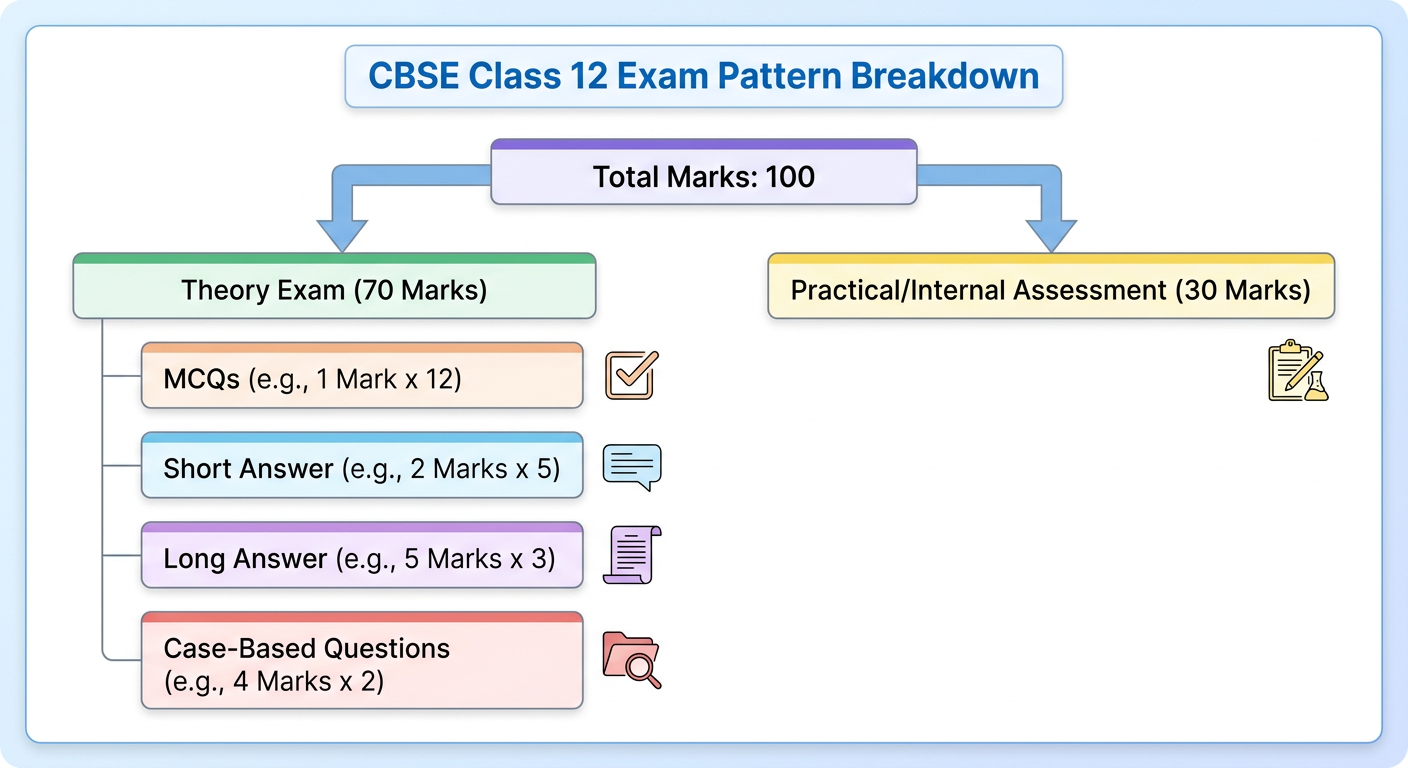
To win any game, you must first understand the rules. The CBSE board exam is no different. Just mugging up the syllabus won't guarantee a top score. You need to understand how you'll be tested and, more importantly, how you'll be marked. This is where the CBSE exam pattern and marking scheme come into play.
CBSE designs its question papers to test a range of skills, from rote memorization to critical thinking and application. Let's break down the key components.
Theory vs. Practical: Understanding the Split
For science subjects like Physics, Chemistry, and Biology, the total score of 100 is not just for the final written exam. It's typically split between theory and practicals.
- Theory Paper: This is the main written exam, usually carrying 70 marks.
- Practical Exam/Internal Assessment: This component carries the remaining 30 marks.
This 70/30 split is crucial. It means that nearly one-third of your marks come from activities conducted in your school. For subjects like Mathematics or English, the split is often 80/20, with 20 marks for internal assessment. Ignoring the practical and internal assessment component is like willingly giving up 20-30% of your marks before you even start.
Types of Questions to Expect
The CBSE question paper is a mixed bag designed to assess different levels of understanding. You'll generally find:
- Multiple Choice Questions (MCQs): These one-mark questions test your factual knowledge and conceptual clarity. They are quick to answer but require precision.
- Very Short Answer (VSA) & Short Answer (SA) Questions: These range from 2 to 3 marks and require you to write concise, to-the-point answers. They test your ability to explain concepts clearly.
- Long Answer (LA) Questions: These are the heavy hitters, usually for 5 marks. They require detailed explanations, derivations, or step-by-step problem-solving. This is where your in-depth understanding is tested.
- Competency-Based/Case-Study Questions: This is a newer addition to the CBSE exam pattern. Instead of a direct question, you'll be given a paragraph, a diagram, or a data set and asked questions based on it. These questions test your ability to apply concepts to real-world scenarios. For example, instead of asking you to "Define Ohm's Law," a question might describe a circuit with varying voltage and current readings and ask you to analyze the relationship.
The Importance of the CBSE Marking Scheme
Here lies the biggest difference between boards and competitive exams. JEE and NEET are often about getting the single correct answer. The CBSE marking scheme, however, is your friend. It follows a system of step-marking.
This means you get marks for each correct step in a derivation or a numerical problem, even if your final answer is incorrect due to a calculation error. If a 5-mark question involves four key steps, you could still get 3 or 4 marks by getting the first few steps right.
This is why showing your work is non-negotiable in the board exam. Write down the formulas used, substitute the values clearly, and present your answer in a logical sequence. You can find detailed marking schemes along with the official sample papers on the CBSE website, which show you exactly how marks are allocated for each step.
Mastering the CBSE Syllabus: What to Study and How
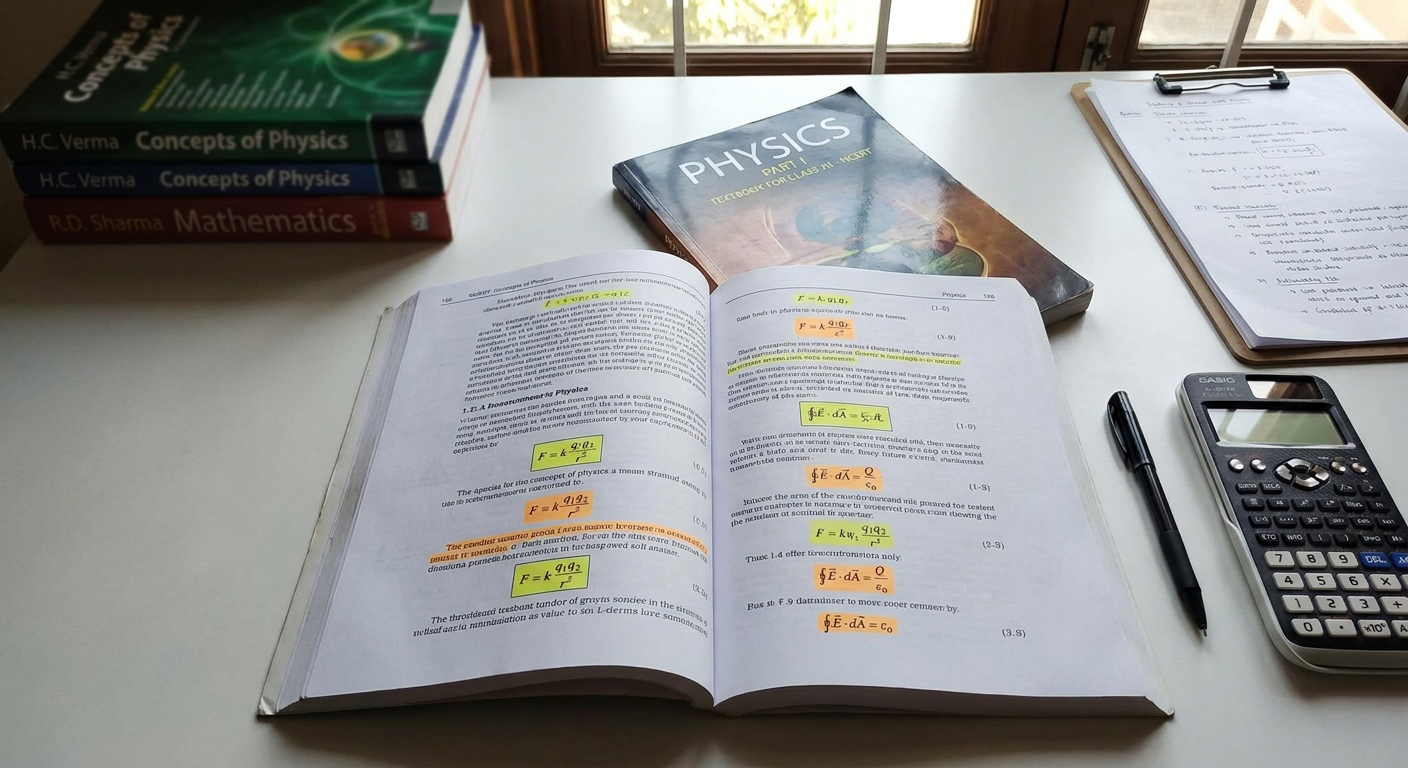
Now that you know the rules of the game, let's talk about the playbook: the CBSE syllabus. The syllabus is your map. Without it, you're just wandering aimlessly through a forest of information. Mastering it requires a smart approach, not just hard work.
NCERT Books: Your Foundation and Your Fortress
If there is one piece of advice that every single topper, teacher, and expert agrees on, it's this: NCERT textbooks are the bible for the CBSE board exam. You must treat them as such.
The CBSE question paper is designed, almost exclusively, from the content within the NCERT books. The language of the questions, the diagrams used, and the concepts tested are all directly sourced from these texts. Many students make the mistake of jumping to bulky reference books while their NCERTs gather dust. Don't be that student.
Your strategy for NCERT should be thorough:
- Read every line: Don't just skim the chapters. Important one-mark questions are often hidden in the details of a paragraph or in a box.
- Solve every question: This includes the in-text 'blue box' questions, the solved examples, and every single question at the end of the chapter. Do not skip any.
- Master the NCERT Exemplar: The Exemplar problems are a step up in difficulty and are fantastic for developing application-based skills. They are a goldmine for tricky questions that often appear in the exam.
For at least 90-95% of your board exam paper, a complete and thorough command of the NCERT textbook is more than enough.
Beyond NCERT: When to Use Reference Books
So, do reference books have no place? Not at all. They can be very useful, but they must be used strategically.
Reference books like H.C. Verma for Physics, R.D. Sharma for Maths, or O.P. Tandon for Chemistry are excellent for practice. They offer a larger variety of problems on each topic, which can help solidify your understanding. This is particularly helpful if you are also preparing for JEE or NEET, as these books often bridge the gap in difficulty.
The key is balance. Use reference books for practice after you have completely mastered the corresponding chapter from NCERT. Don't use them to learn a concept for the first time. That's what NCERT is for. Stick to one good reference book per subject. Having too many will only lead to confusion and incomplete preparation.
Tracking the Latest CBSE Syllabus Changes
While the core concepts remain the same, CBSE sometimes makes minor additions or deletions to the syllabus each year. It is absolutely crucial to be working with the latest syllabus. Studying a deleted topic is a waste of your precious time, and missing a new addition could cost you marks.
The most reliable source for the latest curriculum is always the official CBSE Academic website. You can also check our detailed JEE/NEET syllabus breakdown, which we keep updated with the latest changes from NTA and CBSE to help you study smart.
The Strategic Link Between Board Prep and JEE/NEET
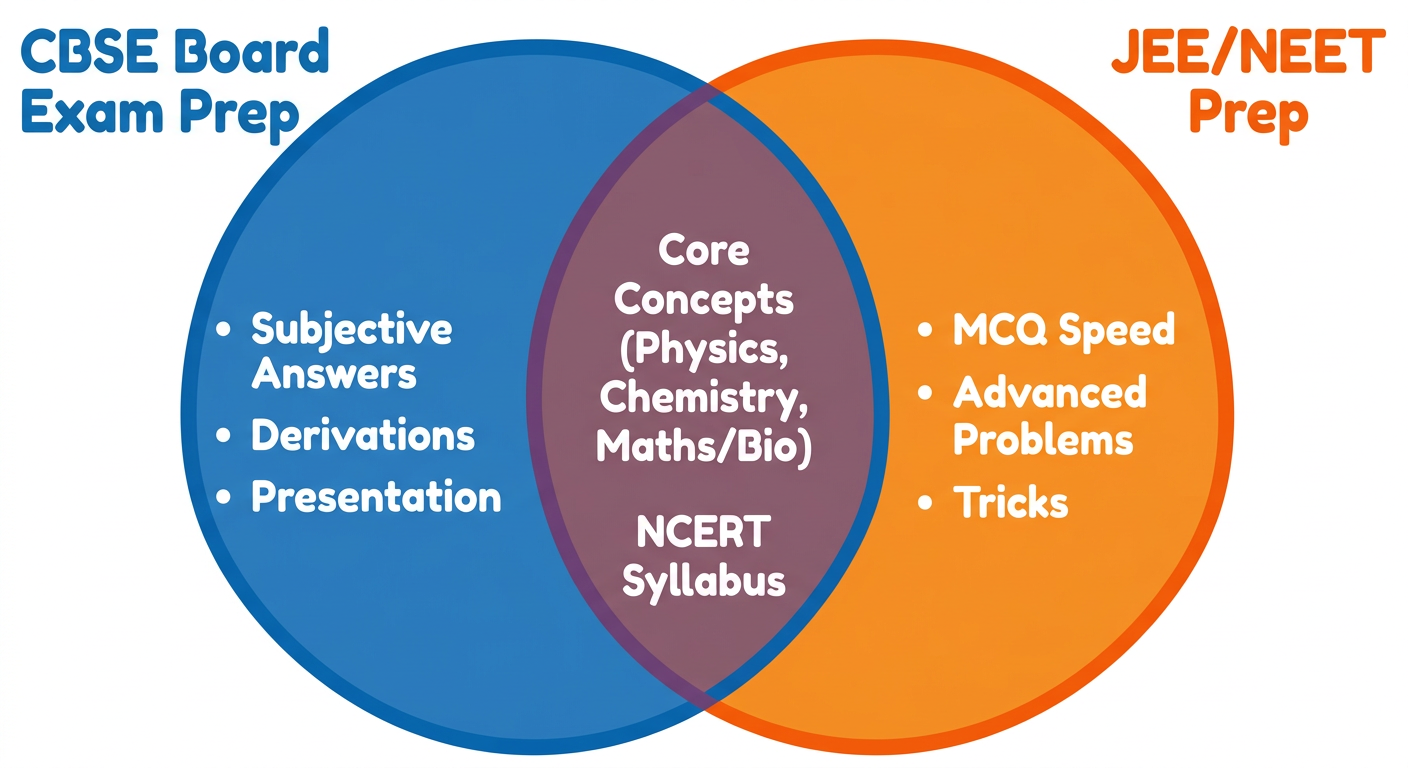
This is the million-dollar question for every science student: "How do I manage boards and competitive exams together?" Many see them as two separate, conflicting goals. The secret is to see them as one integrated process.
The syllabus overlap between the CBSE Class 12 curriculum and JEE/NEET is almost 100% for the corresponding subjects. The same concepts of electromagnetism, calculus, organic chemistry, and genetics are tested in both exams. The difference lies not in what is tested, but how it's tested.
Bridging the Gap: From Subjective to Objective
Your board exam preparation focuses on building a deep, fundamental understanding. It teaches you to explain concepts in detail, derive formulas from scratch, and present your solutions logically. This is the subjective approach. It builds your foundation.
Your JEE/NEET preparation focuses on speed, accuracy, and application. It teaches you to solve complex problems quickly, often using shortcuts and tricks. This is the objective approach. It builds your problem-solving muscle.
These two approaches are not enemies. They are two sides of the same coin. Here's how to integrate them:
- Learn First, Trick Later: When you study a new chapter, first learn it from the NCERT textbook in detail, as if you're preparing for a subjective test. Solve the problems step-by-step.
- Switch to Objective Mode: Once you're comfortable with the concepts, switch to solving MCQs on that topic. Time yourself. Try to find faster ways to get to the answer. This is where your coaching material and books like H.C. Verma come in.
- Example in Action: Imagine you're studying Integration. For the board exam, you need to write out every step of a 'by parts' integration, mentioning the ILATE rule. For JEE, you might use a shortcut like the DI method (tabular integration) to solve it in 30 seconds. The smart student learns both. The deep understanding from the board method helps you know why the shortcut works, making you less likely to make a mistake under pressure.
Time Management for the Dual Goal
Balancing both requires a smart schedule, especially from October onwards.
- Allocate Time Daily: Dedicate a few hours each day specifically for board-style preparation. This could involve writing down answers, practicing derivations, or working on your English/fifth subject.
- Don't Ignore Languages: Your English/Hindi and the fifth subject (like Computer Science or Physical Education) are part of your final percentage. Scoring well in them is an easy way to boost your overall score. Don't neglect them until the last month.
- Weekend Mock Tests: Use your weekends for mock tests. You could alternate: one weekend for a full JEE/NEET pattern test, the next for a 3-hour board exam paper.
- The Final Sprint (Jan-Feb): The 1-2 months leading up to the boards should see a significant shift towards subjective answer writing and revision of all subjects. By this time, your core concept preparation for JEE/NEET should be mostly complete.
Practical Exams and Internal Assessment: The 'Free' Marks You Can't Ignore

In the grand scheme of board exam preparation, the 30 marks for practicals and internal assessment can feel like a side quest. But this side quest has a major impact on your final score. Scoring 28-30 marks here provides a massive buffer and can be the difference between 85% and 90%.
These marks are often misunderstood. They aren't 'free'. You have to earn them throughout the year. The component is usually broken down into several parts:
- The Practical Exam Day: This is the main event where an external examiner comes to your school. It typically involves performing one or two experiments, a viva (oral questions), and submitting your project file and lab record.
- Lab Record/Practical File: This is the journal where you document all the experiments you've performed throughout the year. A neat, complete, and well-maintained record creates a great first impression.
- Project File: Most subjects require you to prepare a research-based project on a chosen topic. This needs to be done sincerely, not just a copy-paste job from the internet.
- Viva Voce: This is where the external examiner asks you questions, usually based on the experiments you performed or your project. Your confidence and conceptual clarity are key here.
Here are some tips to ace your CBSE practical exams:
- Be Regular: Don't skip your lab classes. Perform the experiments yourself to understand the procedure and precautions.
- Maintain Your Records: Complete your lab manual and project file on time. Don't leave it all for the last week.
- Know Your Stuff: For the viva, thoroughly revise the concepts related to your experiments and your project. Be honest if you don't know an answer, rather than trying to guess.
- Practice the Experiments: If possible, do a dry run of the main experiments a day or two before the exam so you are confident with the procedure.
Treat these 30 marks with the seriousness they deserve. They are the lowest-hanging fruit in your quest for a high percentage.
The Power of Previous Year Questions (PYQs) and Sample Papers
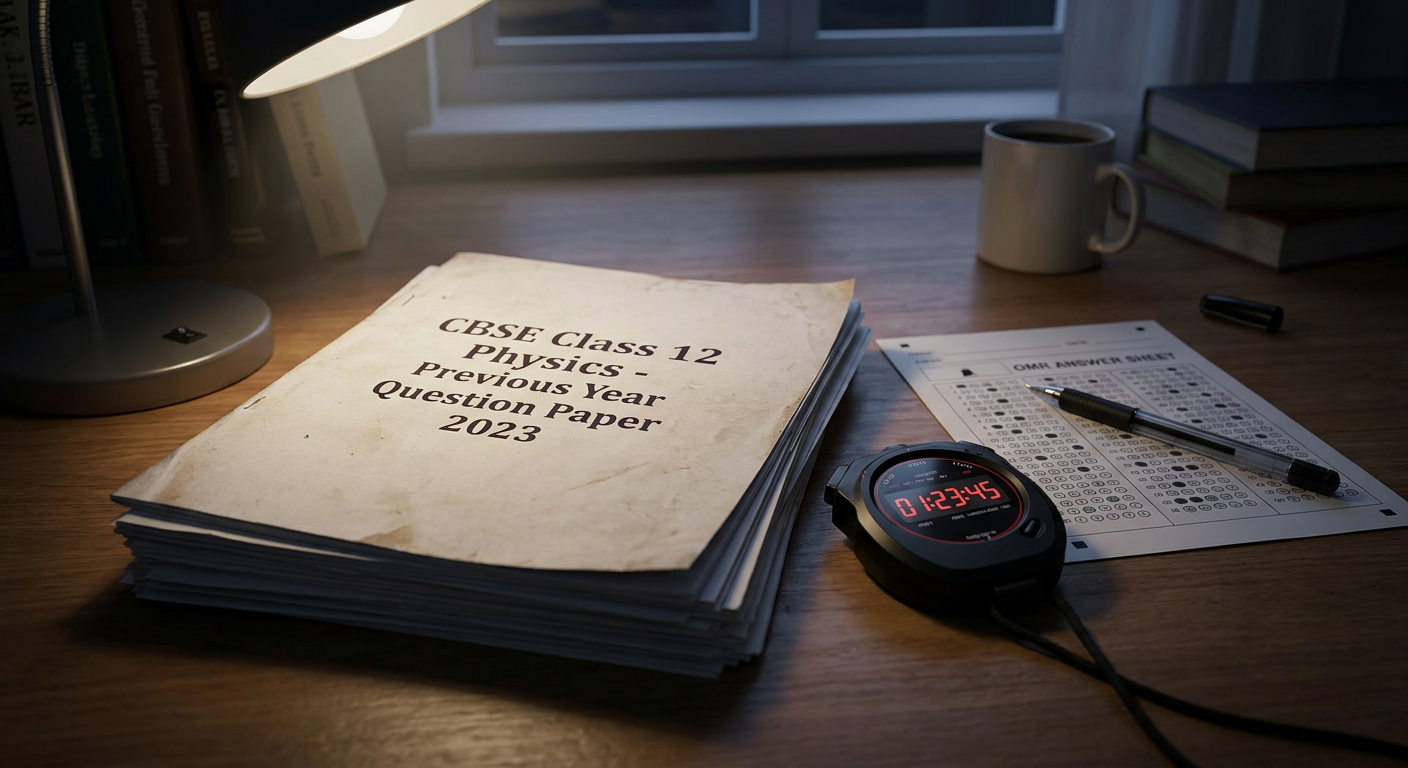
If NCERT is your textbook, then Previous Year Questions (PYQs) are your crystal ball. There is no better tool to understand the exact nature, pattern, and difficulty level of the CBSE board exam. Solving PYQs is not just practice; it's a simulation of the real exam.
Why are PYQs so important?
- They Reveal Patterns: You'll notice that certain topics and even specific types of questions are repeated frequently over the years. This helps you identify the high-yield areas that deserve more of your attention.
- They Teach Time Management: Solving a full 3-hour paper gives you a real feel for the time pressure. You learn how to allocate your time across different sections and questions.
- They Perfect Your Answering Style: By comparing your answers to the topper's answer sheets or official marking schemes, you learn how to structure your answers, what keywords to include, and how much to write for a 2-mark vs. a 5-mark question.
Your strategy for PYQs should be systematic. Start by solving the last 5-7 years of papers. Don't just read the questions; solve them in an exam-like condition. Set a timer for 3 hours, sit in a quiet room, and write the entire paper. Once done, get it checked by a teacher or self-evaluate it honestly.
In addition to PYQs, CBSE releases its own official Sample Question Papers (SQPs) every year. These are extremely important as they reflect the board's latest thinking on the paper pattern and question types for the upcoming exam. Always solve the current year's SQP first. You can find a vast collection of previous year questions on our platform to get started.
Exam Day Strategy: From Writing the Paper to Managing Stress
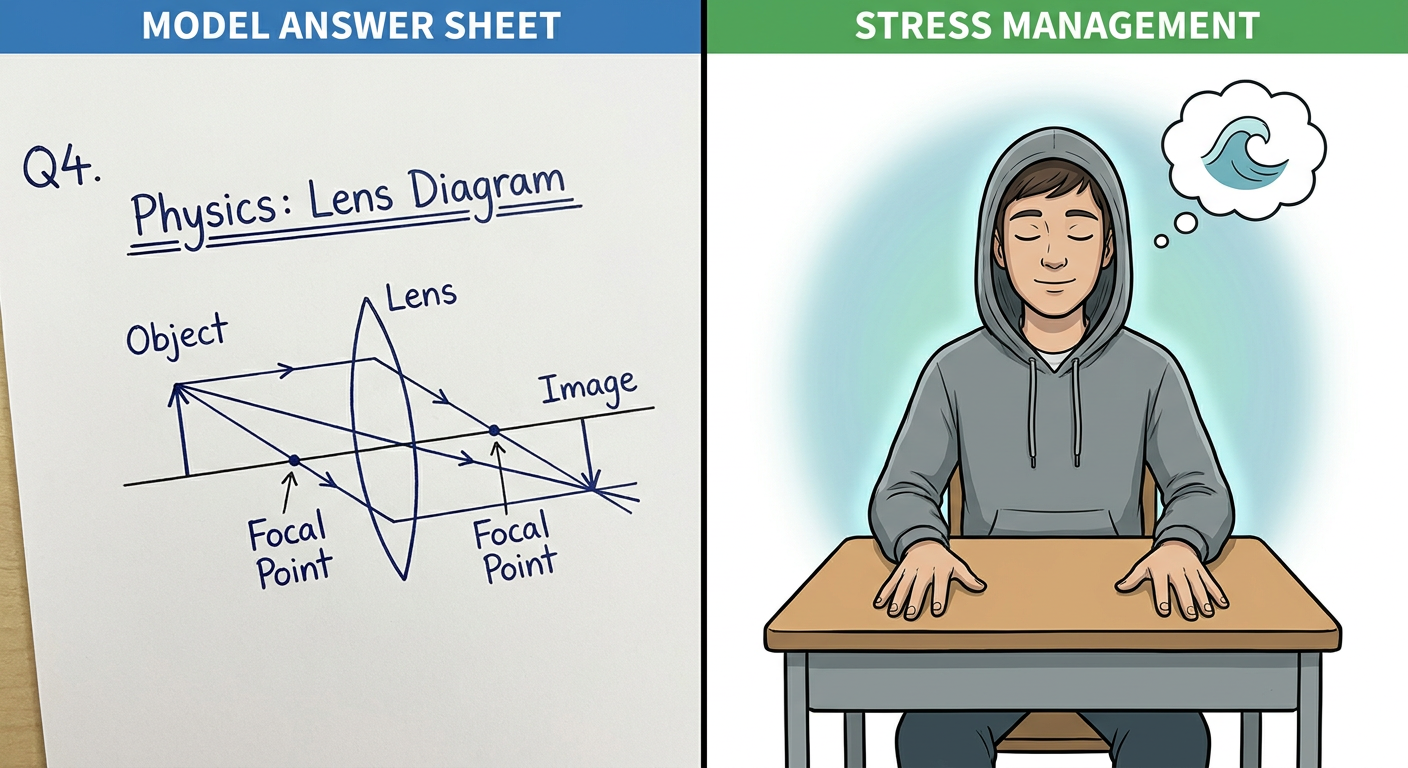
After months of hard work, it all comes down to those three hours in the exam hall. A brilliant student can underperform due to poor exam strategy, while a well-prepared student can maximize their score with smart execution. How you perform on D-day matters immensely.
The Art of Presentation
Remember, your answer sheet is being checked by a human being who has to evaluate hundreds of copies. A neat, well-structured, and easy-to-read paper makes their job easier and can subconsciously create a positive impression.
- Neatness Counts: Use a pen that doesn't smudge. Write clearly. If you have to cancel something, strike it through with a single line instead of scribbling over it.
- Structure Your Answers: Use bullet points for questions that ask for features or differences. Underline key headings and important terms. This helps the examiner quickly spot the key parts of your answer.
- Draw Diagrams: In subjects like Biology and Physics, a well-labeled diagram can fetch you full marks even if your text is slightly weak. Always draw diagrams with a pencil and label them clearly.
- Leave Space: Leave a line or two between answers to separate them clearly. Start each new section on a fresh page if possible.
Time Management Inside the Exam Hall
Time is your most valuable resource during the exam. Managing it well is a skill.
- Use the 15-Minute Reading Time: This is a golden period. Don't just read the paper; plan your attack. Quickly identify the questions you are confident about and the ones that might be tricky. Decide the order in which you will attempt the sections.
- Allocate Time Wisely: Have a rough mental clock. For example, in a 70-mark paper over 180 minutes, you have roughly 2.5 minutes per mark. Don't spend 20 minutes on a 5-mark question.
- Attempt What You Know First: Start with the section you are most confident in. This builds momentum and boosts your morale. It also ensures you secure the marks for what you know well.
- Save Time for Revision: Always aim to finish the paper 10-15 minutes early. Use this time to revise your answers, check for silly calculation errors, and ensure you have attempted all the questions.
Handling Exam Stress and Anxiety
It's completely normal to feel nervous before and during an exam. The key is not to let that anxiety overwhelm you.
- Get Enough Sleep: Pulling an all-nighter before an exam is the worst thing you can do. A well-rested brain performs significantly better. Aim for 7-8 hours of sleep.
- Eat Light: Have a light but nutritious breakfast. Avoid heavy or oily food that can make you feel lethargic.
- Breathe: If you feel a wave of panic during the exam, just put your pen down for 30 seconds. Close your eyes and take a few deep breaths. It helps reset your focus.
- Stay Positive: You have prepared for this. Trust your preparation. Go into the hall with a confident and positive mindset.
After the Exam: Understanding Your CBSE Results

The wait for the results can be more nerve-wracking than the exams themselves. When the results are finally declared, you need to know how to access them and, more importantly, how to interpret them.
Results are typically announced on the official CBSE websites, such as cbseresults.nic.in and the main CBSE site. You can also access your digital marksheet through DigiLocker, which is a government-run digital document wallet.
Your marksheet will show your marks in theory and practicals/internal assessment for each subject, along with a grade. The overall percentage is what most colleges look at. This is usually a simple average of your main five subjects.
What if Things Don't Go as Planned?
Sometimes, despite your best efforts, you may not get the score you hoped for, or you might fail in a subject. Don't panic. CBSE has provisions in place.
- Compartment Exam: If a student fails in one or two subjects, they can appear for the Compartment Exam, which is held shortly after the results are declared. This gives you a second chance to pass the class in the same year.
- Improvement Exam: If you have passed the exam but are not satisfied with your marks in a particular subject, you can appear for the Improvement Exam the following year to try and score better. Only the better of the two scores will be considered.
- Verification and Re-evaluation: If you strongly believe there has been an error in the totaling of your marks or the evaluation of your paper, you can apply for verification or re-evaluation through a formal process on the CBSE website.
Your board result is an important milestone, but it does not define your entire life or your potential. Whether you score 95% or 75%, what matters is what you do next. Use your JEE or NEET score to find the best possible college. You can use tools like a JEE rank predictor to get an idea of where you stand and what colleges you might be eligible for based on your performance.
FAQs
When are CBSE board exams usually conducted?
Typically, the main theory examinations for CBSE Class 10 and Class 12 are conducted between February and April. The practical exams are usually completed in January and early February. However, you must always check the official date sheet released on the CBSE website for the exact schedule for that academic year.
What is the passing criteria for CBSE Class 12?
To pass the CBSE Class 12 board exam, a student must secure a minimum of 33% marks in each of the five main subjects. This 33% is calculated separately for theory and practical components. You must pass both parts individually to be declared 'Pass' in that subject.
Can I appear for improvement exams in more than one subject?
Yes, students who have passed the exam can appear for the improvement exam in one or more subjects in the subsequent year. This is a chance to improve your percentage. There is no limit to the number of subjects you can choose for improvement, but you only get one attempt for improvement exams.
How important are Class 12 board marks for JEE/NEET?
While the direct weightage of board marks in JEE/NEET ranking has been removed, they are still very important. To be eligible for admission into NITs, IIITs, and other GFTIs, a student needs to secure at least 75% marks in their Class 12 board exam (or be in the top 20 percentile of their board). For SC/ST candidates, the eligibility is 65%. While there is no such percentage criterion for NEET, many medical colleges may have their own admission criteria.
Where can I find the latest CBSE syllabus and sample papers?
The single most reliable source is the official CBSE Academic website (cbseacademic.nic.in). They upload the detailed syllabus for all subjects, sample question papers, and marking schemes for each academic session. It is highly recommended to download these directly from the official source to ensure you have the correct and most updated information.
Is NCERT enough to score above 95% in the CBSE board exam?
Absolutely, yes. A thorough, line-by-line understanding of the NCERT textbooks, combined with solving all its in-text and exercise questions, is the core requirement. To push your score from the 90-95% range to 95%+, you should supplement your NCERT preparation with NCERT Exemplar problems and by solving the last 5-7 years of previous year question papers in a timed manner. This combination is a proven formula for success.