JIC Report 2026: 73% of Top 500 JEE Advanced Rankers Choose Computer Science - Allen
Your complete guide to cracking the IIT JEE Advanced exam, covering eligibility, paper pattern, syllabus, preparation strategy, and rank analysis.
18 min read
Ever watched the launch of a Chandrayaan mission and felt that fire in your belly? That dream of building something magnificent, something that pushes the boundaries of science and technology? For lakhs of Indian students, that dream begins with a single, formidable gateway: the Indian Institutes of Technology (IITs). And the key to unlocking that gate is the Joint Entrance Examination, or JEE Advanced.
But let's be honest. It's more than just an exam; it’s a legend. It's the final boss battle after you've cleared the JEE Main level. It’s whispered about in coaching centres and worried over at dinner tables across the country. It’s designed not just to test what you know, but how you think.
Feeling overwhelmed? Don't be. This guide is your complete roadmap. We'll break down everything you need to know, from the nitty-gritty of eligibility and paper patterns to the battle-tested strategies that toppers use. By the end of this, the JEE Advanced will feel less like a monster and more like a challenge you are ready to conquer.
What Is the JEE Advanced Exam, Really?
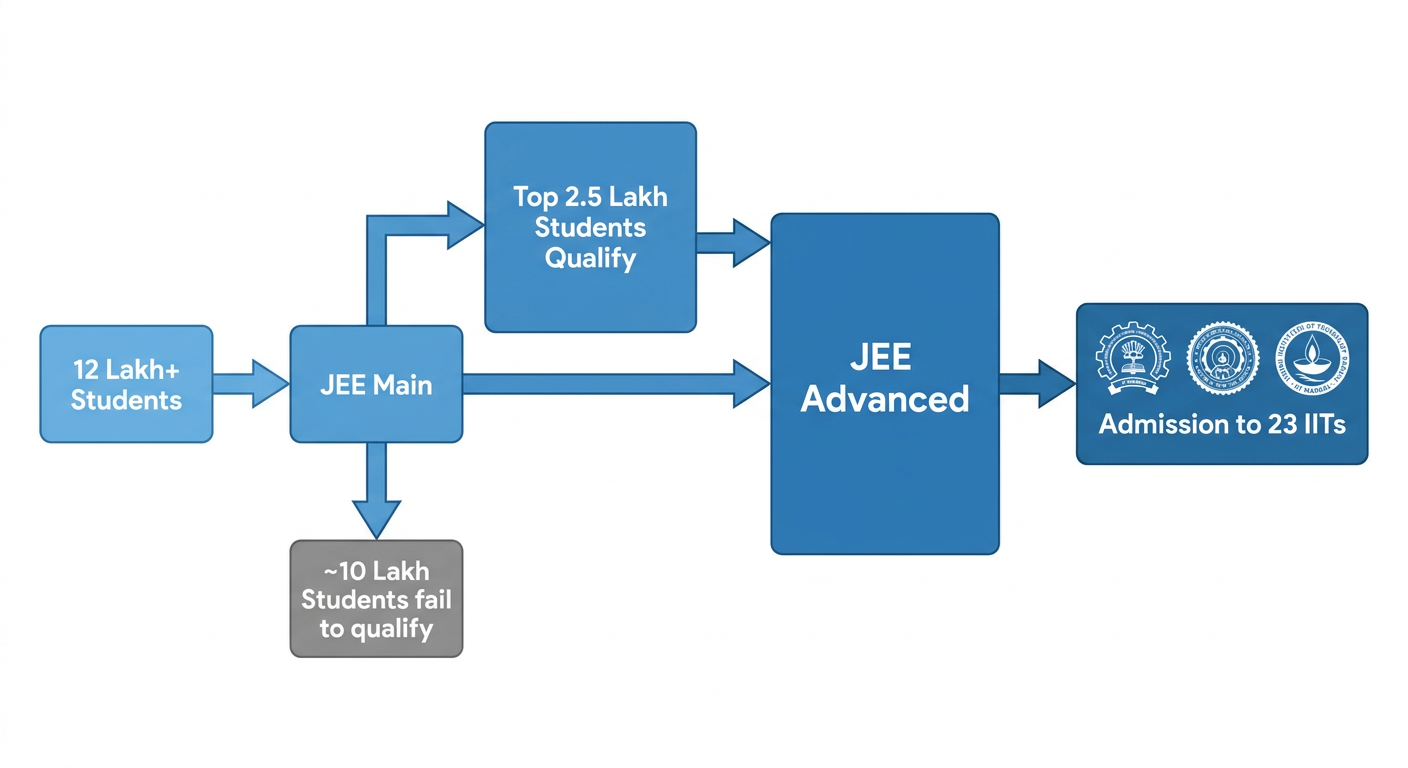
At its core, the JEE Advanced is the second and final stage of the Joint Entrance Examination, the most prestigious engineering entrance examination in India. Think of JEE Main as the qualifier. It’s a massive screening test that filters a vast pool of aspirants down to the most serious contenders. Only the top performers in JEE Main (approximately the top 2.5 lakh candidates) earn the right to sit for JEE Advanced.
This exam is the exclusive gateway for admission into the undergraduate programs at the 23 Indian Institutes of Technology (IITs). Getting a good rank here means you get to choose your seat in some of the finest engineering colleges in the world. It’s not just about securing a degree; it's about gaining an identity, a network, and a launchpad for your career that is second to none.
The key difference isn't just exclusivity; it's the philosophy. While JEE Main tests your knowledge, speed, and accuracy across a wide syllabus, JEE Advanced probes the depth of your understanding. It challenges your analytical skills, your problem-solving abilities, and your temperament under pressure. The questions are often multi-conceptual, requiring you to pull together ideas from different topics to arrive at a solution. This is why it has earned its reputation as one of the toughest exams globally.
Are You Eligible? Checking the Boxes for JEE Advanced
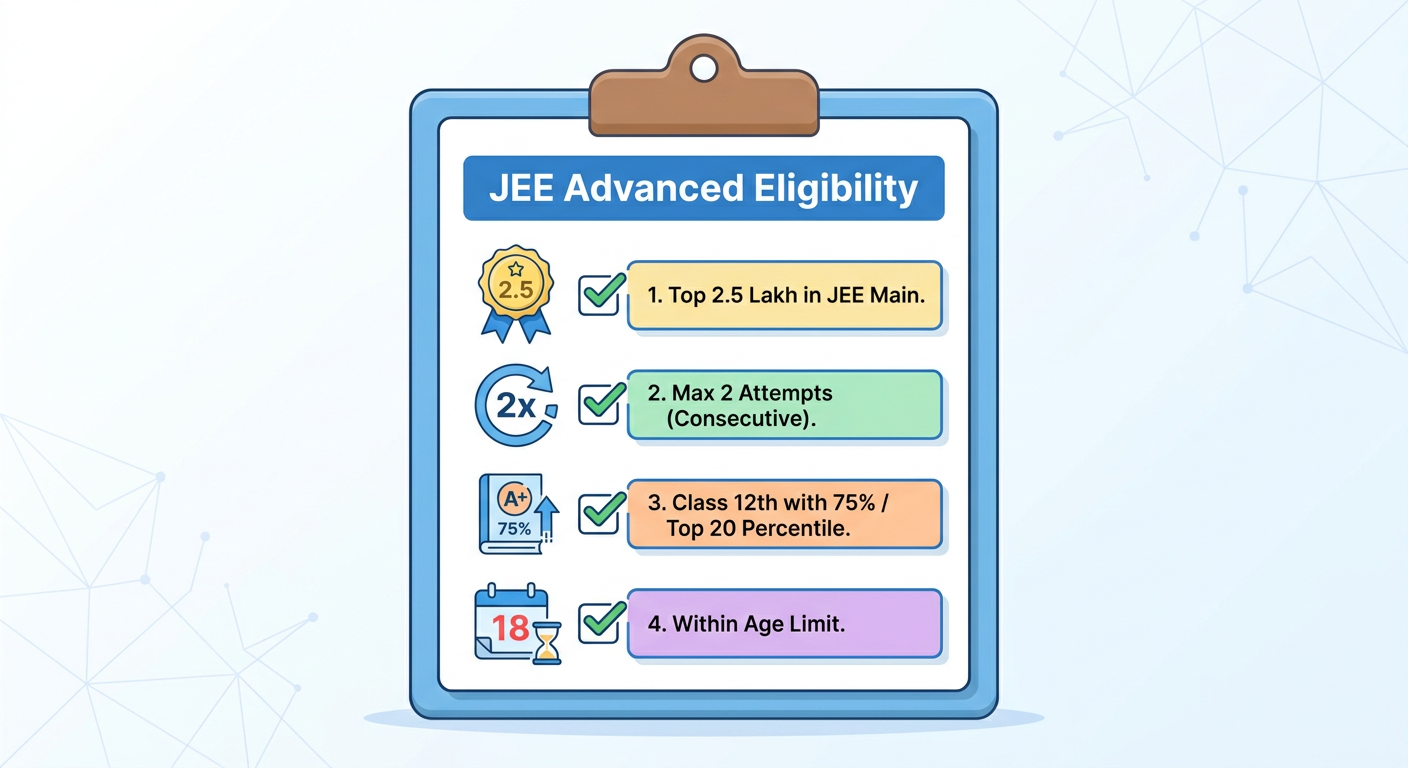
Before you dive headfirst into years of preparation, it's crucial to ensure you meet the strict eligibility criteria. These rules are non-negotiable, and failing to meet even one can disqualify you. The criteria are set by the Joint Admission Board (JAB) and can sometimes be updated, so always cross-check with the official JEE Advanced site for the latest information brochure.
Here’s a breakdown of the primary requirements.
Performance in JEE Main
This is the very first hurdle. You must appear for the JEE Main paper of the corresponding year and rank among the top 2,50,000 candidates (including all categories). The exact cutoff percentile changes every year depending on the performance of students, so aiming to be comfortably within this rank is essential. You can't just register for JEE Advanced directly.
Age Limit
There is an age limit for appearing in the exam. Candidates should have been born on or after October 1, 1999, for the 2024 exam. A relaxation of five years is given to SC, ST, and PwD candidates. This specific date moves forward each year, so it's a critical point to verify for your target year.
Number of Attempts
This is one of the most important rules. A candidate can attempt JEE Advanced a maximum of two times in two consecutive years. For example, if your Class 12th board exam was in 2023, you could attempt JEE Advanced in 2023 and 2024, regardless of whether you passed the board exam or not. You cannot skip a year and use your second attempt later.
Class 12th (or Equivalent) Examination
A candidate should have appeared for the Class 12th (or equivalent) examination for the first time in either the same year as their first attempt or the year immediately preceding it. For instance, to be eligible for JEE Advanced 2024, a student must have appeared for their Class 12 board exams for the first time in either 2023 or 2024.
Furthermore, you must secure at least 75% aggregate marks in your Class 12th board exam (65% for SC, ST, and PwD candidates). Alternatively, you must be within the top 20 percentile of successful candidates in your respective board. This rule has been waived in certain years due to the pandemic, but it's generally in effect. Always confirm the latest status from the official sources.
Understanding the JEE Advanced Paper Pattern
The JEE Advanced paper pattern is notorious for its unpredictability. The organizing IIT for the year often introduces subtle (and sometimes not-so-subtle) changes to keep students on their toes. However, the fundamental structure and the philosophy behind the question types remain consistent. Understanding this is key to your preparation.
The Two-Paper Structure
The exam consists of two compulsory papers: Paper 1 and Paper 2. Both are typically three hours long and are conducted on the same day with a break in between. You must appear for both papers. Your final rank is calculated based on the aggregate score from both papers. Missing either paper means you are out of the race.
This two-paper format is a test of endurance as much as it is of intelligence. Six hours of intense focus with high-stakes questions requires immense mental stamina. Many students perform well in Paper 1 but suffer a drop in Paper 2 due to fatigue. Building this stamina through full-length mock tests is non-negotiable.
The Ever-Changing Question Types
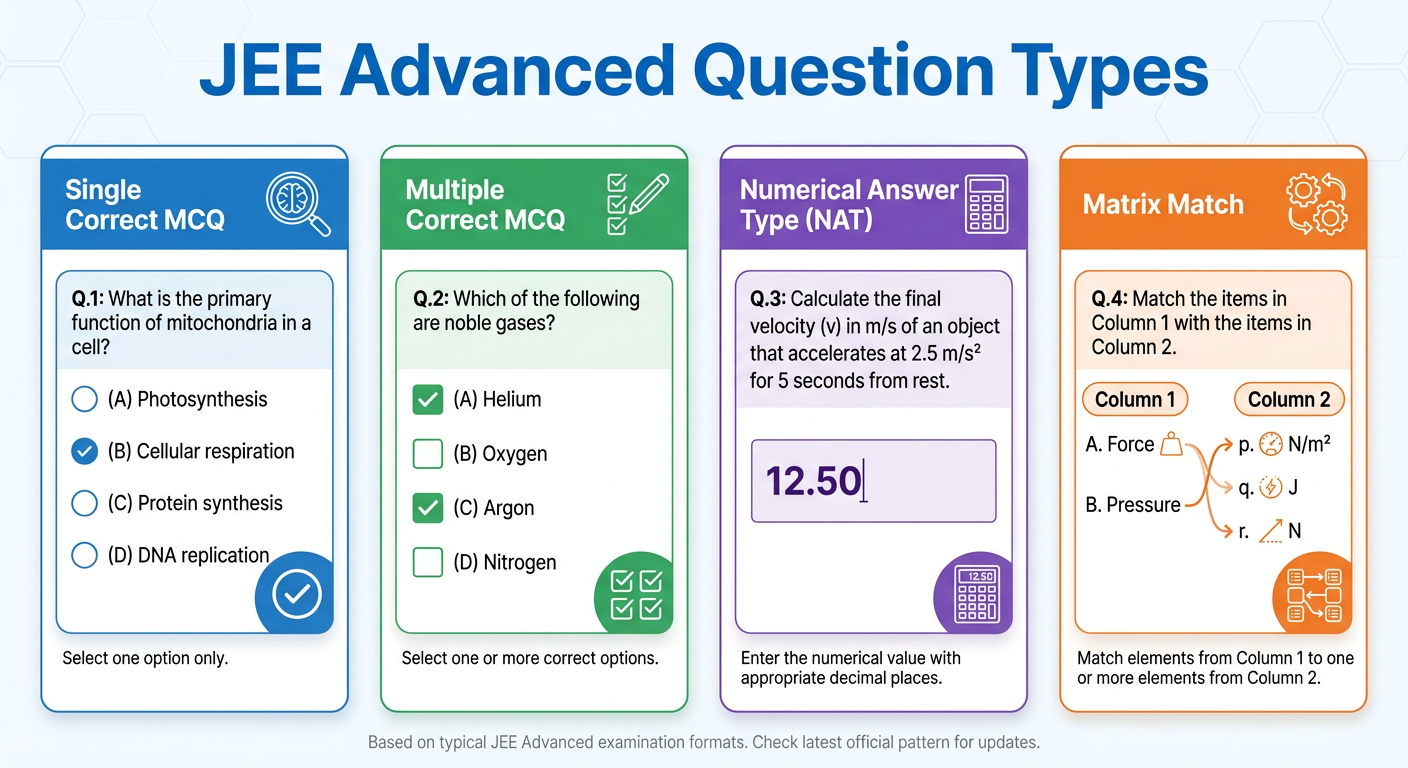
This is where JEE Advanced truly separates itself from JEE Main. You will encounter a variety of question formats, and you must be comfortable with all of them. Common types include:
- Single Correct Option MCQs: The classic format. One correct answer out of four options.
- Multiple Correct Options MCQs: These are tricky. One or more options can be correct. You get full marks only if you select all the correct options and no incorrect ones. Partial marks are often awarded.
- Numerical Answer Type (NAT): You have to solve the problem and enter a numerical value as your answer. There are no options to choose from, eliminating guesswork. These often do not have negative marking, making them scoring opportunities if you are confident.
- Paragraph/Comprehension Based Questions: A passage of information is given, followed by two or three questions based on it. This tests your ability to comprehend and apply new information quickly.
- Matrix Match (Match the Following): You have to match entries from one column to entries in another. These can be complex, with one-to-one or one-to-many matching.
The Perils of Negative Marking
Negative marking is a crucial element of the JEE Advanced paper pattern. The marking scheme is not uniform and can change from section to section, year to year. For example, a single correct MCQ might be +3 for a correct answer and -1 for a wrong one. A multiple correct MCQ might award +4 for all correct choices, with partial marks for partially correct answers, and often -2 for an incorrect selection.
This is not a game of maximizing attempts; it's a game of maximizing accuracy. Guesswork can be devastating to your rank. The ability to identify and skip questions you are not sure about is as important as solving the ones you know. This is a skill that must be honed during your preparation phase.
Decoding the JEE Advanced Syllabus: What to Study
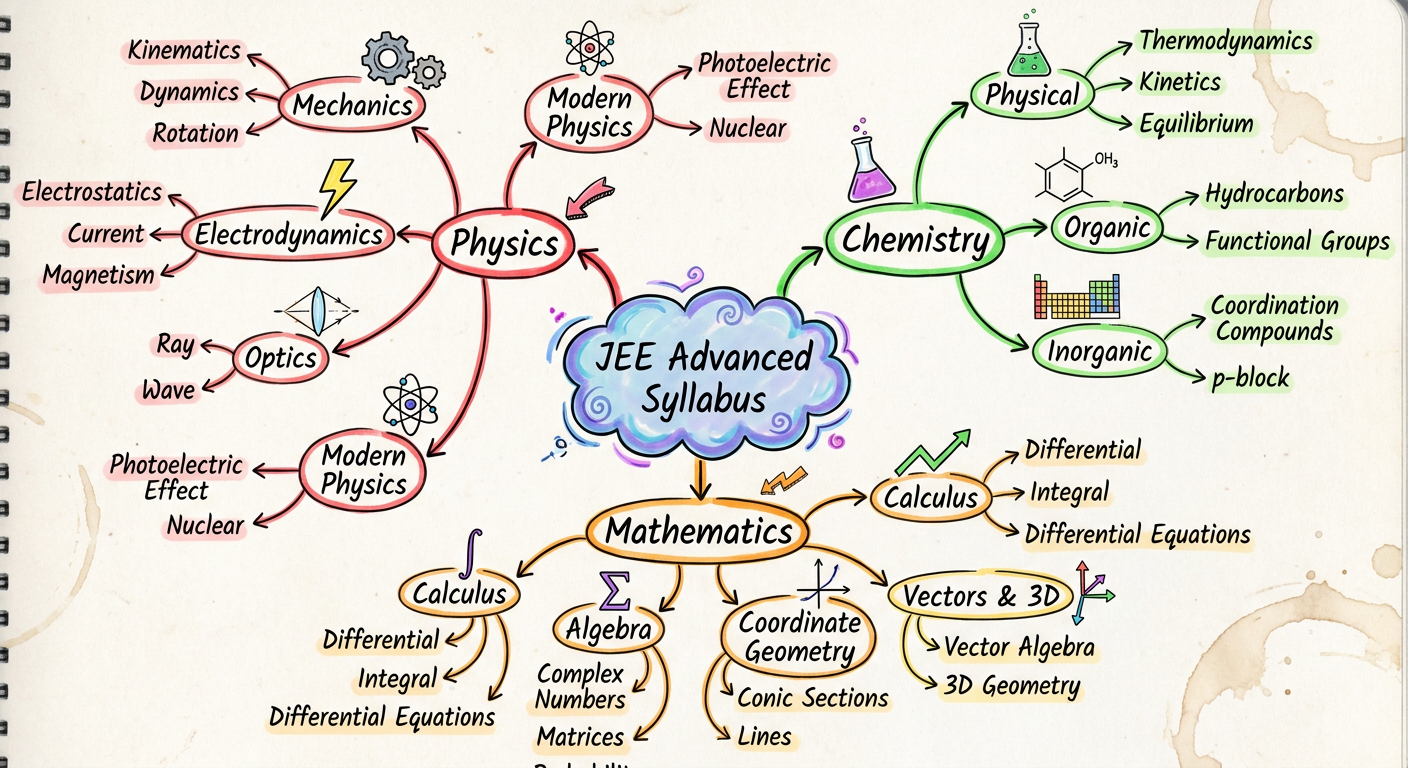
The JEE Advanced syllabus is vast and deep. While it is broadly based on the topics covered in Class 11 and 12, it goes much further in terms of conceptual depth and the complexity of application. Simply knowing the formulas from your NCERT books won't be enough. You need a profound, first-principles understanding of every topic.
You can find the complete topic-wise breakdown on our JEE syllabus page, but here's a high-level overview of the most important areas in each subject.
Physics: From Mechanics to Modern Physics
Physics in JEE Advanced is all about application. Questions are designed to test your ability to model a physical situation and apply the correct principles. Rote learning is useless here.
- High-Weightage Topics: Mechanics (especially Rotational Motion), Electrodynamics (Electrostatics, Current, Magnetism, EMI), Optics (both Geometric and Wave), Thermodynamics & KTG, and Modern Physics.
- Key to Success: Develop strong visualization and problem-solving skills. I.E. Irodov is a famous book for a reason – it forces you to think. Don't just solve problems; understand the 'why' behind each step. Master concepts like conservation laws, as they are universally applicable.
Chemistry: The Three Pillars
Chemistry is often the most scoring subject in JEE Advanced if prepared strategically. It is a balanced mix of logical deduction (Physical), memorization (Inorganic), and pattern recognition (Organic).
- Physical Chemistry: Focus on conceptual topics like Chemical Equilibrium, Ionic Equilibrium, Thermodynamics, and Electrochemistry. These require strong problem-solving skills, similar to Physics.
- Organic Chemistry: General Organic Chemistry (GOC) is the absolute foundation. Master reaction mechanisms instead of just memorizing named reactions. Topics like Stereochemistry, Hydrocarbons, and Oxygen-containing compounds are vital.
- Inorganic Chemistry: This section can be a rank-booster. Focus on Coordination Compounds, Chemical Bonding, and p-Block elements. While it requires memorization, understanding the underlying trends and reasons (like periodic properties) makes it easier.
Mathematics: The Language of Engineers
Mathematics in JEE Advanced is arguably the most challenging section for many. The questions are often lengthy and require a clever, non-obvious approach. Speed and accuracy are paramount.
- High-Weightage Topics: Calculus (Functions, Limits, Continuity, Differentiability, Application of Derivatives, Integration) is the king. Algebra (Quadratic Equations, Complex Numbers, Permutations & Combinations, Probability), Coordinate Geometry, and Vectors & 3D Geometry are also extremely important.
- Key to Success: Practice is the only way. You need to solve thousands of problems to develop the intuition required. Tricks and shortcuts can be very helpful in saving time. For example, understanding geometric properties can simplify complex coordinate geometry problems.
The Strategy: How to Prepare for JEE Advanced
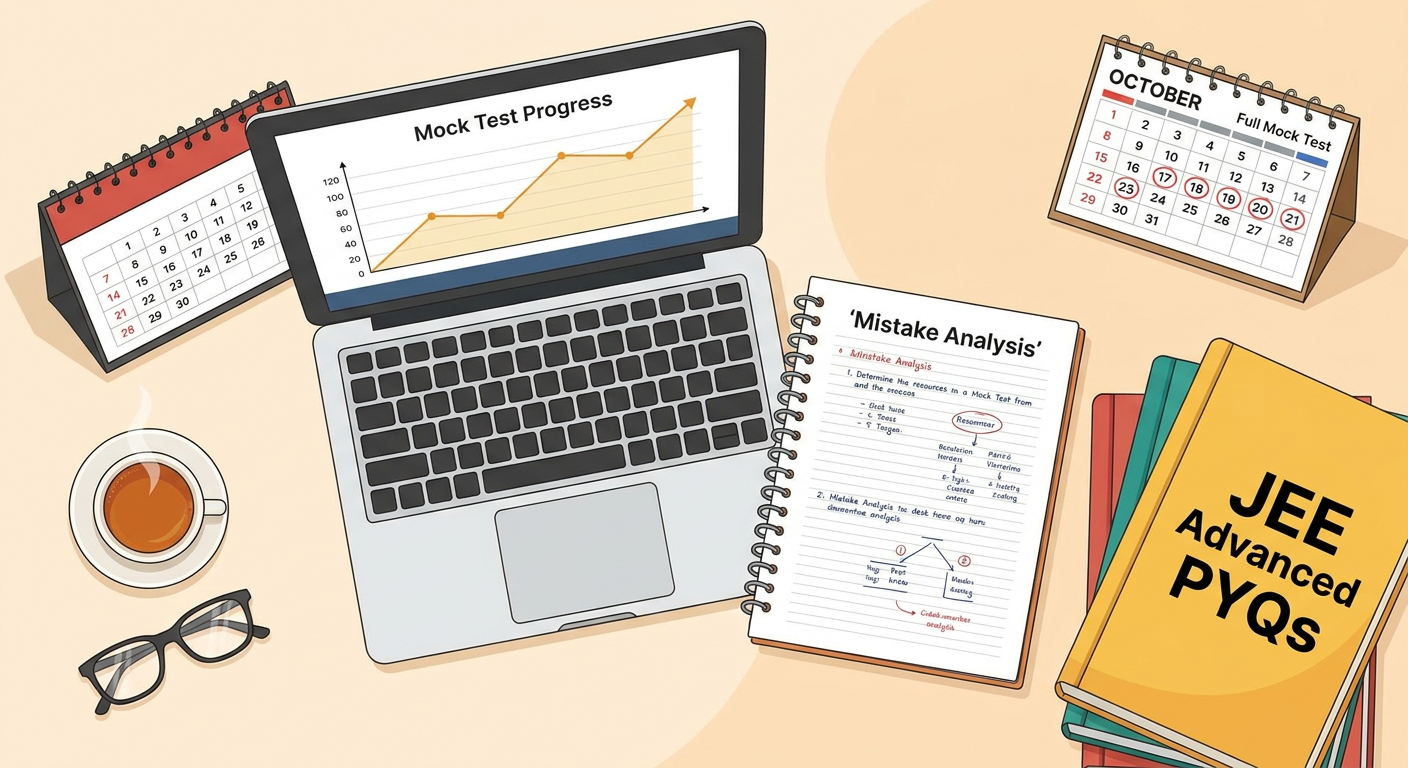
Preparation for JEE Advanced is a marathon, not a sprint. It requires two to three years of sustained, intelligent hard work. Just putting in long hours isn't enough; you need a smart strategy that focuses on quality over quantity.
Building a Rock-Solid Foundation
Your entire preparation hinges on this. Don't rush through topics. Spend time understanding the core concepts from first principles. If you don't understand why a formula works, you won't be able to apply it to an unseen problem in JEE Advanced. Start with NCERT to build a baseline, but quickly move to more advanced books.
This is where a good teacher or mentor becomes invaluable. They can guide you through the complex parts and help you build the right kind of thinking process. Self-doubt is common; having someone to talk to can make a huge difference.
The Right Study Material
Choosing the right books is critical. Using too many books can be confusing, while using too few can leave gaps in your preparation. A good approach is to stick to one or two standard reference books per subject and master them.
- Physics: H.C. Verma's 'Concepts of Physics' for concepts, and a more advanced problem book like D.C. Pandey or I.E. Irodov for problem-solving.
- Chemistry: NCERT is essential, especially for Inorganic. For Physical, P. Bahadur. For Organic, Solomon & Fryhle or Morrison & Boyd.
- Mathematics: R.D. Sharma (Objective) or Arihant/Cengage series are popular choices for a comprehensive problem set.
The Power of Mock Tests and PYQs
This is perhaps the most important part of your preparation journey. Solving previous year questions gives you the best possible insight into the mind of the paper-setter. You understand the level, the patterns, and the important topics.
Mock tests are for practice. Take them seriously, in a timed, exam-like environment. The goal is not just to get a score, but to analyze your performance afterward. Which topics are your weak points? Where did you lose marks? Was it a conceptual error, a calculation mistake, or a time management issue? This analysis is what drives improvement.
Subject-Wise Preparation Strategy
Your approach should be tailored to the demands of each subject.
- For Physics, focus on deriving results, not just remembering them. Always draw a diagram. It helps clarify your thoughts and reduces silly mistakes.
- For Chemistry, create short notes, especially for Inorganic Chemistry. Use mnemonics and mind maps. For Organic, practice writing out reaction mechanisms until they become second nature.
- For Mathematics, maintain a formula book. But more importantly, maintain a 'mistake book' where you note down the problems you got wrong and the correct method. Revising this book is more valuable than solving a new chapter.
JEE Main vs. JEE Advanced: Knowing Your Enemy
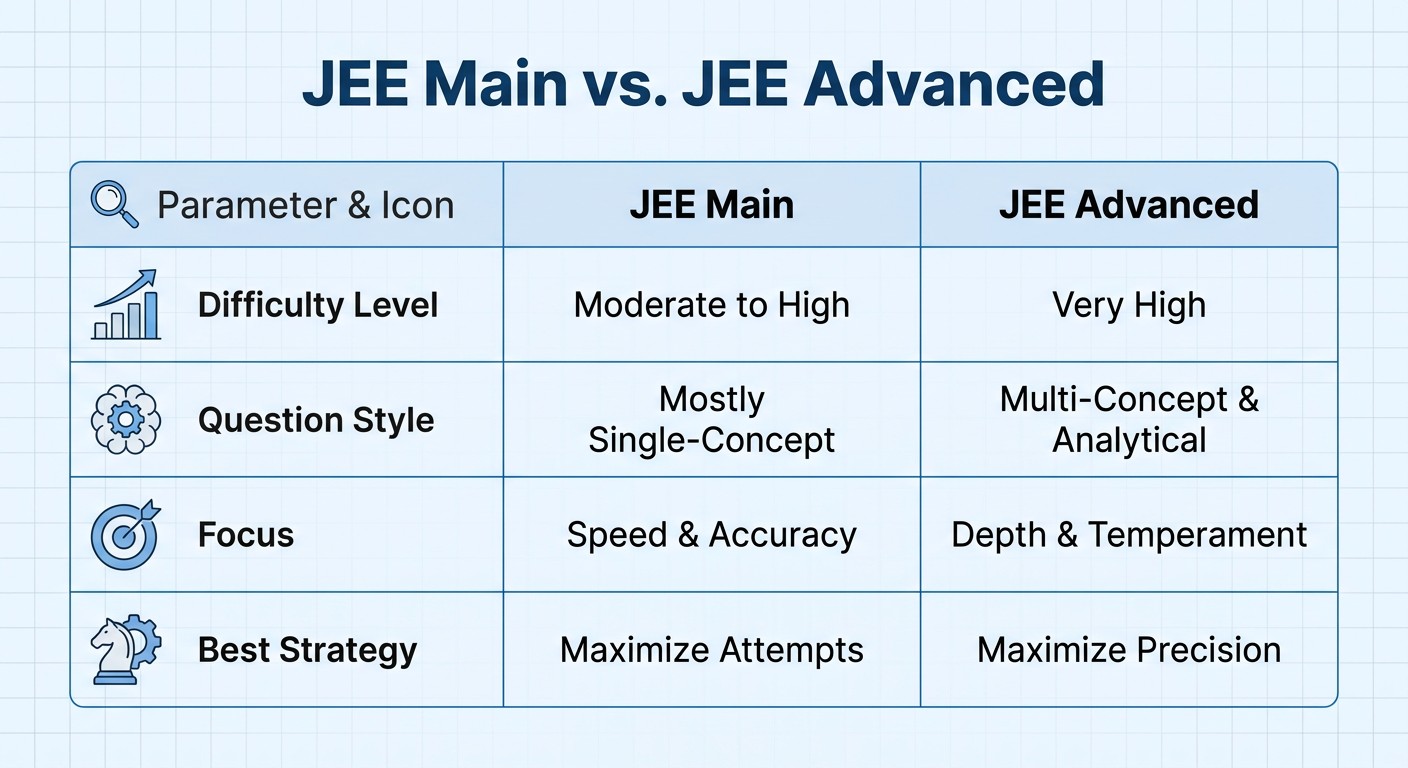
Many students make the mistake of preparing for both exams with the same mindset. This is a strategic error. While the syllabus has a large overlap, the nature of the two exams is fundamentally different. Understanding this difference is key to adapting your strategy after JEE Main.
Difficulty Level
This is the most obvious difference. JEE Main questions are generally direct and formula-based. They test your knowledge and your ability to solve a large number of questions quickly. A typical question in Main might take 2-3 minutes.
JEE Advanced questions, on the other hand, are designed to be challenging. They are often indirect and require deep thinking. A single question can take 5-10 minutes or even more. The overall difficulty is significantly higher, and the cutoff scores are consequently much lower.
Question Style and Complexity
JEE Main mostly features single-concept questions. You identify the topic, apply the formula, and get the answer. The challenge is speed and avoiding calculation errors across 90 questions.
JEE Advanced is famous for its multi-concept questions. A single problem in Physics might require you to use concepts from both Electromagnetism and Mechanics. A math problem might blend Calculus with Coordinate Geometry. This requires a much more flexible and integrated understanding of the subject.
Mindset and Approach
Your mindset needs a complete shift between the two exams. In JEE Main, the goal is to maximize your score by attempting as many questions as you can with high accuracy. The fear of negative marking is present, but the rewards for correct answers are high.
In JEE Advanced, the mindset is one of survival and precision. Your first goal is to clear the subject-wise cutoffs. Your second goal is to maximize your score by being extremely selective. Attempting a question you're unsure about is a huge risk due to harsh negative marking schemes. The art of leaving questions is a critical skill.
Life After the Exam: Ranks, Counselling, and IITs
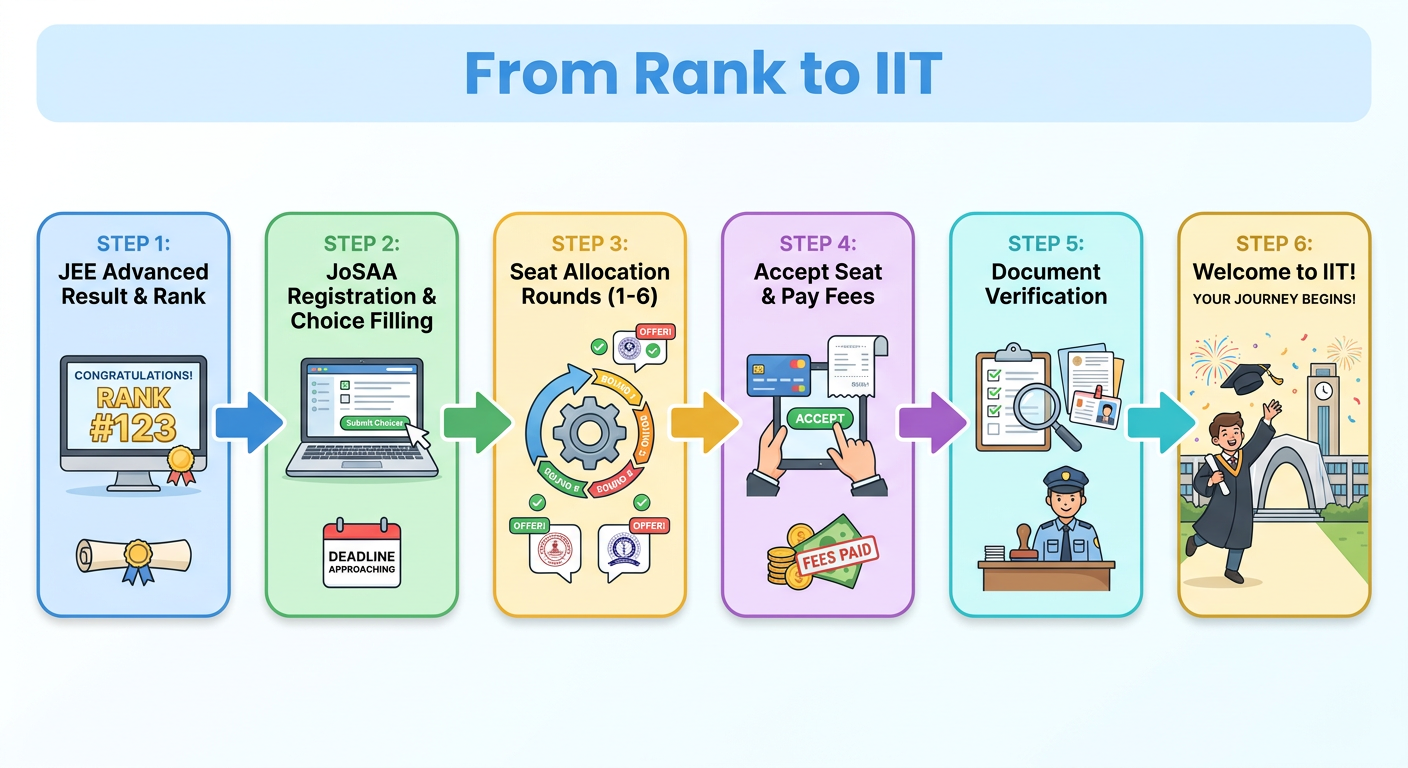
Clearing the exam is just the beginning of another crucial phase. Your rank determines your future. A recent JIC (Joint Implementation Committee) report highlighted a fascinating trend: a staggering 73% of the top 500 rankers in a recent year chose Computer Science and Engineering, showcasing the immense demand for this branch.
How are Ranks Calculated?
Your final score is the aggregate of your marks in Paper 1 and Paper 2. Based on this total score, a Common Rank List (CRL) is prepared. Separate rank lists are also prepared for different categories (OBC-NCL, SC, ST, EWS, PwD).
To be included in a rank list, you must clear two types of cutoffs: a minimum aggregate score and a minimum score in each of the three subjects (Physics, Chemistry, and Mathematics). Failing to clear even one subject cutoff means you won't get a rank, even if your total score is high.
The JoSAA Counselling Process
Once the results are out, the Joint Seat Allocation Authority (JoSAA) conducts the counselling for admission to IITs, NITs, IIITs, and other GFTIs. This is a centralized online process where you fill in your choices of institutes and branches in order of preference.
Based on your rank, category, and the choices you've filled, a seat is allocated. This is a complex process with multiple rounds. Filling your choices wisely is extremely important. It's a good idea to use a reliable JEE rank predictor tool to get an idea of your likely options beforehand.
Choosing Your IIT and Branch
This is a decision that will shape your career. Do you prioritize the branch or the IIT? Is Computer Science at a newer IIT better than a core branch at an older IIT? There are no easy answers. It depends on your interests and career goals.
Research different branches. Talk to seniors studying in various IITs. Understand that the 'IIT tag' itself opens many doors, regardless of the branch. But your passion for the subject you study for four years is what will ultimately determine your success and happiness.
What Makes JEE Advanced So Tough?
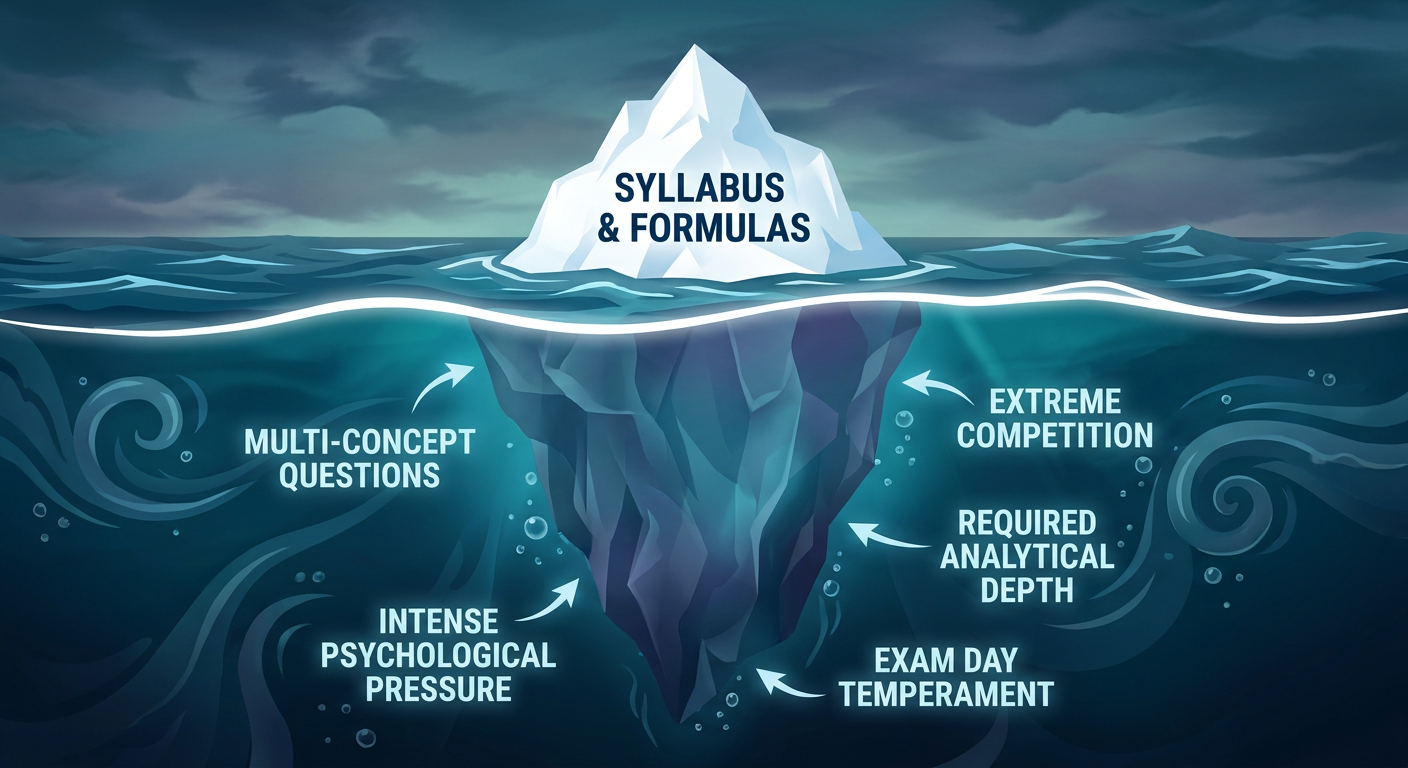
Why does this exam have such a fearsome reputation globally? It's not just one thing, but a combination of factors that create a perfect storm of difficulty.
The Sheer Competition
It starts with the numbers. Over 10 lakh students take JEE Main. Only the top 2.5 lakh qualify to sit for JEE Advanced. They are competing for roughly 17,000 seats in the IITs. This brutal competition ratio means that even brilliant students can miss out due to small mistakes. You are competing with the absolute best from across the nation.
The Intellectual Challenge
The question papers are a work of art, crafted by professors from the IITs. They are designed to be original. You will almost never find a question that is a direct repeat from a previous year or a textbook. They are designed to test your raw intelligence and your ability to apply concepts in novel situations. This is what makes rote learning completely ineffective.
The Psychological Pressure
The stakes are incredibly high. Years of preparation, family expectations, and personal dreams all culminate in two three-hour sessions on a single day. The exam environment is stressful. The clock is ticking. A tough question at the beginning can shatter your confidence. Maintaining your composure and a calm, logical mind under this immense pressure is the ultimate test. This 'exam temperament' is often the deciding factor that separates the top rankers from the rest.
FAQs
How many times can I attempt JEE Advanced?
You can attempt the JEE Advanced exam a maximum of two times, and they must be in two consecutive years. For example, if you appear for your Class 12 board exams in 2024, you can attempt JEE Advanced in 2024 and 2025.
Is NCERT enough for JEE Advanced?
No. While NCERT books are excellent for building a strong foundation and are indispensable for Chemistry (especially Inorganic), they are not sufficient for the depth and complexity of questions asked in JEE Advanced. You must supplement them with advanced reference books and extensive problem-solving practice.
What is a good score in JEE Advanced?
This changes every year depending on the paper's difficulty. A 'good score' is a relative term. In some years, a score of 50% of the total marks could land you in the top 1000, while in an easier year, you might need over 60%. The focus should be on maximizing your score relative to others, not on a fixed target.
Is there negative marking in JEE Advanced?
Yes, absolutely. Negative marking is a key feature of the exam. The scheme varies for different question types (single correct, multiple correct, etc.) and can be quite punishing. It's critical to be accurate and avoid guessing.
Which IIT is the best for Computer Science?
Traditionally, IIT Bombay, IIT Delhi, IIT Madras, IIT Kanpur, and IIT Kharagpur are considered the top choices for Computer Science and Engineering (CSE) due to their established faculty, research opportunities, and strong placement records. However, newer IITs like Hyderabad and Guwahati also have excellent and rapidly growing CSE departments.
Can I get into an IIT without qualifying JEE Advanced?
No. Qualifying JEE Advanced is the only way to get admission into the B.Tech programs at any of the 23 IITs. Other prestigious institutes like NITs and IIITs use the JEE Main score for their admissions, but for the IITs, clearing JEE Advanced is mandatory.