IIT Madras, Bombay and Delhi took 408 of the top 500 JEE Advanced ranks - India Today
Master the JEE Advanced exam with our complete guide on syllabus, paper pattern, eligibility, cutoffs, and top preparation strategies to get into an IIT.
16 min read
Remember Rancho from '3 Idiots'? The guy who aced exams not by cramming, but by truly understanding things. That's the core philosophy behind the JEE Advanced. It isn't just another exam; it's the final gateway to the most prestigious engineering institutes in India, the IITs.
After clearing the hurdle of JEE Main, you're one of the top 2.5 lakh students in the country. Now comes the real challenge. The JEE Advanced exam is designed to test your depth of knowledge, your problem-solving skills, and your ability to think under pressure. It's the ultimate test of your scientific aptitude.
Feeling overwhelmed? Don't be. This guide is your roadmap. We will break down every single aspect of the JEE Advanced, from eligibility and paper patterns to the best preparation strategies and what ranks you need for top IITs. Let's get started on your journey to that coveted IIT seat.
What Exactly is the JEE Advanced Exam?
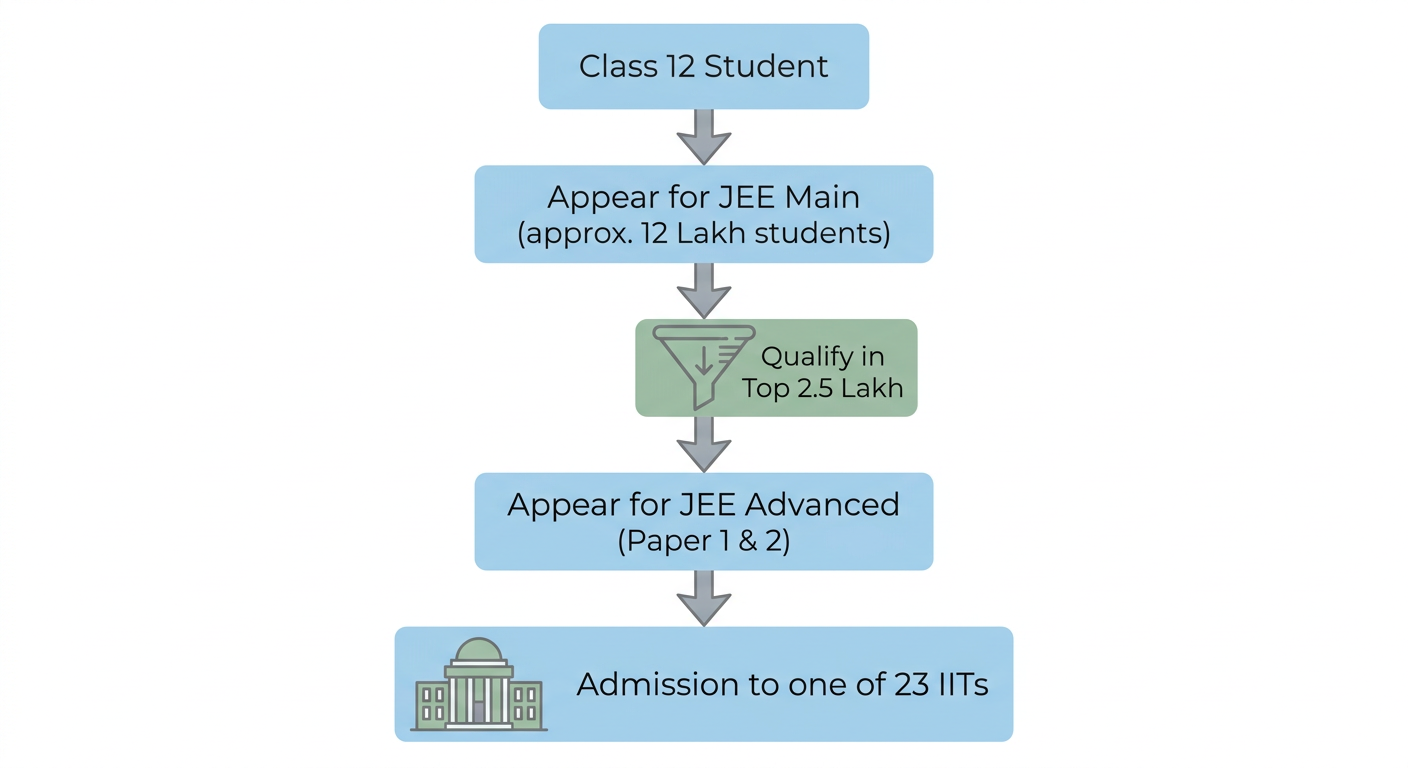
The Joint Entrance Examination (JEE) Advanced is the second and final stage of the two-tier JEE system. Think of JEE Main as the qualifier and JEE Advanced as the main event. Its sole purpose is to select the brightest minds for admission into the undergraduate programs at the 23 Indian Institutes of Technology (IITs).
Unlike JEE Main, which is conducted by the National Testing Agency (NTA), the JEE Advanced is organized by one of the seven zonal IITs on a rotational basis. This includes IIT Bombay, IIT Delhi, IIT Madras, IIT Kanpur, IIT Kharagpur, IIT Guwahati, and IIT Roorkee. This rotation often brings subtle changes in the paper's flavour each year.
The competition is intense. Out of over 10 lakh students who take JEE Main, only the top 2.5 lakh candidates are eligible to sit for this exam. It’s a battle of the best, where only a few thousand will finally secure a seat.
JEE Advanced vs JEE Main: The Key Differences
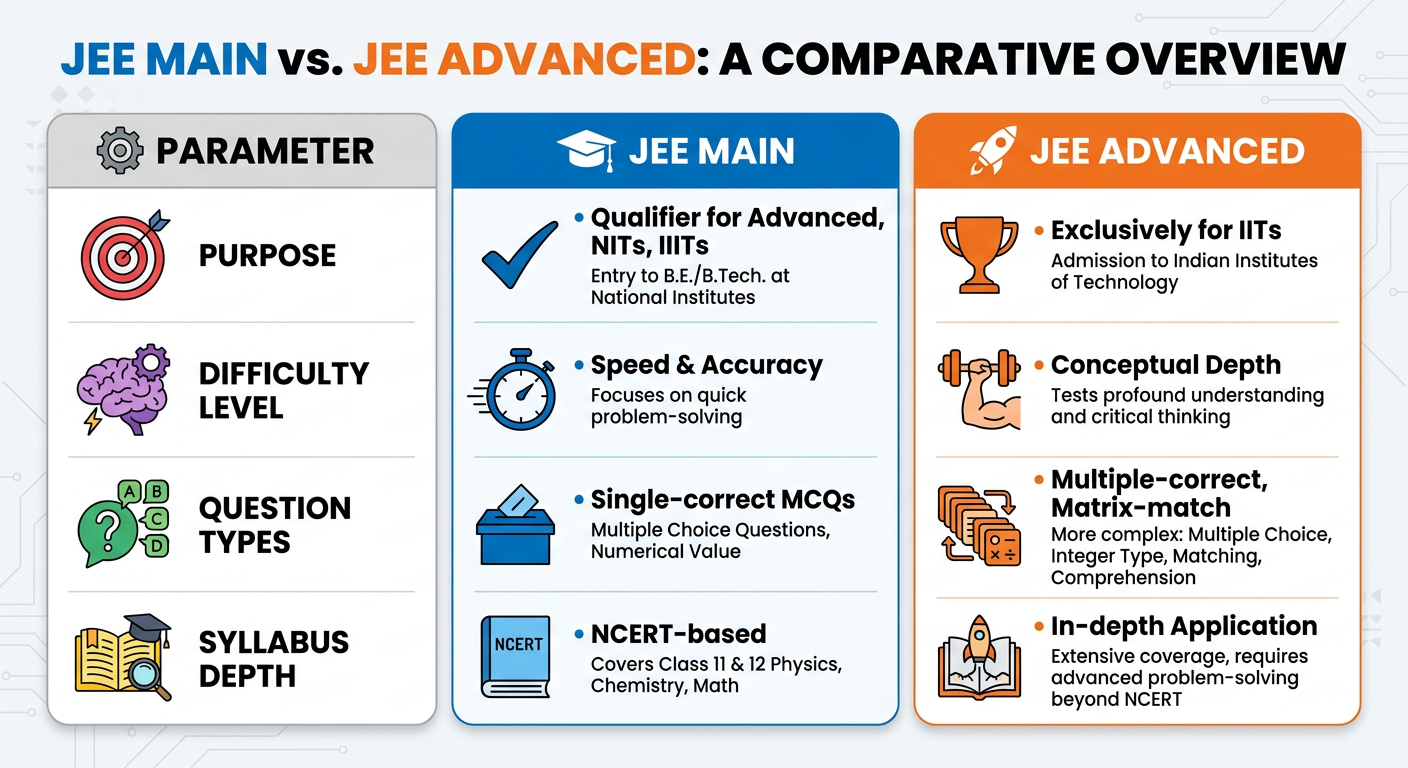 Many students make the mistake of treating their JEE Advanced preparation just like their JEE Main prep. This is a huge error. Understanding the fundamental differences between the two is the first step towards building the right strategy.
Exam Purpose and Scope
JEE Main is a broader exam. It serves as the entrance test for National Institutes of Technology (NITs), Indian Institutes of Information Technology (IIITs), and other Centrally Funded Technical Institutions (GFTIs). Crucially, it also acts as the eligibility test for JEE Advanced.
JEE Advanced, on the other hand, is exclusive. It has only one purpose: admissions to the bachelor's degree programs in the Indian Institutes of Technology (IITs). If your dream is an IIT, this is the only exam that matters.
Difficulty Level
This is the most significant difference. JEE Main primarily tests your knowledge and speed. The questions are largely based on concepts from the NCERT syllabus. If you know the formulas and have practiced enough, you can score well.
JEE Advanced is a different beast entirely. It tests the depth of your conceptual understanding and your analytical abilities. Questions are often multi-conceptual, requiring you to apply principles from two or three different chapters to solve a single problem. Rote learning will get you nowhere here.
Question Types and Marking Scheme
JEE Main has a relatively straightforward paper pattern: Multiple Choice Questions (MCQs) with a single correct answer and Numerical Value Questions. The marking scheme is simple: +4 for a correct answer, -1 for an incorrect MCQ, and 0 for numerical questions.
The JEE Advanced exam pattern is famous for its unpredictability. It features a variety of question formats that can change every year. This includes MCQs with one or more correct answers, paragraph-based questions, matrix-match questions, and numerical answer types. The marking scheme is also complex, often involving partial marks for multiple-correct questions and varying negative marking schemes.
Syllabus Depth
While the core syllabus for both exams is drawn from Class 11 and 12 Physics, Chemistry, and Maths, the depth required for JEE Advanced is far greater. There are a few topics that are exclusive to the Advanced syllabus. More importantly, the application of these topics is at a much higher level, demanding a comprehensive understanding that goes well beyond the textbook.
Are You Eligible? Understanding the JEE Advanced Eligibility Criteria
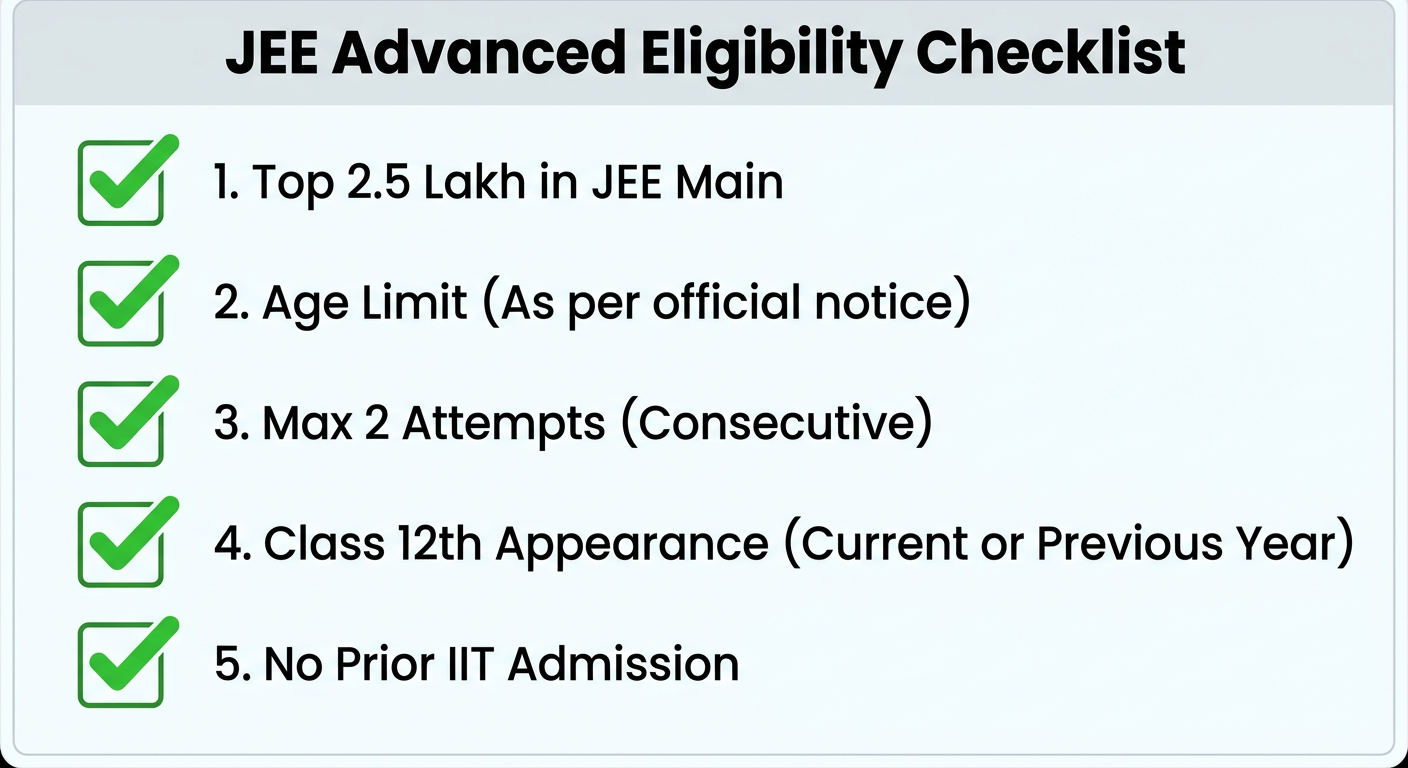 Before you dive headfirst into preparation, it's crucial to ensure you meet all the eligibility criteria. Missing even one can make you ineligible, no matter how well-prepared you are. Here are the five main pillars of JEE Advanced eligibility.
Performance in JEE Main
You must be among the top 2,50,000 successful candidates (including all categories) in Paper 1 of JEE Main. The NTA releases category-wise cutoffs along with the JEE Main results. You must clear the cutoff for your respective category to be eligible.
Age Limit
There is an age restriction. For example, for the 2024 exam, candidates had to be born on or after October 1, 1999. A five-year relaxation is given to SC, ST, and PwD candidates. This specific date changes each year, so always confirm the current rule.
Number of Attempts
This is a strict rule. A candidate can attempt JEE Advanced a maximum of two times in two consecutive years. For instance, if you appear for your Class 12 board exam in 2024, you are eligible for JEE Advanced in 2024 and 2025 only, provided you meet all other criteria.
12th Class Examination
You must have appeared for the Class 12 (or equivalent) examination for the first time in either the year of the exam or the preceding year. Also, you must have passed this examination with Physics, Chemistry, and Mathematics as compulsory subjects.
Previous IIT Admission
If you have been admitted to any IIT in the past, you are NOT eligible to appear for JEE Advanced again. This applies even if you accepted the seat and then decided not to join or dropped out later. However, if you were admitted to a preparatory course at an IIT, you may still be eligible.
Always double-check the latest information bulletin on the official JEE Advanced website for the most accurate and up-to-date eligibility rules.
Decoding the JEE Advanced Paper Pattern and Marking Scheme
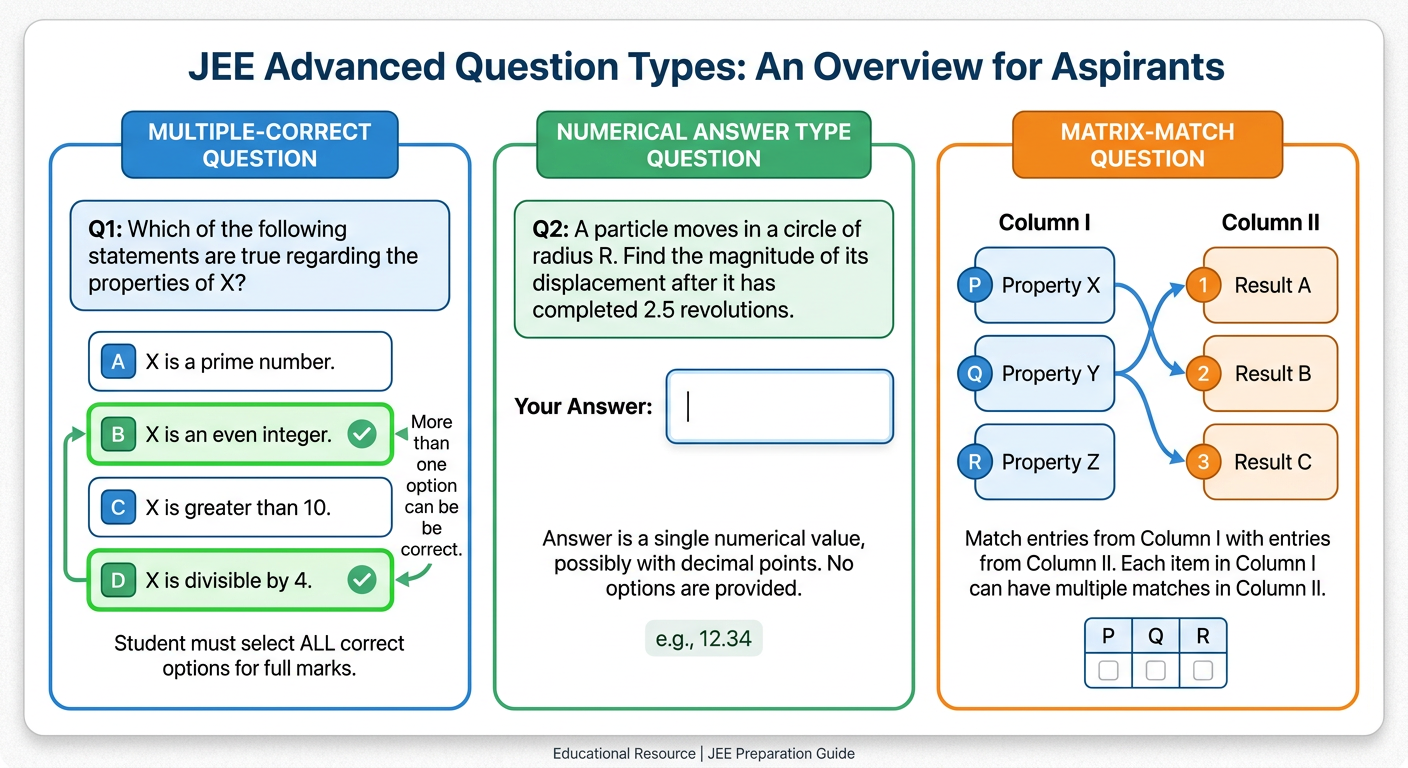 The JEE Advanced paper pattern is legendary for its challenging nature and its tendency to change every year. Being mentally prepared for this is as important as solving problems. The exam consists of two compulsory papers, Paper 1 and Paper 2, held on the same day in two sessions.
Each paper is three hours long and comprises three sections: Physics, Chemistry, and Mathematics. You must appear for both papers. Your final score is the aggregate of your marks in Paper 1 and Paper 2, and this total is used to generate your All India Rank (AIR).
The Ever-Changing Question Types
Familiarity with the question formats is key to a good strategy. While the exact mix varies, here are the common types you can expect:
- Single Correct Option: The classic MCQ with only one correct answer.
- Multiple Correct Options: MCQs where one or more options can be correct. These are tricky and require complete conceptual clarity.
- Numerical Answer Type (NAT): Questions where you have to enter a numerical value as the answer. There are no options provided.
- Paragraph/Comprehension Based: A passage of information is given, followed by two or three questions based on it.
- Matrix Match / List Match: You have to match items in one column with items in another column. These can be simple one-to-one or complex one-to-many matches.
The Dreaded Marking Scheme
The marking in JEE Advanced is not uniform across the paper. It's designed to reward deep knowledge and penalize guessing.
For 'Multiple Correct Options' questions, you might get full marks only if you select all the correct options and no incorrect ones. Some years feature 'partial marking,' where you get proportional credit for identifying some of the correct options. For most MCQ types, there is negative marking for incorrect answers.
An important point is that 'Numerical Answer Type' questions typically do not have negative marking. This makes them an important section to attempt with confidence, even if you are not 100% sure. Always read the instructions for each section carefully at the beginning of the exam, as the marking scheme can and does change.
Mastering the JEE Advanced Syllabus: What to Study
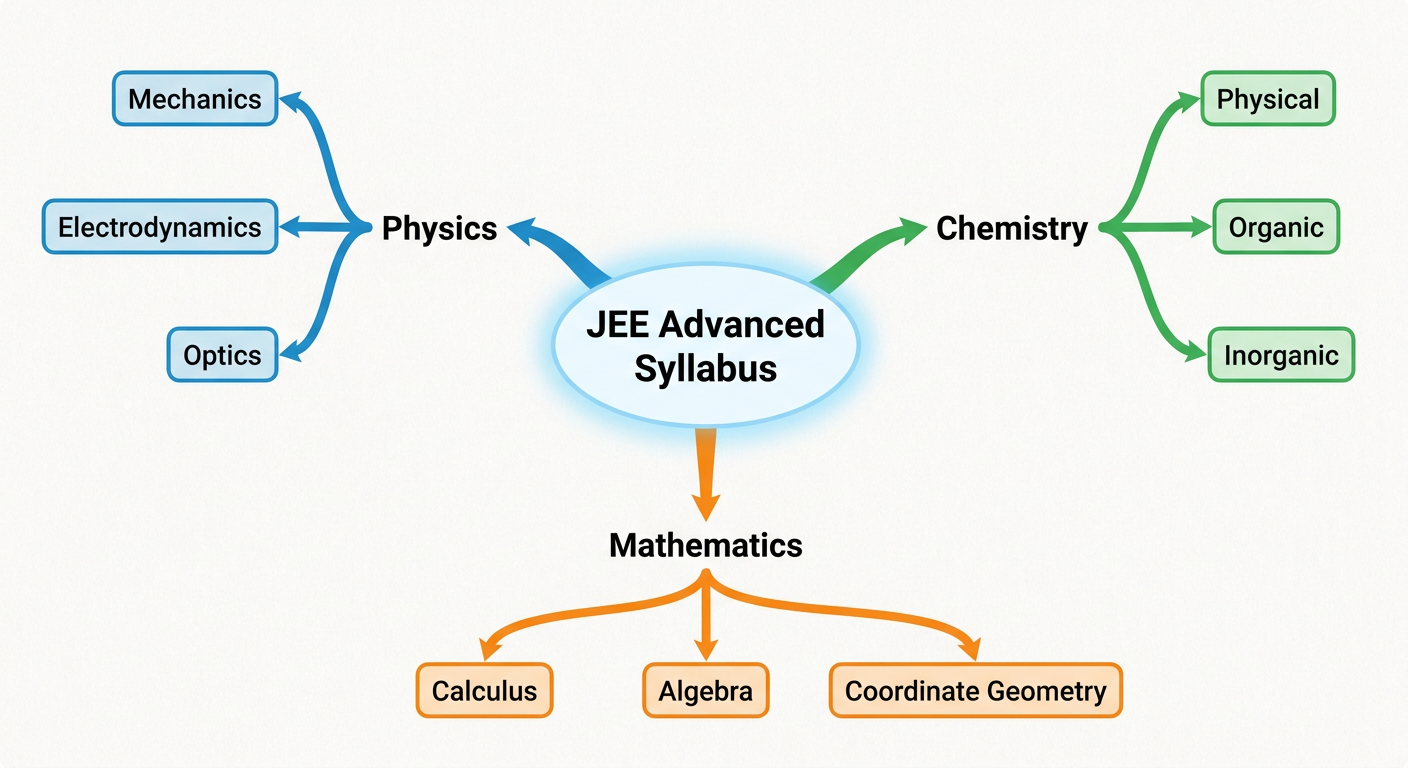 The syllabus for JEE Advanced is vast and deep. While it builds upon the foundation of JEE Main, it requires a much more profound understanding of the concepts. Simply knowing the formulas is not enough; you must know how they are derived and where they apply. You can find a detailed breakdown on our JEE syllabus page.
Physics Syllabus Breakdown
Physics in JEE Advanced is highly conceptual and calculation-intensive. Questions often test your fundamental understanding rather than direct formula application. Key areas include:
- Mechanics: This is the bedrock. Topics like Rotational Motion, Kinematics, and Newton's Laws of Motion are extremely important and form the basis for many multi-concept problems.
- Electrodynamics: A high-weightage unit covering Electrostatics, Current Electricity, and a strong focus on Electromagnetic Induction (EMI) and AC Circuits.
- Optics: Both Geometrical and Wave Optics are important. Questions often mix concepts, for example, using mechanics in an optics problem.
- Thermodynamics & KTG: This unit is scoring if your concepts are clear. Focus on thermodynamic processes and the laws of thermodynamics.
- Modern Physics: Topics like Photoelectric Effect, Bohr's Model, and Radioactivity are generally easier and more formula-based, making them very scoring.
Chemistry Syllabus Breakdown
Chemistry is often the rank-deciding subject. It's broadly divided into three parts, and you need to be strong in all of them.
- Physical Chemistry: This part is heavy on numericals. Master topics like Chemical Equilibrium, Ionic Equilibrium, Electrochemistry, and Chemical Kinetics. Practice is key here.
- Organic Chemistry: Focus on understanding reaction mechanisms (like SN1, SN2, E1, E2) and named reactions. General Organic Chemistry (GOC) is the foundation for everything that follows.
- Inorganic Chemistry: Often neglected, but can be very high-yielding. Focus on understanding trends in the periodic table, especially for p-Block and d-Block elements. Chemical Bonding and Coordination Compounds are extremely important chapters.
Mathematics Syllabus Breakdown
Mathematics in JEE Advanced is all about problem-solving skills and creativity. Questions can be long, complex, and require linking ideas from different topics.
- Calculus: This is the most important unit, covering Functions, Limits, Continuity, Differentiation, and Integration (Definite and Indefinite). Application of Derivatives and Definite Integrals are favourite topics for question setters.
- Coordinate Geometry: Another high-weightage area. Straight Lines, Circles, and Conic Sections (Parabola, Ellipse, Hyperbola) must be on your tips.
- Algebra: This includes Quadratic Equations, Complex Numbers, Permutations & Combinations, Probability, and Matrices & Determinants. Probability questions are often tricky and conceptual.
- Vectors and 3D Geometry: This topic is very scoring if you have a good command of the concepts and can visualize the problems.
Your Strategy: How to Prepare for JEE Advanced
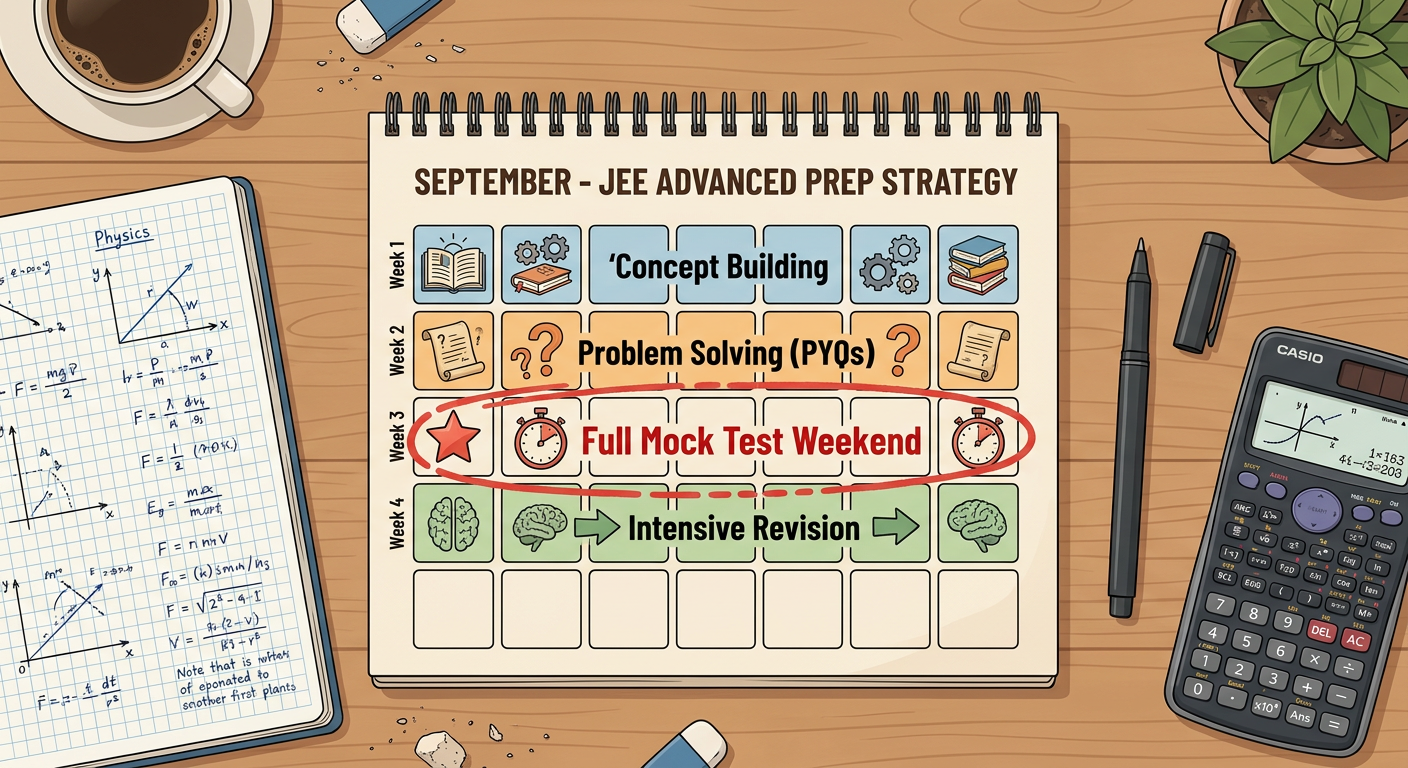 Acing JEE Advanced requires more than just hard work; it requires smart work and a solid strategy. Your preparation must be tailored to the unique demands of this exam.
The Transition from Main to Advanced
The biggest mindset shift required is moving from a 'speed and accuracy' model for JEE Main to a 'depth and analysis' model for JEE Advanced. After your JEE Main exam, dedicate your time to solving tougher, multi-conceptual problems instead of just solving a large volume of easy ones.
Choosing the Right Study Material
Don't drown yourself in a sea of books. It's better to master one or two standard reference books for each subject than to superficially read ten. For problem-solving, books like H.C. Verma for Physics, Solomon & Fryhle for Organic Chemistry, and Cengage or Arihant series for Maths are popular choices. However, your coaching material should be your primary resource.
The Power of Mock Tests and PYQs
This is non-negotiable. Solving Previous Year Questions (PYQs) is the best way to understand the exam's temperament. It shows you the level of depth required and the kind of questions that are asked.
Equally important are mock tests. Take full-length mock tests (Paper 1 and Paper 2 on the same day) in a simulated exam environment. This builds stamina and teaches you time management, which is crucial for a six-hour-long exam. After each test, spend hours analyzing your mistakes. Understanding why you went wrong is more important than the score itself.
Concept Clarity over Rote Learning
I cannot stress this enough. If you don't understand the 'why' behind a concept, you will struggle in JEE Advanced. Focus on deriving formulas, understanding the underlying principles, and questioning everything. This approach will equip you to handle the unfamiliar questions that are a hallmark of this exam.
Subject-wise Preparation Tips
- Physics: Visualize the problem. Draw free-body diagrams. Always start from first principles. Don't just plug in numbers; understand the physical situation.
- Chemistry: For Organic, write down and practice mechanisms repeatedly. For Inorganic, make concise notes for block chemistry and revise them daily. For Physical, maintain a formula sheet and practice a variety of numericals.
- Maths: Practice is the only mantra. Develop the ability to identify the right approach quickly. Don't be afraid of long calculations, but also look for elegant, shorter solutions. Solving a variety of problems exposes you to different patterns.
Understanding JEE Advanced Cutoff and Rank Calculation
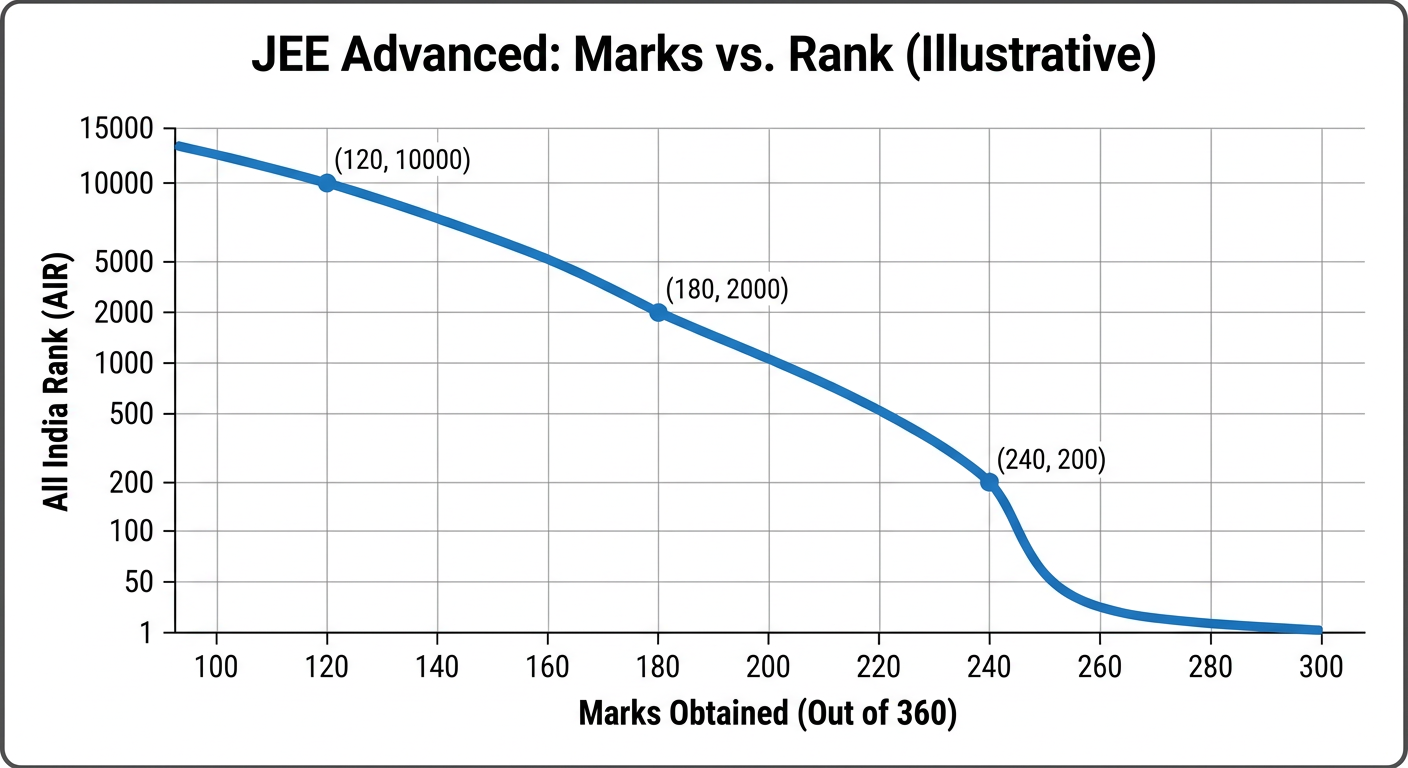 Understanding how your performance translates into a rank is crucial for setting realistic goals. The process involves cutoffs and a final rank calculation based on your aggregate score.
The Qualifying Cutoff
To even be included in the rank list, a candidate must clear two types of cutoffs: a minimum score in each of the three subjects (Physics, Chemistry, Maths) and a minimum aggregate score. These cutoff percentages are decided by the organizing IIT after the exam and vary each year depending on the paper's difficulty. Failing to clear even one of the subject cutoffs means you won't get a rank, regardless of your total score.
The Admission Cutoff
This is the cutoff that really matters for admissions. It is represented as the 'opening' and 'closing' rank for a particular branch in a particular IIT. For example, the closing rank for Computer Science at IIT Bombay might be AIR 67. This means the last student admitted to that course had an All India Rank of 67.
How Ranks Are Calculated (Marks vs Rank)
Your final score is the sum total of the marks you get in Paper 1 and Paper 2. All candidates who clear the qualifying cutoffs are then arranged in descending order of their total score, and All India Ranks (AIR) are assigned. In case of a tie, a tie-breaking policy (based on marks in Maths, then Physics, etc.) is applied.
The relationship between marks and rank is not fixed; it changes dramatically every year. A score of 180 out of 360 (50%) might fetch you a rank under 2000 in a tough year, but the same score might result in a rank of 4000+ in an easier year. You can use tools like a JEE rank predictor with your expected score to get a rough idea of your potential rank.
The Ultimate Prize: Top IITs and Their Closing Ranks
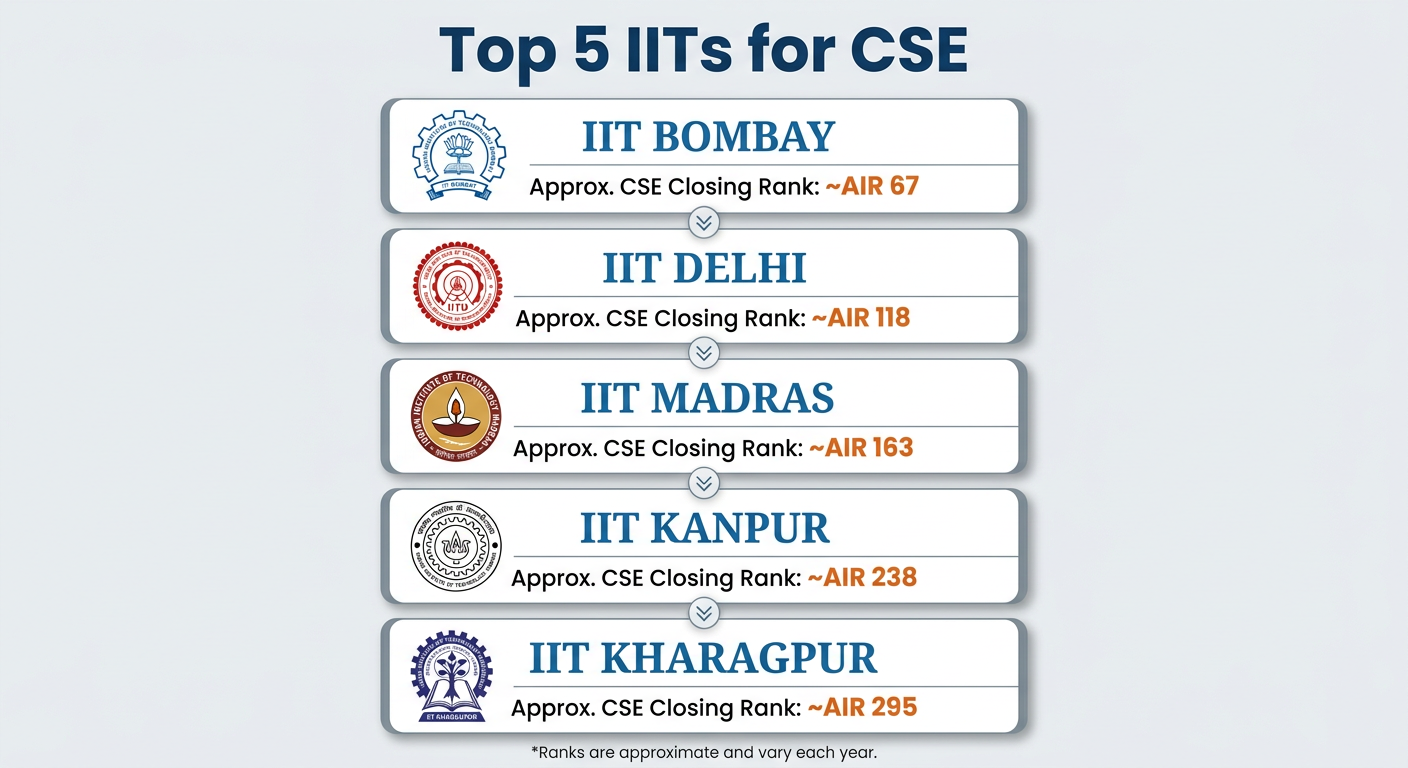 The ultimate goal of cracking JEE Advanced is to secure a seat in one of the top IITs. While all IITs are institutions of excellence, the older ones, often referred to as the 'Top 5' or 'Top 7', are the most sought after.
The undisputed dream for most aspirants is Computer Science and Engineering (CSE) at IIT Bombay. To secure a seat here, you generally need to be within the top 70 ranks in the country. It's a testament to the incredible competition.
Here’s a realistic look at the kind of ranks needed for CSE in the top IITs (based on recent trends, subject to change):
- IIT Bombay (IITB): All India Rank ~60-70
- IIT Delhi (IITD): All India Rank ~110-120
- IIT Madras (IITM): All India Rank ~160-170
- IIT Kanpur (IITK): All India Rank ~230-240
- IIT Kharagpur (IITKGP): All India Rank ~280-300
While CSE is the most popular branch, other core engineering branches like Electrical Engineering, Mechanical Engineering, and Engineering Physics are also highly coveted and require top ranks. For instance, getting into Electrical Engineering at IIT Bombay or Delhi would still require a rank within the top 500.
Cracking JEE Advanced is a monumental achievement. It’s a journey that tests your limits, discipline, and passion for science. But with the right strategy, unwavering focus, and a bit of smart work, you can turn your IIT dream into a reality. For peer support and guidance, consider joining online student communities to stay motivated.
FAQs
How many times can I attempt JEE Advanced?
A candidate can attempt the JEE Advanced exam a maximum of two times, and that too in two consecutive years. For example, if your first attempt is in 2024, your second and final attempt must be in 2025.
Is JEE Advanced harder than NEET?
While both are tough national-level exams, they test different skills. JEE Advanced is widely considered more difficult in terms of conceptual depth, analytical reasoning, and the complexity of problems, especially in Physics and Mathematics.
Can I crack JEE Advanced without coaching?
Yes, it is possible but extremely challenging. It requires immense self-discipline, access to high-quality study material, a rigorous self-study schedule, and, most importantly, a very strong mock test series to benchmark your performance and simulate exam conditions.
What is a good score in JEE Advanced?
This is highly variable and depends on the difficulty of the paper each year. There is no fixed 'good score'. However, historically, a score of around 50% of the total marks often places you in the top 2000 ranks, which is excellent. A score above 35% can usually secure you a seat in an IIT.
Which IIT is best for Computer Science?
Traditionally, IIT Bombay is considered the top choice for Computer Science and Engineering (CSE), followed very closely by IIT Delhi, IIT Madras, and IIT Kanpur. All of these institutions have world-class faculty and excellent placement records.
Do I need to qualify in each subject in JEE Advanced?
Yes, you absolutely do. To be included in the rank list, a candidate must meet the minimum marks requirement for each of the three subjects (Physics, Chemistry, and Mathematics) as well as the minimum aggregate marks, as specified by the organizing IIT for that year.