Top 10 NEET coaching centres in India and their unique marketing strategies - Adgully.com
Get a complete breakdown of the NEET exam for 2025, including eligibility, exam pattern, syllabus, cut-offs, and a winning preparation strategy.
16 min read
What is the NEET Exam? Your Complete 2025 Guide
Think of the biggest final boss in a video game. The one that millions of players try to defeat every year, but only a select few succeed. In the world of Indian education, that boss level has a name: the NEET exam. It's the single gateway to a dream cherished by lakhs of students—a seat in a medical or dental college.
But unlike a game, this isn't about luck. It's about strategy, knowledge, and pure hard work. The National Eligibility cum Entrance Test (NEET-UG) is more than just an exam; it's a turning point that defines careers. Getting through it feels like a monumental task, especially with so much information scattered everywhere.
What is the syllabus? Am I even eligible? How does the marking scheme work? These questions can be overwhelming.
Don't worry, we've got your back. This guide is your complete walkthrough. We will break down every single aspect of the NEET exam, from the application form to the final counselling process. By the end, you'll have a clear roadmap to conquer this challenge.
Understanding the NEET Exam: More Than Just a Test
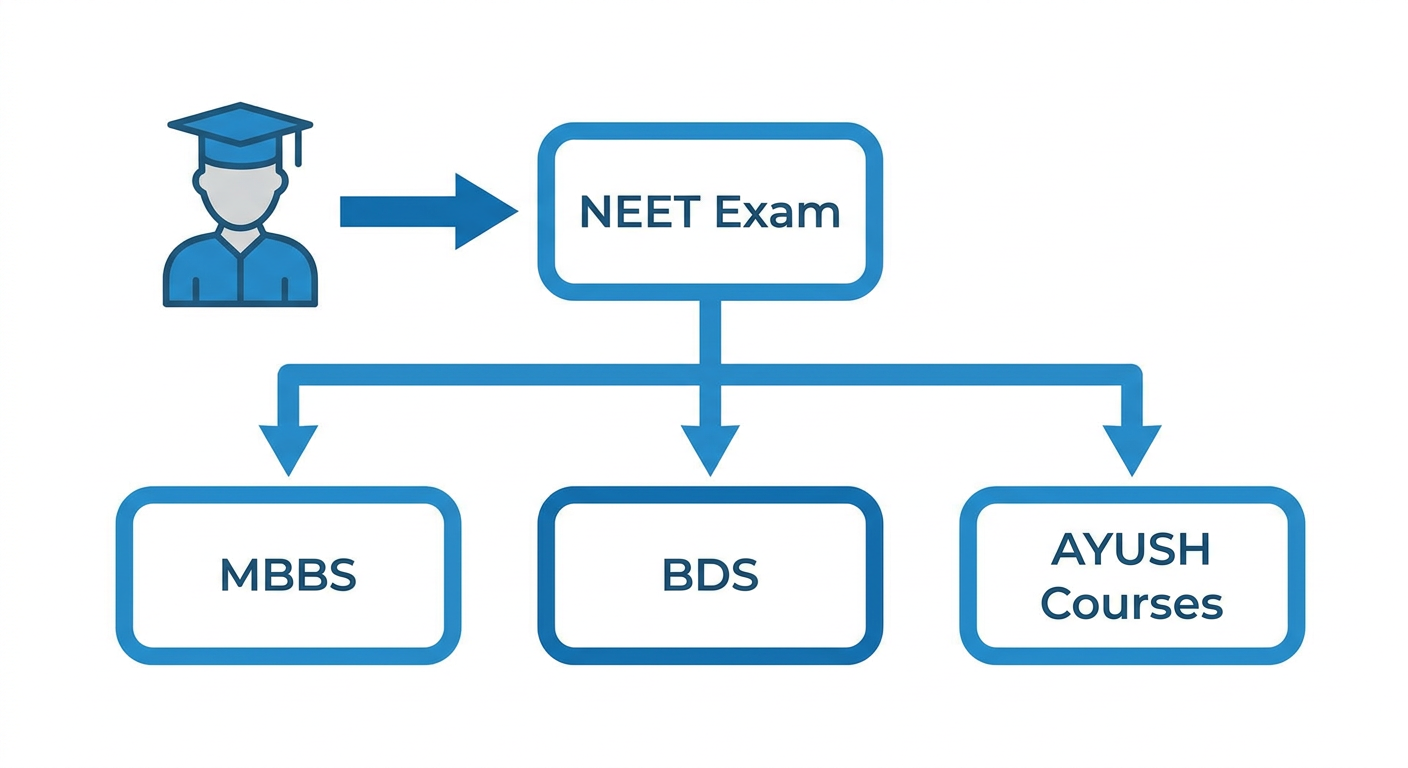
The first step to cracking the NEET exam is to understand what it truly is. Officially, it's the National Eligibility cum Entrance Test (Undergraduate), and it's the one and only medical entrance exam in India for undergraduate courses. If you dream of becoming a doctor, dentist, or pursuing AYUSH courses, this is the door you must unlock.
Conducted by the National Testing Agency (NTA), the NEET exam has replaced all individual state-level and college-level medical entrance tests. This has created a single, unified platform for admissions. It means every student, whether from Kerala or Kashmir, faces the same question paper and the same level of competition.
The scale is massive. Every year, over 20 lakh students appear for a few thousand government medical seats. This high level of competition is what makes NEET one of the toughest exams in the country. But with the right information and a solid plan, you can definitely be one of the winners.
NEET Eligibility Criteria: Are You Ready for the Challenge?
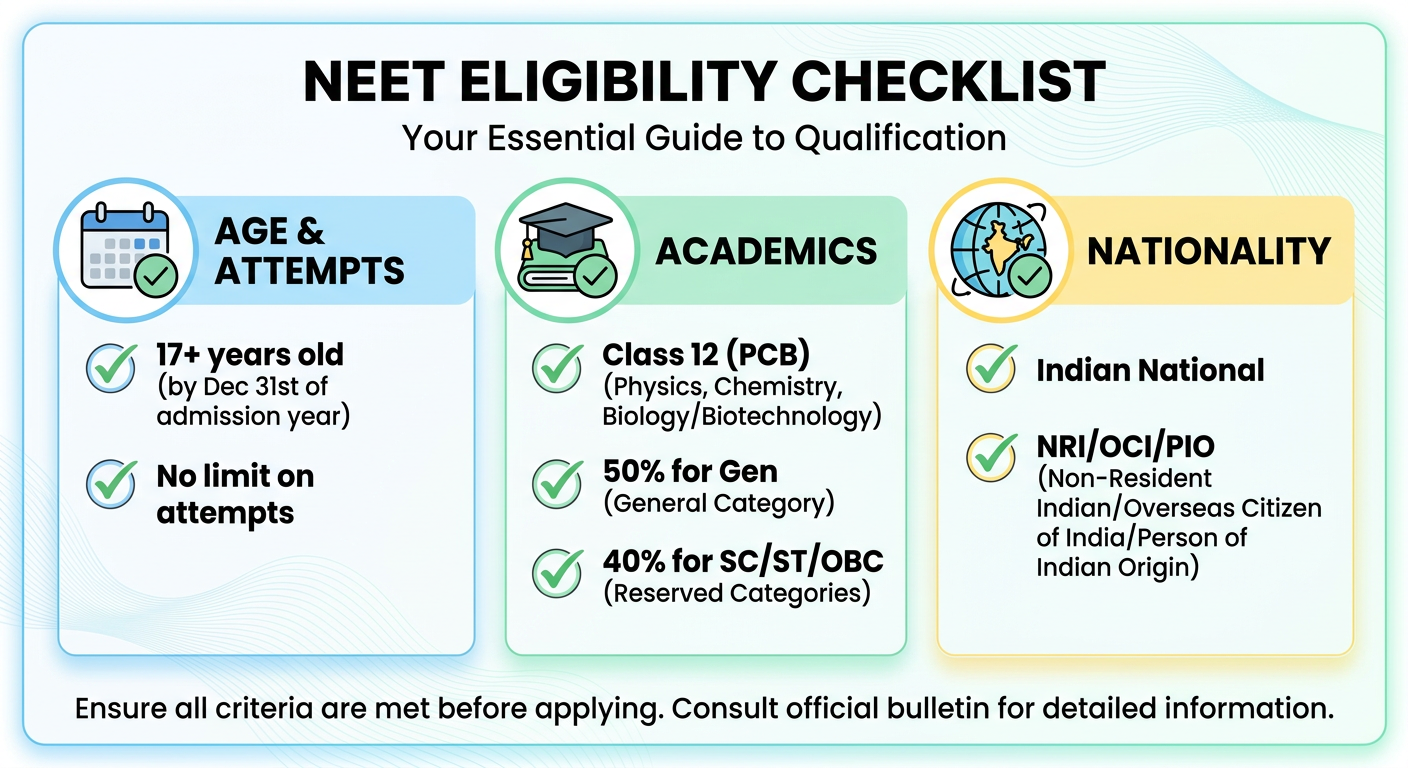
Before you dive into preparation, the first and most crucial step is to check if you are eligible. The NTA sets clear guidelines, and you must meet every single one to be able to sit for the exam. Let's break down the NEET eligibility rules so there’s no confusion.
Age Limit and Attempts
When it comes to age, the rule is quite straightforward. You must be at least 17 years old at the time of admission or should complete that age on or before 31st December of the year of your admission.
What about an upper age limit? For now, there is no upper age limit for appearing in the NEET exam. This was decided by the National Medical Commission (NMC) and has been in place for the last few years. Similarly, there is no restriction on the number of attempts a student can make.
Educational Qualifications
This is where things get specific. To be eligible for the NEET exam, you must have either passed your Class 12 board exams or be appearing for them in the current academic year.
The subject combination is non-negotiable. You must have taken Physics, Chemistry, and Biology/Biotechnology as your core subjects. English is also a mandatory subject. The minimum marks required in your Class 12 exams (in PCB combined) vary by category:
- General/Unreserved Category: 50% marks
- OBC/SC/ST Category: 40% marks
- Persons with Disabilities (PwD) Category: 45% marks
Remember, this is the aggregate percentage in Physics, Chemistry, and Biology. Your marks in other subjects don't count towards this specific eligibility requirement.
Nationality and OCI/NRI Candidates
The NEET exam is open to a wide range of candidates. You are eligible if you are:
- An Indian National
- A Non-Resident Indian (NRI)
- An Overseas Citizen of India (OCI)
- A Person of Indian Origin (PIO)
- A Foreign National
These candidates are eligible for seats in medical/dental colleges under various quotas, including the All India Quota and institutional quotas. However, the specific rules and seat reservations for OCI/NRI candidates can be complex, so it's always a good idea to check the official information bulletin for the year you are applying.
Decoding the NEET Exam Pattern 2025
Knowing the rules of the game is half the battle won. The NEET exam pattern is designed to test your knowledge, accuracy, and time management skills. It has remained consistent for the past few years, but it's vital to understand every detail.
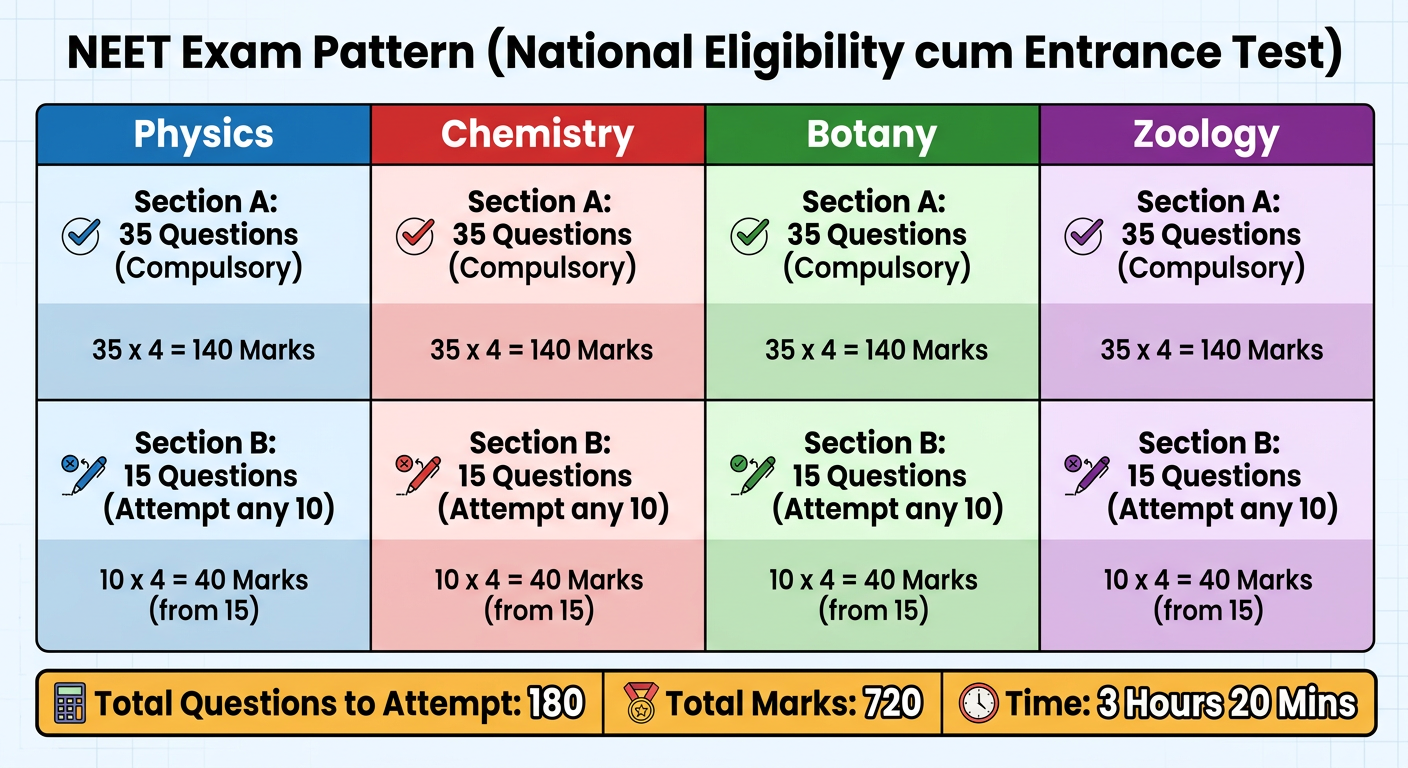
The exam is a traditional pen-and-paper test, which means you'll be filling out an OMR sheet. You'll have 3 hours and 20 minutes (200 minutes) to answer 180 questions. That's just a little over a minute per question, making speed incredibly important.
NEET is a multilingual exam, conducted in 13 different languages, including English, Hindi, Bengali, Tamil, and Gujarati. You can choose your preferred language while filling out the application form.
Subject-wise Breakdown and Marking Scheme
The entire paper is made up of Multiple Choice Questions (MCQs), with four options for each question and only one correct answer. The questions are divided into four subjects: Physics, Chemistry, Botany, and Zoology.
Each subject is further split into two sections: Section A and Section B.
- Section A has 35 questions, and all are compulsory.
- Section B has 15 questions, out of which you need to attempt any 10. This internal choice is a great advantage if used wisely.
Here is a clear breakdown of the structure and the marking scheme:
| Subject | Section A | Section B (Attempt any 10) | Total Marks |
|---|---|---|---|
| Physics | 35 Questions (140) | 15 Questions (40) | 180 |
| Chemistry | 35 Questions (140) | 15 Questions (40) | 180 |
| Botany | 35 Questions (140) | 15 Questions (40) | 180 |
| Zoology | 35 Questions (140) | 15 Questions (40) | 180 |
| Total | 140 Questions | 40 Questions (from 60) | 720 Marks |
The marking scheme is simple but strict:
- +4 marks for every correct answer.
- -1 mark for every incorrect answer (negative marking).
- 0 marks for any unattempted question.
Negative marking is a critical factor. Guesswork can seriously damage your score. It’s better to leave a question unanswered if you are completely unsure about it.
Mastering the NEET Syllabus: What to Study?
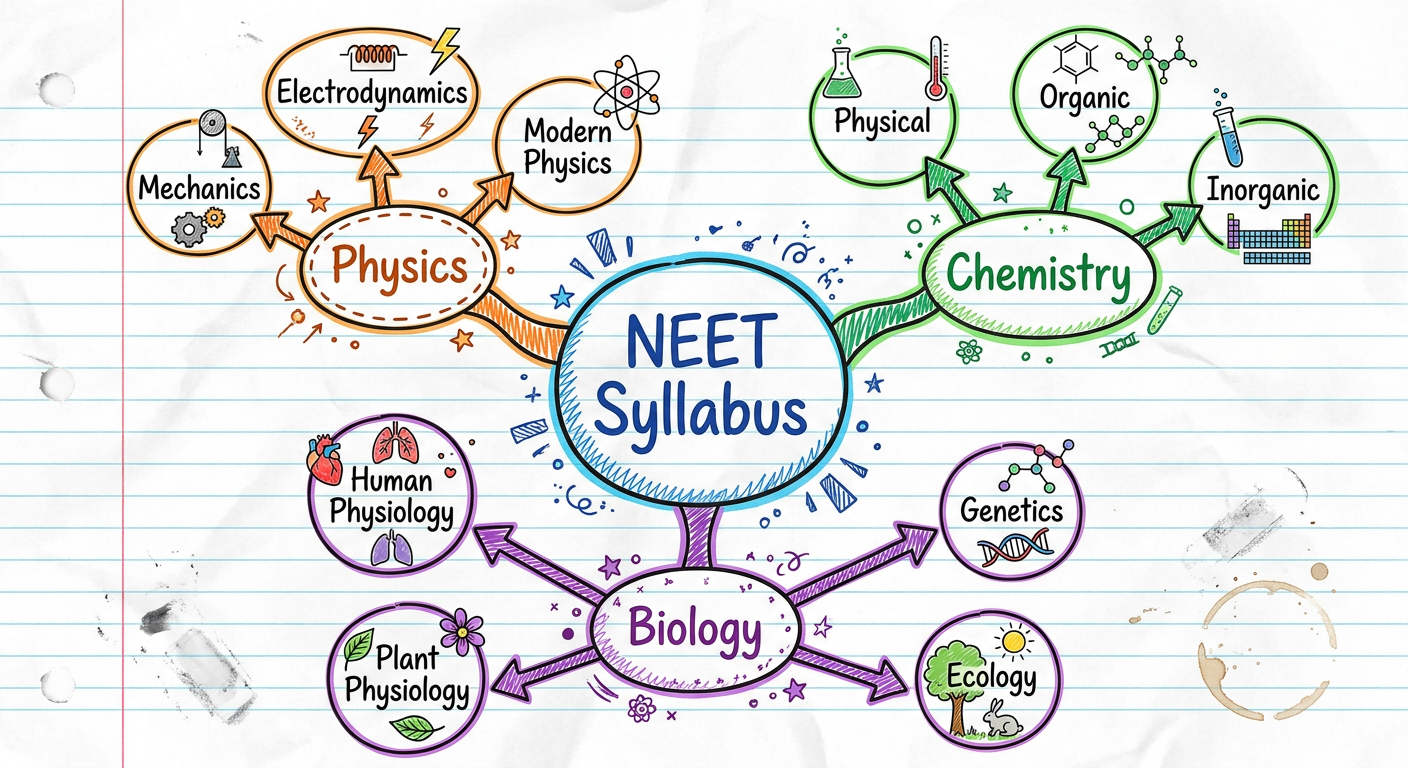
The NEET syllabus is vast, covering the entire curriculum of Class 11 and Class 12 Physics, Chemistry, and Biology. The NTA specifies the syllabus based on the curriculum recommended by the National Medical Commission (NMC), which is largely aligned with the CBSE board and other state boards.
The most important piece of advice anyone can give you is this: NCERT textbooks are your holy grail. A majority of the questions, especially in Biology and Chemistry, are asked directly from the lines and concepts explained in NCERT books. Before you touch any other reference book, you must master your NCERTs inside out. For a detailed topic-wise breakdown, you can always refer to our JEE/NEET syllabus page.
Physics Syllabus Highlights
Physics is often the most challenging subject for NEET aspirants due to its focus on numerical problems and conceptual depth. Key units with high weightage include:
- Mechanics: Covers everything from Laws of Motion and Work, Energy, and Power to Rotational Motion and Gravitation. This unit forms a significant chunk of the paper.
- Electrodynamics: Includes Electrostatics, Current Electricity, and Magnetic Effects of Current. These chapters are concept-heavy and require a lot of practice.
- Modern Physics: Topics like Dual Nature of Matter, Atoms, Nuclei, and Semiconductor Electronics are relatively easier and very high-scoring.
- Optics: Ray Optics and Wave Optics are important and often have a predictable set of question types.
- Heat and Thermodynamics: This unit is crucial and has a good weightage in the exam.
Chemistry Syllabus Highlights
Chemistry in NEET is a balanced mix of theory, concepts, and numericals. It is broadly divided into three parts:
- Physical Chemistry: Chapters like Equilibrium, Thermodynamics, and Chemical Kinetics are important and numerical-based.
- Inorganic Chemistry: This section is heavily based on NCERT. Chemical Bonding, p-Block Elements, and d & f-Block Elements are must-do chapters. Direct questions are often framed from the textbook.
- Organic Chemistry: General Organic Chemistry (GOC) is the foundation. Hydrocarbons, Aldehydes, Ketones, and Carboxylic Acids, and Biomolecules are high-weightage topics.
Biology (Botany & Zoology) Syllabus Highlights
Constituting 50% of the NEET paper (360 marks), Biology is the most critical subject. Your goal should be to score as high as possible here. The questions are almost exclusively from NCERT.
- Botany: High-priority units include Plant Physiology, Plant Diversity, Genetics and Evolution, and Ecology. Don't skip any diagrams or summary tables in the NCERT.
- Zoology: Human Physiology is the most important unit, with questions coming from every chapter. Other key areas are Human Reproduction, Animal Diversity, and Biotechnology.
The NEET Application Form and Process
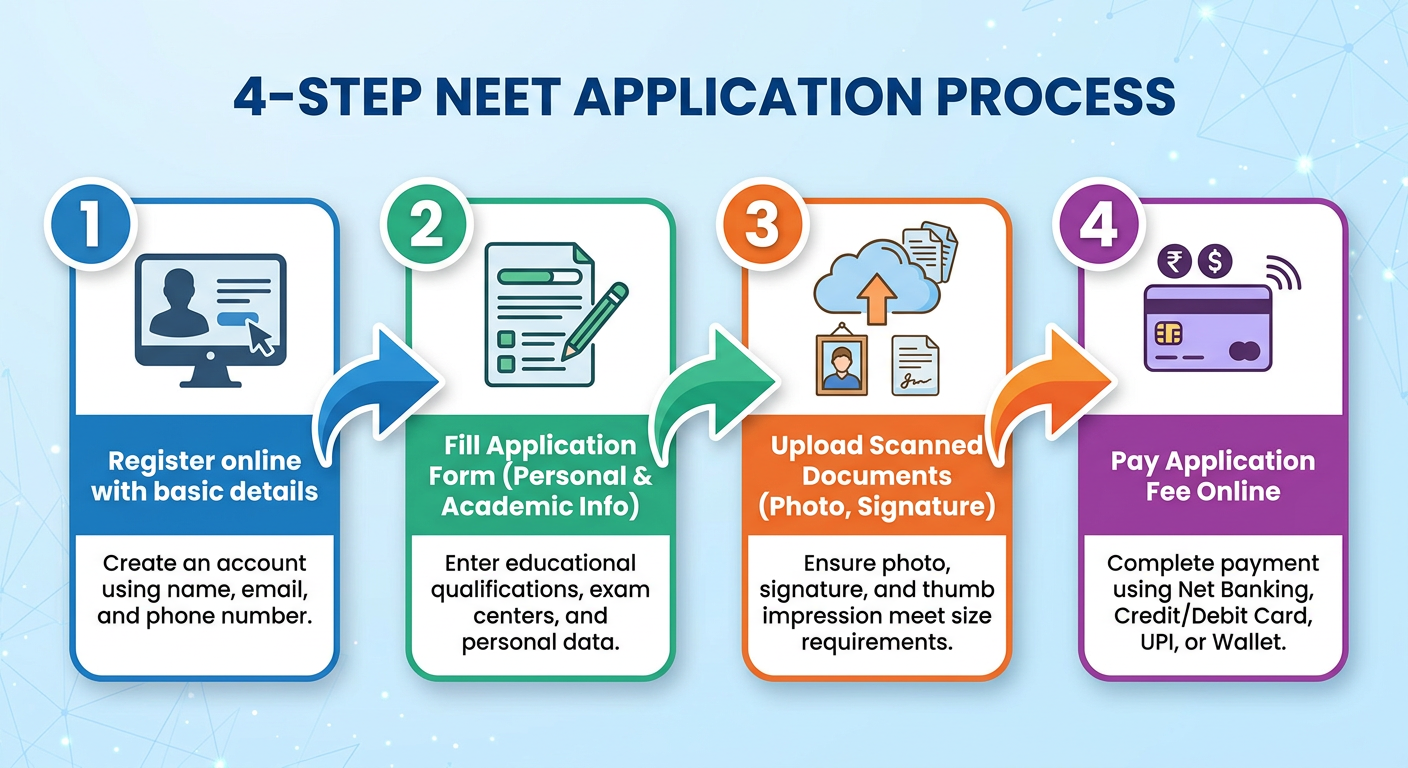
Knowing how to correctly fill out the NEET application form is a crucial step that saves you from last-minute panic. The process is completely online and usually opens for about a month, typically between February and March. Always keep an eye on the official NTA NEET website for the exact dates.
The process can be broken down into a few simple steps:
-
Online Registration: Visit the official site, which you can find at https://neet.nta.nic.in/. You'll need to provide your basic details like name, parent's name, mobile number, and email ID to generate your application number and password.
-
Filling the Application Form: Log in with your credentials and fill in all your personal, academic, and contact details carefully. This is also where you'll choose your exam city preferences.
-
Uploading Documents: You will be required to upload scanned copies of your recent passport-sized photograph, a postcard-sized photograph, your signature, and your left and right-hand thumb impressions. Make sure these are in the specified format and size.
-
Paying the Application Fee: The final step is to pay the fee online using a debit card, credit card, net banking, or UPI. The fee varies by category and is non-refundable.
After a few weeks, the NTA opens a 'correction window' for a few days. This is your one chance to edit any mistakes you might have made in the form. Once the forms are processed, you can download your Admit Card from the NTA website a few weeks before the exam date. The Admit Card is your entry ticket to the examination hall.
Understanding NEET Cut Off and Scoring
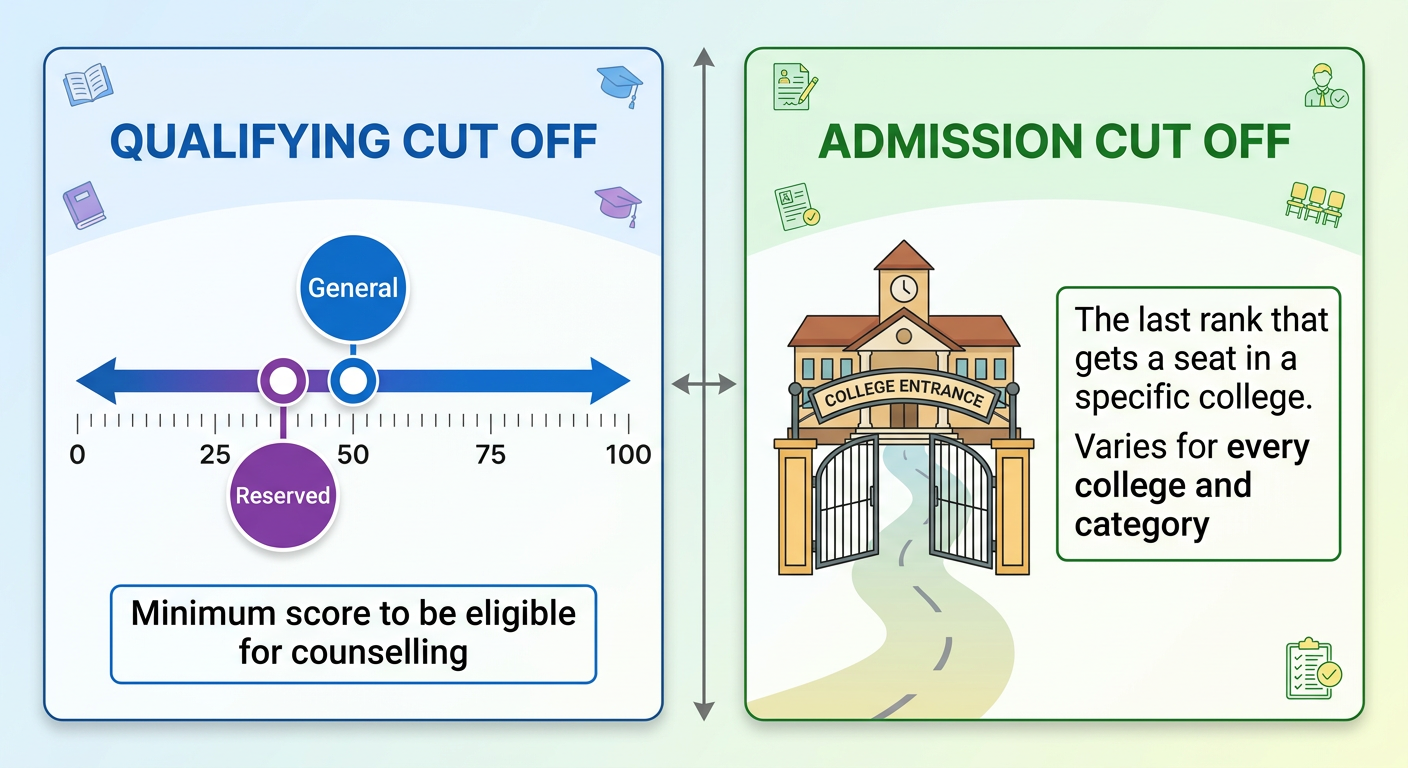
One of the most talked-about topics among NEET aspirants is the NEET cut off. It's important to understand that there are two different types of cut-offs: the qualifying cut-off and the admission cut-off. They mean very different things.
Qualifying Cut Off Percentile
The qualifying cut-off is the minimum score you need to be eligible to participate in the counselling process for medical seats. This is determined by the NTA and is expressed as a percentile, not as marks.
A percentile indicates your performance relative to all other candidates who took the exam. The standard qualifying percentiles are:
- General/EWS Category: 50th percentile
- OBC/SC/ST Category: 40th percentile
- General-PwD Category: 45th percentile
The actual marks corresponding to these percentiles change every year depending on the overall difficulty of the paper and the performance of the students. For example, the 50th percentile might be 137 marks one year and 145 the next.
Admission Cut Off Ranks
This is the cut-off that really matters for getting a seat. The admission cut-off is the last rank (or score) at which a student gets admission into a specific college for a specific course under a specific category. This is not a fixed number and varies greatly from college to college.
Factors that influence the admission cut-off include:
- The difficulty level of the NEET exam.
- The total number of students who appeared for the exam.
- The total number of available MBBS/BDS seats.
- The reservation policies.
Admission happens through two main quotas: the 15% All India Quota (AIQ) for government colleges across India, and the 85% State Quota for students within their own state. Generally, the cut-offs for top government colleges through the AIQ are very high. You can use tools like a JEE rank predictor to get an idea of where you stand, which works on similar principles for NEET as well.
Crafting a Winning NEET Preparation Strategy

With a clear understanding of the exam, it's time to build a solid NEET preparation plan. Lakhs of students study the same books, but what separates the toppers is their strategy and consistency.
The Golden Rule: NCERT is Your Bible
We cannot stress this enough. For Biology and Inorganic Chemistry, you should treat your NCERT textbooks as the ultimate source. Read them multiple times, make notes, and memorize the important diagrams, tables, and facts. For Physics and Physical Chemistry, NCERT is your base, but you will need to supplement it with practice from a good MCQ book.
Building a Realistic Timetable
A good timetable is your roadmap. It should be balanced, giving adequate time to all three subjects. Don't just allocate hours; set daily and weekly targets for the topics you want to cover. Make sure your schedule includes time for revision, practice, and rest. Burnout is real, so don't try to study 16 hours a day from the start.
The Power of Mock Tests and PYQs
Solving previous year questions (PYQs) is the best way to understand the actual level and pattern of the NEET exam. It helps you identify important topics and common question types.
Once you have completed a significant portion of the syllabus, start taking full-length mock tests regularly. Mock tests simulate the real exam environment and are crucial for improving your speed, accuracy, and time management. The real learning happens when you analyze your mistakes after each test. Identify your weak areas and work on them.
Choosing the Right Study Material
It's easy to get lost in the sea of reference books available in the market. The key is to limit your resources. Stick to NCERT as your primary text. For extra practice, you can pick one good reference book per subject. For Physics, many students prefer HC Verma. For Chemistry and Biology, a good objective MCQ book is sufficient. Hoarding too many books will only lead to confusion.
Life After the NEET Exam: What's Next?
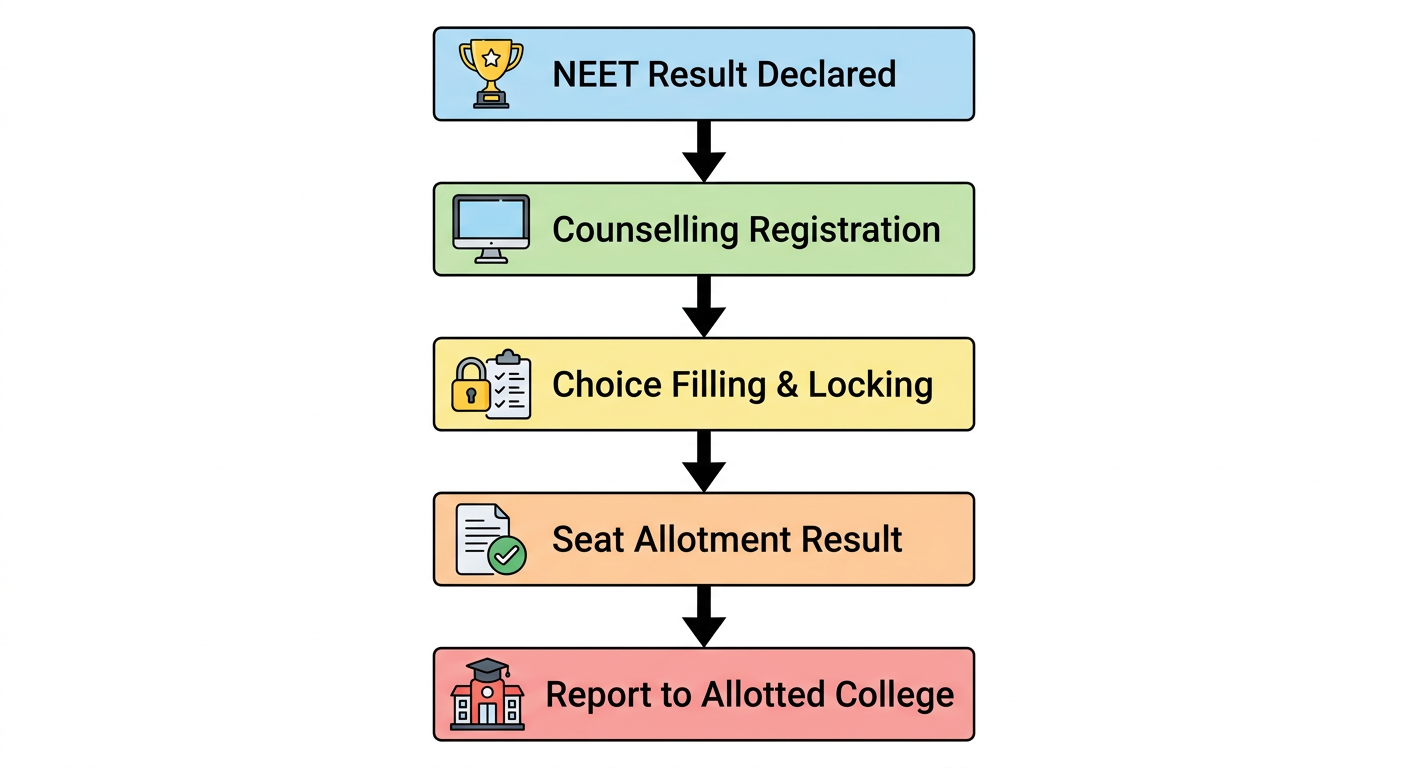
The journey doesn't end when you walk out of the examination hall. The post-exam phase is just as important and involves several steps that lead to your final admission.
First, the NTA releases the provisional answer key, and you get a chance to challenge it if you find any discrepancies. After considering the challenges, the final answer key and the NEET result are declared. You can download your scorecard, which will contain your marks, percentile score, and All India Rank (AIR), from the NTA website.
If you have cleared the qualifying cut-off, you become eligible for the counselling process. This is where you apply for seats in various colleges based on your rank. The Medical Counselling Committee (MCC) conducts the counselling for the 15% All India Quota, Deemed/Central Universities, and AFMC seats. For the remaining 85% state quota seats, the respective state counselling authorities conduct their own counselling sessions.
The process involves online registration, choice filling (where you list your preferred colleges in order), seat allotment based on rank and choices, and finally, reporting to the allotted college to complete the admission formalities. This is the final step that turns your dream of wearing a white coat into a reality.
FAQs
How many times can I attempt the NEET exam?
As per the current guidelines from the National Medical Commission (NMC), there is no limit on the number of attempts for the NEET exam. You can appear for it as many times as you want, provided you meet the other eligibility criteria.
Is NEET very difficult to crack?
NEET is considered a tough exam due to the high level of competition for a limited number of seats. However, the exam itself is based on the Class 11 and 12 syllabus. With consistent hard work, a smart strategy, and proper guidance, it is definitely possible to crack the NEET exam with a good rank.
Can I prepare for NEET without coaching?
Yes, you can absolutely prepare for NEET without joining a coaching institute. Many students crack the exam every year through self-study. The key is to be disciplined, follow a structured study plan, rely on NCERT books, and use online resources and mock test series effectively.
What is a good score in NEET for a government medical college?
This varies every year and depends heavily on your category and the state you belong to. For a general category student, a score of 620+ out of 720 is generally considered safe for securing a seat in a government medical college through the All India Quota, though cut-offs for top colleges are much higher.
When will the NEET 2025 exam be conducted?
Historically, the NEET-UG exam is conducted on the first Sunday of May. While the official date for NEET 2025 is yet to be announced by the NTA, you can expect it to be around the same time. Always check the official NTA NEET website for confirmed dates.
Are calculators allowed in the NEET exam?
No, calculators, log tables, or any other electronic gadgets are strictly prohibited inside the NEET examination hall. All calculations have to be done manually.