Over 10,000 women qualify for JEE Advanced 2026, highest in 6 years - India Today
Understand the JEE Advanced exam pattern, syllabus, eligibility, and preparation strategy to secure your seat in one of India's prestigious IITs.
16 min read
What is JEE Advanced? Your Guide to Cracking the IIT Dream
Think of your JEE journey like a video game. You’ve battled through levels 11 and 12, collected power-ups in the form of formulas and concepts, and defeated the first mini-boss: JEE Main. Many celebrate here, and rightly so. But for a select few, the final castle looms. The ultimate challenge. The final boss fight. That boss is the JEE Advanced.
This isn't just another exam. It's the one and only gateway to the most prestigious engineering colleges in India: the Indian Institutes of Technology (IITs). Qualifying for it is an achievement; cracking it is a life-changing event. But what exactly does this final boss look like? What are its moves, its weaknesses, its secrets?
This guide is your complete walkthrough. We'll break down everything from eligibility and exam patterns to the winning strategies you need to land that final, decisive blow. Forget the myths and the fear. It's time to understand the enemy and prepare for victory.
What is JEE Advanced and Why is It So Important?
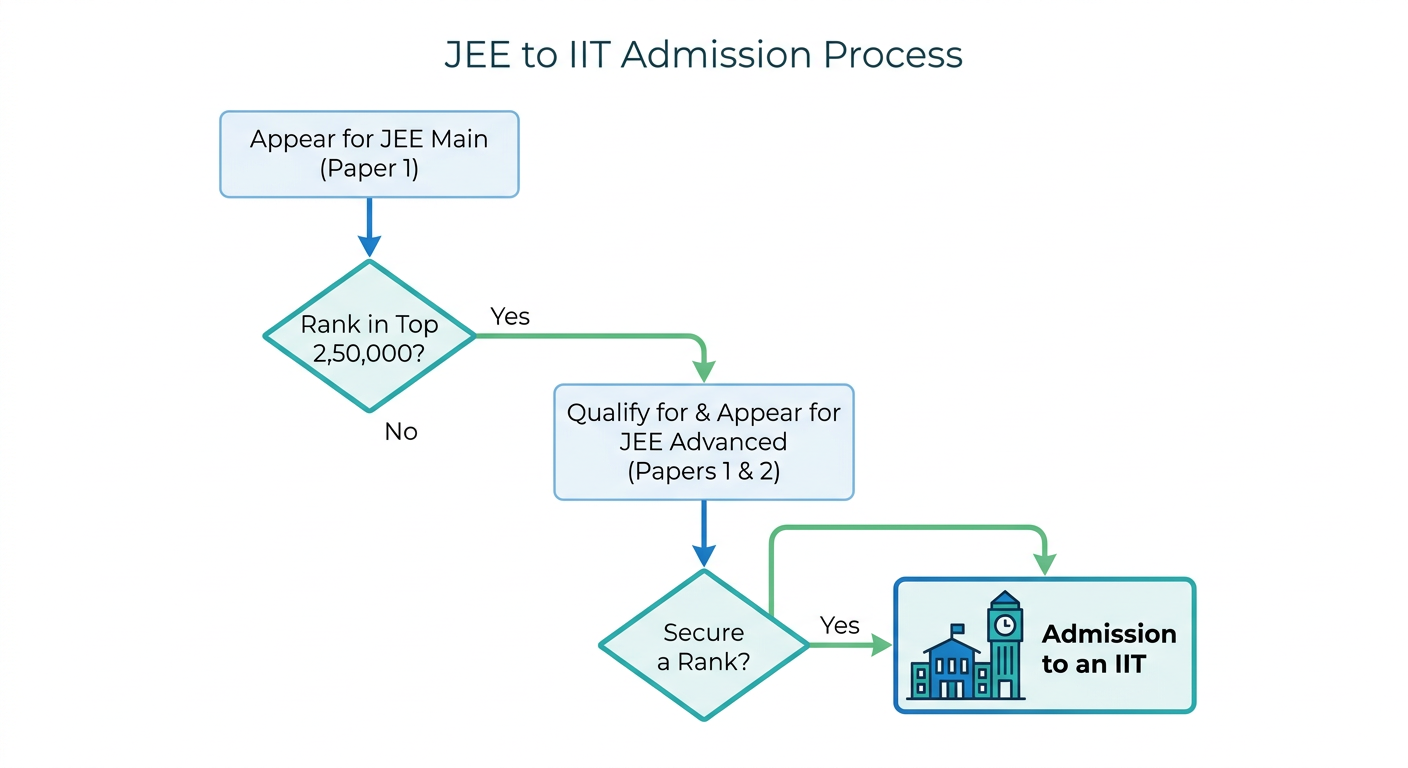
The Joint Entrance Examination (JEE) Advanced is the second and final stage of the JEE system. While JEE Main opens doors to NITs, IIITs, and other Government-Funded Technical Institutes, the JEE Advanced is exclusively for admission into the undergraduate engineering, science, and architecture programs at the 23 IITs. Simple as that. No Advanced rank, no IIT seat.
This exclusivity is what makes it one of the most competitive and challenging undergraduate exams on the planet. It's not designed to test what you know, but rather how you think. It filters for students who have a deep, intuitive grasp of scientific principles and can apply them to solve complex, multi-layered problems they've never seen before.
Passing JEE Main is about proving you have the knowledge. Cracking JEE Advanced is about proving you have the intellect and analytical prowess worthy of an IITian. The prize is immense: a world-class education, a powerful alumni network, and a brand name that opens doors for a lifetime. That is why lakhs of students fight for it every year.
JEE Advanced Eligibility Criteria: Are You in the Race?
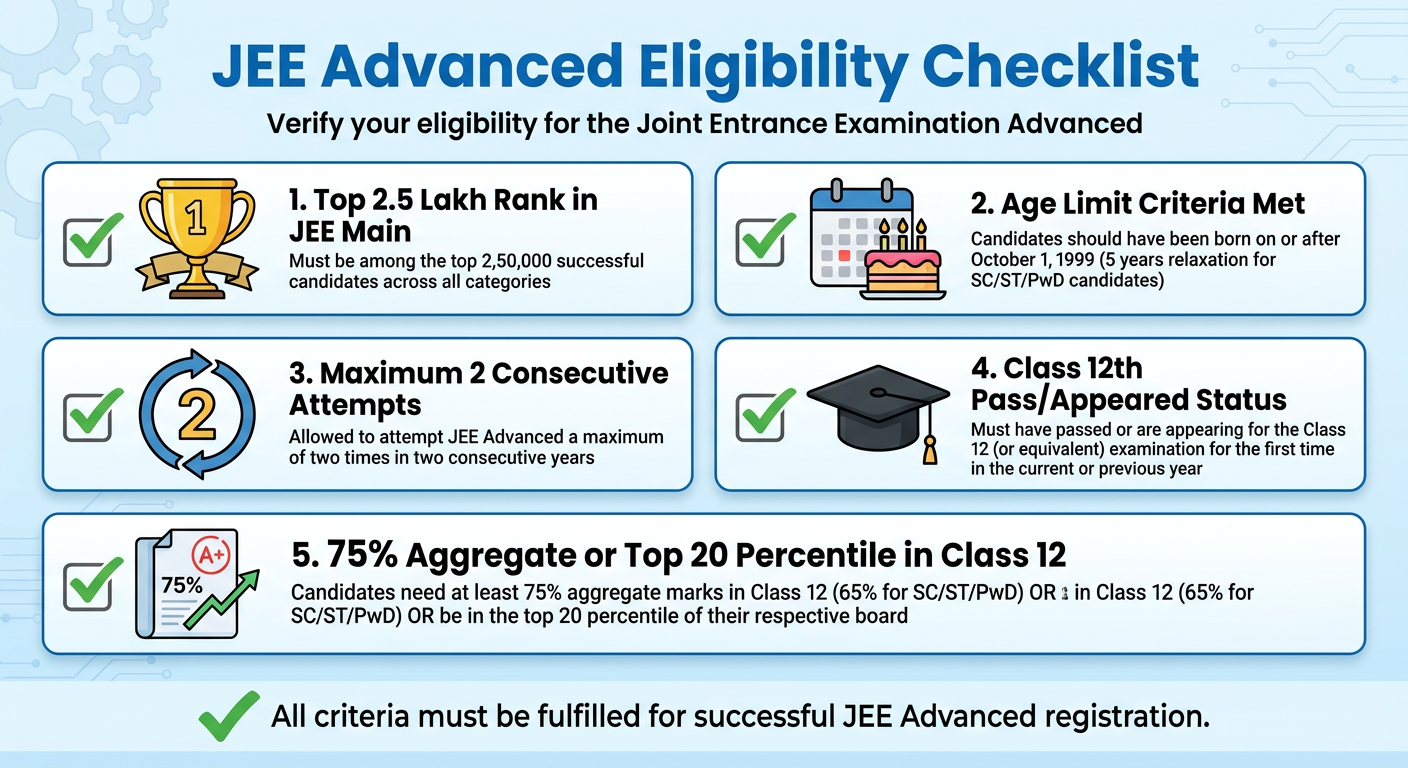
Before you even dream of the IITs, you need to make sure you're eligible to fight the final battle. The criteria for JEE Advanced eligibility are strict and non-negotiable. Here’s a breakdown of the checkpoints you must clear.
1. Performance in JEE Main: This is the first gate. You must appear for JEE Main Paper 1 and rank among the top 2,50,000 candidates (including all categories). This cutoff number is fixed, but the score required to achieve that rank varies each year depending on the difficulty of the paper and overall student performance.
The 2.5 lakh spots are distributed across categories: 10% for GEN-EWS, 27% for OBC-NCL, 15% for SC, and 7.5% for ST. The remaining 40.5% are for the General category. A 5% horizontal reservation is also available for PwD candidates in each category.
2. Age Limit: There is a strict age limit. A candidate should have been born on or after October 1, 1999, for the 2024 exam. A five-year relaxation is given to SC, ST, and PwD candidates. Always check the official information brochure on the JEE Advanced website for the current year's exact date criteria.
3. Number of Attempts: This is crucial. You can attempt JEE Advanced a maximum of two times in two consecutive years. For instance, if you appear for your Class 12th board exams in 2025, you are eligible for JEE Advanced in 2025 and 2026, and that's it. This limited window makes every attempt incredibly valuable.
4. Appearance in Class 12th (or equivalent) Examination: You must have appeared for your Class 12th board examination for the first time in either the same year as the exam or the year immediately preceding it. In simple terms, only students from the latest two board batches are eligible.
5. Minimum Marks in Class 12th: This rule has seen changes, so pay close attention. To be admitted to an IIT, a candidate must either secure at least 75% aggregate marks in their Class 12th board exam (65% for SC, ST, PwD) OR be within the top 20 percentile of successful candidates in their respective board. Due to pandemic-related disruptions, this criterion was relaxed in previous years, but it's often reinstated. Always confirm the latest rule from the official sources.
6. No Prior IIT Admission: If you have already been admitted to an IIT through JoSAA counseling, you are not eligible to appear for JEE Advanced again. You get one shot at the IIT system.
The Core Difference: JEE Main vs JEE Advanced
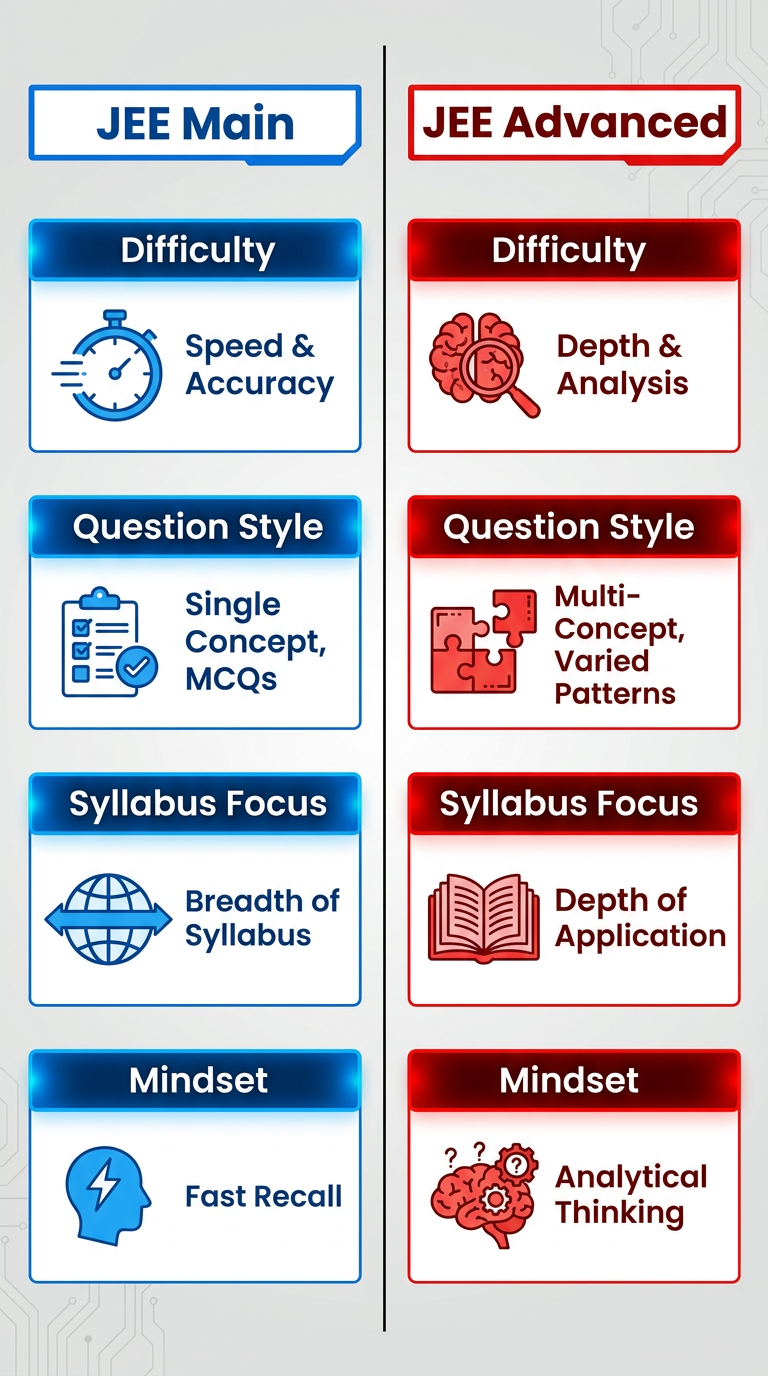
Many students mistakenly think that preparing for JEE Main automatically prepares them for Advanced. This is a dangerous misconception. While the core syllabus has overlaps, the philosophy behind the two exams is worlds apart. Understanding this difference is the first step in crafting the right strategy.
Level of Difficulty
JEE Main is a test of speed and accuracy. The questions are often direct, formula-based, and test a single concept. You can do well by having a strong command of the syllabus and being quick with your calculations. It's a wide-ranging test that checks the breadth of your knowledge.
JEE Main vs JEE Advanced is a different beast altogether. It tests the depth of your understanding. Questions are designed to be tricky, original, and often require the application of multiple concepts from different chapters to solve a single problem. Rote learning will get you nowhere here; it demands sharp analytical and reasoning skills.
Exam Pattern & Question Types
JEE Main has a relatively predictable pattern. It consists of two sections for each subject: MCQs with a single correct answer and Numerical Value questions. You know what you're getting into.
The JEE Advanced exam pattern is notoriously unpredictable. The organizing IIT changes it every year. You might face single correct MCQs, multiple correct MCQs (the most dangerous type), numerical answer questions (with and without ranges), paragraph-based questions, and matrix-match columns. The marking scheme, including negative marking, can also vary from section to section within the same paper. This uncertainty is a core part of the challenge.
Syllabus Scope
The official syllabus for both exams looks similar. However, the application is what differs. JEE Main sticks closely to the defined topics. The JEE Advanced syllabus, while technically a subset of the Main syllabus, explores the fringes and interconnections of these topics.
For example, a topic like 'Rotational Motion' in Physics might be a straightforward question in Main, but in Advanced, it could be combined with Electromagnetism or Simple Harmonic Motion. You need to be ready for anything.
Conducting Body
This small detail has big implications. JEE Main is conducted by the National Testing Agency (NTA) across the country. It's a standardized operation.
JEE Advanced is conducted by one of the seven zonal IITs (Bombay, Delhi, Guwahati, Kanpur, Kharagpur, Madras, Roorkee) on a rotational basis. Each IIT brings its own flavor to the paper, influencing the type of questions asked and the overall difficulty. Analyzing papers from different IITs is a key part of preparation.
Decoding the JEE Advanced Exam Pattern
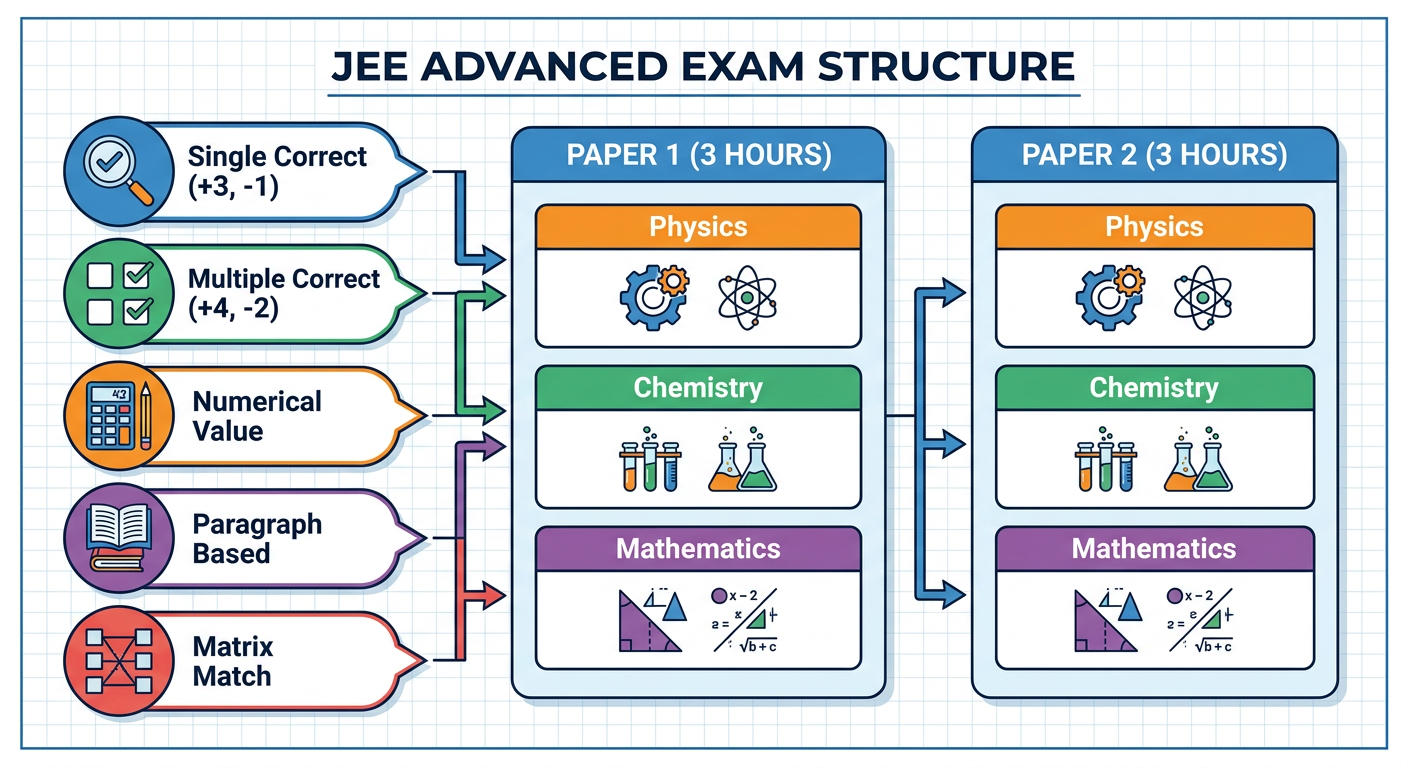
If you walk into the exam hall expecting a standard test, you're in for a shock. The JEE Advanced exam pattern is designed to keep you on your toes. Here's what we know for sure, and what you need to be prepared for.
The exam consists of two papers, Paper 1 and Paper 2, both held on the same day with a break in between. Both are compulsory. Attending both papers is mandatory to be considered for a rank.
- Duration: Each paper is 3 hours long. That's a total of 6 hours of intense mental exertion on a single day.
- Subjects: Both papers are divided into three sections: Physics, Chemistry, and Mathematics.
- Language: The question papers are printed in both English and Hindi.
Now for the unpredictable part: the question types and marking scheme. These are announced only a few days before the exam, and sometimes, you only discover the exact details in the exam hall itself. The key is to be familiar with all possible variations:
- Single Correct Option MCQs: The classic format. One correct answer out of four options. Usually carries positive marks for a correct answer and negative marks for a wrong one.
- Multiple Correct Option(s) MCQs: The game-changer. One or more options can be correct. You get full marks only if you select all the correct options and none of the incorrect ones. Partial marks may be awarded, but this is also where negative marking can be severe. These questions truly test your clarity of thought.
- Numerical Value Answer Type: You have to calculate a numerical answer and enter it using the on-screen keypad. The answer could be an integer or a decimal. Sometimes a range is accepted. There is often no negative marking for these, making them scoring opportunities if you are confident.
- List-Match Set (Matrix-Match): You'll be given two columns and have to match entries from one to the other. This can be a simple one-to-one match or a more complex one-to-many match.
- Paragraph/Comprehension Based Questions: A paragraph of information is given, followed by two or three questions based on it. These test your ability to comprehend and apply information in a given context.
The key takeaway is flexibility. Your preparation must include practicing all these question types extensively. During the exam, the first thing you must do is carefully read the instructions for each section to understand the marking scheme.
Mastering the JEE Advanced Syllabus
While the pattern is unpredictable, the JEE Advanced syllabus is well-defined. It is largely based on the topics you study in Class 11 and 12 for your board exams, but the depth required is far greater. You cannot just skim the surface; you must dive deep into the core principles of every topic. For the most up-to-date and detailed syllabus, always refer to the official information brochure available on the JEE Main NTA website.
Let's look at some of the high-impact areas in each subject.
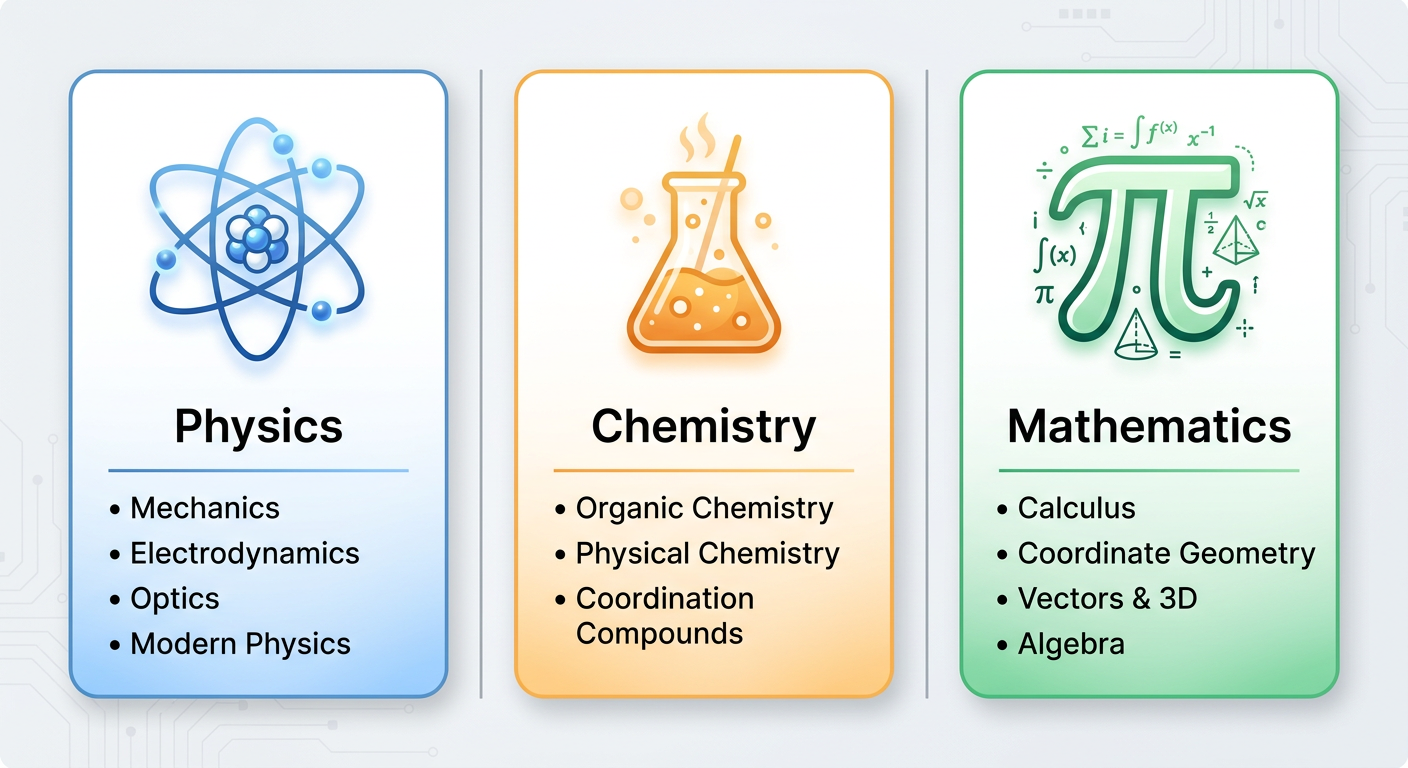
Physics Syllabus Highlights
Physics in JEE Advanced is known for its clever and application-based problems. You need to be a master of concepts and visualization. Key areas to focus on include:
- Mechanics: This is the foundation. Topics like Rotational Motion, Work-Energy-Power, and Simple Harmonic Motion are perennial favorites. Problems often integrate multiple concepts.
- Electrodynamics: A vast and crucial unit. From Electrostatics and Current Electricity to Magnetism and EMI, this section carries significant weightage. The link between electricity and magnetism is a fertile ground for complex questions.
- Optics: Both Geometrical and Wave Optics are important. Be prepared for problems involving combinations of lenses and mirrors, and concepts like interference, diffraction, and polarization.
- Modern Physics: This is often considered a scoring area. Topics like Dual Nature of Matter, Atoms, Nuclei, and Photoelectric Effect are conceptually rich and have a high weightage.
- Thermodynamics: Questions often test a deep understanding of the laws of thermodynamics, kinetic theory of gases, and their applications.
Chemistry Syllabus Highlights
Chemistry is often the rank-deciding subject. It's a blend of memorization, understanding, and application. A balanced approach is key.
- Organic Chemistry: This is the king of JEE Advanced Chemistry. It's not about memorizing reactions but understanding mechanisms (SN1, SN2, E1, E2), stereochemistry, and the application of named reactions. GOC (General Organic Chemistry) must be crystal clear.
- Physical Chemistry: This section is calculation-intensive. Topics like Chemical Equilibrium, Ionic Equilibrium, Thermodynamics, Electrochemistry, and Chemical Kinetics are extremely important. Practice numericals relentlessly.
- Inorganic Chemistry: While it has a reputation for being memory-based, recent papers have focused on conceptual questions in areas like Chemical Bonding and Coordination Compounds. p-Block elements are vast but very important.
Mathematics Syllabus Highlights
Maths in JEE Advanced is a test of your problem-solving stamina, creativity, and precision. The questions can be lengthy and require a calm, systematic approach.
- Calculus: Both Differential and Integral Calculus form the backbone of the Maths paper. Application of Derivatives, Definite Integration, and Differential Equations are hot topics.
- Coordinate Geometry: This is a massive and high-weightage unit, covering Straight Lines, Circles, and Conic Sections (Parabola, Ellipse, Hyperbola). A strong visual and analytical approach is needed.
- Vectors and 3D Geometry: Another very important topic. Questions are often application-based and test your spatial visualization skills.
- Algebra: Don't neglect it. Complex Numbers, Permutations & Combinations, Probability, and Matrices & Determinants are consistent sources of challenging questions.
A Winning Strategy for JEE Advanced Preparation
Talent and intelligence are not enough to crack JEE Advanced. You need a bulletproof strategy, relentless hard work, and monk-like discipline. This is a marathon, not a sprint. Here's a practical roadmap for your JEE Advanced preparation.
Building a Strong Conceptual Foundation
This is the absolute, non-negotiable first step. Forget about tips and tricks for a moment. You must focus on building a rock-solid understanding of the 'why' behind every concept and formula. Start with NCERT books to build a baseline, but quickly move to advanced reference books recommended by your teachers. For example, HC Verma is excellent for Physics concepts, while books like Irodov offer a challenge in problem-solving. Don't just read; question, analyze, and derive things yourself.
The Power of Problem Solving and PYQs
JEE Advanced is a problem-solving exam. Your entire preparation should revolve around it. After you've understood a concept, solve a wide variety of problems based on it. Start with single-concept questions and gradually move to multi-concept, challenging problems.
The most valuable resource here is the collection of Previous Year Questions (PYQs). They are your direct window into the mind of the paper-setters. Solve the last 15-20 years of papers not as a test, but as a learning exercise. Analyze the solution, understand the thought process, and identify the combination of concepts used. This is more valuable than solving hundreds of questions from a random textbook.
Mock Tests and Time Management
Knowledge without application under pressure is useless. Mock tests are where you bridge this gap. You must regularly take full-syllabus mock tests in a simulated exam environment. This means taking both Paper 1 and Paper 2 on the same day with the correct time gap.
After every mock test, spend more time analyzing your performance than you spent taking the test. Where did you lose marks? Was it a conceptual error, a calculation mistake, or a time management issue? Which questions should you have attempted? Which ones should you have left alone? This analysis helps you build a personal exam strategy. You can use a JEE rank predictor tool to get an idea of where you stand with your mock scores.
The Role of Coaching and Self-Study
There is no single answer here. A good coaching institute provides a structured schedule, experienced faculty, and a competitive peer group. However, coaching is not a magic wand. The real work happens during your self-study hours.
Whether you're in coaching or studying on your own, discipline is paramount. Create a realistic timetable and stick to it. Allocate time for learning new topics, problem-solving, revision, and mock tests. Utilize the wealth of free resources available online, including notes, formula sheets, and masterclasses, to supplement your learning.
Life After Cracking the Exam: The IITs in India
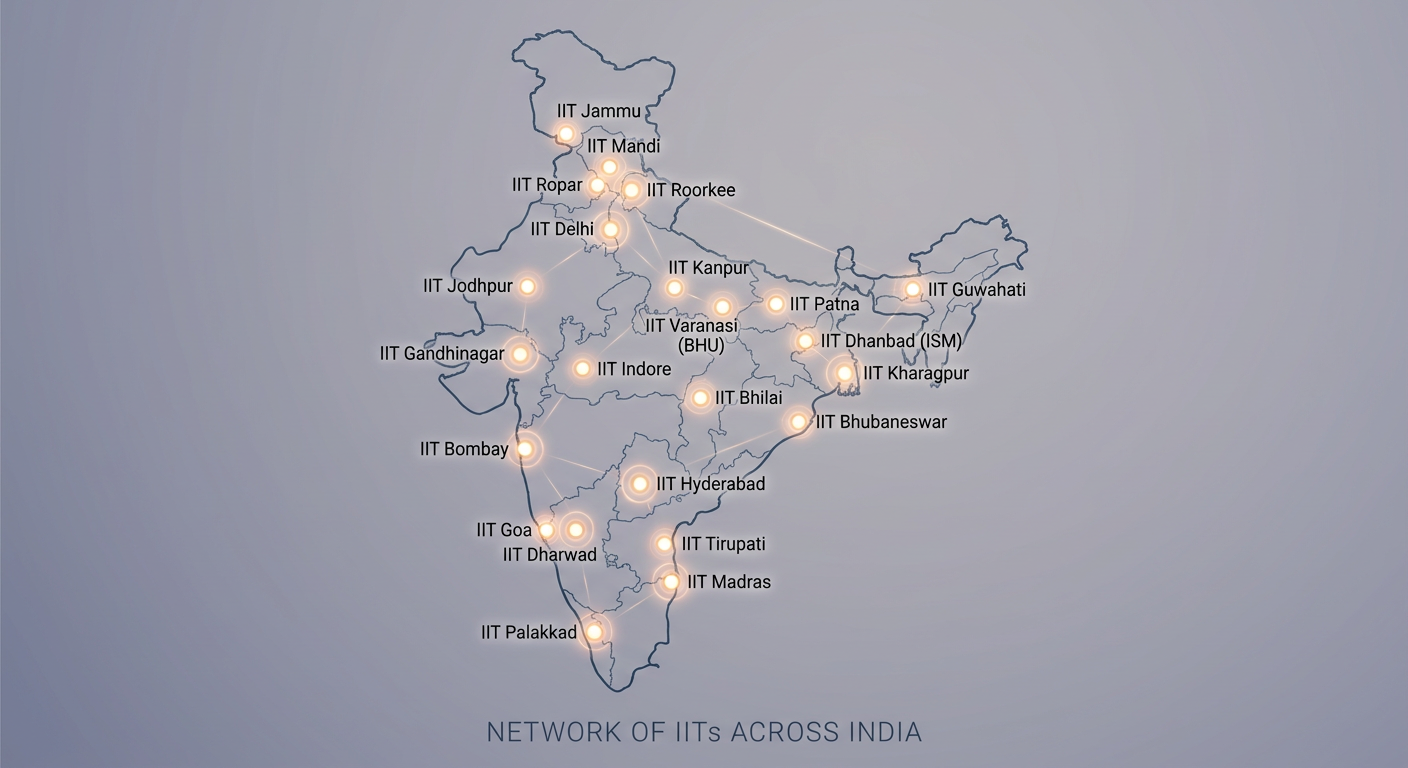
After the intense preparation and the grueling exam day comes the reward. A good rank in JEE Advanced opens the gates to the 23 IITs in India, institutions that are synonymous with excellence.
These institutes are broadly categorized into older, more established IITs and newer, second and third-generation IITs. The 'Top 7' older IITs are in Kharagpur, Bombay, Madras, Kanpur, Delhi, Guwahati, and Roorkee. The other institutes, while newer, are rapidly growing in infrastructure and reputation.
The admission process is managed centrally through the Joint Seat Allocation Authority (JoSAA) counselling. Based on your JEE Advanced rank, category, and the choices you fill, you are allocated a seat in a specific branch and IIT. A higher rank gives you more choices, allowing you to opt for sought-after branches like Computer Science in a top IIT.
Getting into an IIT is not the end of the journey, but the beginning of a new one. It’s an environment that pushes you to your limits, exposes you to brilliant minds, and provides opportunities that can shape your entire career.
FAQs
What is the 75% criteria for JEE Advanced?
To be eligible for admission to an IIT, a candidate must have secured at least 75% aggregate marks in their Class 12 board examination (65% for SC/ST/PwD candidates) OR be in the top 20 percentile of their board. This rule has been relaxed in the past, so it's critical to check the official JEE Advanced information brochure for the current year.
How many times can I attempt JEE Advanced?
A candidate can attempt JEE Advanced a maximum of two times in two consecutive years. For example, if your first Class 12 board exam appearance is in 2025, you can attempt JEE Advanced in 2025 and 2026 only.
Is JEE Advanced harder than NEET?
Comparing them is difficult as they test different skills. NEET is a vast syllabus focused on knowledge, speed, and accuracy in Biology, Physics, and Chemistry. JEE Advanced has a smaller syllabus but tests deep analytical and problem-solving skills in Physics, Chemistry, and Maths. Most experts consider the question quality and complexity in JEE Advanced to be higher, making it arguably the tougher exam.
Can I crack JEE Advanced with self-study only?
Yes, it is possible but extremely difficult. It requires immense discipline, the right study material, and a solid strategy for self-assessment (especially through mock tests). Many successful candidates have done it, but it's a path that demands extraordinary dedication and self-motivation.
What is a good rank in JEE Advanced?
'Good' is subjective. To get into any of the older IITs in a core engineering branch, a rank under 5,000 is often needed. For the most sought-after branches like Computer Science at IIT Bombay or Delhi, you typically need to be in the top 100. Any rank that gets you a seat in any IIT (under 15,000 - 18,000 depending on the year and category) is a fantastic achievement.
Which IIT conducts JEE Advanced this year?
The exam is conducted by one of the seven zonal IITs on a rotational basis: IIT Bombay, IIT Delhi, IIT Guwahati, IIT Kanpur, IIT Kharagpur, IIT Madras, and IIT Roorkee. You should check the official JEE Advanced website to know which IIT is the organizing institute for the current year.