JEE-Advanced 2026: Comp Science first choice among top 500; IIT Bombay gets max top rankers - The Economic Times
Get the complete strategy for cracking the JEE Advanced exam, including syllabus, eligibility, exam pattern, and preparation tips to secure a top rank in IIT.
11 min read
Think of your JEE journey like a movie. JEE Main is the action-packed first half where you prove you have what it takes. But the JEE Advanced? That's the final boss battle. It’s the climax where the real heroes are forged, and the gates to the prestigious Indian Institutes of Technology (IITs) swing open.
Every year, lakhs of students take a shot, but only a select few make it through. This exam isn't just about knowing formulas; it's a test of your concepts, your temperament, and your problem-solving grit. It’s designed to find the best of the best.
Feeling the pressure? Don't worry. This guide is your ultimate cheat sheet. We'll break down everything you need to know about the JEE Advanced exam, from eligibility and syllabus to a winning strategy that will help you walk into that exam hall with confidence.
What Exactly is the JEE Advanced Exam?
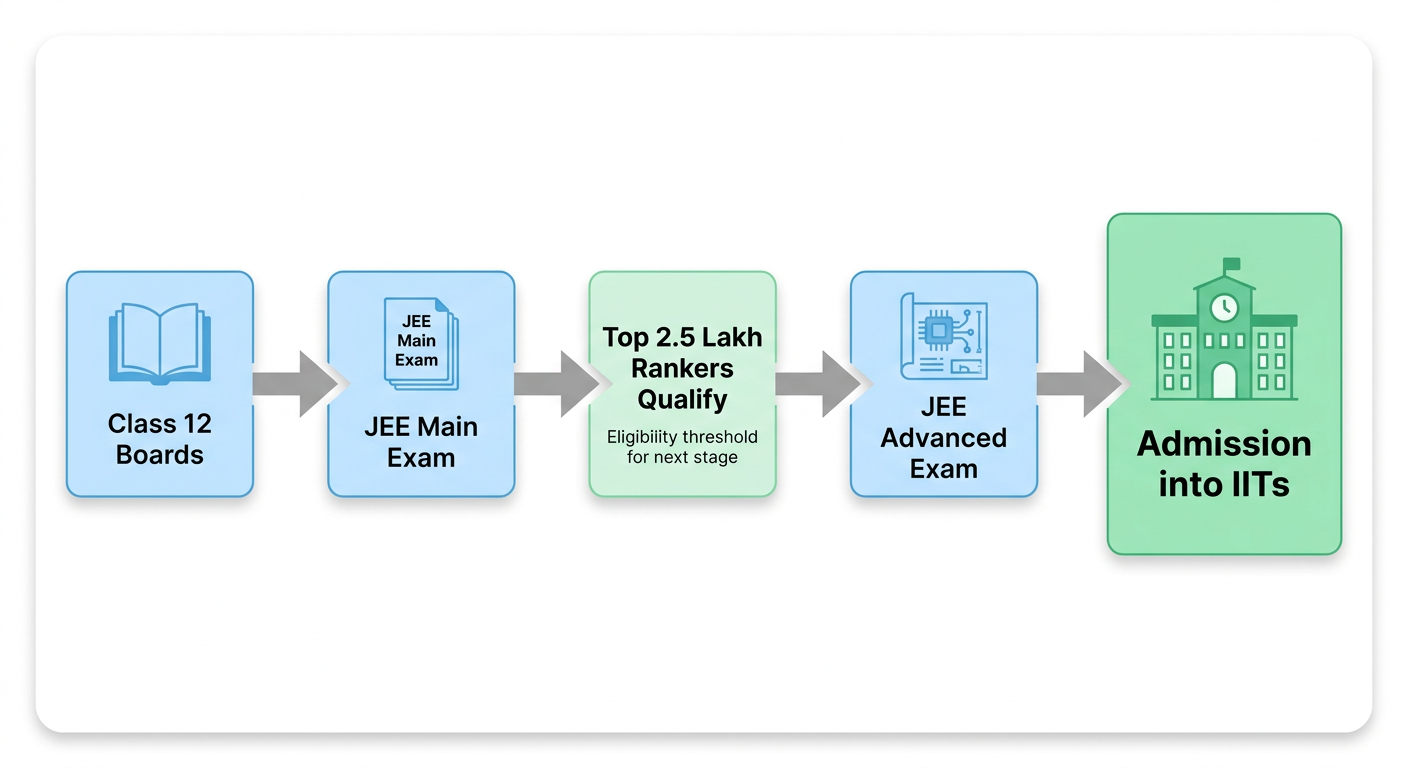
The JEE Advanced is the second and final stage of the Joint Entrance Examination, the most prestigious engineering entrance exam in India. If you dream of studying at an IIT, this is the only way in. Think of it as an exclusive key to a very exclusive club.
While JEE Main opens doors to NITs, IIITs, and other Government Funded Technical Institutes, JEE Advanced is conducted specifically for admissions into the undergraduate programs at the 23 IITs across the country. It is conducted by one of the seven zonal IITs (like Bombay, Delhi, Kharagpur) on a rotational basis under the guidance of the Joint Admission Board (JAB).
The exam is famous for its high difficulty level and its creative, application-based questions. It's not about how much you know, but how well you can apply what you know to solve complex, multi-concept problems you've never seen before.
JEE Advanced vs. JEE Main: Key Differences to Know
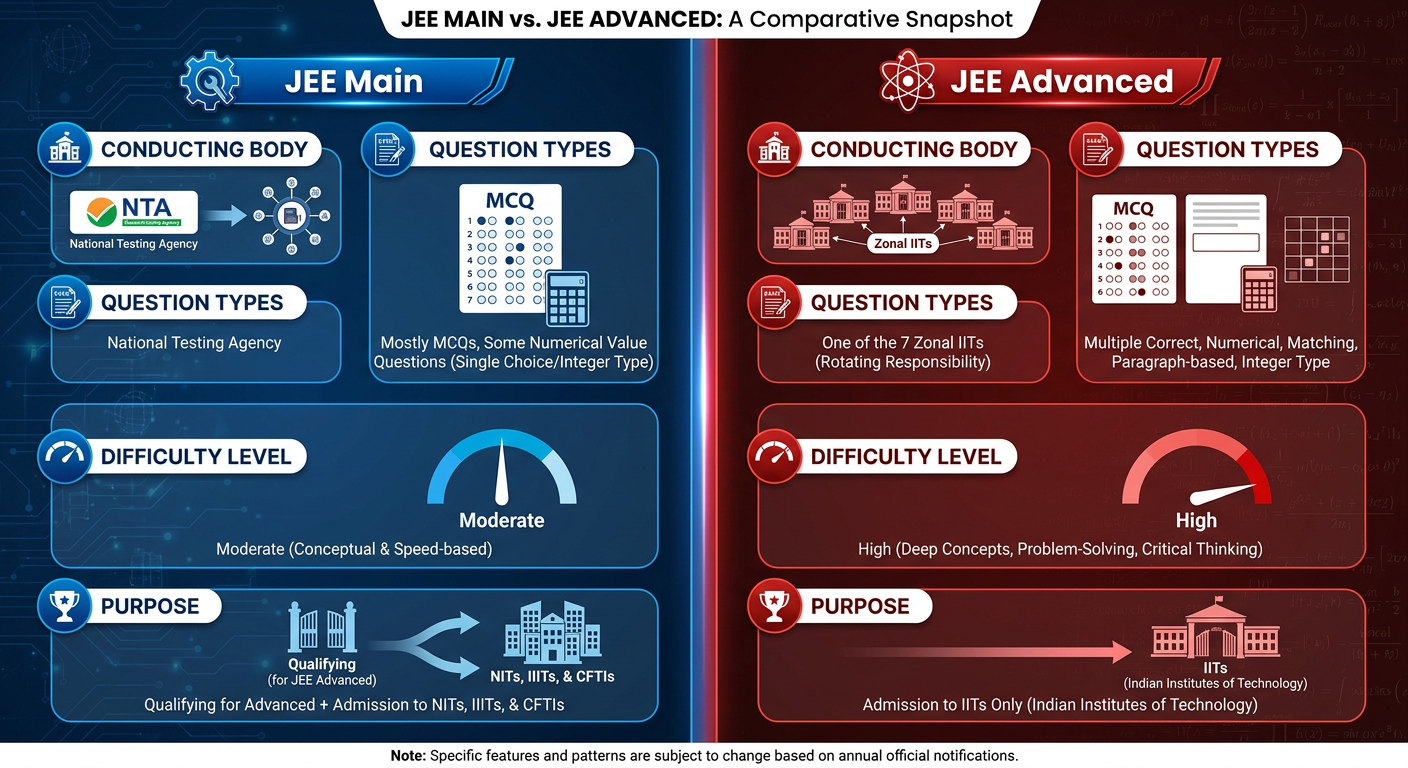
Many students make the mistake of thinking that preparing for JEE Main automatically prepares them for Advanced. While the foundation is the same, the two exams are worlds apart. Understanding these differences is the first step in building the right strategy.
They are not just two levels of the same game. They are two different games altogether. Let's break down the core distinctions you absolutely must understand.
Exam Pattern and Question Types
JEE Main mostly sticks to a predictable pattern of single-choice multiple-choice questions (MCQs) and a few numerical answer questions. It tests your speed and accuracy on a wide range of topics.
JEE Advanced, on the other hand, is completely unpredictable. It features a variety of question formats that can change every year. You'll face multiple-correct MCQs (where one or more options can be right), numerical answer types (with no options), paragraph-based questions, and matrix-match columns. This complexity requires a much deeper understanding and a very careful approach to avoid negative marking.
Syllabus Depth
The core topics in Physics, Chemistry, and Mathematics are largely the same for both exams. However, the depth required for JEE Advanced is significantly greater. While JEE Main might ask for a direct application of a formula, Advanced will ask a question that requires you to derive a concept or combine principles from two different chapters.
Some topics are also exclusive to the Advanced syllabus. It's crucial to check the official JEE Advanced syllabus to ensure you don't miss these critical areas during your preparation.
Difficulty Level and Scoring
This is the most obvious difference. The difficulty level of JEE Advanced is exponentially higher than JEE Main. The questions are designed to test your analytical skills and are often lengthy and intricate. The cutoff for qualifying is often surprisingly low due to this toughness.
Scoring is also more complex. JEE Advanced often features partial marking (for marking some of the correct options in a multiple-correct question) and different negative marking schemes, which can vary from section to section. This makes your attempt strategy just as important as your knowledge. For the latest information, always refer to the official JEE Main NTA website.
Understanding the JEE Advanced Eligibility Criteria
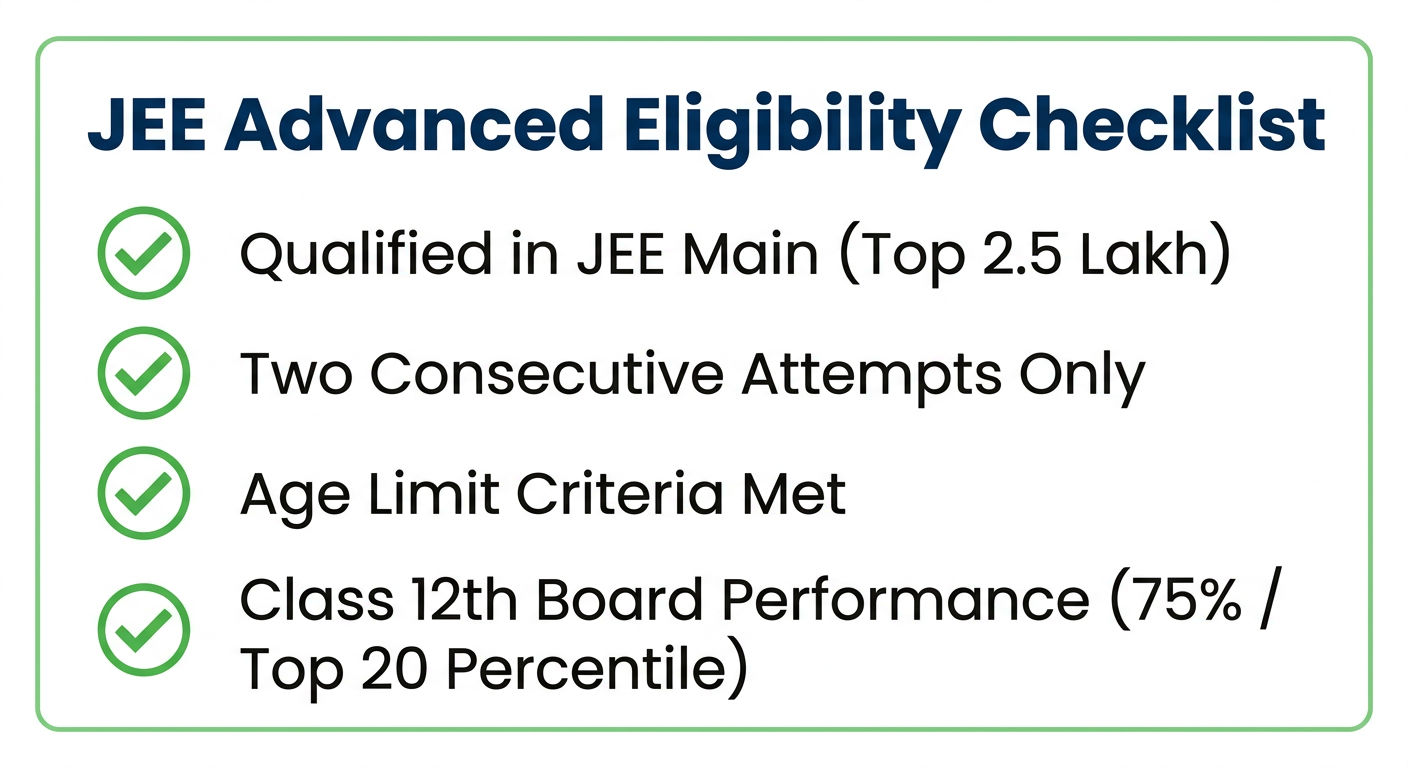
Before you even start dreaming of an IIT, you need to make sure you can actually appear for the exam. The eligibility criteria for JEE Advanced are strict, and you must satisfy every single one of them. Missing even one can disqualify you, so pay close attention.
Performance in JEE Main
This is the first and most important hurdle. You must be among the top performers in the JEE Main exam of that year. Typically, the top 2,50,000 candidates (including all categories) from the JEE Main paper 1 become eligible to sit for JEE Advanced. This number is the gatekeeper, ensuring only the most serious contenders move to the final round.
Age Limit
A candidate should be born on or after October 1, 1999 (this year is an example, it changes each year). There is a five-year relaxation for SC, ST, and PwD candidates. Always check the official information brochure for the specific year you are attempting for the exact dates.
Number of Attempts
This is a crucial rule that catches many students off guard. A candidate can attempt the JEE Advanced a maximum of two times in two consecutive years. This means if you appear for your class 12th board exam in 2025, you can attempt JEE Advanced in 2025 and 2026, and that's it. Plan your attempts wisely.
Class 12th Performance
Qualifying for the exam is one thing, but getting admission is another. To be admitted to an IIT, a candidate must have secured at least 75% aggregate marks in their Class 12 (or equivalent) board examination. For SC, ST, and PwD candidates, the requirement is 65%. Alternatively, you must be within the top 20 percentile of successful candidates in your respective board exam.
Decoding the JEE Advanced Exam Pattern
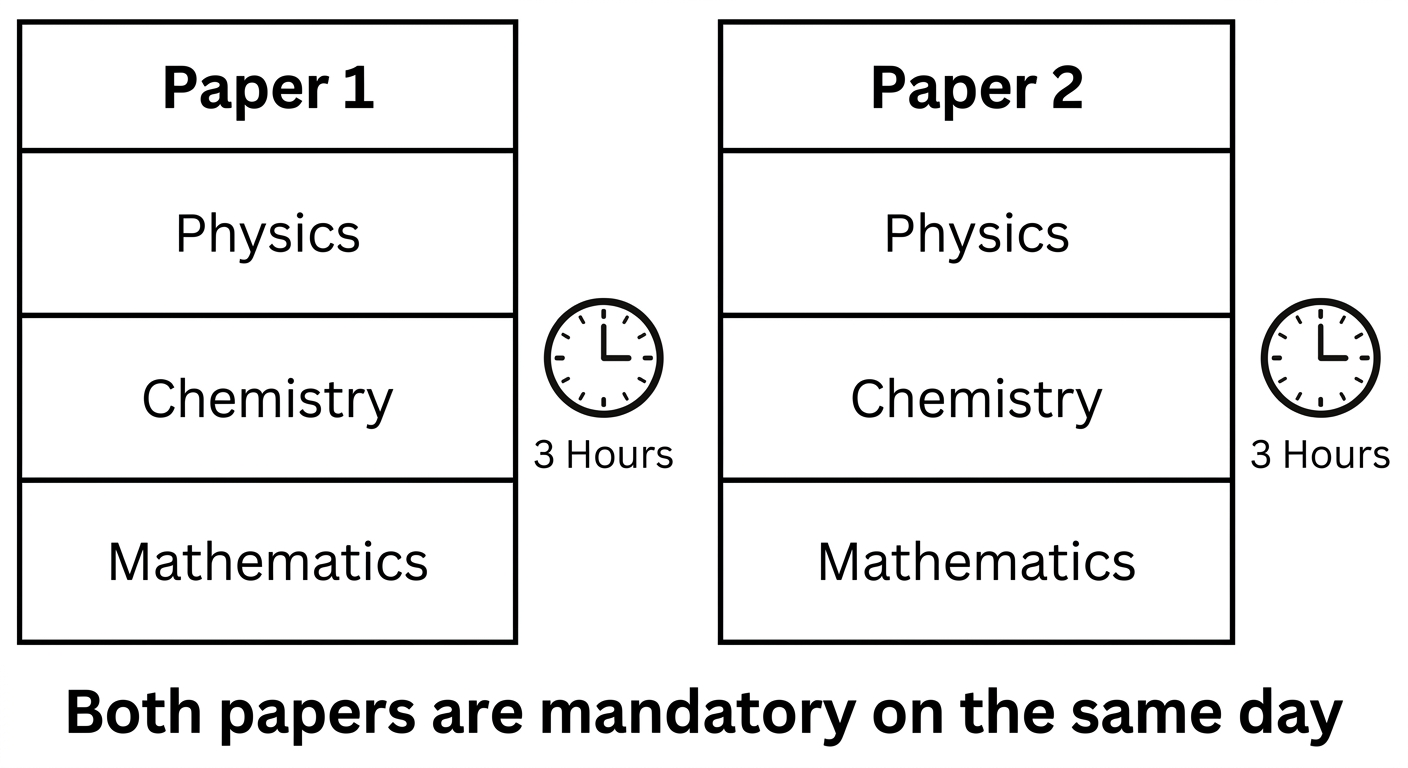 The JEE Advanced exam pattern is designed to be a comprehensive test of a student's knowledge and mental stamina. It's not a sprint; it's a marathon split into two parts on the same day. Being familiar with the structure is key to managing your time and energy effectively.
The exam consists of two compulsory papers: Paper 1 and Paper 2. Both papers are three hours long and are held on the same day with a break in between. You must appear for both papers to be considered for a rank.
Each paper is divided into three sections: Physics, Chemistry, and Mathematics. The total marks and the type of questions can vary each year, which is a deliberate part of the challenge. The organizing IIT sets the paper and has the freedom to introduce new patterns. For the most accurate, year-specific details, you should always consult the official JEE Advanced website closer to the exam date.
The Complete JEE Advanced Syllabus
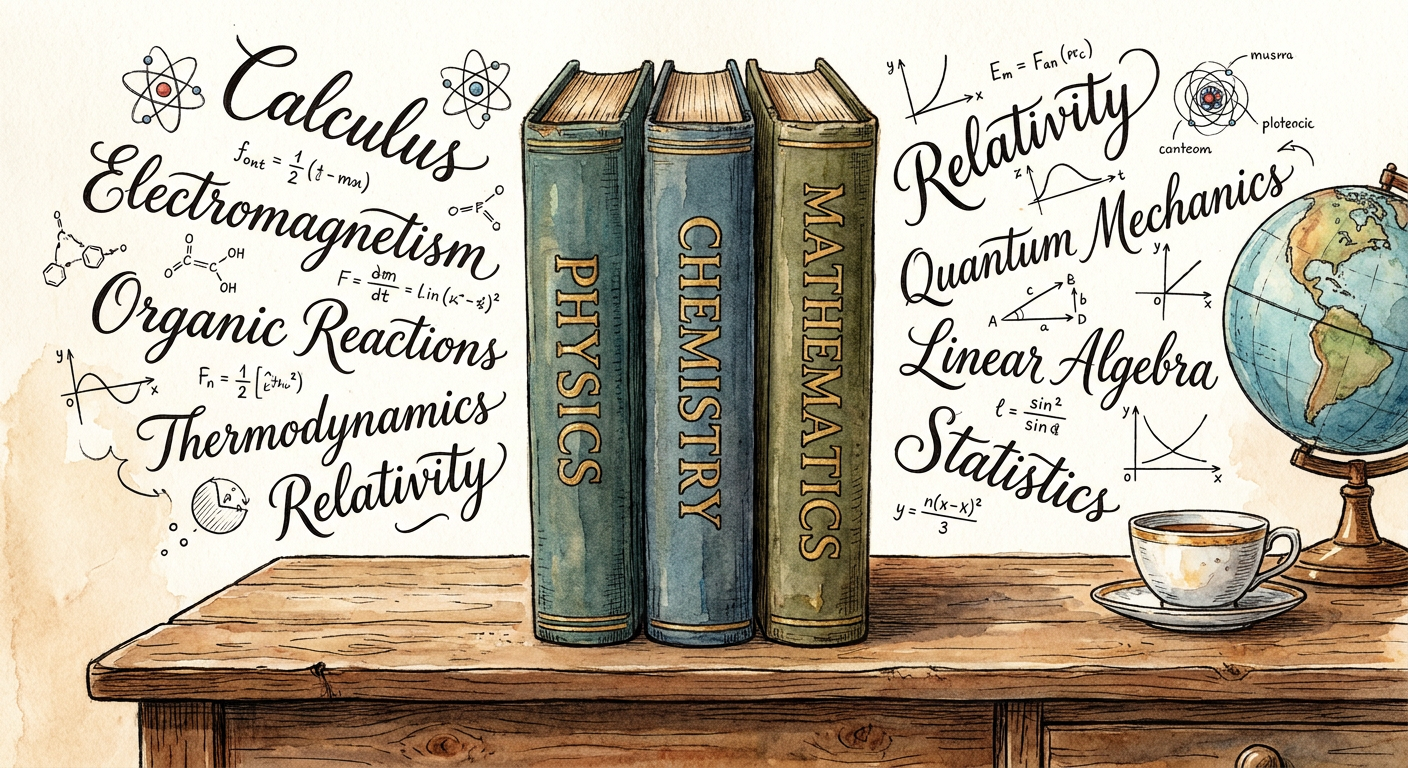 The JEE Advanced syllabus builds upon the foundation of the JEE Main syllabus but goes much deeper. It demands a thorough, microscopic understanding of every concept. Rote learning will get you nowhere here; it's all about the 'why' and 'how'.
The syllabus is broadly divided into Physics, Chemistry, and Mathematics. In Physics, you'll dive deep into Mechanics, Electromagnetism, Optics, and Modern Physics. Chemistry is split into Physical, Organic, and Inorganic, with each demanding a different approach—problem-solving in Physical, mechanism-based understanding in Organic, and detailed knowledge in Inorganic.
Mathematics covers a vast range, with Algebra, Calculus, and Coordinate Geometry forming the backbone. Topics like Vectors & 3D Geometry and Trigonometry are also critical. To get a complete chapter-wise breakdown, you should check out our detailed JEE syllabus resources.
High-Weightage Topics to Focus On
While the entire syllabus is important, some areas have historically carried more weight. Focusing a little extra on these can give you a competitive edge.
- Physics: Rotational Motion, Electromagnetism (especially EMI), Thermodynamics, Optics, and Modern Physics often see a high number of questions.
- Chemistry: In Organic Chemistry, General Organic Chemistry (GOC) and reaction mechanisms are fundamental. In Physical Chemistry, focus on Electrochemistry, Chemical Kinetics, and Thermodynamics. For Inorganic, Chemical Bonding and Coordination Compounds are non-negotiable.
- Mathematics: Calculus (both Differential and Integral) is king. Other crucial areas include Complex Numbers, Matrices & Determinants, and Conic Sections from Coordinate Geometry.
Crafting Your Winning Preparation Strategy
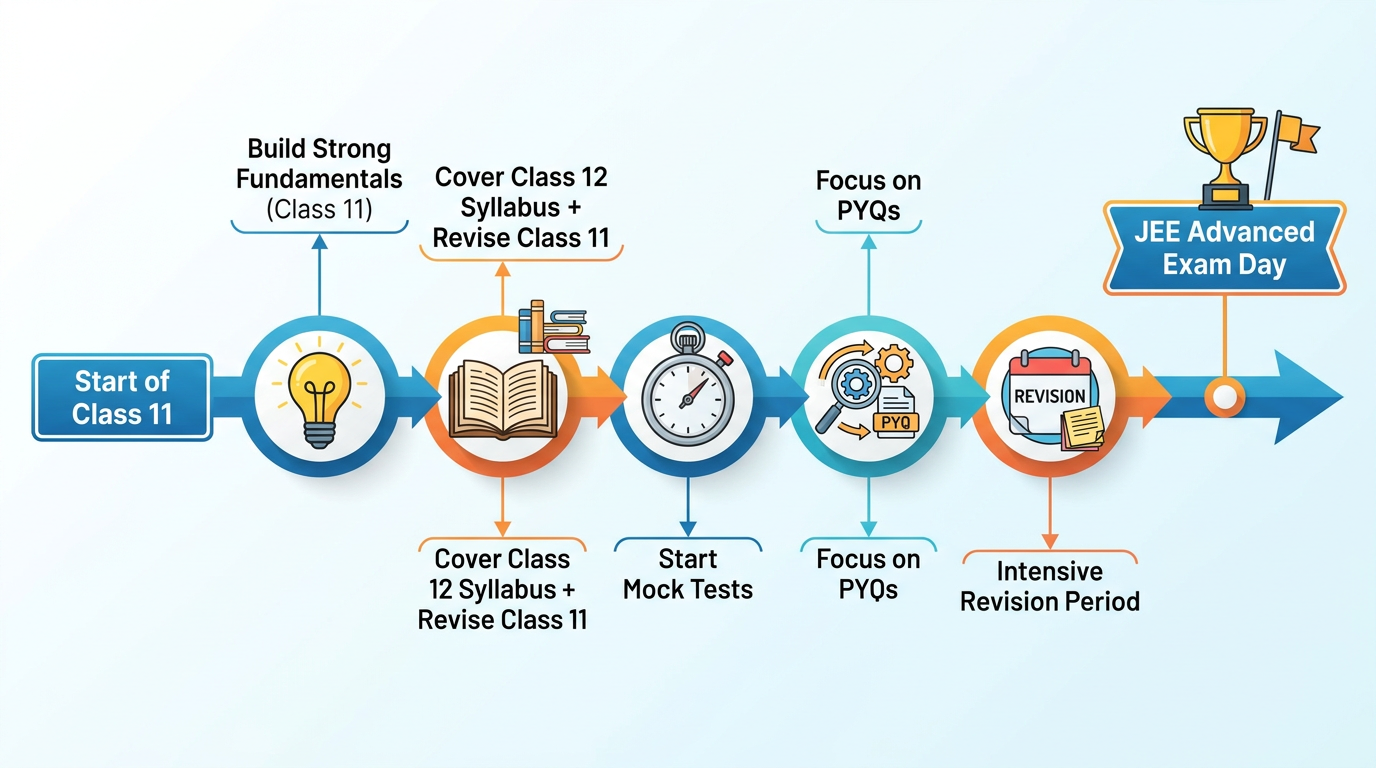 Cracking IIT JEE is less about magic and more about a disciplined, consistent strategy. Simply studying hard isn't enough; you need to study smart. Your preparation plan should be robust yet flexible, tailored to your strengths and weaknesses.
Start with Strong Fundamentals
Your entire preparation stands on the foundation of your conceptual clarity. Start with NCERT books for Class 11 and 12 to build this base. Once your concepts are clear, move on to advanced reference books like H.C. Verma for Physics, Solomon & Fryhle for Organic Chemistry, and books by authors like S.L. Loney or Arihant publications for Mathematics.
The Power of Mock Tests and PYQs
This is the single most important part of your preparation. Solving previous year questions is like getting a direct look into the mind of the paper-setter. It helps you understand the question patterns, difficulty level, and time management required.
Regularly taking mock tests under exam conditions is equally crucial. It builds your stamina for the six-hour-long exam day and helps you fine-tune your attempt strategy. After every mock test, analyze your performance to identify weak areas and silly mistakes. Use tools like a JEE rank predictor to see where you stand and what you need to improve.
Subject-Wise Approach
Each subject demands a unique approach. For Physics, focus on deriving formulas and understanding the underlying concepts, as direct questions are rare. For Mathematics, practice is the only way forward; solve as many different types of problems as you can.
Chemistry requires a balanced strategy. Physical Chemistry is problem-based like Physics. Organic Chemistry is about understanding reaction mechanisms, not just memorizing reactions. Inorganic Chemistry does require memorization, but making smart notes and regular revision can make it manageable.
Time Management and Revision
Creating a realistic timetable is essential. Allocate sufficient time for all three subjects daily. Don't forget to schedule dedicated time for revision. A topic studied but not revised is as good as a topic not studied at all. Keep short notes and formula sheets handy for quick revisions in the final months.
What is a Good Score & Rank in JEE Advanced?
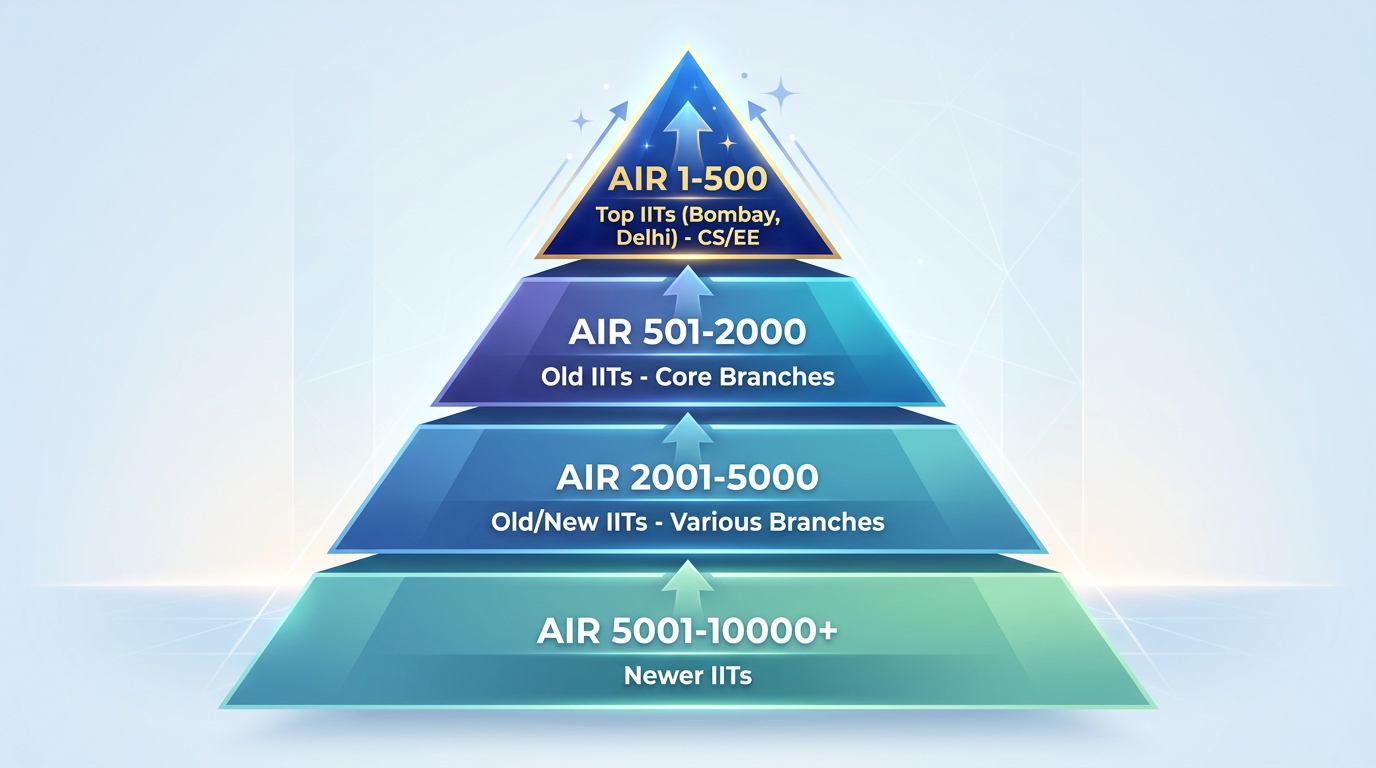 This is a question every aspirant asks. The answer isn't a fixed number. What constitutes a 'good' score changes dramatically every year depending on the paper's difficulty. In some years, scoring just 35% of the total marks has been enough to land a rank under 10,000.
The key is to focus on your relative performance. Your goal is to do better than the majority of the other serious candidates. Generally, a score above 50% of the total marks will almost certainly place you within the top 2000-3000 ranks, which is excellent.
Ultimately, your rank determines your destiny. Recent trends, as highlighted by reports, show that IIT Bombay remains the top choice for most of the top 500 rankers. Unsurprisingly, Computer Science and Engineering is the most sought-after branch, a dream for many who crack the IIT JEE exam. Securing a rank under 500 often means you can get your desired branch in one of the top old IITs.
FAQs
How many students appear for JEE Advanced?
Every year, the top 2.5 lakh students from JEE Main are eligible to appear for JEE Advanced. Out of these, typically around 1.5 to 1.7 lakh students actually register and sit for the exam.
Can I crack JEE Advanced in one year?
It is very difficult but not impossible, especially if your fundamentals from Class 11 are very strong. It requires extreme dedication, a smart study plan, and 12-14 hours of focused effort every day. A two-year integrated program is the most recommended path.
Is there negative marking in JEE Advanced?
Yes, absolutely. The negative marking scheme is one of the trickiest parts of the exam. It can vary for different sections. Some may have -1, some may have -2, and some sections (like numerical answer types) might have no negative marking. It is crucial to read the instructions on the paper very carefully.
What books should I refer to for JEE Advanced?
Beyond NCERT, some standard recommendations are H.C. Verma's 'Concepts of Physics', I.E. Irodov for Physics problems, Solomon & Fryhle for Organic Chemistry, J.D. Lee for Inorganic Chemistry, and books by S.L. Loney and Hall & Knight for Mathematics. However, focusing on one good book per subject and your coaching material is better than hoarding too many books.
Is a calculator allowed in the exam hall?
No, physical calculators or any electronic devices are strictly prohibited inside the exam hall. For complex calculations, a virtual scientific calculator is provided on the computer screen during the exam. It's a good idea to practice using it during your mock tests.