NEET-PG 2026 counselling: Round 1 registration from October 12; check full schedule - Deccan Herald
Your complete guide to the NEET exam is here. Understand the exam pattern, syllabus, eligibility, cutoffs, and top preparation strategies to ace India's biggest medical entrance exam.
17 min read
Think of the most iconic doctor you've seen on screen. Maybe it's Dr. Preeti from Kabir Singh, with her quiet determination, or the brilliant and quirky Dr. House. For many of us, the dream starts there: the white coat, the stethoscope, the power to heal. But in India, the path to that dream has a clear, massive gateway. That gateway is the NEET exam.
This single exam decides the fate of over 20 lakh students every year. It’s a challenge, no doubt about it. The competition is intense, and the syllabus is vast. But it’s not an impossible mountain to climb. It’s a marathon that tests your knowledge, your patience, and your strategy.
This guide is your roadmap. We will break down every single aspect of the National Eligibility cum Entrance Test, from what it is to how you can conquer it. Forget the confusion and the noise. Let's get started on your journey to becoming a doctor.
What Exactly is the NEET Exam? The First Step to Your MBBS Dream
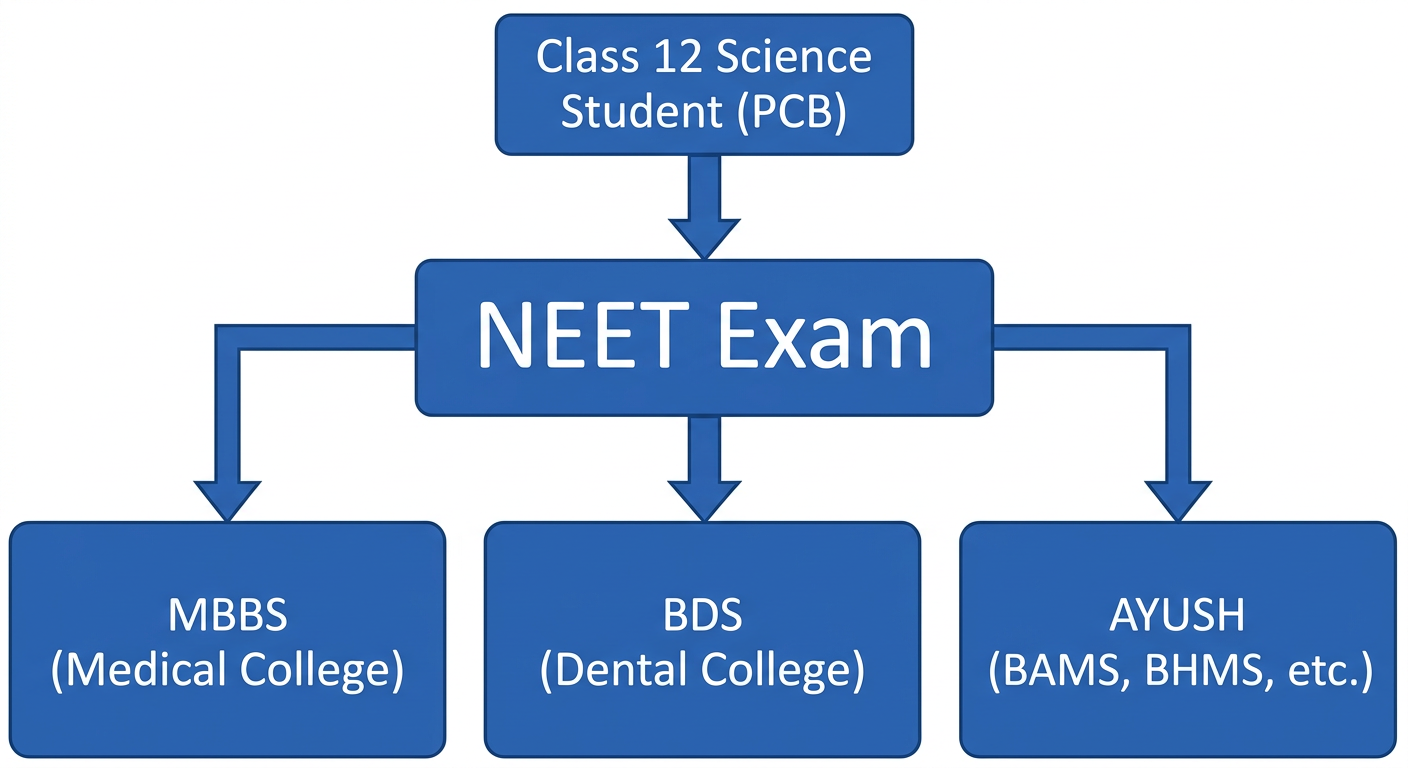
So, what is this big deal about the NEET exam? Simply put, the National Eligibility cum Entrance Test (Undergraduate), or NEET (UG), is the single, unified national-level entrance examination for students who wish to study medicine in India. If you dream of pursuing an MBBS (Bachelor of Medicine, Bachelor of Surgery), BDS (Bachelor of Dental Surgery), or AYUSH courses (like BAMS, BHMS), this is the only exam you need to focus on.
Gone are the days when students had to juggle multiple state-level and private college entrance exams. Before NEET became mandatory, there was the All India Pre-Medical Test (AIPMT) and various PMTs conducted by different states. It was a chaotic and stressful time for students. The introduction of NEET brought a 'One Nation, One Exam' policy for medical admissions, simplifying the process immensely.
The exam is conducted by the National Testing Agency (NTA), the same body that conducts JEE Main. NTA is responsible for everything from releasing the application form to declaring the results. Its role is to ensure the NEET exam is conducted in a fair and transparent manner across the country. Understanding its structure is your first step towards building a winning strategy.
Are You Eligible? Decoding NEET Eligibility Criteria
Before you dive headfirst into preparation, the most crucial step is to check if you're eligible. The last thing you want is to prepare for two years only to find out you missed a critical requirement. The NTA sets clear guidelines, so let's break them down into simple terms.
Age Limit and Attempts
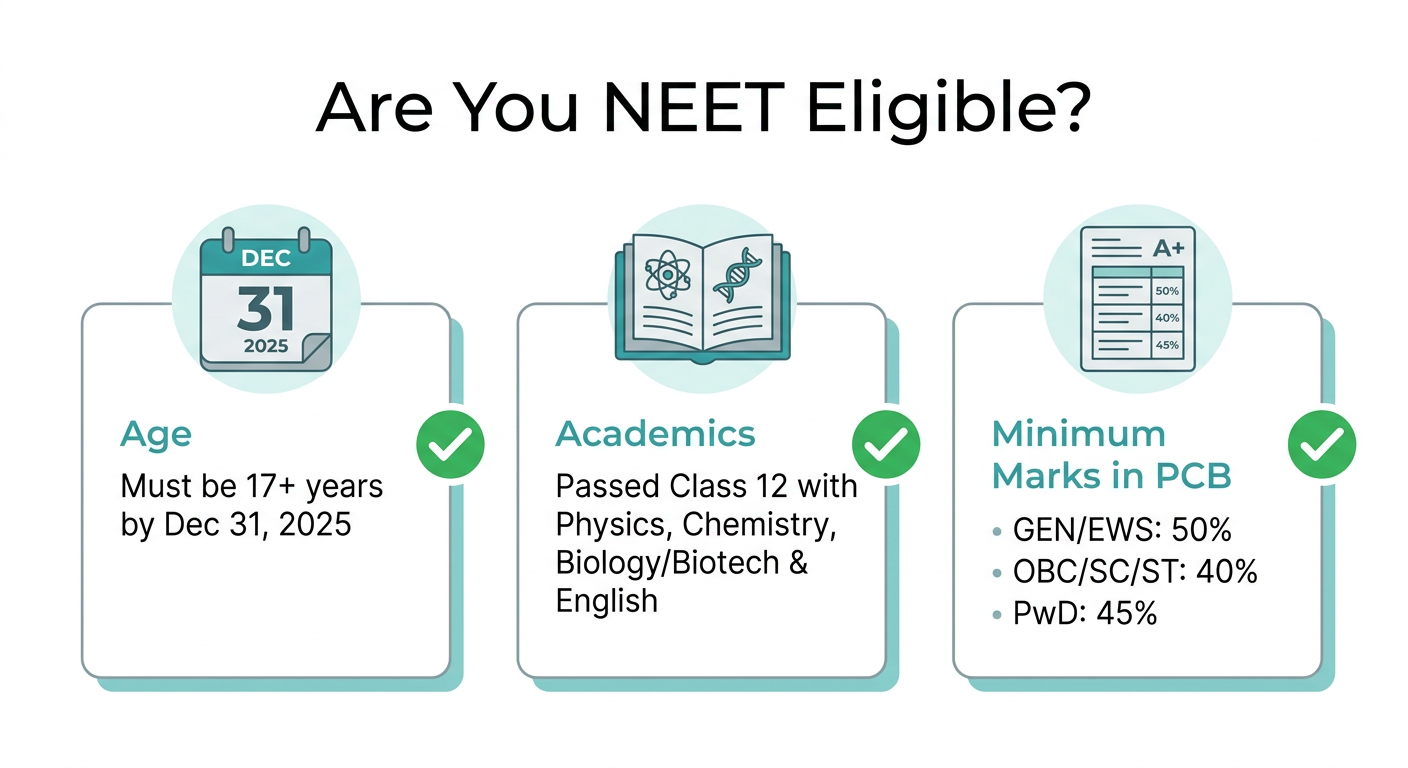
A common point of confusion for students is the age limit. Here’s the simple rule: you must have completed 17 years of age at the time of admission or will complete that age on or before 31st December of the year of your admission.
What about the upper age limit? For now, there is no upper age limit to appear for the NEET exam. The Supreme Court's ruling has removed the previous restrictions. Similarly, there is no cap on the number of attempts you can make. This is a huge relief for droppers and students who want to improve their scores.
Educational Qualifications (Class 12)
This is the core academic requirement. You must have passed your Class 12 or equivalent examination with Physics, Chemistry, Biology/Biotechnology, and English as core subjects.
But just passing isn't enough. There's a minimum percentage requirement in your PCB subjects combined:
- General/EWS Category: You need a minimum of 50% marks.
- OBC/SC/ST Category: The requirement is relaxed to 40% marks.
- Persons with Disabilities (PwD): The minimum is 45% for General-PwD and 40% for reserved-PwD candidates.
Nationality and OCI/PIO/Foreign Nationals
The NEET exam is open to Indian Nationals, Non-Resident Indians (NRIs), Overseas Citizens of India (OCIs), Persons of Indian Origin (PIOs), and Foreign Nationals. The eligibility and admission quotas might differ for these categories, especially for seats in private universities. If you fall into one of these categories, it's a good idea to check the detailed information bulletin on the official NTA NEET website.
Understanding the NEET Exam Pattern: Know Your Battlefield
To win a battle, you must know the terrain. For a NEET aspirant, the exam pattern is that terrain. Knowing the structure, marking scheme, and time limits helps you build an effective strategy and avoid surprises on exam day. The NTA has maintained a consistent pattern over the last few years.
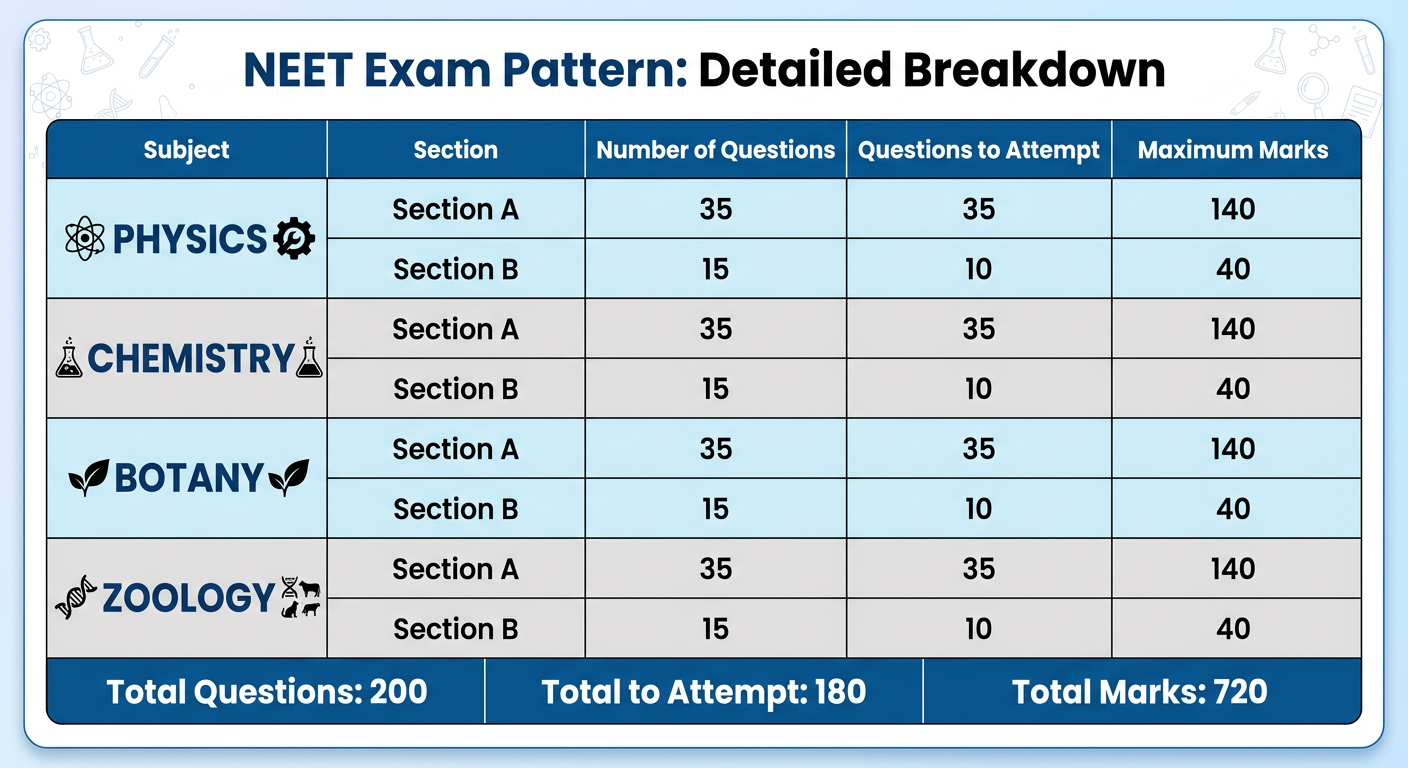
First, the basics. NEET is a pen-and-paper, offline exam. You'll be given an OMR sheet to mark your answers. The duration of the exam is 3 hours and 20 minutes (200 minutes). You'll face a total of 200 multiple-choice questions (MCQs), but you only have to attempt 180.
Section-wise Breakdown: Physics, Chemistry, and Biology
The entire NEET exam pattern is designed to test your core science knowledge. The paper is divided into three subjects, with Biology further split into Botany and Zoology.
Each subject (Physics, Chemistry, Botany, Zoology) has two sections:
- Section A: This section contains 35 compulsory questions.
- Section B: This section contains 15 questions, out of which you must attempt any 10. This choice is a strategic advantage if you use it wisely. You can skip the questions you are least confident about.
This structure applies to all four subjects, making a total of 200 questions presented to you.
The Marking Scheme: Every Mark Counts!
Understanding the marking scheme is non-negotiable. It dictates your entire approach to answering questions.
Here’s how it works:
- Correct Answer: +4 marks.
- Incorrect Answer: -1 mark.
- Unattempted Question: 0 marks.
That '-1' for a wrong answer is the game-changer. This is called negative marking, and it means that blind guessing can seriously hurt your score. It’s often better to leave a question unanswered than to guess and lose a mark you earned. Your preparation should include practicing how to decide which questions to attempt and which to leave.
Language and Medium of the Exam
To ensure accessibility for students across India, the NTA NEET exam is conducted in 13 different languages. These are: English, Hindi, Assamese, Bengali, Gujarati, Kannada, Malayalam, Marathi, Odia, Punjabi, Tamil, Telugu, and Urdu.
You can choose your preferred language while filling out the application form. However, remember that the option for regional languages is available only at test centers in their respective states. Choosing English gives you access to centers all over India.
Mastering the NEET Syllabus: What to Study?
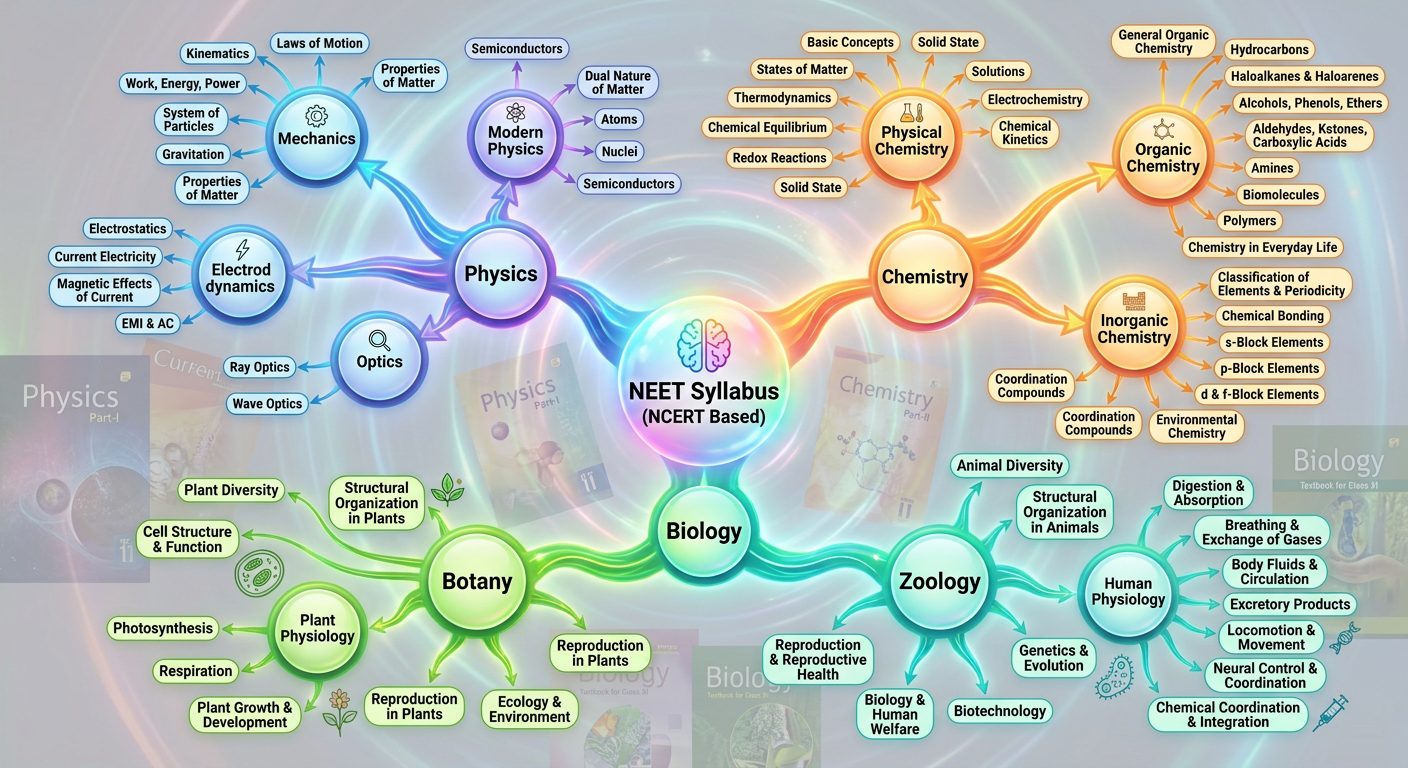
The NEET syllabus can seem like a vast ocean, and it's easy to feel lost. But there's a very clear lighthouse to guide you: the NCERT textbooks for Class 11 and Class 12. The National Medical Commission (NMC) officially prescribes the syllabus, which is almost entirely based on the topics covered in these books.
Your first and most important task is to master the NCERT content, especially for Biology. Many questions in the NEET exam are directly picked from lines, diagrams, and tables in the NCERT books. You can find the complete, updated list of topics on the official NTA website or on our detailed JEEcrackers syllabus page.
NEET Physics Syllabus Highlights
Physics is often the subject that medical aspirants find most challenging. It requires a strong conceptual understanding and problem-solving skills. The syllabus covers a wide range of topics.
Key units include Mechanics (from Kinematics to Rotational Motion), Properties of Bulk Matter, Thermodynamics, Electrodynamics (Electrostatics, Current Electricity, Magnetism), Optics, and Modern Physics (Dual Nature of Matter, Atoms, Nuclei). Don't just memorize formulas; understand how they are derived and where to apply them. Our formula sheets can be a great quick-revision tool.
NEET Chemistry Syllabus Highlights
Chemistry in NEET is a balanced mix of three parts: Physical, Organic, and Inorganic. Each requires a different approach. Physical Chemistry is formula and calculation-intensive, much like Physics. Organic Chemistry is all about reaction mechanisms, name reactions, and understanding the flow of electrons. Inorganic Chemistry relies heavily on memorizing trends, properties, and exceptions, especially from blocks of the periodic table.
Important chapters include Chemical Bonding, Equilibrium, Thermodynamics, s-p-d-f block elements, Coordination Compounds, and the entire slate of Organic Chemistry chapters from Class 11 and 12.
NEET Biology Syllabus Highlights (Botany & Zoology)
This is the highest-scoring section of the NEET exam, carrying 360 out of 720 marks. Your performance here can make or break your rank. The syllabus is vast but highly rewarding if you are systematic. NCERT is the undisputed king for Biology.
Key units in Botany include Diversity in Living World, Structural Organisation in Plants, Plant Physiology, and Reproduction in Plants. For Zoology, focus on Structural Organisation in Animals, Human Physiology (a very high-weightage unit), Human Reproduction, and Genetics & Evolution. Read each line, understand each diagram, and memorize the examples given. There are no shortcuts here.
The NEET Preparation Strategy: From Aspirant to Achiever
 A plan is what separates a wish from a goal. Cracking the NEET preparation phase requires more than just hard work; it demands smart work. With over 20 lakh students competing, having a structured strategy is your biggest advantage.
Building a Strong Foundation (The First Year)
Many students make the mistake of taking Class 11 lightly. This is a huge blunder. The NEET syllabus gives almost equal weightage to Class 11 and Class 12 topics. Use your first year of junior college to build a rock-solid conceptual foundation.
Focus on understanding the 'why' behind every concept, not just the 'what'. Make detailed notes. Solve problems related to each chapter as you complete it. If you master your Class 11 concepts, your Class 12 preparation will become much smoother, as many topics are interconnected.
The Crucial Final Lap (The Second Year & Droppers)
Your Class 12 year, or your drop year, is when the pressure mounts. This is the time to integrate your Class 11 and Class 12 studies. A good approach is to align your NEET preparation with your board exam syllabus, as they are very similar. Create a timetable that allocates time for new topics, revision of old topics, and regular testing.
For droppers, the challenge is to stay motivated and identify the weaknesses from the previous attempt. Was it a lack of conceptual clarity, poor time management, or silly mistakes? Analyze your old performance and build your new strategy around fixing those specific issues.
Subject-wise Strategy for NEET
- Biology: Read NCERT multiple times. Make your own handwritten notes from it. Pay special attention to diagrams, their labels, and scientific names. Practice MCQs from a good question bank to test your recall.
- Physics: Don't be afraid of the numbers. Start with the theory, understand the concept, and then move to solving problems. Begin with solved examples, then try easier questions, and gradually move to more complex ones. Consistency is key.
- Chemistry: For Physical Chemistry, practice numericals daily. For Organic, create a separate notebook for name reactions and mechanisms; revise it daily. For Inorganic, use mnemonics and flashcards to memorize trends and facts from the NCERT book.
The Power of Mock Tests and PYQs
This is perhaps the most critical part of your NEET preparation. Solving Previous Year Questions (PYQs) helps you understand the exam's pattern, difficulty level, and important topics. Mock tests, taken under real exam conditions, train your brain for the 3-hour-20-minute marathon. They build speed, accuracy, and time management skills.
Don't just take tests. Analyze them. Spend as much time analyzing a mock test as you spent taking it. Identify your mistakes: Were they conceptual errors, silly calculation mistakes, or time pressure errors? Work on these weaknesses before the next test. You can find many of these materials in our free resources hub.
Understanding NEET Cutoff and The Admission Process
 After the exam, the next big words you'll hear are 'cutoff' and 'counselling'. It's important to understand what they mean. There are two types of cutoffs in the NEET exam, and they serve very different purposes.
NEET Qualifying Cutoff Percentile vs. Marks
The first is the qualifying cutoff. This is the minimum score you need to be eligible to participate in the counselling process. The NTA sets this cutoff in terms of percentile, not marks. For example:
- General/EWS Category: 50th Percentile
- OBC/SC/ST Category: 40th Percentile
- PwD Categories: 45th and 40th Percentiles
Every year, this percentile corresponds to a specific range of marks. This score changes based on the overall difficulty of the paper and the performance of all the students. You can check the exact qualifying marks on the official result card published by the NTA NEET website.
The Admission Cutoff: Your Ticket to a Top College
Just qualifying is not enough to get a seat. The second, more important cutoff is the admission cutoff. This is the last rank (or score) at which a student gets admission to a particular college in a particular category. This is not a fixed number; it depends on the number of seats available, the number of applicants for that college, and the overall performance of students that year.
Top government medical colleges have very high admission cutoffs, often requiring scores well above 650 for the general category. This is the number you should be aiming for when you set your targets.
The Counselling Process Explained
Once you qualify, you can participate in the counselling process. This is where you are allotted a medical seat based on your rank, the choices you fill, and the availability of seats. The counselling is primarily divided into two main quotas:
- All India Quota (AIQ): 15% of seats in all government medical colleges across the country are filled through a centralized counselling process conducted by the Medical Counselling Committee (MCC).
- State Quota: The remaining 85% of seats are filled by the respective state counselling authorities for students who have the domicile of that state.
Counselling happens in multiple rounds (Round 1, Round 2, Mop-up Round) until all seats are filled.
Beyond MBBS and BDS: Other Courses through NEET
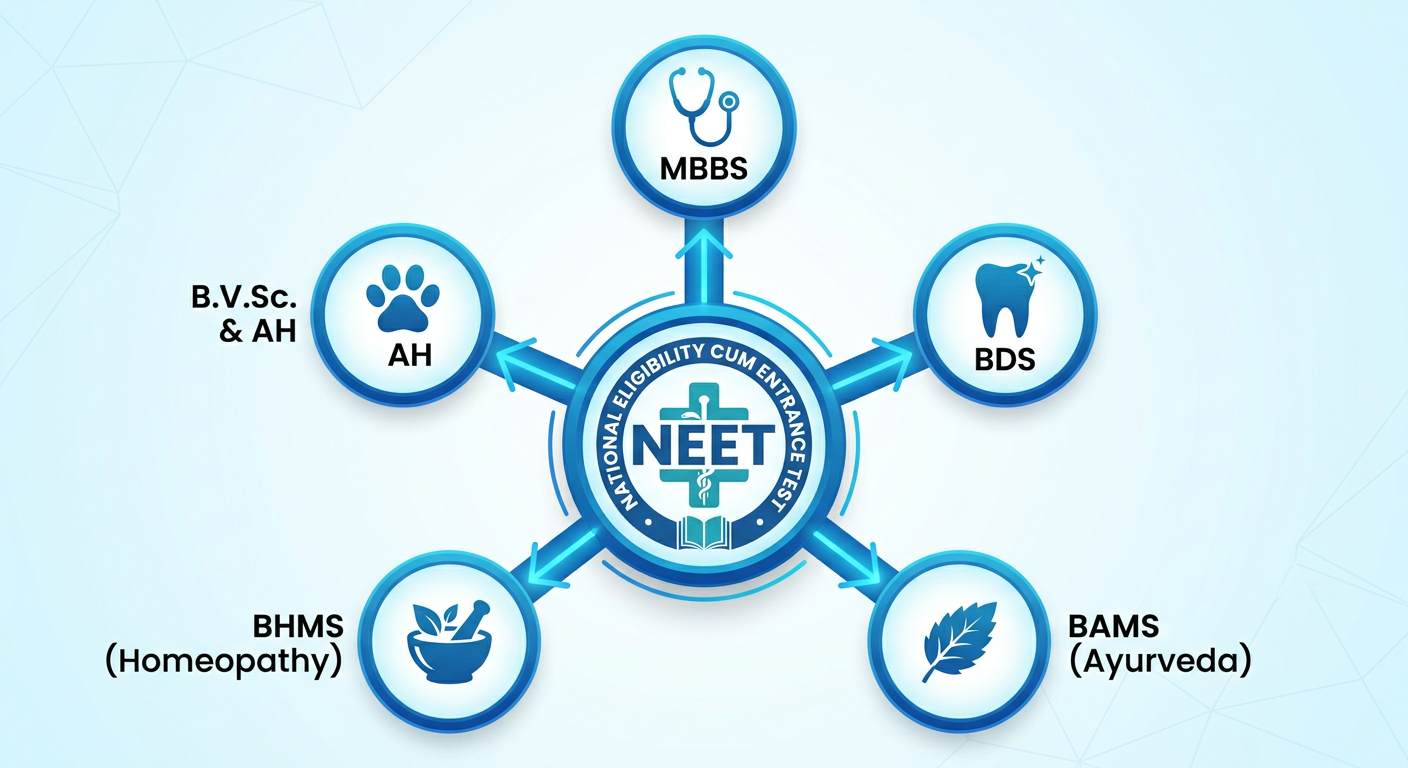 While MBBS is the dream for most NEET aspirants, it's important to know that the NEET exam opens doors to several other respected healthcare professions. Knowing your options can reduce pressure and provide excellent alternative career paths.
MBBS (Bachelor of Medicine, Bachelor of Surgery) and BDS (Bachelor of Dental Surgery) are the most sought-after courses. However, the NEET score is also mandatory for admission to AYUSH courses. This includes:
- BAMS: Bachelor of Ayurvedic Medicine and Surgery
- BHMS: Bachelor of Homeopathic Medicine and Surgery
- BUMS: Bachelor of Unani Medicine and Surgery
- BSMS: Bachelor of Siddha Medicine and Surgery
These are recognized medical systems in India and offer fulfilling careers in holistic healthcare. Additionally, in many states and central institutions, the NEET score is also used for admission to B.V.Sc. & A.H. (Bachelor of Veterinary Science and Animal Husbandry) and select B.Sc. (Nursing) programs. So, a good NEET score gives you a wide array of choices in the vast field of health sciences.
Common Challenges and How to Overcome Them
 The journey of NEET preparation is tough, and it's normal to face hurdles. The key is to anticipate them and have a plan to tackle them. You are not alone in facing these challenges.
Dealing with Exam Stress and Burnout
Studying for 10-12 hours a day for two years can lead to burnout. It's crucial to take regular breaks, get 7-8 hours of sleep, and engage in a hobby. Talk to your parents, friends, or teachers when you feel overwhelmed. Sometimes, just sharing your anxieties can make a big difference.
Joining a student community can also be very helpful. Knowing that others are going through the same struggles can be very comforting. Check out our JEEcrackers student communities to connect with fellow aspirants.
Managing the Vast Syllabus
Feeling overwhelmed by the sheer volume of the syllabus is common. The solution is not to study more, but to study smarter. Prioritize topics based on their weightage in previous years. Use the 80/20 rule: focus on the 20% of topics that give 80% of the marks. Revision is key. Create a revision schedule and stick to it religiously. Spaced repetition is a scientifically proven method to retain information for longer.
The Information Overload Problem
Today, there is no shortage of study material. In fact, there is too much. Students often get trapped in collecting dozens of books, joining multiple coaching classes, and watching endless YouTube videos. This leads to confusion and anxiety.
Stick to a limited set of high-quality resources. Your primary resource should be NCERT. Supplement it with one good reference book per subject and a reliable question bank. Choose one coaching or online platform and trust its methodology. More is not always better; better is better.
FAQs
Is NCERT enough for the NEET exam?
For Biology, NCERT is almost sufficient and should be treated as the holy grail. For Physics and Chemistry, while NCERT builds the foundation, you will need to supplement it with a good reference book for in-depth concepts and practice a wide variety of MCQs from a question bank to develop problem-solving speed and accuracy.
How many hours should I study for NEET?
There is no magic number. Quality matters more than quantity. Most successful students put in 6-8 hours of focused, self-study on weekdays and 10-12 hours on weekends, in addition to their school or coaching classes. The key is consistency and focus during your study hours.
What is a good score in the NEET exam?
'Good' is subjective and depends on your target. To secure a seat in a government medical college under the All India Quota for the general category, a score of 650+ out of 720 is generally considered safe. For top colleges like AIIMS Delhi, the score often needs to be 700+. For state quota seats or private colleges, the required score might be lower.
Can I crack NEET in one year of preparation?
Yes, it is definitely possible to crack the NEET exam in one year, especially if your Class 11 concepts are reasonably clear. It requires immense dedication, a smart and focused strategy, and consistent hard work. This is particularly true for droppers who have an entire year to focus solely on NEET.
How is the NEET rank calculated in case of a tie?
The NTA has a clear tie-breaking policy. If two or more students get the same total score, the rank is decided based on the following order of preference: 1) Higher marks/percentile in Biology, 2) Higher marks/percentile in Chemistry, 3) Higher marks/percentile in Physics, and 4) If the tie still persists, by age, with the older candidate getting the higher rank.