NEET PG Counselling 2026 LIVE: MCC schedule out for 50% AIQ seats; state-wise merit list, closing ranks - Careers360
Your complete guide to the NEET exam, covering the latest syllabus, exam pattern, eligibility, cut-offs, counselling, and a step-by-step preparation strategy.
30 min read
NEET Exam: The Ultimate Guide for Aspirants
Remember watching Munna Bhai M.B.B.S. and thinking about wearing that white coat? For millions of students in India, that dream isn't just a movie plot. It's a goal they work towards for years. The first, and most important, gate they must pass through is the NEET exam. It's the single-largest medical entrance exam in the country, a make-or-break test that determines your future in medicine.
But what is this exam, really? It feels like a giant mountain, especially when you're just starting your climb in Class 11 or 12. There's so much information, so much competition, and so many rumours. It's easy to feel lost.
That's why we built this guide. This is your one-stop resource for everything related to the NEET exam. We will break down every single aspect, from the full form and history to the detailed syllabus, exam pattern, application process, and even post-exam counselling. By the end, you'll have a clear roadmap to conquer NEET.
What Exactly is the NEET Exam?
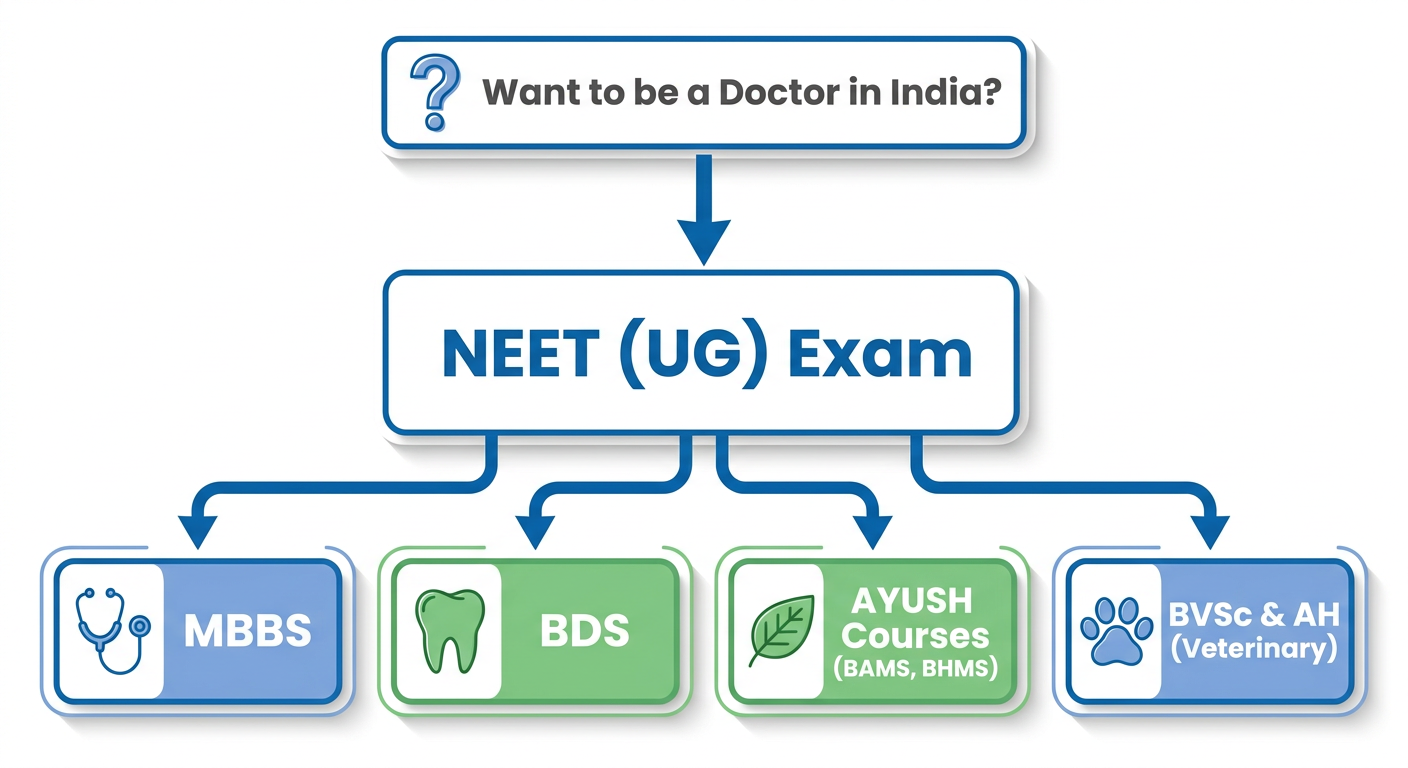 The National Eligibility cum Entrance Test, or NEET, is the uniform entrance examination for admission to most medical and dental colleges across India. Before NEET, students had to appear for multiple state-level and college-level entrance tests (like AIPMT, COMEDK, etc.), which was a chaotic and expensive process. The introduction of the NEET exam streamlined everything into one powerful, nationwide test.
Think of it as the ultimate filter. Whether you're aiming for an MBBS seat in a prestigious AIIMS or a BDS seat in a state government college, your journey starts with a single OMR sheet. It's conducted by the National Testing Agency (NTA), the same body that manages JEE Main, ensuring a standardized and fair process for every aspirant.
The NEET Full Form and Its Meaning
So, what is the NEET full form? It stands for National Eligibility cum Entrance Test. Let's break that down.
- National: It's a single exam for the entire nation, replacing dozens of other tests.
- Eligibility cum Entrance: This is the key. You must first qualify the exam (meet the minimum cut-off percentile) to be eligible for counselling. After that, your high score acts as your entrance ticket to get a seat. Just clearing the eligibility cut-off doesn't guarantee a seat; a high rank is needed for that.
This single test is your gateway to MBBS (Bachelor of Medicine, Bachelor of Surgery), BDS (Bachelor of Dental Surgery), AYUSH courses (Ayurveda, Yoga & Naturopathy, Unani, Siddha, and Homeopathy), and selected B.Sc (Nursing) and BVSc & AH (Veterinary Science) programs.
A Brief History: Why NEET Was Created
To truly understand the importance of the NEET exam, it helps to know why it was started. Before 2013, the medical admission landscape was a mess. Every state had its own exam. Many private and deemed universities had their own tests. A student from Uttar Pradesh might have to appear for 10-15 different exams to maximize their chances.
This system was not only stressful and expensive for students and parents but also faced issues of transparency and fairness. To bring uniformity and meritocracy to the forefront, the Supreme Court of India mandated a single entrance test. After a few legal battles and initial rollouts, NEET was firmly established as the sole medical entrance test.
This move levelled the playing field. Now, a student's ability and preparation, not their ability to travel and pay for multiple forms, determine their medical career path. It created a single, transparent ranking system for all aspirants.
Who Conducts the NEET Exam? (The Role of NTA)
The responsibility for conducting the NEET exam lies with the National Testing Agency (NTA). Established by the Government of India, the NTA is an autonomous and self-sustained testing organization.
Its job is to conduct efficient, transparent, and international-standard tests to assess candidate competency for admissions. For the NEET exam, the NTA handles everything from releasing the official notification and application forms to conducting the exam, declaring the results, and providing the All India Rank (AIR) list to the counselling authorities. You can find all official announcements directly on the official NEET site (NTA).
Are You Eligible? Cracking the NEET Eligibility Code
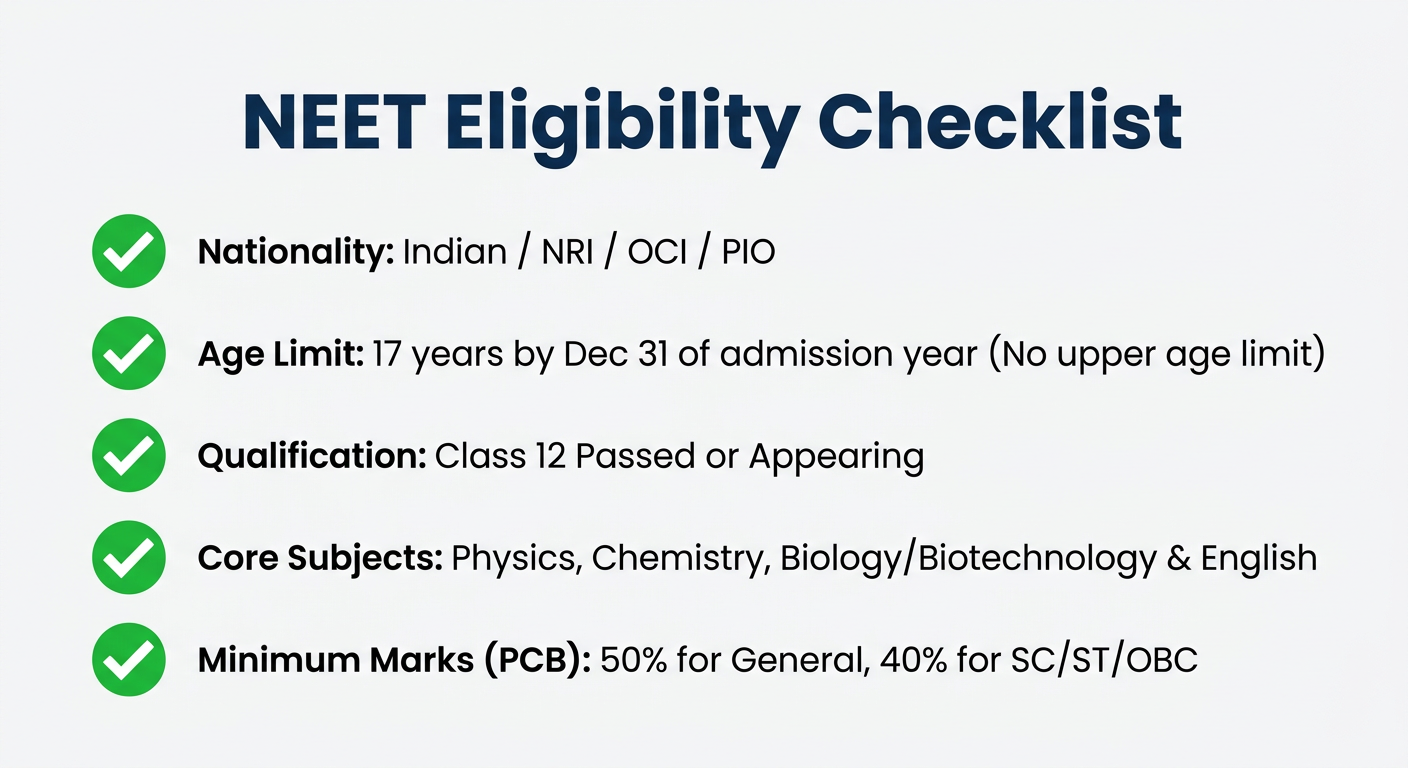 Before you dedicate years to preparation, the first step is to confirm your NEET eligibility. The criteria set by the NTA are strict, and you must meet every single one. Let's break them down into simple, easy-to-understand points.
Nationality and Domicile Rules Explained
This one is pretty straightforward. To be eligible for NEET (UG), you must be:
- An Indian Citizen
- A Non-Resident Indian (NRI)
- An Overseas Citizen of India (OCI)
- A Person of Indian Origin (PIO)
- A Foreign National
While all these categories can appear for the exam, the rules for admission, especially under state quotas, can vary. For the 15% All India Quota (AIQ) seats, eligibility is broad. However, for the 85% State Quota seats, you must fulfill the domicile requirements of the particular state you are applying to, which usually involves residency or schooling in that state for a specified period.
The Age Limit: Minimum and (No) Maximum
This is a common point of confusion. Let's clear it up.
Minimum Age: You must have completed 17 years of age at the time of admission or will complete that age on or before 31st December of the year of your admission. For example, for NEET 2025, you must be born on or before December 31, 2008.
Maximum Age: Here's the good news. As per a decision by the National Medical Commission (NMC), there is no upper age limit to appear for the NEET exam. This allows candidates of any age to attempt the exam, providing more flexibility for droppers or those changing careers.
Academic Qualifications: Your Class 12th Scorecard
Your performance in your Class 12 (or equivalent) board exams is a critical eligibility factor. Here’s what you need:
- You must have passed the Class 12 or equivalent examination from a recognized board.
- Students appearing for their Class 12 or equivalent exam in the year of the test are also eligible to apply provisionally.
But just passing isn't enough. You also need a minimum percentage of marks in Physics, Chemistry, and Biology/Biotechnology taken together:
- General/EWS Category: 50% minimum aggregate marks.
- OBC/SC/ST Category: 40% minimum aggregate marks.
- Persons with Disabilities (PwD) Category: 45% (for General-PwD) and 40% (for reserved-PwD) minimum aggregate marks.
Subject Requirements: The PCB Trinity
To be eligible for the NEET exam, you must have studied certain subjects in your qualifying examination (Class 12 or equivalent).
You must have passed Physics, Chemistry, and Biology/Biotechnology as core subjects. English is also a mandatory subject. The combination of Physics, Chemistry, and Biology (PCB) is the standard path for all medical aspirants. Students with Biotechnology instead of Biology are also eligible.
Number of Attempts: How Many Shots Do You Get?
Just like the age limit, there was previously a lot of confusion about the number of attempts allowed for NEET. The good news is that the restrictions have been removed.
As of now, there is no limit on the number of attempts for the NEET exam. As long as you meet the other eligibility criteria (like age and educational qualification), you can appear for the test as many times as you wish. This is a huge relief for students who may need a couple of drop years to secure a good rank.
The NEET Exam Pattern: Deconstructing the 720 Marks
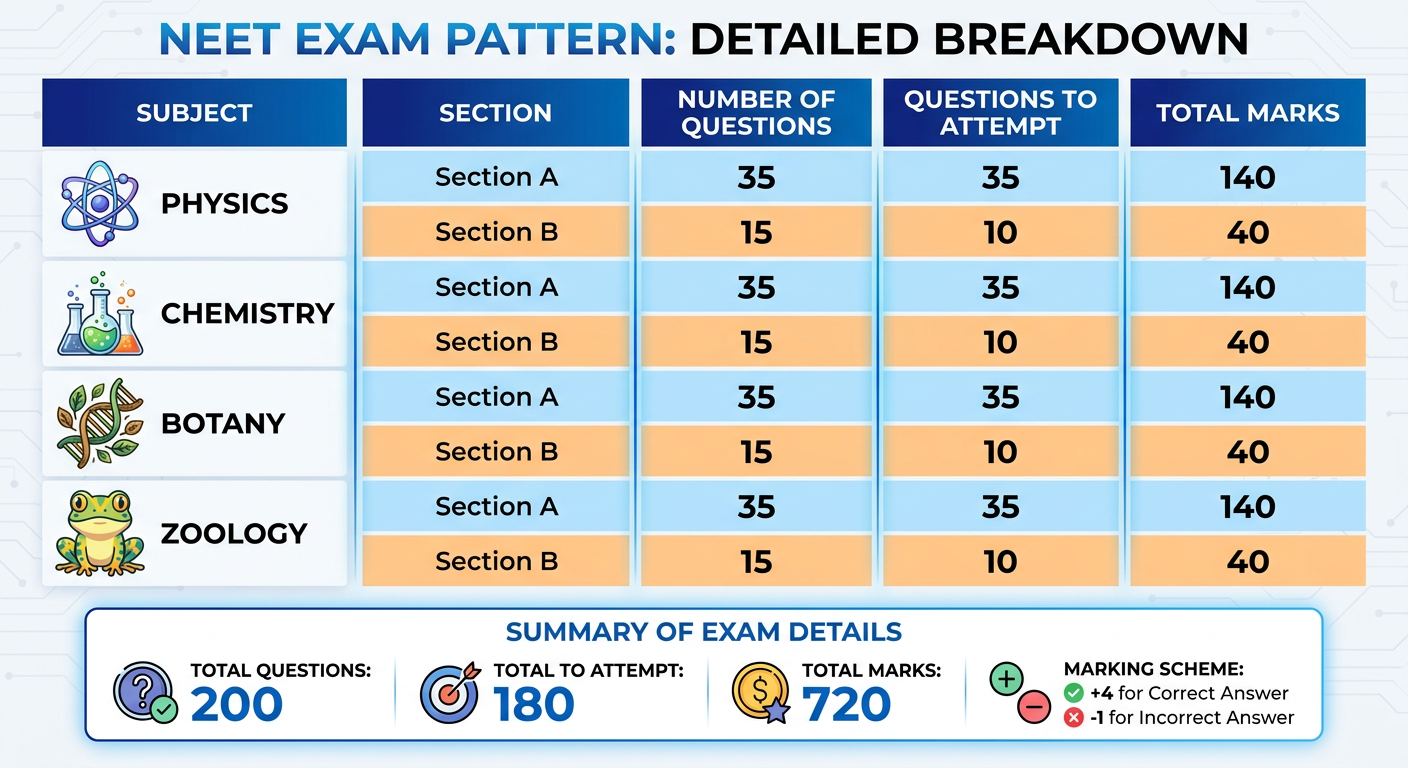 Understanding the NEET exam pattern is just as important as knowing the syllabus. It tells you the rules of the game: the number of questions, the time you have, and how you will be scored. Getting this right is fundamental to building a winning strategy.
Let's dissect the entire structure so you know exactly what you'll face on exam day.
Mode of Exam: Pen, Paper, and OMR Sheets
Despite the push for digitalization in many exams, the NEET (UG) exam is conducted in an offline, pen-and-paper mode. You will be given a question paper booklet and an Optical Mark Recognition (OMR) sheet.
You have to read the questions from the booklet and mark your chosen answer by darkening the corresponding circle on the OMR sheet using a ballpoint pen (usually provided at the center). This method requires a steady hand and careful marking, as improperly filled circles might not be read by the machine. Practice with OMR sheets is a must during your preparation.
Duration and Timings: The 200-Minute Marathon
The NEET exam is a test of knowledge, speed, and endurance. The total duration of the exam is 3 hours and 20 minutes, which is a total of 200 minutes.
During these 200 minutes, you need to attempt 180 questions. This breaks down to roughly 66 seconds per question, including reading, understanding, solving, and marking it on the OMR sheet. Time management is absolutely critical. The standard exam timing is usually from 2:00 PM to 5:20 PM, but you must always confirm this from your admit card.
Subject-wise Breakdown: Physics, Chemistry, Biology
The NEET exam paper is divided into three main subjects, with Biology further split into Botany and Zoology.
- Physics: 50 questions
- Chemistry: 50 questions
- Biology (Botany + Zoology): 100 questions
This gives a total of 200 questions in the paper. However, you don't have to answer all of them. This is where the concept of internal choice comes in, thanks to the two sections within each subject.
Section A vs. Section B: The Element of Choice
This is a relatively new feature in the NEET exam pattern, introduced to provide more flexibility. Each of the four subjects (Physics, Chemistry, Botany, Zoology) is divided into two sections:
- Section A: This section contains 35 compulsory questions. You have to attempt all of them. Each question carries 4 marks, for a total of 140 marks per subject's Section A.
- Section B: This section contains 15 questions, out of which you only need to attempt any 10. This internal choice is a huge strategic advantage. You can pick the 10 questions you are most confident about. If you attempt more than 10, only the first 10 answered questions will be evaluated. These 10 questions also carry 4 marks each, for a total of 40 marks.
This structure means that while the paper has 200 questions in total, you only have to answer 180. The NEET total marks are calculated based on these 180 attempted questions (180 questions x 4 marks/question = 720 marks).
The Marking Scheme: Every Mark Counts (+4, -1)
The NEET marking scheme is simple but unforgiving. It's designed to reward accuracy.
- For each correct answer: You are awarded +4 marks.
- For each incorrect answer: There is a penalty, and -1 mark is deducted from your total score.
- For unanswered or unattempted questions: No marks are awarded or deducted (0 marks).
This negative marking is what makes NEET so challenging. Guesswork can be very costly. It's often better to leave a question unanswered if you are unsure, rather than risking a negative mark. This is a key part of any good NEET preparation strategy.
Language Options: Taking the Test in Your Mother Tongue
To ensure accessibility for students from all over India, the NTA conducts the NEET exam in 13 different languages:
- English
- Hindi
- Assamese
- Bengali
- Gujarati
- Kannada
- Malayalam
- Marathi
- Odia
- Punjabi
- Tamil
- Telugu
- Urdu
You have to choose your preferred language for the question paper while filling out the application form. The choice is final and cannot be changed later. Candidates opting for English will get the test booklet in English only. Those opting for Hindi will get a bilingual booklet (English and Hindi). Candidates opting for regional languages will also get a bilingual booklet in their chosen language and English.
Mastering the NEET Syllabus: Your Blueprint for Success
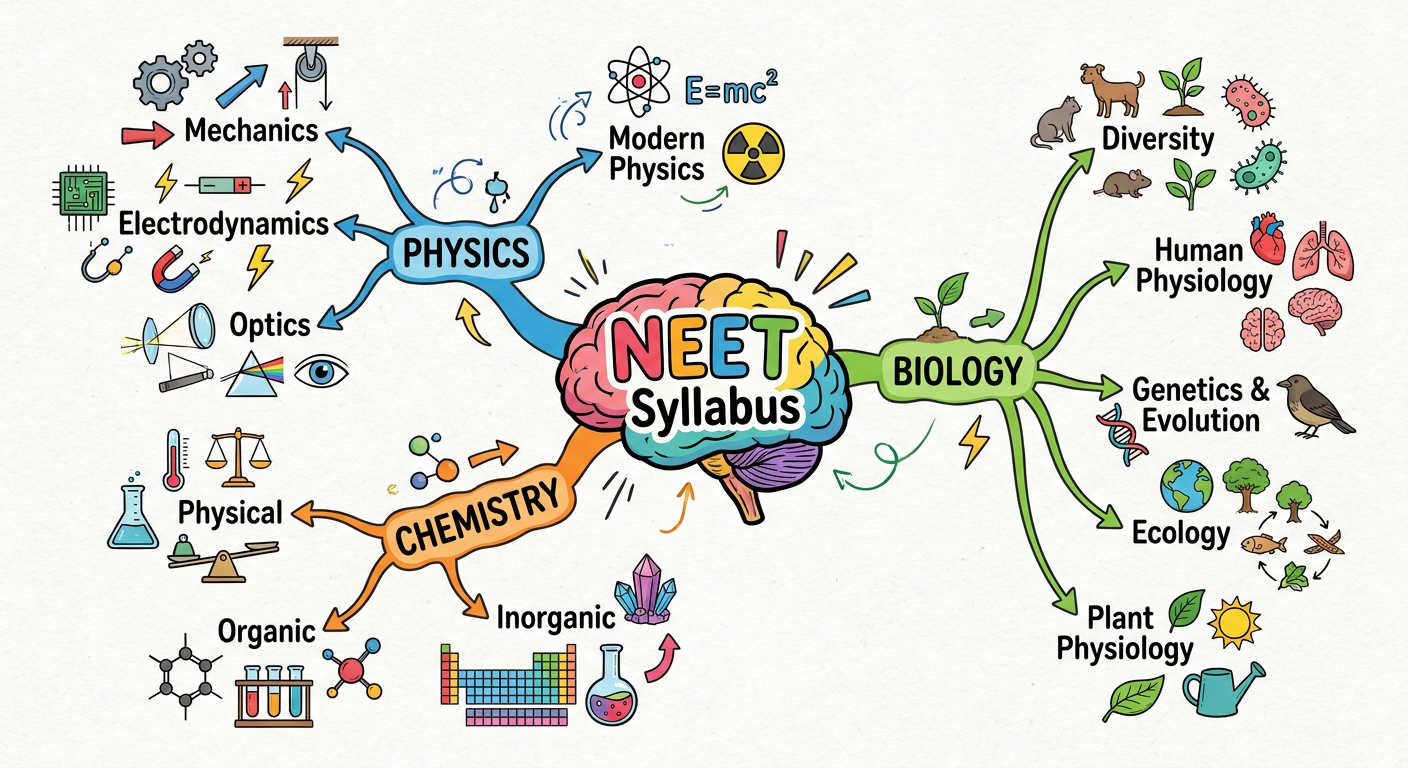 The NEET syllabus is the 'what' of your preparation. It defines the entire universe of topics from which questions can be asked. Knowing the syllabus inside and out isn't just about ticking off chapters; it's about understanding the scope, weightage, and depth required for each topic. The syllabus is prescribed by the National Medical Commission (NMC) and is largely based on the Class 11 and 12 curriculum of the CBSE.
The Core Philosophy: Why NCERT is King
If there is one golden rule for NEET preparation, it is this: NCERT is your Bible. The official syllabus is designed around the NCERT textbooks for Class 11 and 12. A vast majority of questions in the NEET exam, especially in Biology and Inorganic Chemistry, are directly derived from the lines, diagrams, and data within these books.
Before you even think about touching any reference book, you must master every single word of the NCERT textbooks. Read them multiple times, make notes, solve the in-text and exercise questions, and understand every diagram. This forms the unshakeable foundation of your preparation. You can find a complete breakdown on our JEE/NEET syllabus page.
Deep Dive into the Physics Syllabus
Physics is often the most feared subject for medical aspirants. It's calculation-intensive and requires strong conceptual understanding. The syllabus covers both Class 11 and 12 topics.
- Class 11 Physics: This forms the base. Key units include Physical World and Measurement, Kinematics, Laws of Motion, Work, Energy and Power, Motion of System of Particles and Rigid Body, Gravitation, Properties of Bulk Matter, Thermodynamics, and Oscillations and Waves. Mechanics and Thermodynamics are particularly high-weightage areas.
- Class 12 Physics: This section is crucial for scoring well. It includes Electrostatics, Current Electricity, Magnetic Effects of Current and Magnetism, Electromagnetic Induction and Alternating Currents, Electromagnetic Waves, Optics, Dual Nature of Matter and Radiation, Atoms and Nuclei, and Electronic Devices. Modern Physics and Electrodynamics often contribute a significant number of questions.
For Physics, it's not enough to just read theory. You must solve a large number of numerical problems to build speed and accuracy. Start with solved examples, then move to exercises and previous year questions.
Unpacking the Chemistry Syllabus
Chemistry in NEET is a balanced mix of conceptual understanding, memorization, and problem-solving. It's divided into three sections.
- Physical Chemistry: This is the numerical-heavy part of Chemistry. Important chapters include Some Basic Concepts of Chemistry, Structure of Atom, States of Matter, Thermodynamics, Equilibrium, Redox Reactions, Solutions, Electrochemistry, and Chemical Kinetics. Practice is key here.
- Inorganic Chemistry: This section is heavily based on NCERT. It requires memorization of trends, properties, reactions, and structures. Key chapters are Classification of Elements and Periodicity, Chemical Bonding and Molecular Structure, Hydrogen, s-Block Elements, p-Block Elements, d and f Block Elements, and Coordination Compounds. Make concise notes and revise them frequently.
- Organic Chemistry: This section requires a deep understanding of reaction mechanisms. Start with General Organic Chemistry (GOC) to build a strong foundation. Important chapters include Hydrocarbons, Haloalkanes and Haloarenes, Alcohols, Phenols and Ethers, Aldehydes, Ketones and Carboxylic Acids, Organic Compounds Containing Nitrogen, and Biomolecules. Focus on understanding how reactions happen, not just memorizing them.
Conquering the Biology Syllabus
Biology is the highest-scoring subject in NEET, accounting for 360 out of 720 marks. Your aim should be to maximize your score here. The questions are almost exclusively from NCERT.
- Class 11 Biology (Botany & Zoology): The five units are Diversity in Living World, Structural Organisation in Plants and Animals, Cell Structure and Function, Plant Physiology, and Human Physiology. Human Physiology and Plant Physiology are extremely important and high-yield units.
- Class 12 Biology (Botany & Zoology): The five units here are Reproduction, Genetics and Evolution, Biology and Human Welfare, Biotechnology and its Applications, and Ecology and Environment. The Genetics and Evolution unit, along with Biotechnology, carries immense weightage and requires crystal-clear concepts.
For Biology, your strategy should be to read NCERT like a storybook, again and again. Pay special attention to diagrams, scientist names, dates, and data tables. Many questions are framed directly from these elements.
Has the Syllabus Changed Recently? Staying Updated
Yes, for NEET 2024, the NMC released a revised, rationalized syllabus. Several topics and a few chapters that were part of the old NCERT books but were removed from the new ones were officially deleted from the NEET syllabus. However, some new topics were also added, especially in the practical chemistry section.
It is absolutely crucial to base your preparation on the latest official syllabus released by the NTA/NMC. Don't rely on old information. Always download the latest syllabus PDF from the official website to ensure you're not wasting time on deleted topics or missing out on newly added ones.
The Application Journey: Your Step-by-Step Registration Guide
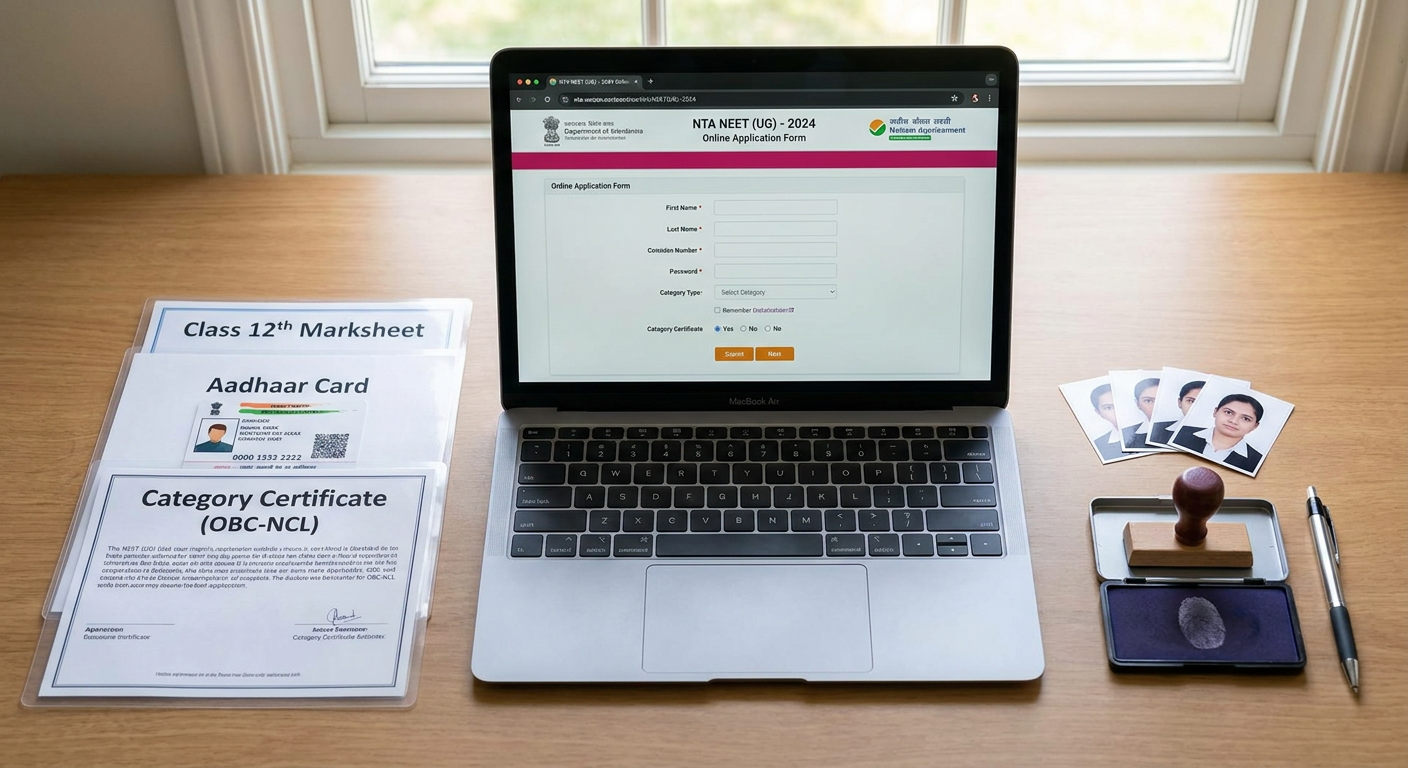 Knowing the syllabus and exam pattern is one thing; successfully applying for the exam is another. The NEET registration process is a critical step that must be done with utmost care. A small mistake here can lead to big problems later, even disqualification. This section provides a detailed walkthrough to ensure a smooth application process.
When to Apply: Tracking the Notification
The NEET application window is typically open for about a month. The official notification, containing the information bulletin and application dates, is usually released by the NTA a few months before the exam date. For NEET 2025, you can expect the forms to be available around February-March 2025.
Your first task is to keep a close eye on the official NTA NEET website: https://neet.nta.nic.in/. All announcements are made here. Bookmark the site and check it regularly once you enter the application season. Don't fall for fake news or rumours on social media.
Documents You'll Need: Get Them Ready!
Before you sit down to fill the form, gather all the required documents and information. This will save you a lot of time and prevent last-minute panic.
Here's a checklist of things you'll typically need:
- A valid mobile number and a personal email ID. All communication from NTA will be sent here.
- Aadhaar card or other valid Government ID proof.
- Class 10 and Class 12 mark sheets and certificates.
- Scanned copy of a recent passport-sized photograph (with white background and 80% face coverage).
- Scanned copy of your signature (on white paper with a black pen).
- Scanned copy of your left and right-hand fingers and thumb impressions.
- Scanned copy of a postcard-sized photograph (4"x6").
- Category certificate (SC/ST/OBC/EWS), if applicable.
- PwD certificate, if applicable.
The NTA provides very specific guidelines for the size, format (JPG/JPEG), and dimensions of these scanned documents. Read the information bulletin carefully and prepare your files accordingly.
The Online Application Form: A Detailed Walkthrough
The application process is entirely online and usually involves these steps:
- Registration: Visit the official website and click on the 'NEET (UG) 2025 Registration' link. You'll need to provide basic details like your name, parents' names, date of birth, mobile number, and email ID to generate a login ID and password.
- Filling the Application Form: Log in with your new credentials and fill in the detailed application form. This will include personal details, educational qualifications (Class 10 and 12 marks), choice of exam cities (you usually get to choose four cities in order of preference), and details about your parents/guardians.
- Uploading Scanned Documents: This is the step where you upload the scanned images of your photograph, signature, and thumb impressions that you prepared earlier. Use the NTA's specifications to avoid rejection.
Take your time and double-check every single entry before proceeding. Your name, date of birth, and parents' names should match exactly with your Class 10 certificate.
Paying the Application Fee
After filling the form and uploading documents, the final step is to pay the application fee. The payment can only be made online through Net Banking, Credit Card, Debit Card, or UPI.
The fee varies by category. For NEET 2024, the fees were approximately:
- General: ₹1700
- General-EWS/OBC-NCL: ₹1600
- SC/ST/PwD/Third Gender: ₹1000
- For candidates outside India: Varies, often around ₹9500
These are indicative figures; always check the latest information bulletin for the exact amount. Your application is considered incomplete until the fee payment is successful. Make sure you save and print the confirmation page after the payment is done.
The Correction Window: Your Second Chance
NTA understands that mistakes can happen. After the main application window closes, they usually open a 'Correction Window' for a few days.
During this period, you can log in and edit certain fields in your application form. However, not all details can be changed. Critical information like mobile number, email ID, and permanent address are usually locked. This is a final opportunity to correct any errors you might have made in your name, category, or academic details. Use it wisely, but the best approach is to be careful in the first place.
NEET Preparation Strategy: From Zero to Hero
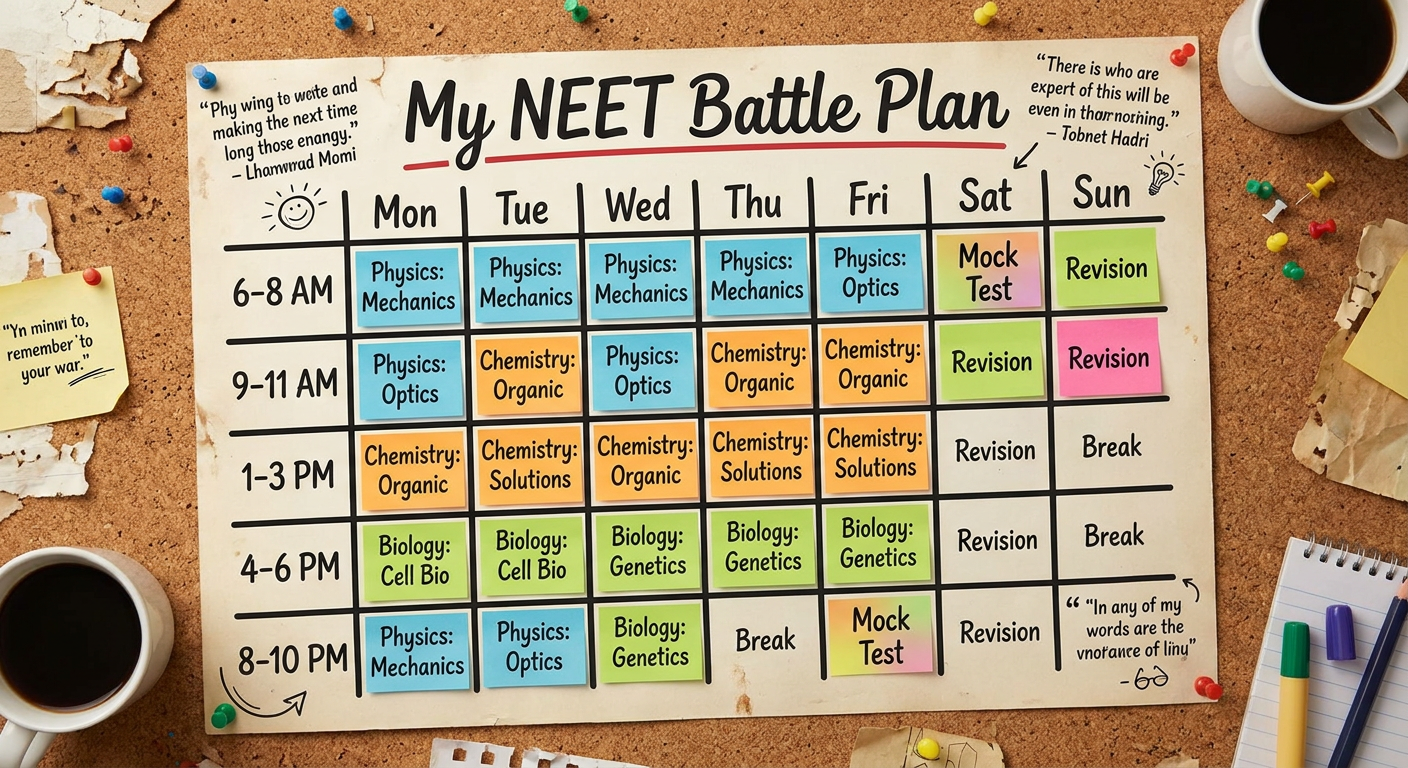 With a clear understanding of the exam, it's time to talk about the most important part: the NEET preparation itself. Cracking the NEET exam is not just about studying hard; it's about studying smart. It requires a disciplined approach, the right resources, and a resilient mindset. Here’s a blueprint to guide your journey.
Building a Realistic Timetable
A timetable is your personal battle plan. It brings structure to your study and ensures all subjects get the attention they deserve. A good timetable is balanced, realistic, and has room for flexibility.
- Balance Subjects: Don't just study your favorite subject. Allocate daily or weekly hours to Physics, Chemistry, and Biology. A common strategy is to study two or three subjects each day. For example, a heavy subject like Physics can be paired with a memory-based one like Biology.
- Mix Theory and Practice: Your schedule should have dedicated slots for learning new concepts (theory), solving problems (practice), and revising old topics. A cycle of Learn-Practice-Revise is highly effective.
- Include Breaks: Studying for 8-10 hours straight is counterproductive. Take short 10-15 minute breaks every 1.5-2 hours. Also, schedule time for hobbies, exercise, and adequate sleep. A healthy mind resides in a healthy body.
The Best Books Beyond NCERT
While NCERT is the foundation, you will need reference books for deeper understanding and extensive practice, especially in Physics and Physical Chemistry.
- Physics: Concepts of Physics by H.C. Verma is excellent for building concepts. For problem-solving, D.C. Pandey's Objective Physics is a popular choice among toppers.
- Chemistry: For Physical Chemistry, N. Avasthi is great for numerical practice. For Organic Chemistry, M.S. Chouhan can help you master reaction mechanisms. For Inorganic Chemistry, stick to NCERT and solve past year papers; it is more than enough.
- Biology: NCERT is supreme. For extra practice, you can use books like Trueman's Elementary Biology or solve objective questions from any standard MCQ book, but always prioritize NCERT content.
Remember, don't hoard books. Stick to one or two standard reference books per subject, along with NCERT. Using too many resources will only lead to confusion.
The Power of Mock Tests and PYQs
This is the most critical part of your preparation. Mock tests and Previous Year Questions (PYQs) simulate the real exam environment and provide the best reality check of your preparation level.
- Previous Year Questions (PYQs): Solving previous year questions helps you understand the exam pattern, the difficulty level, and the high-weightage topics. It's the most authentic source of practice questions. Aim to solve the last 10-15 years' papers multiple times.
- Mock Tests: Join a good test series and give mock tests regularly, especially in the last 3-4 months. Take these tests seriously, in a timed, exam-like environment. The goal isn't just to score marks, but to analyze your performance. After each test, spend hours analyzing your mistakes. Identify weak areas, conceptual errors, and silly mistakes. This analysis is where the real learning happens.
Effective Revision Techniques
With a vast syllabus, revision is the key to retention. Forgetting is natural; regular revision is the solution.
- Spaced Repetition: Don't revise a chapter just once. Revise it after a day, then after a week, then after a month. This technique helps transfer information from short-term to long-term memory.
- Active Recall: Instead of just re-reading a chapter, close the book and try to recall all the key concepts and formulas. This active process strengthens neural connections.
- Short Notes & Formula Sheets: Maintain a separate notebook for short notes, formulas, and important reactions. These will be your best friend for quick revision in the final days before the exam. You can find ready-made formula sheets in our resources section to get you started.
Subject-Specific Strategies
Each subject in NEET demands a different approach.
- Physics: Focus on concepts first, then practice. Don't be afraid of the math. Start with easy problems and gradually increase the difficulty. Maintain a formula logbook.
- Chemistry: For Physical, practice numericals. For Inorganic, make flashcards and use mnemonics to remember trends and facts. For Organic, practice reaction mechanisms until they become second nature.
- Biology: Read NCERT multiple times. Underline key points. Pay close attention to diagrams and their labels. Practice MCQs to train your brain to spot details, as questions are often framed from specific lines in the book.
Understanding Scores, Ranks, and Cut-offs
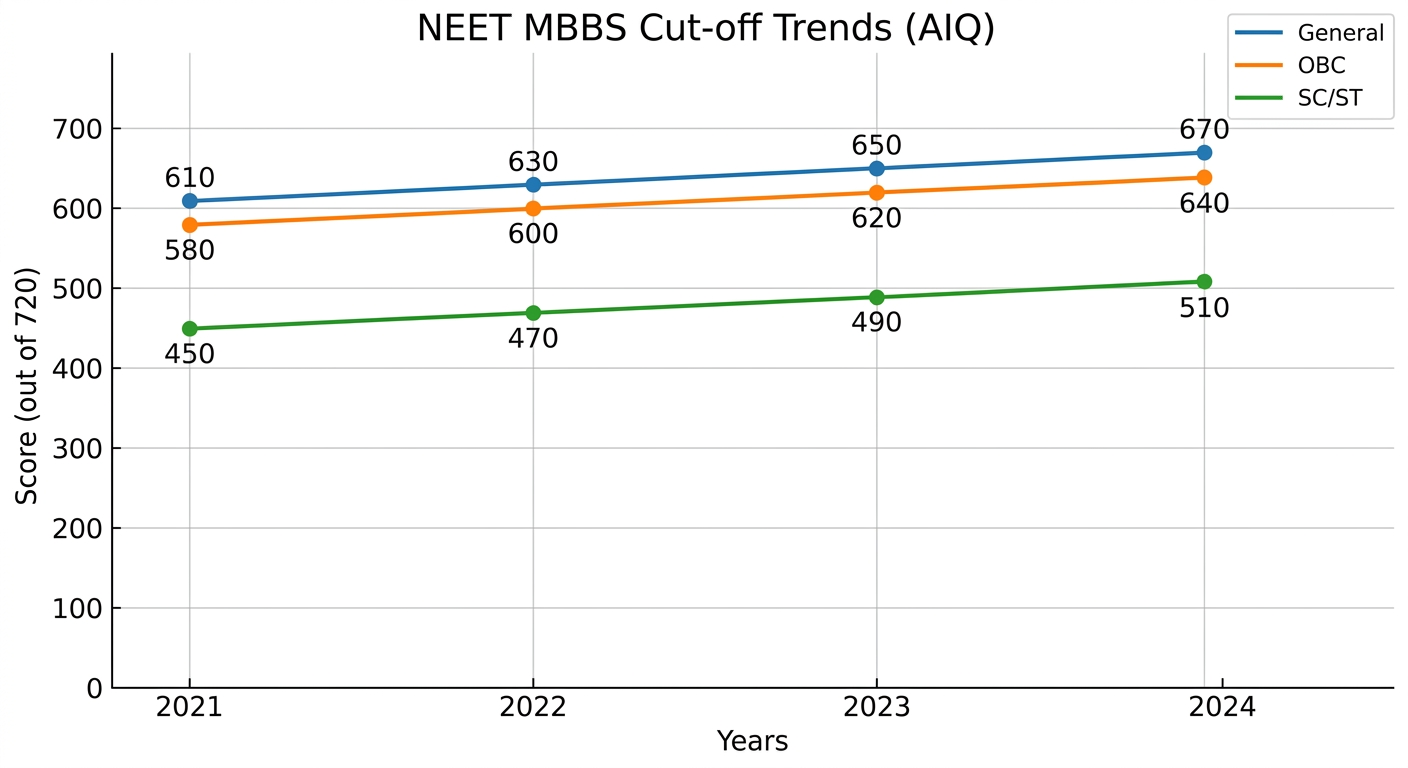 After the exam is over, the focus shifts entirely to results, ranks, and the all-important NEET cut off. Understanding how your score translates into a rank and what kind of score is needed for a government medical college is crucial for managing expectations and navigating the counselling process.
How Your Raw Score Becomes a Rank
Your raw score is simply the total marks you obtain out of 720, based on the +4/-1 marking scheme. However, your admission is not based on your score but on your All India Rank (AIR).
The NTA prepares the merit list by arranging all candidates in descending order of their scores. If two or more candidates obtain the same score (a tie), the NTA uses a tie-breaking policy to assign ranks. The policy usually prioritizes:
- Candidate with higher marks/percentile in Biology.
- If the tie persists, candidate with higher marks/percentile in Chemistry.
- If the tie persists, candidate with higher marks/percentile in Physics.
- If the tie still persists, candidate with fewer incorrect answers.
This process ensures every single student gets a unique All India Rank.
What is a "Good Score" in NEET?
This is a subjective question, but we can define it based on goals. A "good score" is one that gets you a seat in your desired college.
- For a Government MBBS Seat (All India Quota): This is highly competitive. For a general category student, a score of 610-620+ is generally considered safe for securing a seat through the 15% AIQ. For top colleges like AIIMS Delhi, MAMC Delhi, etc., you need to be in the 700+ range.
- For a Government MBBS Seat (State Quota): The cut-off varies significantly from state to state. In highly competitive states like Delhi, Rajasthan, and Kerala, the cut-off can be as high as the AIQ cut-off. In other states, it might be slightly lower, perhaps in the 580-600 range for the general category.
- For Government BDS/AYUSH Seats: The cut-offs are generally lower than for MBBS. A score in the range of 550-580 might be sufficient for a government BDS seat.
These are just estimates and can change every year. Your goal should always be to maximize your score, aiming for 650+ to be on the very safe side.
NEET Cut Off: Qualifying vs. Admission
It's important to understand the difference between the qualifying cut-off and the admission cut-off.
- Qualifying Cut-off: This is the minimum score (or percentile) you need to be eligible to participate in the counselling process. It is announced by the NTA along with the results. It is usually set at the 50th percentile for the General category and the 40th percentile for reserved categories. Clearing this does not guarantee a seat.
- Admission Cut-off: This is the last rank (or score) at which a student was admitted to a particular college in a particular category. This is the 'real' cut-off that determines your admission. It is only known after the counselling process is completed.
Analyzing Past Years' Cut-off Trends
Looking at the cut-off trends from previous years gives you a realistic target. You'll notice that the cut-off for government MBBS seats has been steadily rising over the years. This is due to an increasing number of aspirants and better preparation levels.
For example, a score of 580 might have been enough for an AIQ seat a few years ago, but today it might not be. This upward trend emphasizes the need to aim higher each year. You can find detailed cut-off lists for various colleges on official counselling websites and educational portals.
Factors that Influence the Cut-off Each Year
The cut-off is not a fixed number; it's dynamic and changes every year based on several factors:
- Difficulty level of the NEET exam: A tougher paper usually leads to a lower cut-off, and an easier paper leads to a higher one.
- Total number of candidates: More candidates mean more competition, which can push the cut-off up.
- Total number of seats available: An increase in the number of MBBS/BDS seats can lead to a slightly lower cut-off.
- Overall performance of candidates: If the top performers score exceptionally high, it tends to pull the entire cut-off range upwards.
The Final Frontier: NEET Counselling Explained
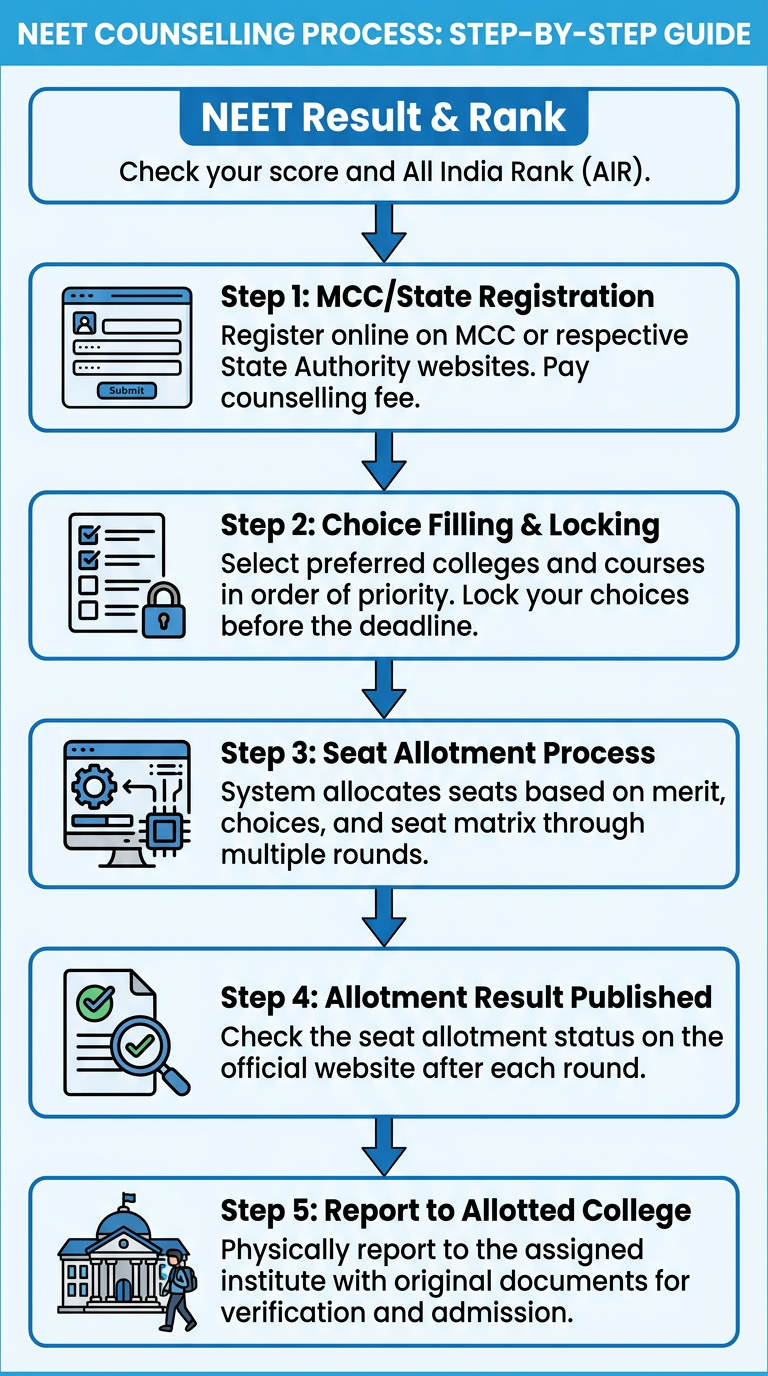 Scoring well in the NEET exam is only half the battle won. The next crucial phase is the NEET counselling, which is the process through which you are allotted a medical seat based on your rank, choices, and category. It can seem complex, but understanding the basics will help you navigate it successfully.
All India Quota (AIQ) vs. State Quota
The medical seats in India are broadly divided into two main quotas:
- 15% All India Quota (AIQ): 15% of the total seats in all government medical colleges (except those in Jammu & Kashmir) are reserved for the AIQ. Any student from any state can apply for these seats based on their All India Rank. This allows a student from, say, Maharashtra to get a seat in a college in West Bengal.
- 85% State Quota: The remaining 85% of seats in government medical colleges within a state are reserved for students who fulfill that state's domicile criteria. The counselling for these seats is conducted separately by the respective state medical authorities.
Additionally, all seats in Deemed Universities, Central Universities (like AMU, BHU), and AIIMS/JIPMER are filled through the AIQ counselling process.
The Role of the MCC (Medical Counselling Committee)
The counselling for the 15% All India Quota, as well as for Deemed/Central Universities, AIIMS, and JIPMER, is conducted by the Medical Counselling Committee (MCC) of the Directorate General of Health Services (DGHS).
The MCC is the central body that manages the entire online counselling process, from registration to seat allotment. You need to register on the MCC website to participate in this counselling. For the 85% State Quota seats, each state has its own counselling authority (e.g., KEA for Karnataka, DMER for Maharashtra).
The Counselling Process: Registration, Choice Filling, and Seat Allotment
The MCC counselling process is typically conducted online in several rounds (Round 1, Round 2, Mop-up Round, Stray Vacancy Round). Here are the general steps:
- Registration: Eligible candidates must register on the MCC portal by paying a non-refundable registration fee and a refundable security deposit.
- Choice Filling and Locking: This is the most important step. You have to fill in your choices of colleges and courses in order of your preference. You can fill in as many choices as you want. Be very careful with your preference order. After filling, you must lock your choices. If you don't, they are automatically locked at the deadline.
- Seat Allotment: Based on your rank, the choices you filled, your category, and seat availability, the MCC's software will allot you a seat. The results are published online.
- Reporting to College: If you are allotted a seat and you are happy with it, you must report to the allotted college within the specified dates with all your original documents to complete the admission formalities.
If you are not allotted a seat in Round 1 or wish to upgrade, you can participate in subsequent rounds of counselling.
Important Documents for Counselling
When you go to the allotted college for admission, you will need a set of original documents for verification. It's wise to prepare multiple attested photocopies of these as well.
The essential list includes:
- NEET Admit Card
- NEET Scorecard or Rank Letter
- Class 10 Certificate and Mark Sheet (for date of birth proof)
- Class 12 Certificate and Mark Sheet
- ID proof (Aadhaar/PAN/Passport)
- Eight passport-sized photographs (same as the one on the application form)
- Provisional Allotment Letter (downloaded from the MCC website)
- Category Certificate (if applicable)
- Domicile Certificate (for State Quota)
Missing any of these documents can lead to the cancellation of your admission, so be extremely organized. This is the final step in a long journey. Prepare well for it, and soon you'll be starting your life as a medical student. For more help, you can always connect with peers and seniors in our student community groups.
FAQs
What is the full form of NEET?
NEET stands for the National Eligibility cum Entrance Test. It is the single, uniform entrance exam conducted for admission to most undergraduate medical (MBBS), dental (BDS), and AYUSH courses in India.
How many times can I attempt the NEET exam?
There is no limit on the number of attempts for the NEET exam. As long as you meet the age and educational eligibility criteria, you can appear for the test as many times as you need to achieve your desired score and rank.
Is the NEET exam difficult to crack?
NEET is considered one of the most competitive exams in India due to the vast syllabus and the huge number of aspirants (over 20 lakh) competing for a limited number of seats. However, with consistent effort, a smart strategy, and the right guidance, it is very much crackable. The difficulty lies more in the competition than in the complexity of the questions themselves.
What is a good score in NEET for a government college?
A 'good score' depends on your category and the state you are applying to. For a general category student, a score above 620 out of 720 is generally considered safe for securing a government MBBS seat through the All India Quota. For top-tier colleges, you would need to score above 700.
Can I prepare for NEET and my Class 12 Boards together?
Yes, absolutely. The syllabus for NEET is based on the Class 11 and 12 curriculum, primarily NCERT. By thoroughly preparing your board exam subjects (Physics, Chemistry, Biology), you are simultaneously covering a huge portion of the NEET syllabus. The key is to supplement your board preparation with objective question practice and mock tests from the beginning.
Are NCERT books enough for the NEET exam?
NCERT books are the most important resource for NEET, especially for Biology and Inorganic Chemistry, from which a majority of questions are directly asked. However, for Physics and Physical Chemistry, while NCERT is essential for building concepts, it's highly recommended to use additional reference books for in-depth problem-solving practice to build the speed and application skills required for the exam.