JEE Main 2027 Registration: Application Form Expected Soon - Allen
Your complete guide to the JEE Main exam. Understand the eligibility, exam pattern, syllabus, application process, and winning preparation strategy for India's biggest engineering entrance test.
16 min read
JEE Main: The Ultimate Guide to India's Biggest Engg Exam
Remember Rancho from '3 Idiots'? That burning curiosity, the passion for engineering, and the dream of making it to a top college. For millions of students across India, that dream begins with a single, monumental challenge: the Joint Entrance Examination. It's the first major battle in the war for a coveted engineering seat. And the gateway to this entire world is the JEE Main exam.
But what is this exam really about? Is it just about mugging up formulas? Or is there a smarter way to crack it? If you're a student (or a parent) feeling overwhelmed by the sheer volume of information, you've come to the right place. This is your one-stop, A-to-Z guide. We'll break down everything from eligibility and exam pattern to a foolproof preparation strategy, cutting through the noise and giving you the clarity you need to succeed.
What Exactly is the JEE Main Exam?
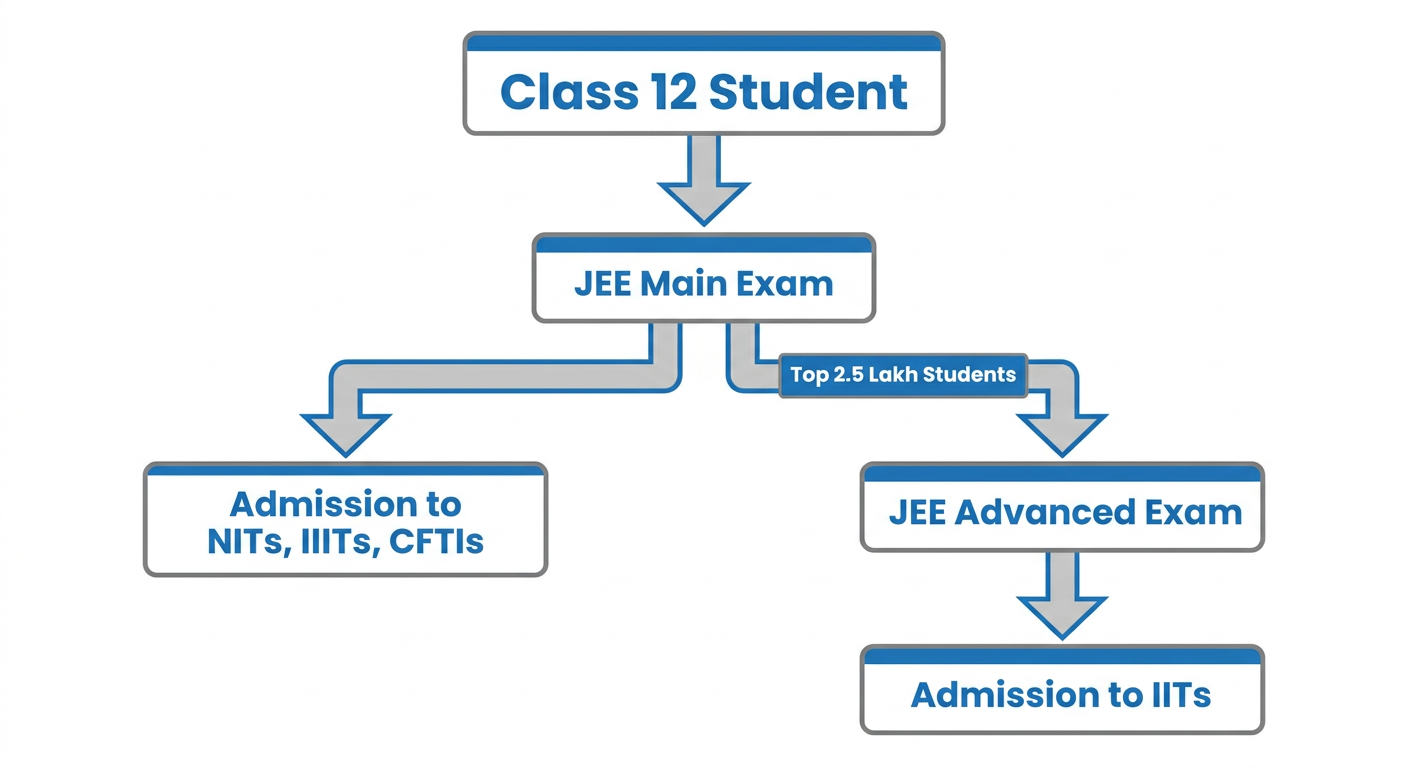
Let's start with the basics. JEE Main stands for Joint Entrance Examination – Main. It's a national-level entrance test conducted by the National Testing Agency (NTA). Think of it as the great qualifier. This single exam serves two massive purposes.
First, it is the direct admission gateway to some of the country's best engineering colleges. These include the National Institutes of Technology (NITs), Indian Institutes of Information Technology (IIITs), and other Centrally Funded Technical Institutes (CFTIs).
Second, and for many, its most critical role, is that it acts as the screening test for JEE Advanced. If you dream of studying at an Indian Institute of Technology (IIT), you MUST first clear the JEE Main exam and rank among the top candidates. There is no other way to get a ticket to sit for the JEE Advanced exam.
The exam is typically conducted in two sessions, usually in January and April. This is a huge advantage for students. You can attempt both, and your best score of the two will be considered for your final rank. This gives you a chance to test the waters, learn from your mistakes, and significantly improve your performance.
JEE Main Eligibility Criteria: Can You Appear for the Exam?
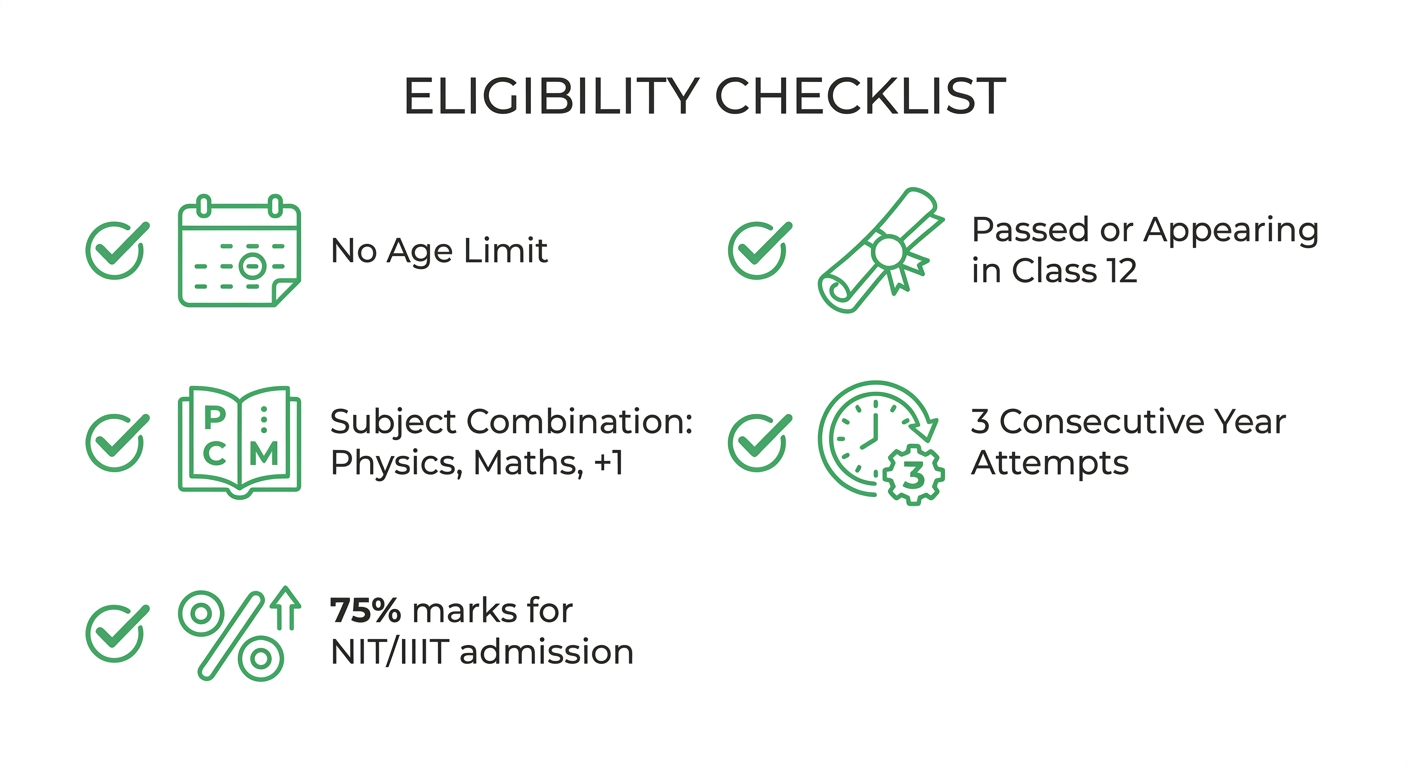
Before you dive into preparation, it's crucial to know if you're even eligible to write the exam. The JEE Main eligibility criteria set by the NTA are quite specific. Let's break them down into simple, easy-to-understand points.
Age Limit Good news! There is no age limit for appearing in the JEE Main. As long as you meet the educational qualifications, you can apply.
Qualifying Examination (QE) A candidate must have passed their Class 12 or equivalent examination. This includes final exams from boards like CBSE, ICSE, and various state boards. Students appearing for their Class 12 board exams in the current academic year are also eligible to apply.
Year of Passing Class 12 You can attempt the JEE Main for three consecutive years starting from the year you pass your Class 12 exam. For example, for JEE Main 2025, students who passed Class 12 in 2023, 2024, or are appearing in 2025 will be eligible.
Required Subjects in Class 12 For the B.E./B.Tech paper, you must have passed your Class 12 exam with Physics and Mathematics as compulsory subjects. Alongside these, you need one subject from Chemistry, Biotechnology, Biology, or a Technical Vocational subject.
The 75% Criteria (for Admission) This is a common point of confusion. To be eligible for admission into NITs, IIITs, and CFTIs through the central counselling (JoSAA/CSAB), a candidate must have secured at least 75% aggregate marks in their Class 12 board exam (or be in the top 20 percentile of their board). For SC/ST candidates, this is relaxed to 65%. Remember, this is for admission, not for appearing in the JEE Main itself. You can still write the exam and qualify for JEE Advanced even if you don't meet this specific criterion.
Understanding the JEE Main Exam Pattern
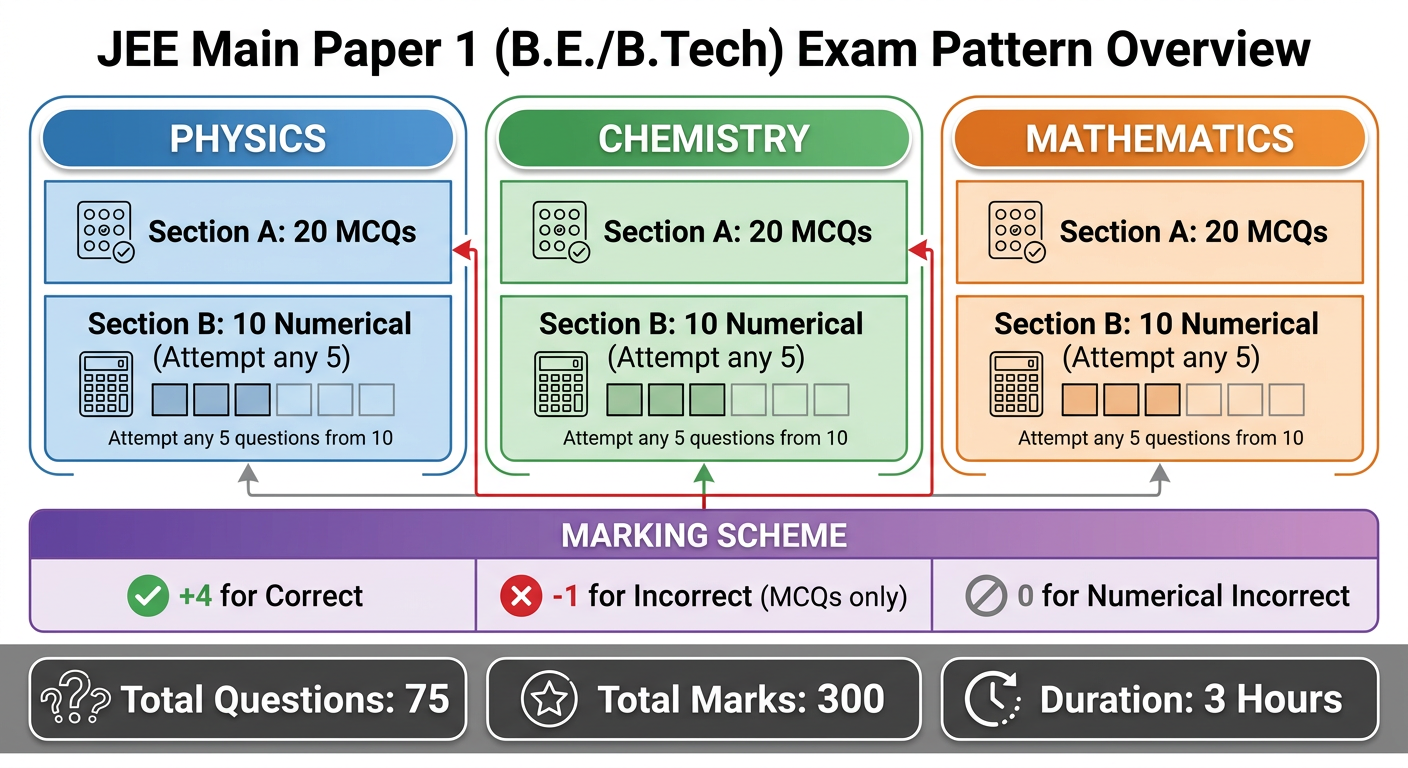
The JEE Main exam pattern is the blueprint of the question paper. Knowing it inside-out is key to building an effective strategy. There are three papers conducted under JEE Main, but we'll focus primarily on Paper 1, which is for B.E./B.Tech aspirants.
Paper 1 (B.E./B.Tech) This is the paper that over 95% of students appear for.
- Mode of Exam: It's a fully Computer-Based Test (CBT). You'll answer questions on a computer at a designated exam centre.
- Subjects: Physics, Chemistry, and Mathematics.
- Number of Questions: Each subject has 30 questions. These are split into two sections:
- Section A: 20 Multiple-Choice Questions (MCQs).
- Section B: 10 Numerical Value Questions, out of which you must attempt any 5. Your answers will be a numerical value that you type in.
- Total Questions: You have to attempt a total of 75 questions (25 per subject).
- Marking Scheme: For MCQs, you get +4 marks for a correct answer and -1 for an incorrect answer. For Numerical Value questions, you get +4 for a correct answer, and there is no negative marking for incorrect answers. This makes attempting the numerical questions a great strategic move.
- Total Marks: 300 Marks (100 per subject).
- Duration: 3 hours (180 minutes).
For students interested in architecture or planning, Paper 2A (B.Arch) and Paper 2B (B.Planning) have different structures, including a drawing test for B.Arch that is conducted offline.
Decoding the JEE Main Syllabus
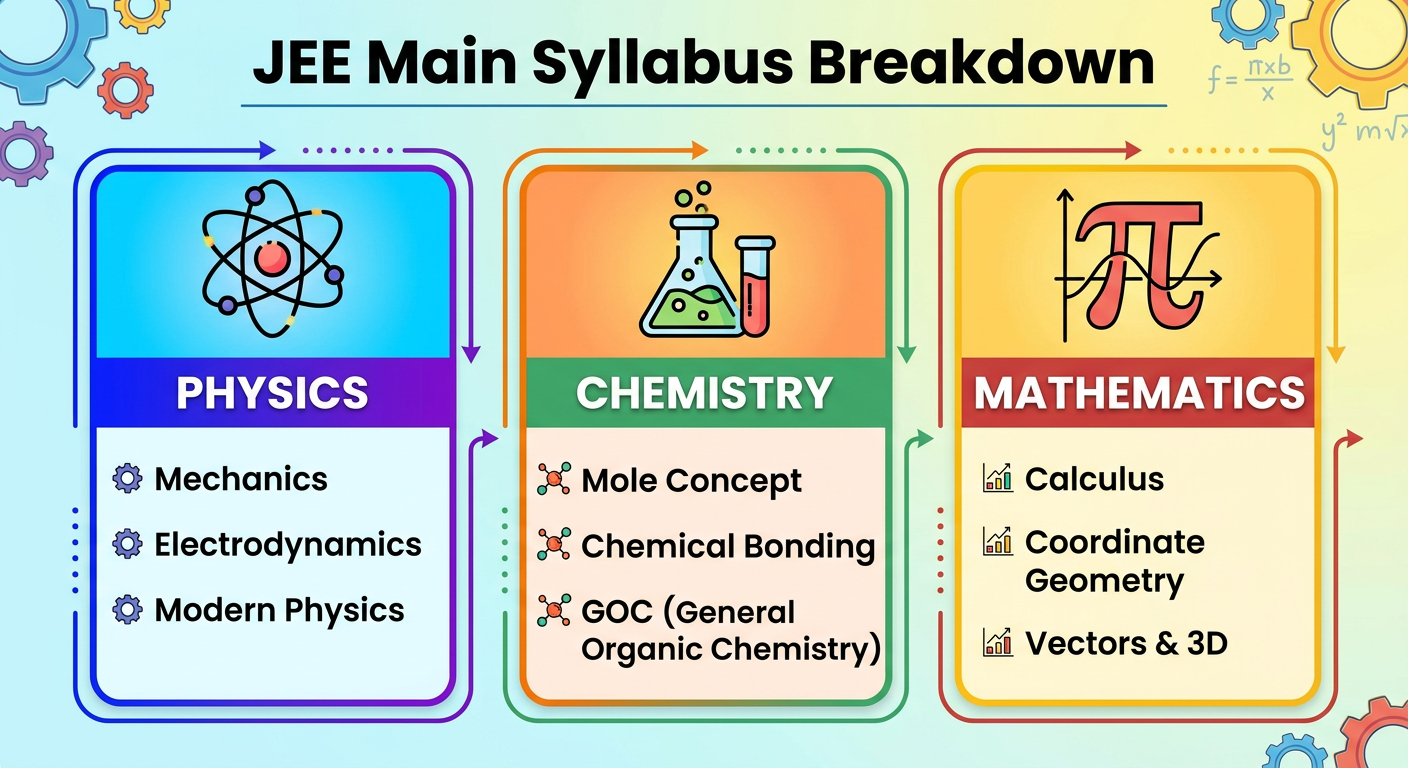
The JEE Main syllabus is vast, covering the curriculum of both Class 11 and Class 12 from boards like CBSE. The NTA releases the official syllabus document on its website, which is the ultimate source of truth. It's crucial to download and stick to the latest version, as there can be minor changes from year to year.
For a detailed, chapter-wise breakdown, you can always check our updated JEE syllabus page. But to give you a broad overview, here are some of the high-weightage areas you absolutely cannot ignore:
Physics: The syllabus is a mix of theory and numericals. Key areas include Mechanics (everything from Kinematics to Rotational Motion), Electrodynamics (Electrostatics, Magnetism, EMI), Modern Physics (Dual Nature, Atoms, Nuclei), and Optics. Conceptual clarity is paramount here.
Chemistry: Often considered the most scoring subject in NTA JEE Main. It's divided into three parts. Physical Chemistry (Mole Concept, Thermodynamics, Equilibrium) is numerical-heavy. Organic Chemistry (General Organic Chemistry, Hydrocarbons, Aldehydes & Ketones) requires a deep understanding of reaction mechanisms. Inorganic Chemistry (Chemical Bonding, Coordination Compounds, p-Block elements) relies heavily on memorization directly from the NCERT textbook.
Mathematics: This subject is all about practice and problem-solving speed. The most important units are Calculus (Limits, Differentiation, Integration), Coordinate Geometry (Straight Lines, Circles, Conics), and Algebra, especially Vectors and 3D Geometry. Mastering these can give you a massive edge.
One common mistake is to skip chapters that seem difficult or have less weightage. Don't do it. The JEE Main often features easy questions from these 'unimportant' chapters, which are essentially free marks if you've covered the basics.
The JEE Main Application Form and Registration Process
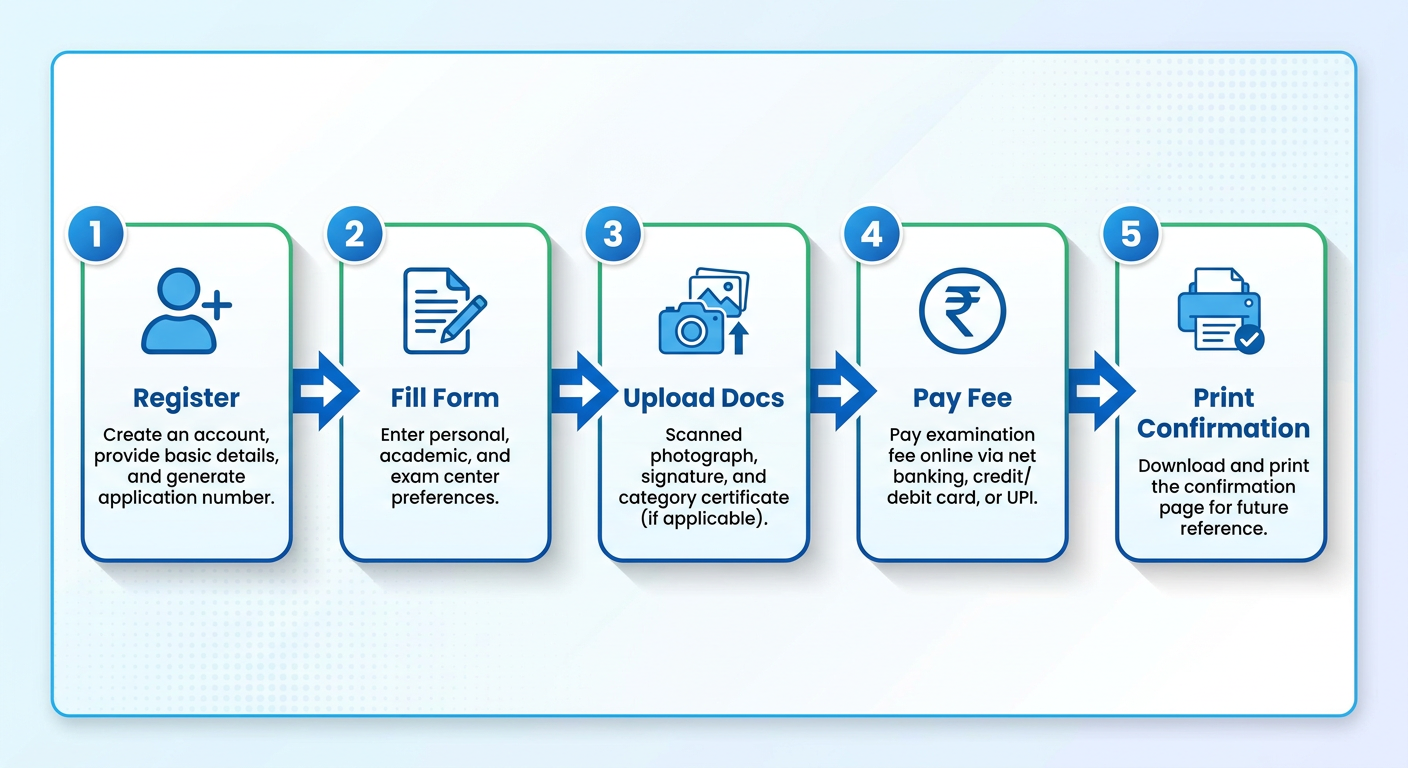
Filling out the JEE Main application form correctly is the first administrative step in your journey. The process is entirely online and happens through the official NTA website. It's a straightforward process, but you need to be very careful to avoid any errors.
Here’s a typical step-by-step guide to the registration process:
-
New Candidate Registration: First, visit the official JEE Main website, which is jeemain.nta.nic.in. You'll need to create your login credentials by providing basic details and setting up a password. Your application number will be generated here.
-
Fill the Application Form: Log in with your application number and password. You will then need to fill out a detailed form asking for personal details, academic qualifications (like Class 10 and 12 marks), and contact information. Double-check everything before submitting.
-
Upload Scanned Documents: You will be required to upload scanned copies of your recent passport-sized photograph, signature, and category certificate (if applicable, like EWS/OBC-NCL/SC/ST). The NTA specifies the exact format (JPG/JPEG) and size limits for these files, so make sure your documents comply.
-
Pay the Application Fee: The final step before submission is to pay the fee. This can be done online using Net Banking, Debit/Credit Card, or UPI. The fee varies based on your gender, category, and whether you are applying from within or outside India.
-
Print the Confirmation Page: After successful payment, a Confirmation Page will be generated. Download it, save a soft copy, and print a few hard copies for your records. This page is proof that you have successfully registered.
Keep an eye on the official website for the exact dates. Registration for the first session usually begins around November, and for the second session, it opens in February.
Crafting Your JEE Main Preparation Strategy
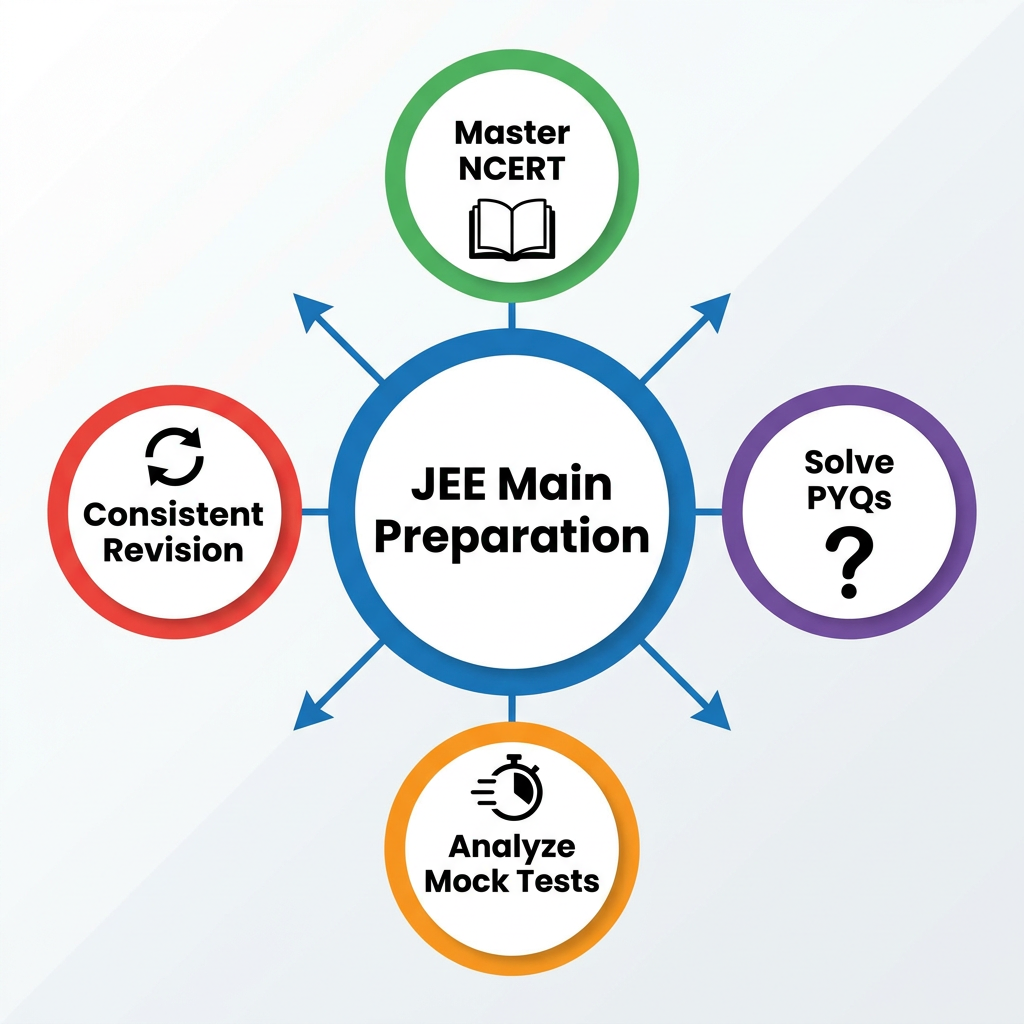
Success in the JEE Main exam isn't about studying 16 hours a day. It's about studying smart. A well-thought-out strategy can make all the difference between a good score and a great rank. Your JEE Main preparation should be built on a few strong pillars.
Building a Solid Foundation
Everything starts here. Before you jump to complex reference books, you must master the NCERT textbooks for Physics, Chemistry, and Mathematics. The JEE Main paper is heavily based on the concepts explained in NCERT. Many questions, especially in Chemistry, are picked directly from the lines of these books.
Focus on understanding the 'why' behind every concept, not just memorizing the 'what'. Build a realistic and consistent study schedule that balances all three subjects. Don't let backlogs pile up; clear your doubts as soon as they arise. You can join online student communities to discuss problems with peers.
Subject-Wise Strategy for Physics, Chemistry, and Maths
A one-size-fits-all approach doesn't work. Each subject demands a unique strategy.
-
Physics: This subject tests your conceptual depth and application skills. Spend time understanding the derivations and the physical meaning of formulas. Mechanics and Electromagnetism are vast but crucial. Practice a wide variety of problems to get comfortable with different question types.
-
Chemistry: Your rank booster! Inorganic Chemistry is all about NCERT; read it multiple times. For Organic Chemistry, focus on understanding reaction mechanisms instead of just memorizing reactions. Physical Chemistry requires consistent numerical practice, similar to Physics.
-
Mathematics: This subject is a game of speed and accuracy. The more you practice, the better you get. Topics like Calculus, Vectors & 3D, and Coordinate Geometry are extremely important and form a large chunk of the paper. Learning shortcuts and tricks can save you valuable time in the exam. For example, knowing specific tricks for common problems can be a lifesaver.
The Power of Mock Tests and PYQs
This is perhaps the most critical part of your preparation. Solving Previous Year Questions (PYQs) is non-negotiable. It gives you the best possible idea of the exam's difficulty level, question patterns, and important topics. Aim to solve at least the last 10 years' papers.
Alongside PYQs, taking regular mock tests is essential. Take these tests in a simulated exam environment: timed, without distractions. After every test, spend more time analyzing your performance than you spent taking the test. Identify three things: conceptual errors, silly mistakes (calculation errors, reading the question wrong), and time management issues. Work on improving one aspect at a time.
Choosing the Right Study Material
In the market flooded with books, it's easy to get lost. The golden rule is: less is more. Stick to a few standard books and master them, rather than superficially reading ten different ones.
Your core should be NCERT. For advanced practice, you can use one standard reference book per subject, like H.C. Verma for Physics, or a Cengage/Arihant series for Maths. To supplement your learning, you can use our library of free resources, which includes curated notes, important derivations, and formula sheets to aid your revision.
JEE Main Score vs. Percentile vs. Rank
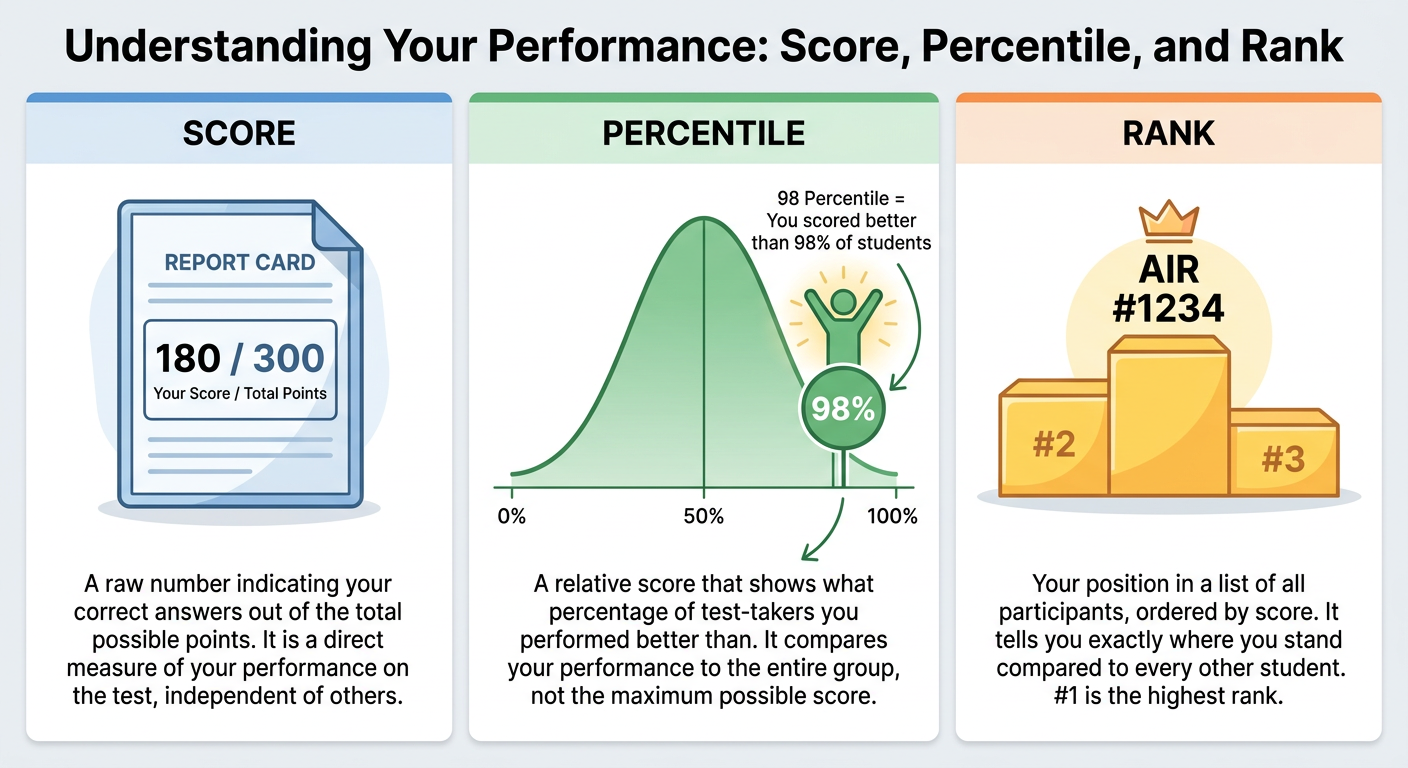
After you get your results, you'll see three different numbers: Score, Percentile, and Rank. It’s important to understand what each of them means.
-
Score: This is the most straightforward. It's the total marks you obtained out of 300, calculated based on the marking scheme (+4 for correct, -1 for incorrect MCQ).
-
Percentile: This is a relative score. Your percentile indicates the percentage of candidates who scored equal to or below you in that specific session. For instance, a 99 percentile means you performed better than 99% of the candidates in your session. The NTA uses a normalization process to calculate percentiles, which ensures that no student is at a disadvantage due to varying difficulty levels across different exam shifts.
-
Rank (All India Rank - AIR): This is your final position among all the candidates who appeared in both sessions of the JEE Main that year. The rank is calculated based on the best of your two percentile scores. This final All India Rank is what is used for counselling and seat allocation in NITs, IIITs, and CFTIs. You can get an estimate of your potential rank using a JEE rank predictor tool.
In short: your absolute performance is your Score, your relative performance in a single shift is your Percentile, and your final, ultimate standing is your Rank.
What Happens After the JEE Main Results?
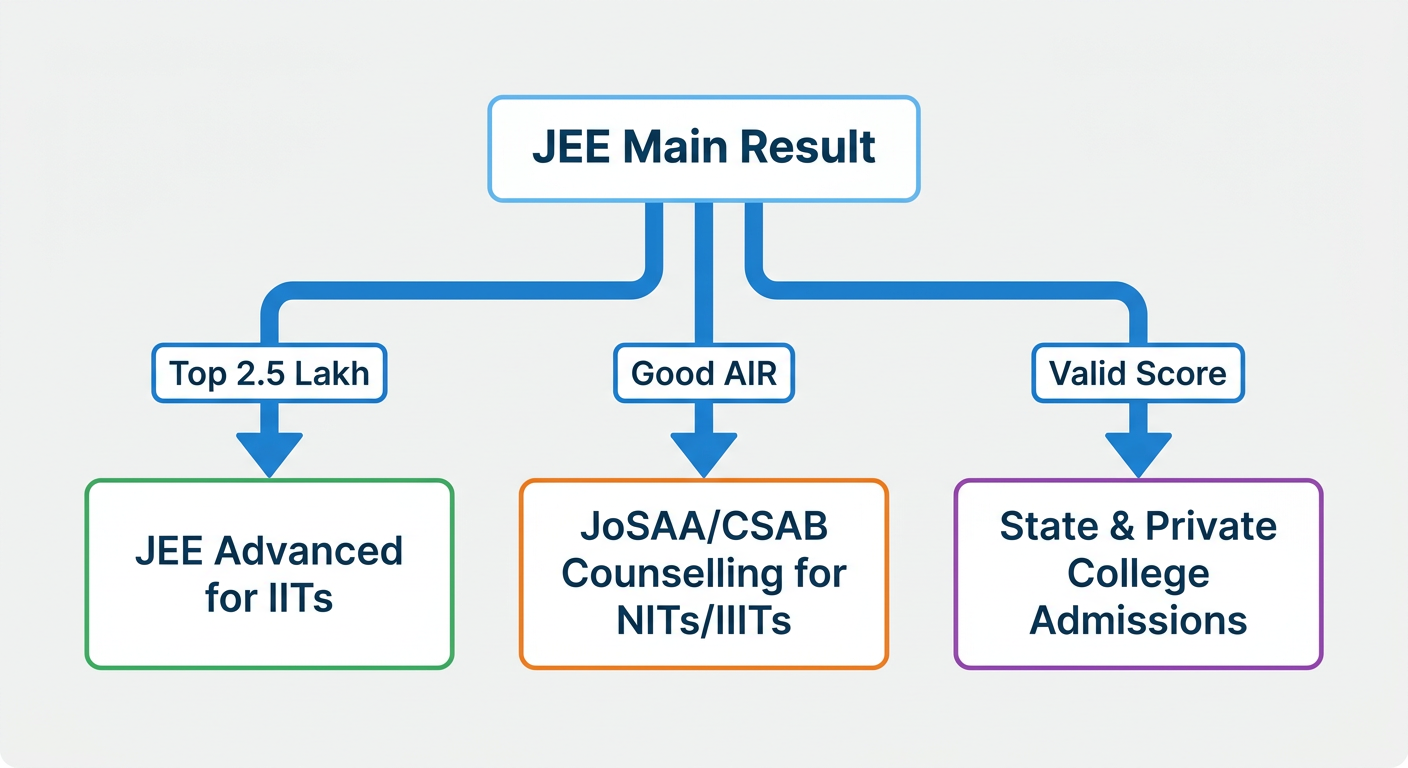
The announcement of the JEE Main result opens up three distinct paths for a student. Your final rank and whether you've cleared the cutoff for JEE Advanced determine which path you'll take.
Path 1: Qualifying for JEE Advanced This is the dream for many. The NTA releases a cutoff percentile for each category (General, EWS, OBC-NCL, SC, ST). Candidates who score at or above this cutoff percentile (approximately the top 2,50,000 students) become eligible to register for and appear in the JEE Advanced exam. This is the exclusive gateway to the prestigious Indian Institutes of Technology (IITs). You can find more details on the official JEE Advanced website.
Path 2: Counselling for NITs, IIITs, and CFTIs If you have a good All India Rank in JEE Main, you are eligible for admission into the 31 NITs, 26 IIITs, and other Government Funded Technical Institutes (GFTIs). The admission process is handled through a centralized counselling platform called JoSAA (Joint Seat Allocation Authority), followed by CSAB (Central Seat Allocation Board) for special rounds.
The process involves registering for counselling, filling in your preferred choices of colleges and branches (choice filling), and then seats are allocated based on your rank, choices, and category.
Path 3: Admission to State and Private Engineering Colleges Your JEE Main score is a valuable asset even beyond the central counselling system. Many state government engineering colleges and a large number of private universities across India accept JEE Main scores for admission to their B.E./B.Tech programs. Some conduct their own counselling, while others might offer direct admission based on your score.
Common Mistakes to Avoid During JEE Main Preparation
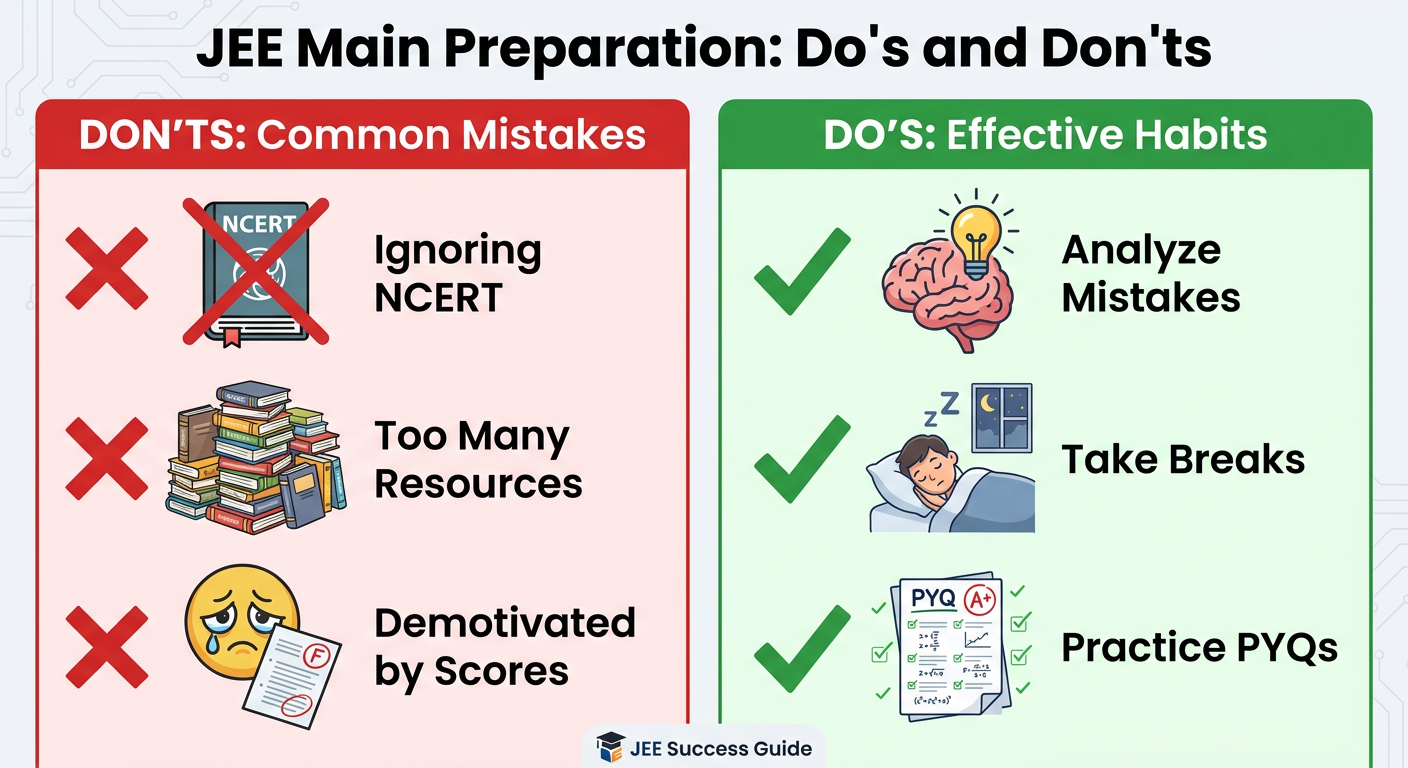
Knowing what not to do is just as important as knowing what to do. Thousands of talented students falter not because of a lack of knowledge, but because of avoidable mistakes. Here are some common pitfalls to watch out for.
- Ignoring NCERT: Thinking NCERT is 'too easy' is the biggest blunder. It is the foundation, and a significant portion of the paper is directly derived from it.
- Piling up Backlogs: Procrastinating on difficult topics creates a backlog that becomes impossible to clear later. Address weak areas and doubts immediately.
- Not Taking Mock Tests Seriously: Taking mock tests without analyzing them is a waste of time. The real learning happens during the analysis phase.
- Collecting Too Many Books: Buying every recommended book leads to confusion and incomplete preparation. Stick to one or two standard resources per subject and master them.
- Neglecting Your Health: Long study hours without adequate sleep, nutrition, and breaks lead to burnout. A healthy mind resides in a healthy body. Aim for 6-7 hours of sleep every night.
- Getting Demotivated by Low Scores: Your mock test scores will fluctuate. Don't let a few bad scores demotivate you. See them as diagnostic tools to identify areas for improvement.
- Avoiding Mistake Analysis: Keep a 'mistake notebook'. For every error you make in a test, write down the concept and the reason for the error. Revise this notebook regularly.
Cracking the JEE Main is a marathon, not a sprint. It tests your knowledge, temperament, and strategy. Stay consistent, stay focused, and believe in your preparation. You can do this!
FAQs
What is the full form of JEE?
The full form of JEE is Joint Entrance Examination. It is conducted in two stages: JEE Main and JEE Advanced, for admission to top engineering colleges in India.
How many times can I attempt JEE Main?
A candidate can attempt the JEE Main exam for three consecutive years. Since the exam is held twice a year (two sessions), this means a student can appear for a maximum of six attempts in total.
Is there negative marking in JEE Main?
Yes, there is negative marking. For Multiple-Choice Questions (MCQs), you get +4 marks for a correct answer and -1 mark is deducted for an incorrect answer. However, for the Numerical Value Questions, there is no negative marking.
Is the 75% criteria in Class 12 compulsory for appearing in JEE Main?
No, the 75% aggregate marks criteria (65% for SC/ST) in Class 12 is not required for appearing in the JEE Main exam. It is an eligibility criterion for admission into NITs, IIITs, and CFTIs through JoSAA/CSAB counselling.
Which session's score is considered for the final rank?
The best of the two NTA percentile scores from the January and April sessions is considered for preparing the final merit list and calculating the All India Rank (AIR).
What is a good percentile in JEE Main?
A 'good' percentile depends on your goal. To qualify for JEE Advanced, you typically need around 90-91 percentile for the General category (this varies each year). For admission into a good branch in a top NIT, a percentile of 98.5+ is generally considered safe.