NTA 2027 exam cycle starts; JEE Main registration soon, Session 2 dates to factor in NEET, CUET - India Today
Everything you need to know about the JEE Main exam. Get details on eligibility, syllabus, exam pattern, preparation strategy, cutoffs, and top colleges.
17 min read
Ever felt like you're the main character in a high-stakes movie? The clock is ticking, the mission is tough, and millions are watching. For lakhs of engineering aspirants in India, that movie is real, and it’s called the Joint Entrance Examination.
The first, most crucial level of this mission is the JEE Main. It’s more than just an exam; it's the gateway that opens doors to the country's most prestigious engineering colleges. Getting a good score here is the first step towards a dream career in technology.
This guide is your ultimate strategy brief. We'll break down everything from the application form to the final counselling process. Whether you're a student just starting your Class 11 journey or a parent trying to navigate this complex world, we've got you covered. Let's decode the NTA JEE Main exam together.
What Exactly is the JEE Main Exam?
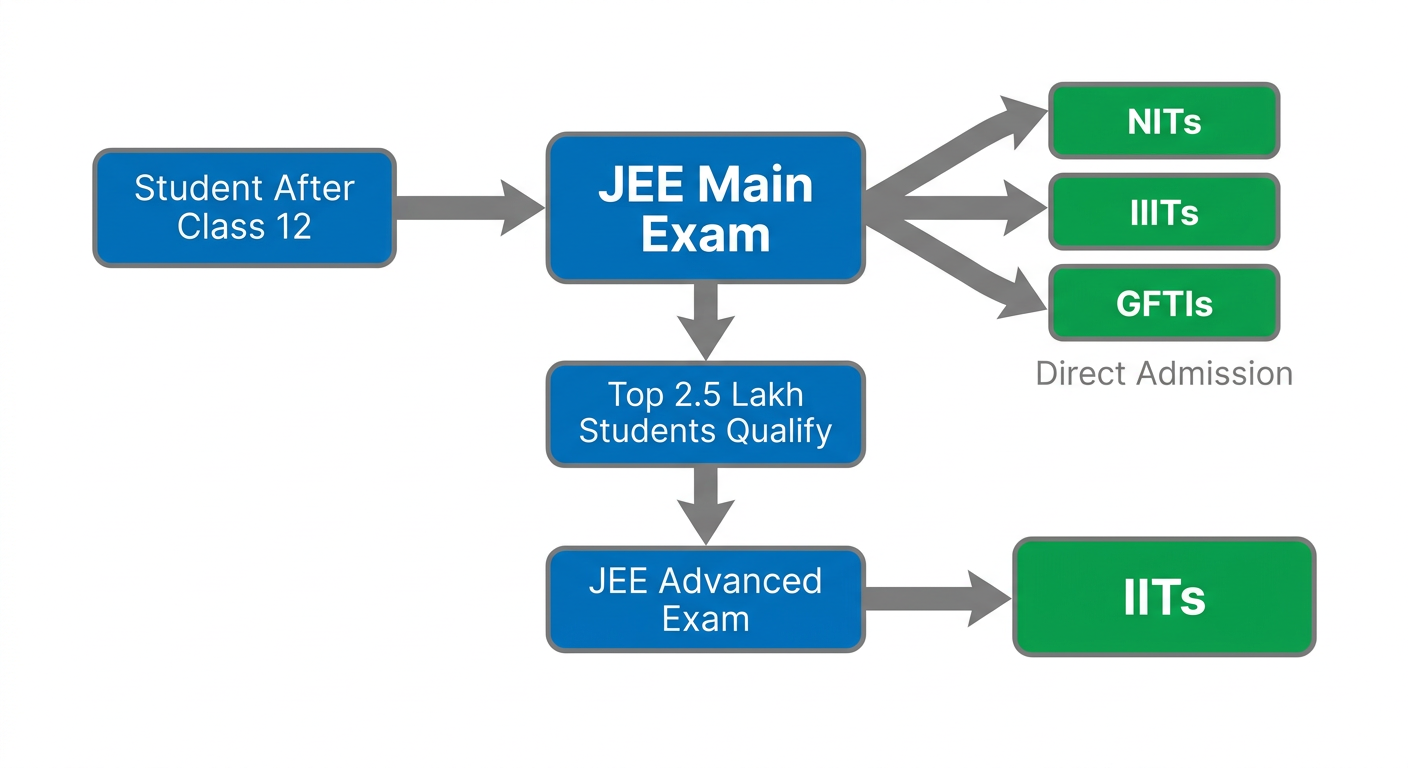 The JEE Main is a national-level computer-based entrance examination conducted by the National Testing Agency (NTA). Think of it as the grand qualifier for engineering admissions across India. It serves two primary, very important purposes.
First, it is the sole eligibility test for the JEE Advanced exam. If you dream of studying at an Indian Institute of Technology (IIT), you must first clear the JEE Main qualifying cutoff. Only the top 2.5 lakh (approximately) students are allowed to sit for JEE Advanced.
Second, your JEE Main score is your direct ticket to admission in many top-tier technical institutes. This includes the 31 National Institutes of Technology (NITs), 26 Indian Institutes of Information Technology (IIITs), and other Centrally Funded Technical Institutes (CFTIs). Many states and private universities also use these scores for their admission process.
To give students a better chance, the NTA conducts the exam in two sessions, typically in January and April. You can appear for one or both sessions. The NTA then considers your best performance of the two for the final ranking. This is a huge advantage, as it gives you a second chance to improve your score and reduces pressure.
JEE Main Eligibility Criteria: Are You In?
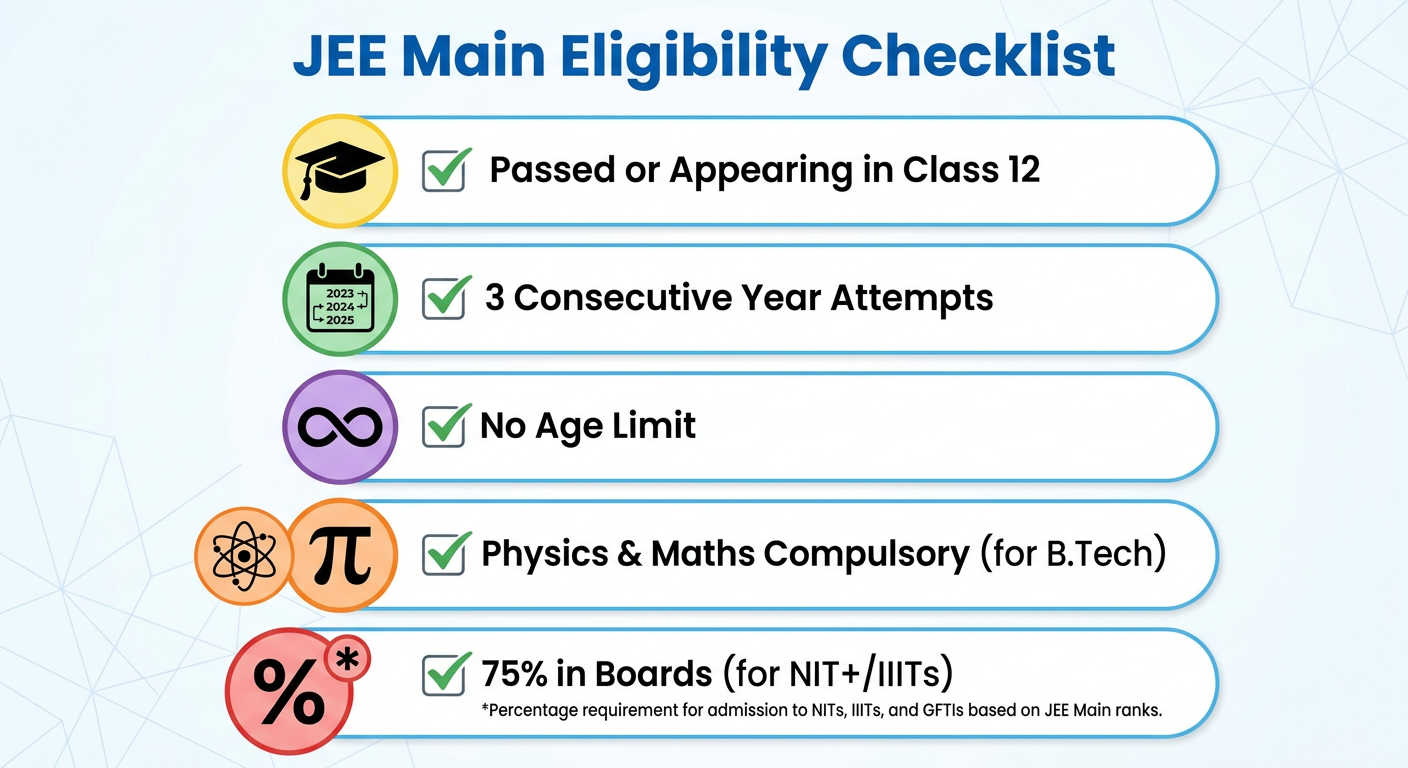 Before you dive into preparation, it’s crucial to check if you meet the eligibility criteria. The rules are set by the NTA and are non-negotiable. Let’s break them down into simple terms.
Age Limit
There is no age limit for appearing in the JEE Main exam. As long as you meet the educational qualifications, you can apply. However, there is a condition on the year you pass your Class 12 or equivalent examination. A candidate can attempt the exam for three consecutive years starting from the year they pass their Class 12 board exams.
Educational Qualification
To be eligible, a candidate must have passed the Class 12 or an equivalent qualifying examination. Students who are appearing for their Class 12 board exams in the current academic year are also eligible to apply. This means if you're in 12th grade now, you can and should apply for the upcoming sessions.
Subject Combination
This is a critical point. For Paper 1 (B.E./B.Tech), you must have passed your Class 12 exam with Physics and Mathematics as compulsory subjects. Alongside these, you need one subject from Chemistry, Biotechnology, Biology, or a Technical Vocational subject. For B.Arch and B.Plan papers, the requirements may vary slightly, but Physics, Chemistry, and Maths are the standard foundation.
The 75% Criteria Explained
There is a lot of confusion about this rule. For admission to NITs, IIITs, and CFTIs, a candidate generally needs to secure at least 75% marks in their Class 12 board exam (or be in the top 20 percentile of their board). For SC/ST candidates, the requirement is 65%.
However, this rule has been relaxed in the past, especially during the COVID-19 pandemic. It's extremely important to always check the latest information brochure released by the NTA on the official JEE Main site for the current academic year, as this rule can be subject to change.
Understanding the JEE Main Exam Pattern
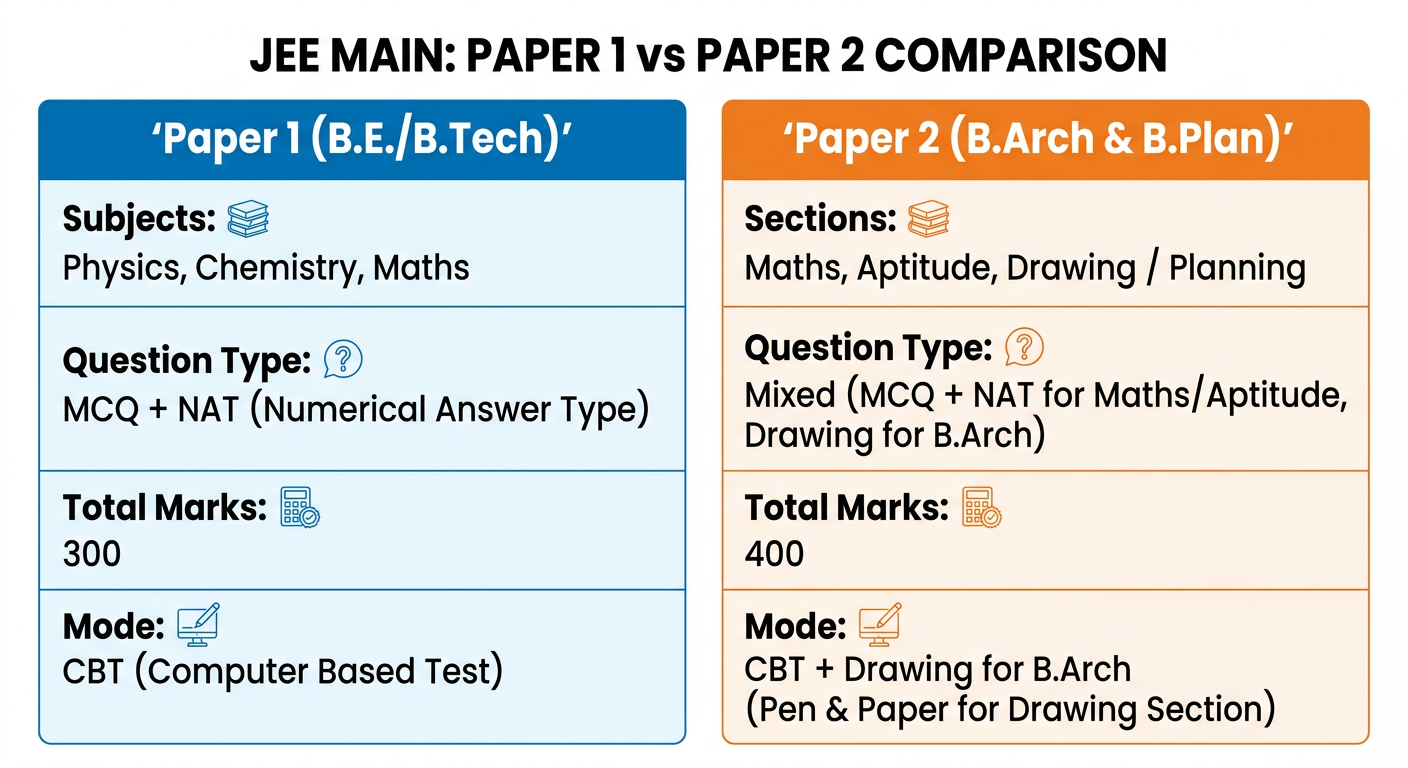 Knowing the exam pattern is like knowing the rules of the game. You must understand the question types, marking scheme, and time duration to build an effective strategy. The JEE Main exam has different papers for different courses.
Paper 1 (B.E./B.Tech) Deep Dive
This is the most popular paper, taken by over a million students each year. It is a gateway to all core engineering branches.
- Subjects: Physics, Chemistry, and Mathematics.
- Mode: Fully Computer-Based Test (CBT).
- Duration: 3 hours.
- Question Types: The paper has two types of questions. Multiple Choice Questions (MCQs) where you choose one correct option out of four. And Numerical Answer Type (NAT) questions, where you have to enter a numerical value as the answer.
- Marking Scheme: For MCQs, you get +4 marks for a correct answer and a penalty of -1 mark for a wrong answer. For NAT questions, you get +4 for a correct answer, and there is no negative marking.
- Question Distribution: Each subject has 30 questions. This is split into 20 MCQs (all compulsory) and 10 NAT questions (out of which you must attempt any 5). So, you attempt a total of 75 questions (25 from each subject) for a maximum of 300 marks.
Paper 2A (B.Arch) Pattern
For aspiring architects, this is the paper to take. It tests a different set of skills compared to the B.E./B.Tech paper.
- Parts: It consists of three parts. Part I is Mathematics (CBT), Part II is the Aptitude Test (CBT), and Part III is the Drawing Test (Pen-and-Paper based).
- Marking: The Mathematics and Aptitude sections follow a marking scheme similar to Paper 1. The Drawing test is evaluated based on your sketching and design skills.
- Total Marks: The entire paper is for a total of 400 marks.
Paper 2B (B.Plan) Pattern
This paper is for students interested in a Bachelor of Planning degree. It focuses on analytical and planning-based abilities.
- Parts: This also has three parts. Part I is Mathematics (CBT), Part II is the Aptitude Test (CBT), and Part III consists of Planning-Based Questions (CBT).
- Mode: This entire paper is conducted in a Computer-Based Test mode.
- Total Marks: The paper is for a total of 400 marks, testing your mathematical, aptitude, and planning knowledge.
Decoding the JEE Main Syllabus
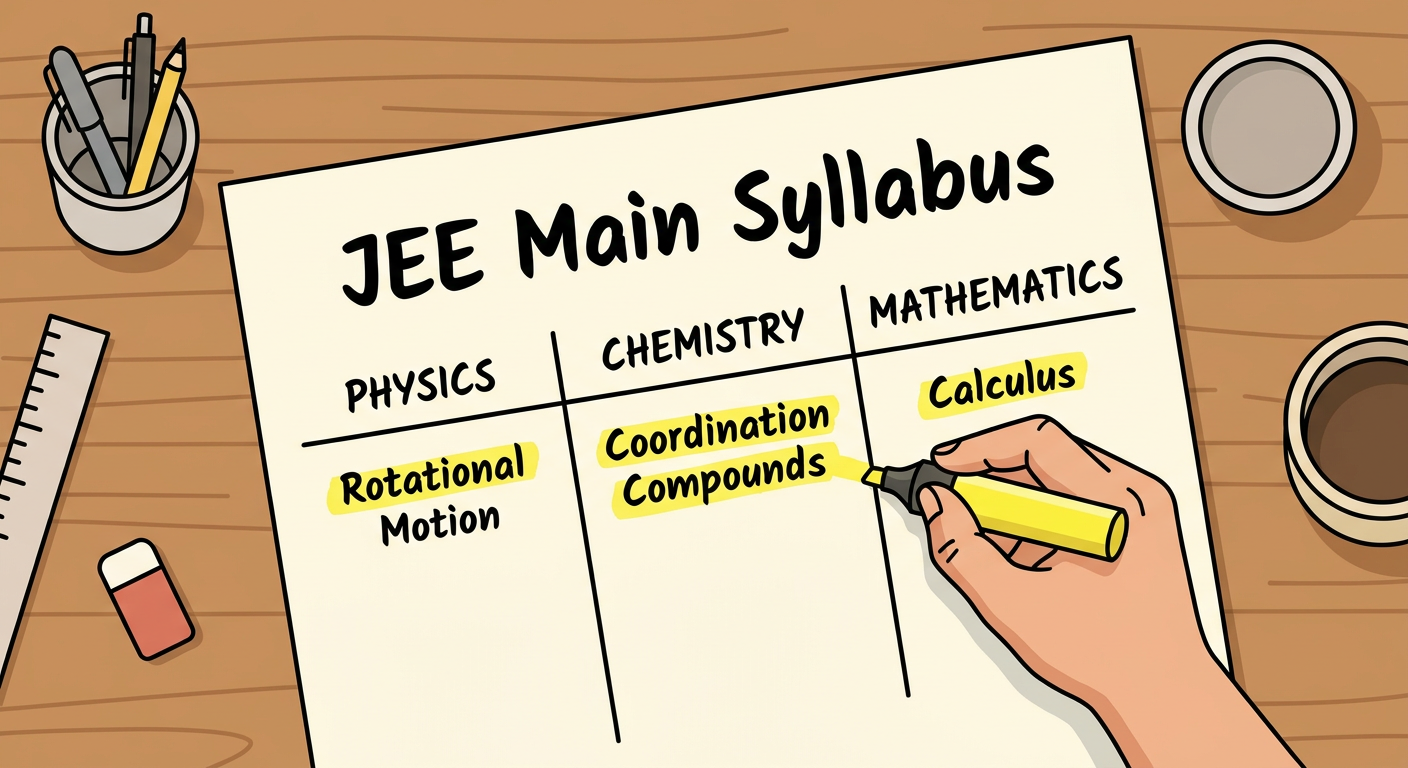 The JEE Main syllabus is vast, covering the curriculum of both Class 11 and Class 12 from CBSE boards. The NTA releases the official syllabus every year, and it's your holy grail. In recent years, there have been some deletions of topics to align with the rationalized NCERT curriculum, so it's vital to download the latest version.
Instead of getting overwhelmed by the sheer volume, a smart approach is to focus on high-weightage topics first. You can find a detailed breakdown on our JEE syllabus page, but here's a quick overview of chapters you absolutely cannot skip.
High-Weightage Topics in Physics
Physics in JEE Main is a mix of concepts and problem-solving. You need a clear understanding to score well.
- Mechanics: This is the foundation. Topics like Kinematics, Laws of Motion, and Rotational Motion are always present.
- Electrodynamics: A large and important unit, covering Electrostatics, Current Electricity, and Magnetism. It's formula-heavy but very scoring.
- Modern Physics: This is considered one of the easiest and most scoring parts of physics. Topics like Dual Nature of Matter, Atoms, Nuclei, and Semiconductors are a must-do.
- Optics & Waves: Ray Optics and Wave Optics are important, with predictable question patterns.
Key Areas in Chemistry
Chemistry is often the most scoring subject in JEE Main, as many questions are direct and memory-based.
- Physical Chemistry: Focus on Chemical Kinetics, Equilibrium, Thermodynamics, and Electrochemistry. These require both conceptual clarity and numerical practice.
- Organic Chemistry: General Organic Chemistry (GOC) is the backbone. After that, focus on Hydrocarbons, Aldehydes, Ketones, and named reactions.
- Inorganic Chemistry: This is heavily based on NCERT. Chemical Bonding and Coordination Compounds are conceptual and high-weightage. Don't forget to memorize the trends and reactions in s, p, d, and f-block elements.
Must-Do Chapters in Mathematics
Maths requires the most practice. Speed and accuracy are key to scoring well in this section.
- Calculus: This is the largest part of the syllabus, including Limits, Continuity, Differentiation, Integration, and Differential Equations.
- Coordinate Geometry: Conic Sections (Parabola, Ellipse, Hyperbola) and Straight Lines are very important.
- Vectors & 3D Geometry: This is a highly scoring and relatively easy topic if your concepts are clear.
- Algebra: Key chapters include Matrices & Determinants, Sequences & Series, and Binomial Theorem.
The JEE Main Registration Process Step-by-Step
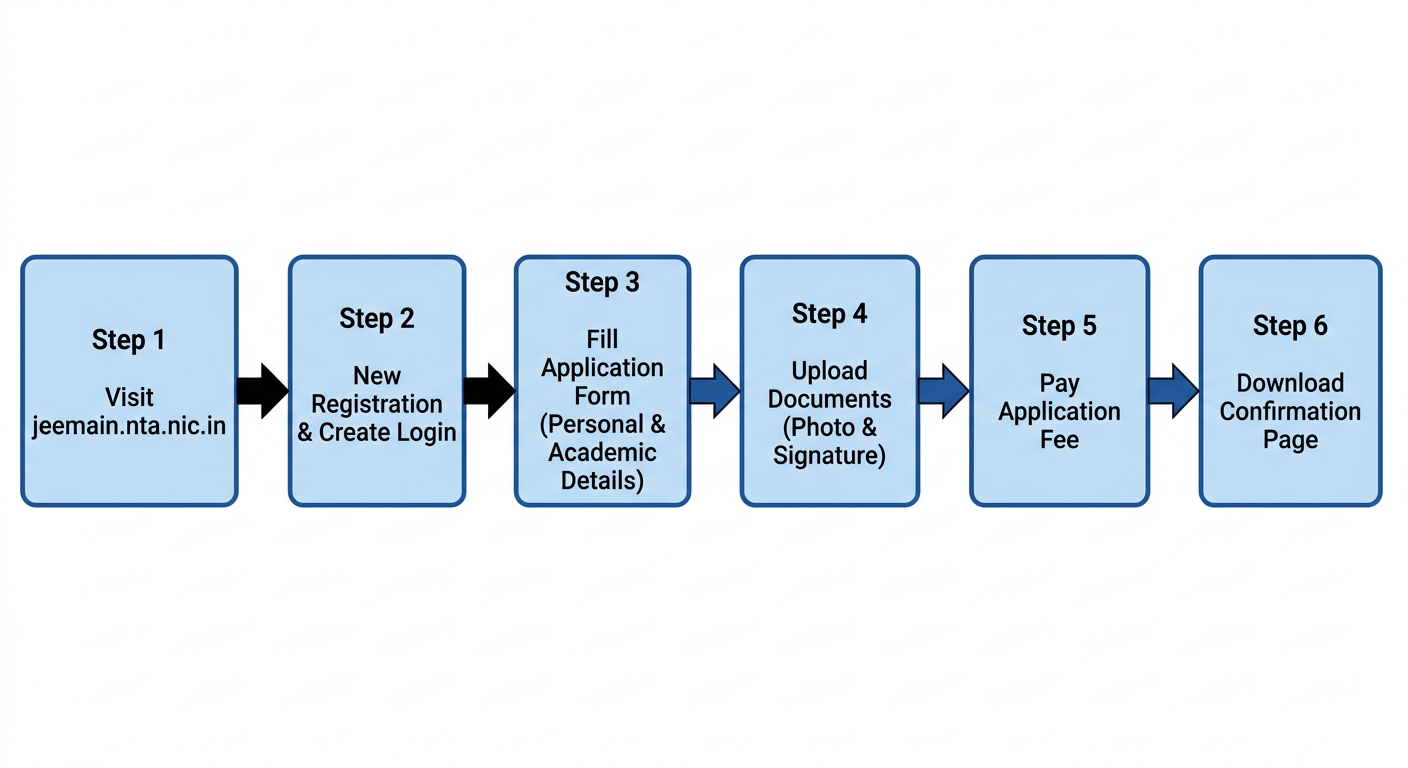 The entire JEE Main registration process happens online through the official NTA website. It's a straightforward but meticulous process. Paying close attention to every detail is crucial to avoid any last-minute hassles.
First, head over to the official NTA JEE Main website. The registration window for each session opens for a specific period, usually a few weeks. You must complete your application within this timeframe. The process can be broken down into three main parts.
Documents You'll Need
Before you start filling the form, keep these things ready in a digital format as per the specifications mentioned in the information bulletin:
- A recent passport-sized photograph.
- Your scanned signature.
- Category certificate (if applicable, for EWS, OBC-NCL, SC, ST).
- PwD certificate (if applicable).
- A valid mobile number and email ID for communication.
Filling the Application Form
This is the core of the process. You'll start by creating a login using your personal details. Once logged in, you'll need to fill in:
- Personal Details: Your name, parents' names, date of birth, etc., exactly as in your Class 10 certificate.
- Academic Details: Your Class 10 and 12 marks and school information.
- Choice of Exam Cities: You can choose up to four cities in order of preference where you'd like to take the exam.
- Uploading Documents: Upload the scanned copies of your photograph and signature that you prepared earlier.
Double-check every single entry before you submit. Any mistake can lead to disqualification or issues during counselling.
Fee Payment and Confirmation
After filling the form, the final step is to pay the application fee. The payment can be made online through Net Banking, Debit Card, Credit Card, or UPI. The fee varies based on your category, gender, and the papers you choose to appear for.
Once the payment is successful, the most important step is to download and print the 'Confirmation Page'. This is your proof that the application has been submitted successfully. Keep it safe for future reference.
A Winning Strategy for JEE Main Preparation
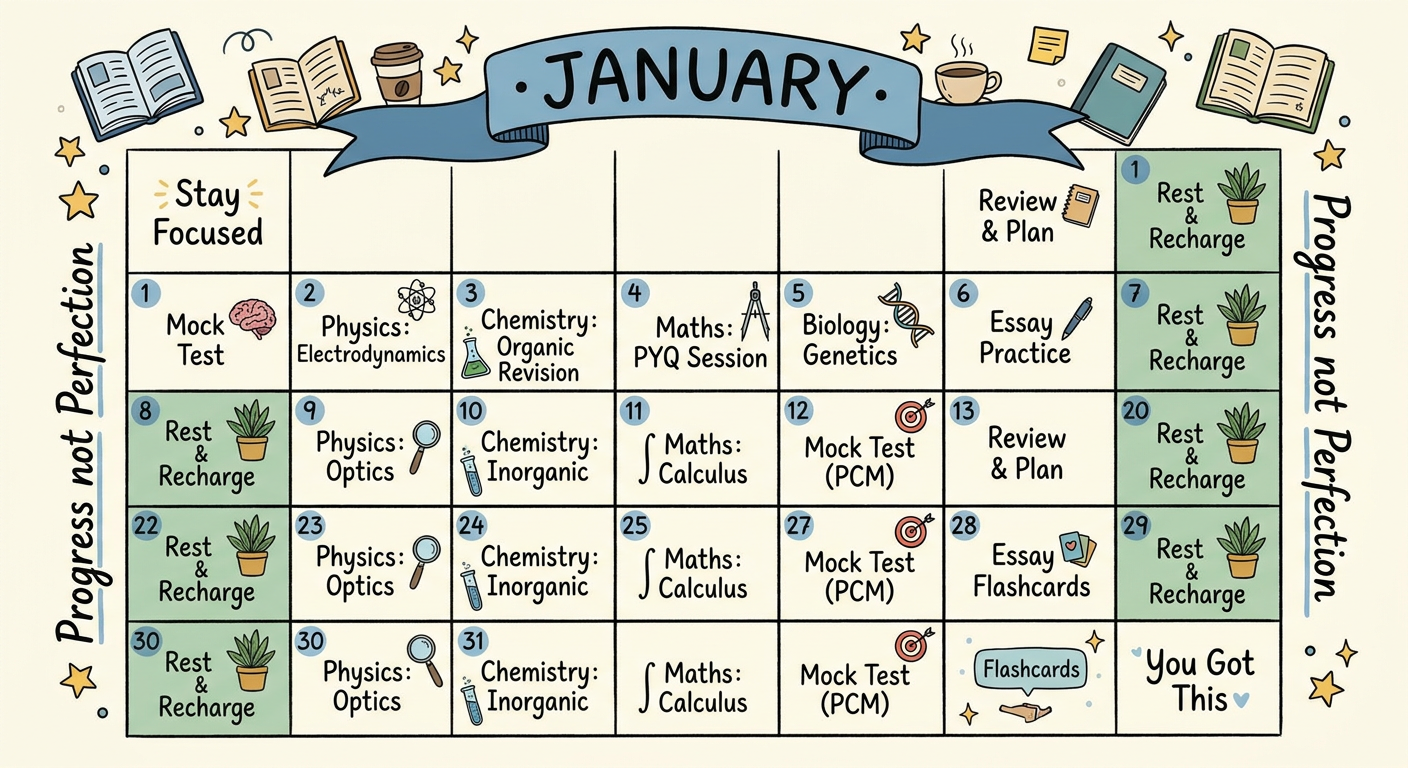 Cracking JEE Main isn't about studying 16 hours a day. It's about studying smart. A well-planned strategy, consistent effort, and the right resources can make all the difference. Here’s a roadmap to guide your preparation.
Building a Strong Foundation
The entire JEE syllabus is built upon the concepts taught in Class 11 and 12. Your NCERT textbooks are the single most important resource. Start by reading every chapter thoroughly and solving all the in-text and exercise questions. NCERT is especially crucial for Chemistry, where many questions are directly picked from the textbook.
The Power of Previous Year Questions (PYQs)
Once you have a decent grasp of the concepts, it's time to understand the exam's DNA. The best way to do this is by solving Previous Year Questions. Solving PYQs helps you understand the question patterns, difficulty level, and high-weightage topics. Aim to solve at least the last 10 years of papers.
Mock Tests: Your Best Friend
Mock tests are the key to converting your knowledge into marks. They help you build exam temperament, manage your time effectively, and identify your weak areas. Take a mock test every week in the final few months of your preparation. After every test, spend more time analyzing your mistakes than you spent taking the test. This analysis is where the real improvement happens.
Subject-Wise Preparation Tips
Each subject requires a slightly different approach.
For Physics, focus on deep conceptual understanding. Don't just memorize formulas; understand how they are derived. Practice a wide variety of problems to build application skills.
For Chemistry, balance is key. Physical Chemistry needs problem-solving, Organic Chemistry needs understanding mechanisms and reactions, and Inorganic Chemistry needs systematic memorization from NCERT.
For Mathematics, there is no substitute for practice. The more problems you solve, the better your speed and accuracy will become. Focus on accuracy first, and speed will follow. When tackling complex topics like integration, knowing tricks and rules is vital. For instance, the ILATE rule for integration by parts is a lifesaver.
Understanding Scores, Ranks, and Percentile
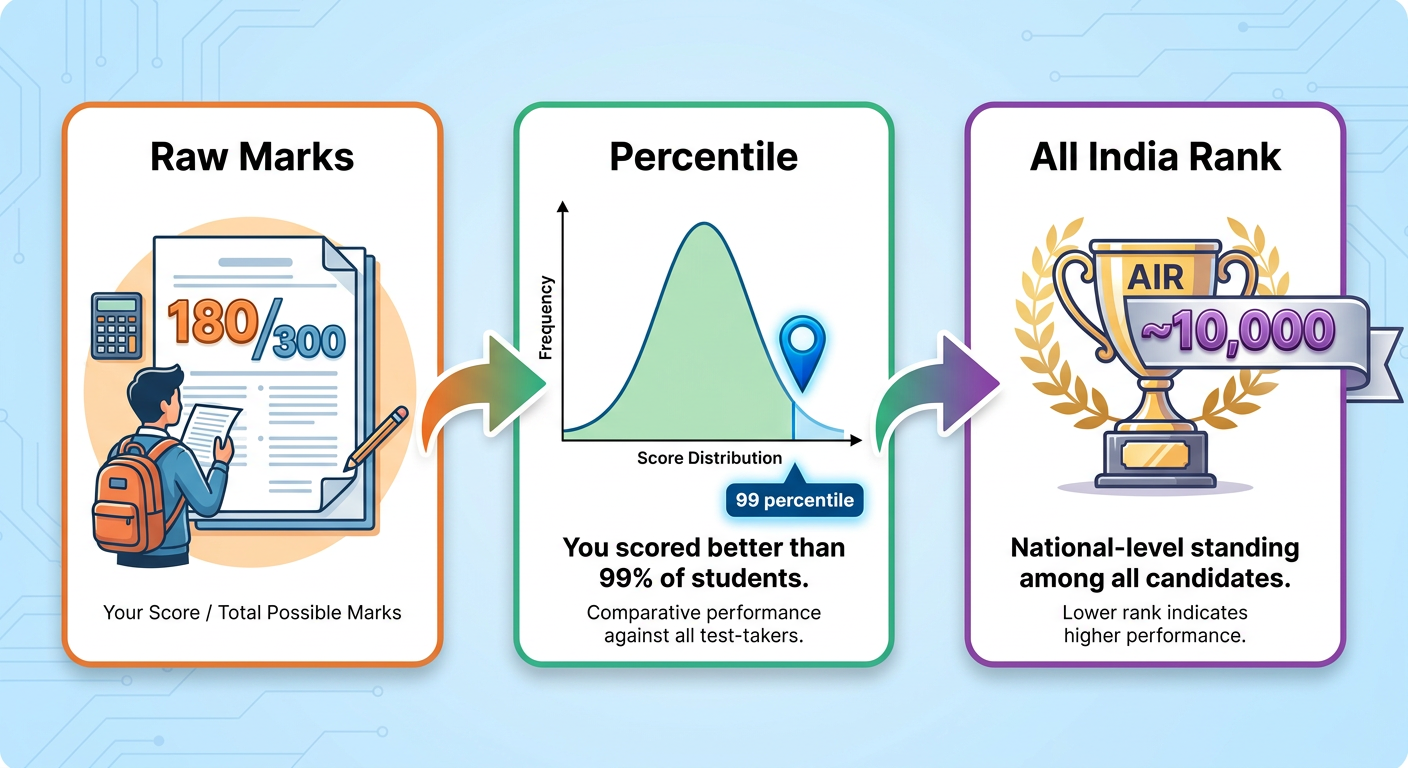 After the exam, the NTA doesn't release your raw marks directly. Instead, you get an NTA Score, also known as a percentile. This system can be confusing, so let’s break it down.
The JEE Main exam is conducted in multiple shifts across several days. The difficulty level of the paper might vary slightly from one shift to another. To ensure fairness, the NTA uses a process called normalization. Your raw score is converted into a percentile score.
A percentile score indicates the percentage of candidates who scored equal to or below you in that session. For example, if you have a 99 percentile, it means you scored better than 99% of the students who appeared in that session. This method ensures that no student is at a disadvantage due to a tougher paper.
Your final All India Rank (AIR) is calculated after the second session, based on your best percentile score out of the two attempts. This rank determines your eligibility for JEE Advanced and your admission prospects in various colleges. You can use a JEE rank predictor tool to get an idea of your potential rank based on your expected score.
What is the JEE Main Cutoff?
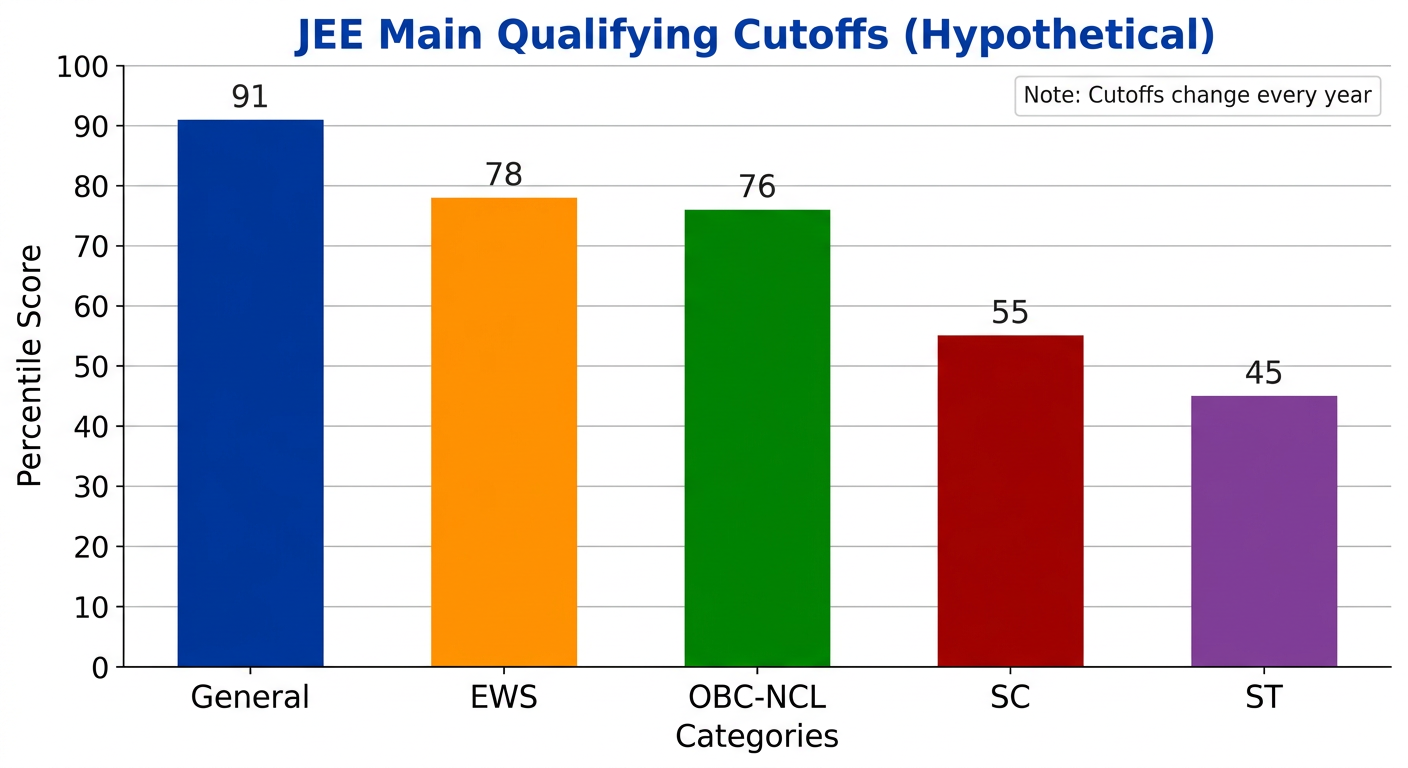 The term 'cutoff' in the context of JEE Main can mean two different things. It's important to understand the distinction.
First, there is the Qualifying Cutoff. This is the minimum percentile score a candidate needs to become eligible to appear for the JEE Advanced exam. The NTA releases this cutoff along with the JEE Main final results. This cutoff varies for different categories (General, EWS, OBC-NCL, SC, ST, PwD) and changes every year depending on the number of candidates and the overall performance.
Second, there is the Admission Cutoff. This refers to the opening and closing ranks for admission into a particular branch of a specific college. For example, the closing rank for Computer Science at NIT Trichy would be its admission cutoff for that year. These cutoffs are released by the Joint Seat Allocation Authority (JoSAA) after each round of counselling.
To get into the IITs, you must first clear the JEE Main qualifying cutoff and then secure a rank in the JEE Advanced exam. For NITs, IIITs, and GFTIs, admission is based directly on your JEE Main All India Rank.
Top Colleges Accepting JEE Main Scores
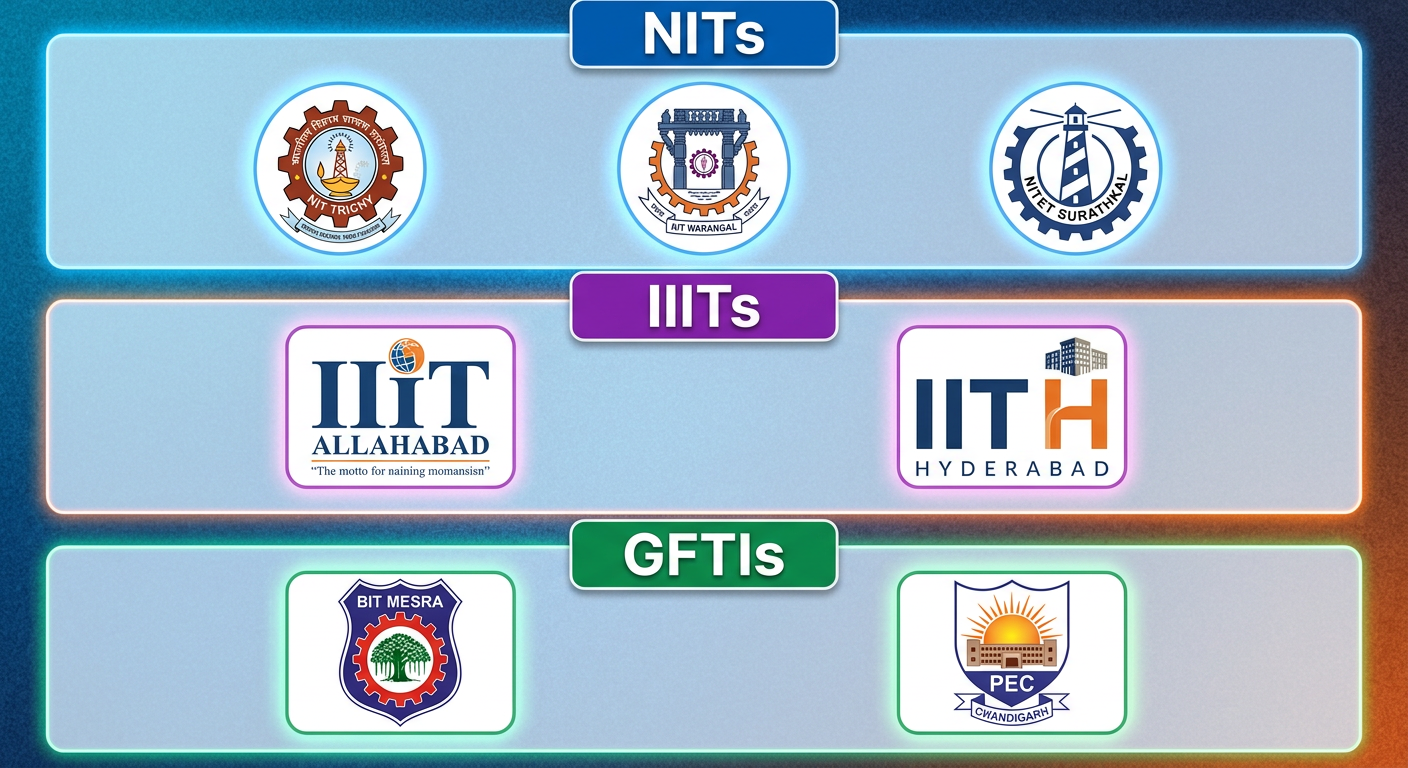 A good rank in JEE Main opens the door to some of India's finest engineering institutions. The admission process is centralized through JoSAA counselling, where you fill in your choices of colleges and branches based on your rank.
National Institutes of Technology (NITs)
There are 31 NITs across the country, and they are among the most sought-after colleges after the IITs. Top NITs like Trichy, Warangal, Surathkal, Allahabad, and Calicut have excellent academic reputations and placement records. Admission to these is highly competitive.
Indian Institutes of Information Technology (IIITs)
There are 26 IIITs, which focus on Information Technology and related fields. Some, like IIIT Hyderabad and IIIT Bangalore (which have their own exams but also consider JEE Main scores for some programs), are considered on par with top IITs for computer science. Others, like IIIT Allahabad and IIIT Lucknow, are also excellent choices.
Government Funded Technical Institutes (GFTIs)
This is a list of other centrally funded technical institutes that use JEE Main scores for admission. This includes prestigious colleges like the PEC University of Technology (Chandigarh), Birla Institute of Technology (Mesra), and several others.
State-Level and Private Universities
Apart from these, many states conduct their own counselling for state engineering colleges using JEE Main ranks. A host of top private universities like Thapar Institute of Engineering and Technology, KIIT, and DA-IICT also accept JEE Main scores.
Life After the Exam: Counselling and Admission
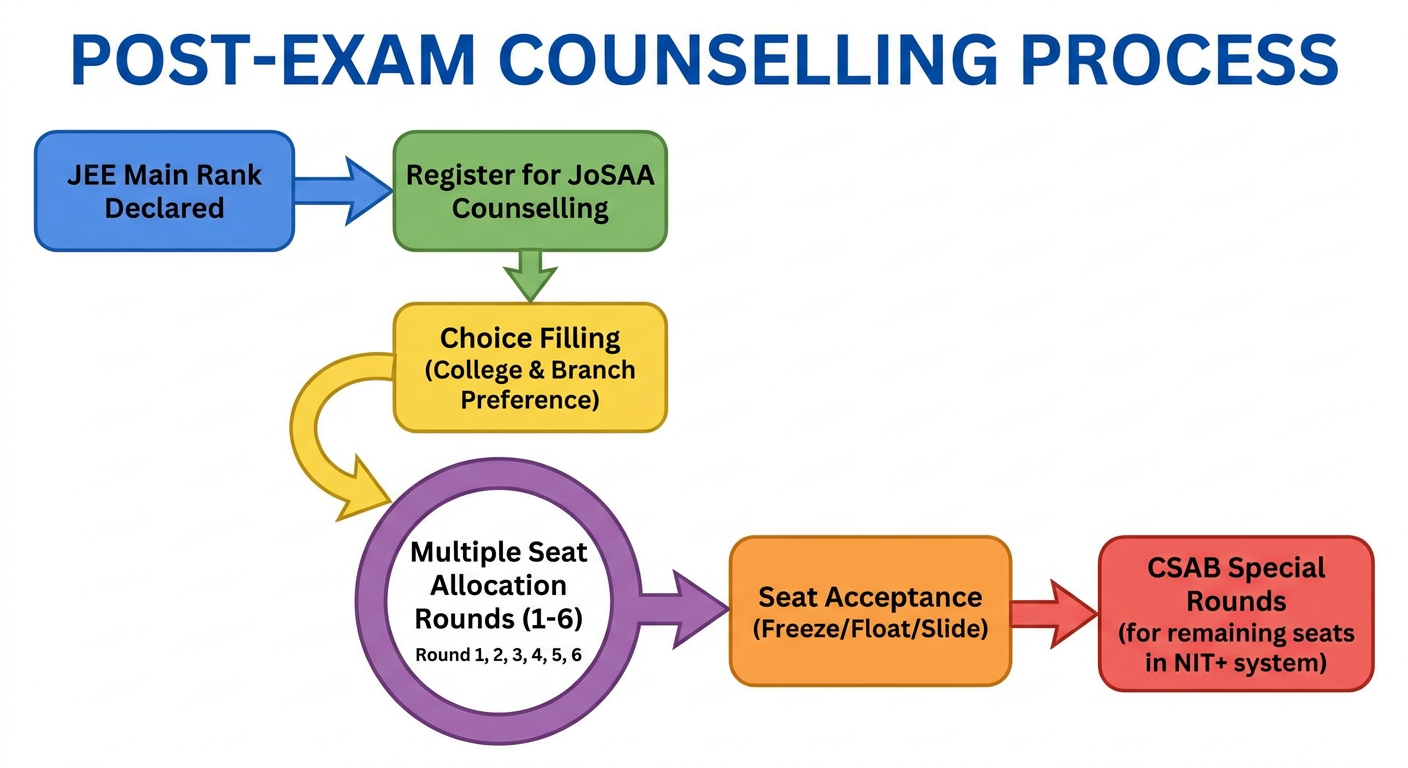 Clearing the exam is only half the battle won. The next crucial phase is the counselling process. The Joint Seat Allocation Authority (JoSAA) conducts the joint counselling for admissions to 110+ institutes, including IITs, NITs, IIITs, and GFTIs.
The process is entirely online. After the results are declared, eligible candidates have to register on the JoSAA portal. The most critical step here is 'Choice Filling'. You have to fill in your preferred colleges and branches in decreasing order of preference. This is a very important step, as the seat allocation algorithm will assign you the best possible seat based on your rank and the choices you filled.
JoSAA conducts multiple rounds of seat allocation. After each round, you have the option to 'Freeze' (accept the allocated seat), 'Float' (accept the seat but remain open for a better one in subsequent rounds), or 'Slide' (accept the seat but look for a better branch in the same institute). For any remaining seats in the NIT+ system, a special round of counselling is conducted by the Central Seat Allocation Board (CSAB).
FAQs
How many times can I attempt JEE Main?
A candidate can attempt the JEE Main exam a maximum of two times in a year (January and April sessions) for three consecutive years. This means a total of six attempts are possible starting from the year a student passes their Class 12 exam.
Is the 75% criteria in Class 12 mandatory for JEE Main?
For appearing in the JEE Main exam itself, there is no percentage criterion. However, for admission into NITs, IIITs, and GFTIs, a candidate generally needs to have secured 75% in their Class 12 boards (65% for SC/ST) or be in the top 20 percentile of their board. Always check the latest NTA brochure for the most current rules.
What is a good percentile in JEE Main?
A 'good' percentile is subjective and depends on your goal. To qualify for JEE Advanced, you typically need a percentile above 90-91 (for the general category), though this varies. For admission into a top NIT with a core branch, a percentile of 99+ is often required.
Can I appear for both JEE Main sessions?
Yes, you absolutely can. The NTA encourages students to appear for both sessions. The best of the two percentile scores will be used for creating the final merit list, so it's a great opportunity to improve your performance.
Are NCERT books enough for JEE Main?
NCERT books are essential and form the foundation for your preparation, especially for Chemistry. However, for Physics and Mathematics, you will need to supplement your preparation with a standard reference book for more in-depth problem-solving and practice. Solving Previous Year Questions and taking mock tests from our free resources hub is also crucial.
What is the difference between JEE Main and JEE Advanced?
JEE Main is the qualifying exam for JEE Advanced and also the direct entrance test for NITs, IIITs, and GFTIs. JEE Advanced is the exclusive entrance exam for admission into the 23 IITs. JEE Advanced is considered significantly tougher than JEE Main, with a more complex question pattern that tests deep conceptual knowledge.