JEE Main 2027 Session 1 Registration Date, Exam Schedule, Application Form - PW
Get all the details about the JEE Main exam, including the latest exam pattern, full syllabus, eligibility criteria, and a winning preparation strategy. Your journey to an NIT starts here.
14 min read
JEE Main: A Complete Guide for Aspirants
Ever watched a movie where the hero has to clear multiple, high-stakes levels to win? That’s a bit like the journey to your dream engineering college. It's a challenging mission, and the first major level you must conquer is the Joint Entrance Examination, or JEE Main.
For lakhs of students across India, this exam is the gateway to a future in technology and innovation. But with its two annual sessions, multiple papers, and a vast syllabus, it can feel overwhelming. Where do you even begin?
Don't worry, we've got your back. This is your mission briefing. We will break down everything you need to know about the JEE Main exam. From eligibility and exam patterns to registration and a winning strategy, this guide is your one-stop resource. Let's get you ready for success.
What is the JEE Main Exam, Really?
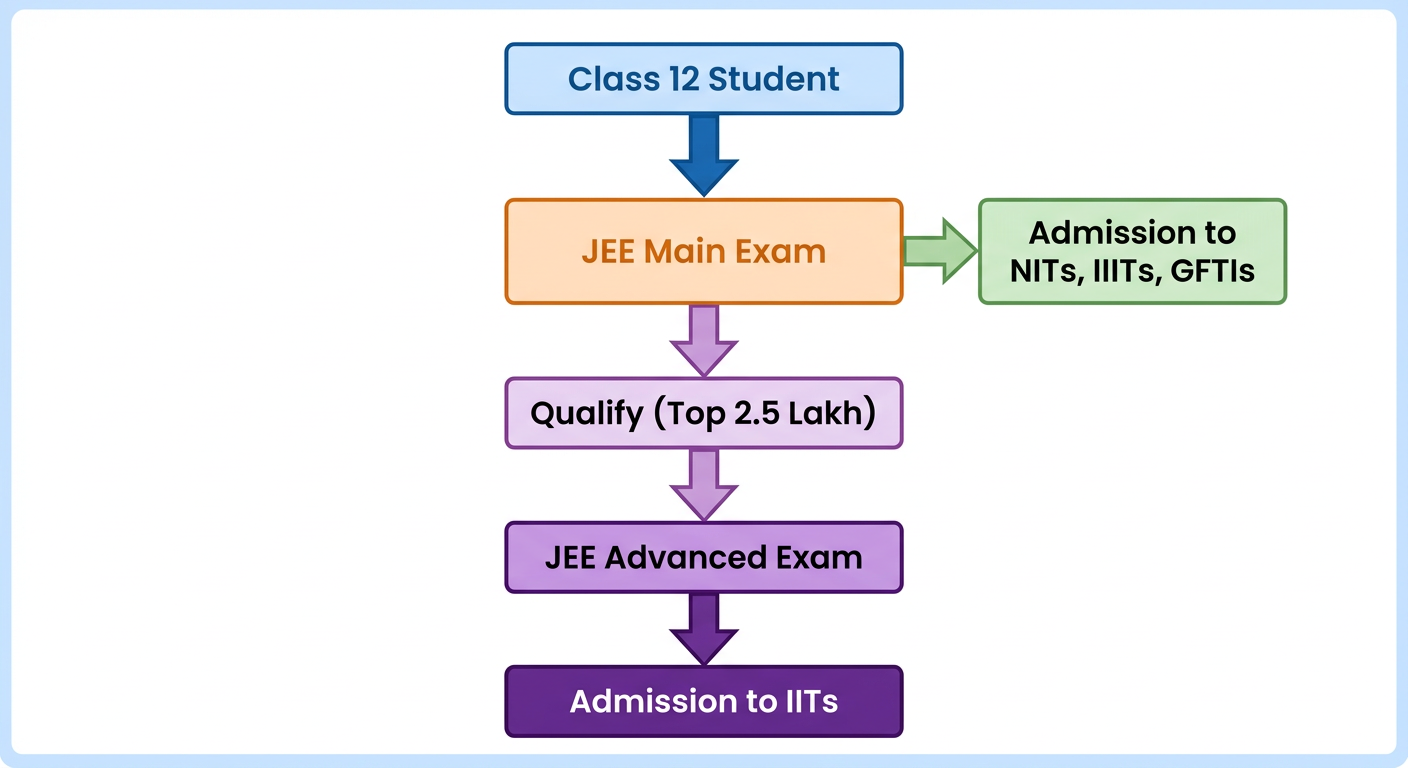
The JEE Main is more than just an exam; it's the first significant step towards a career in engineering, architecture, or planning in India. Conducted by the National Testing Agency (NTA), it is a computer-based test held at a national level.
Think of it as having two primary functions. First, it is the direct admission test for undergraduate courses in premier institutes like the National Institutes of Technology (NITs), Indian Institutes of Information Technology (IIITs), and other Centrally Funded Technical Institutions (GFTIs).
Second, it serves as the eligibility test for the next level: JEE Advanced. Only the top-performing students in JEE Main (around 2.5 lakh candidates) get the chance to sit for JEE Advanced, which is the sole admission test for the prestigious Indian Institutes of Technology (IITs). So, acing this exam opens up multiple pathways to success.
Understanding the Two Sessions of JEE Main
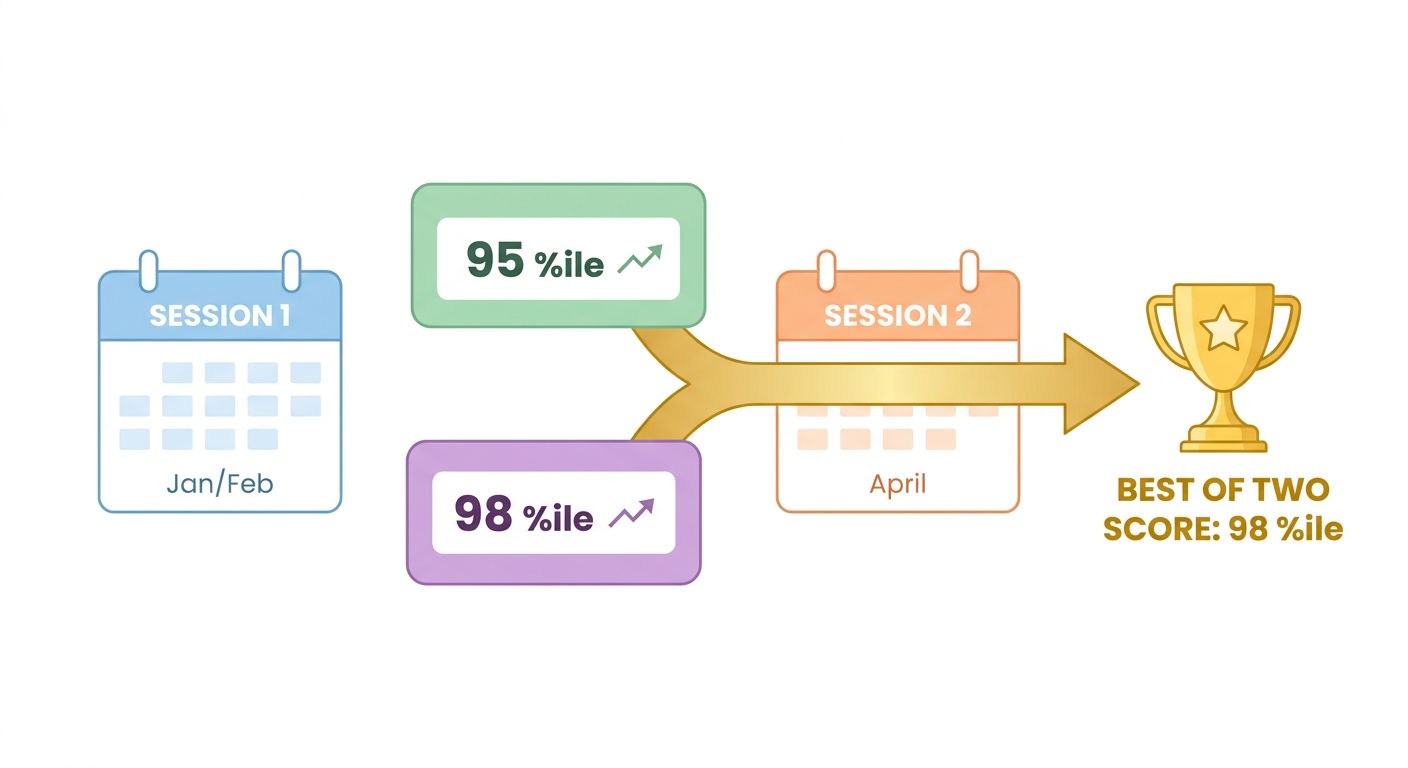
One of the best features of the modern JEE Main format is that it happens twice a year. Typically, Session 1 is held in January/February, and Session 2 is held in April. This isn't just to give you two dates to worry about. It's a huge strategic advantage.
Why two sessions? The NTA introduced this system to give students more flexibility and reduce stress. If you have a bad day during one exam, it's not the end of your dream. You have a second chance to prove yourself. This system allows you to appear in one or both sessions.
Here’s the best part: for your final rank, the NTA considers the best of your two scores. So, if you score a 95 percentile in Session 1 and a 98 percentile in Session 2, your final score will be the 98 percentile. This gives you a fantastic opportunity to learn from your mistakes in the first attempt and significantly improve your All India Rank (AIR).
JEE Main Eligibility Criteria: Are You In?
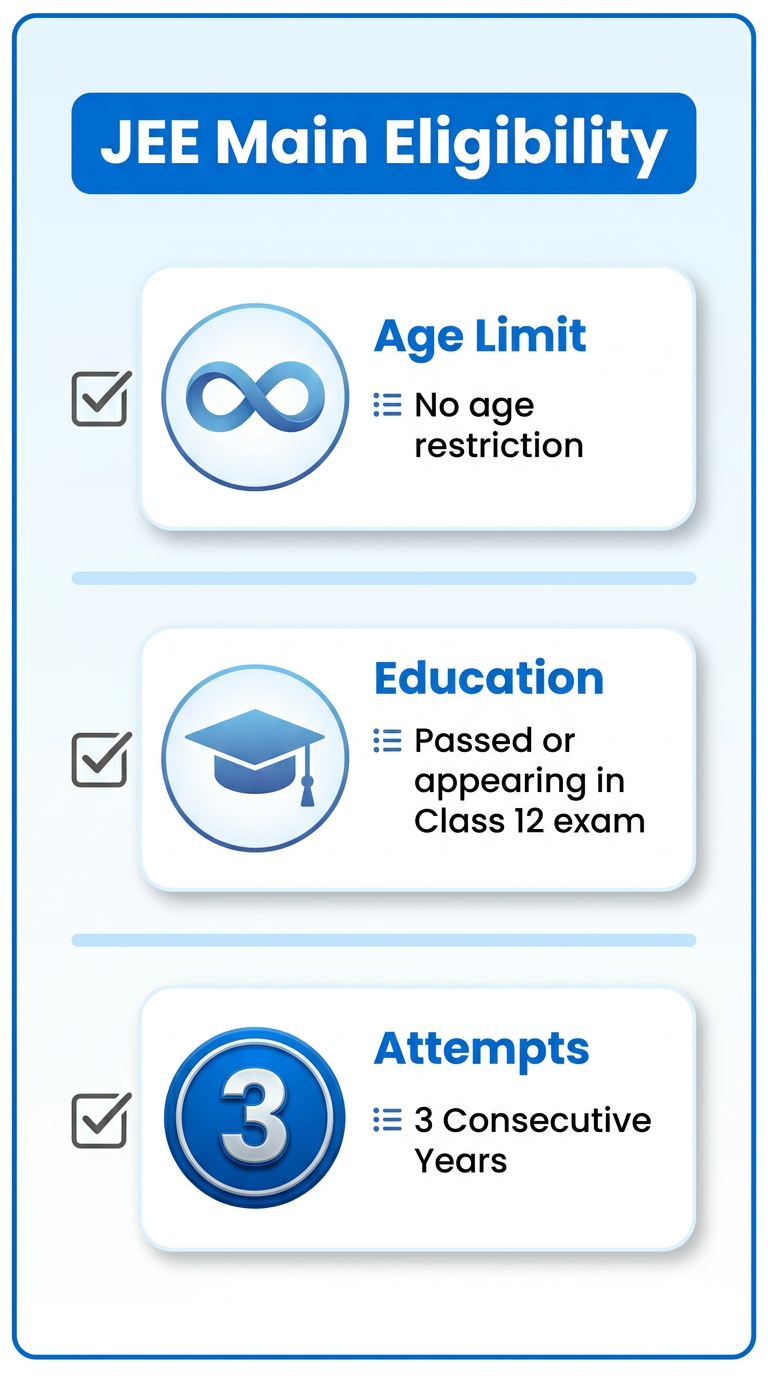
Before you dive into preparation, it's crucial to confirm you meet the eligibility criteria for JEE Main. The rules are quite specific, so let's break them down clearly. Missing a small detail here can cause big problems later.
Age Limit
Good news! There is no age limit for appearing in the JEE Main exam. As long as you meet the educational qualifications, you are eligible to apply. This flexibility helps students who may have taken a gap year or are from different educational timelines.
Educational Qualifications
To be eligible, you must have passed your Class 12 or an equivalent qualifying examination in the current year or the two preceding years. For most students, this means if you are applying for JEE Main 2025, you should have passed your Class 12 exam in 2023, 2024, or be appearing for it in 2025.
For B.E./B.Tech courses, it is mandatory to have passed Class 12 with Physics and Mathematics as compulsory subjects, along with either Chemistry, Biotechnology, Biology, or Technical Vocational subjects. For B.Arch and B.Planning, Mathematics is a compulsory subject.
Number of Attempts
A candidate can attempt the JEE Main for three consecutive years. For example, a student who appears for their Class 12 exam in 2025 can attempt JEE Main in 2025, 2026, and 2027. This provides ample opportunity to secure a good rank.
Cracking the JEE Main Exam Pattern
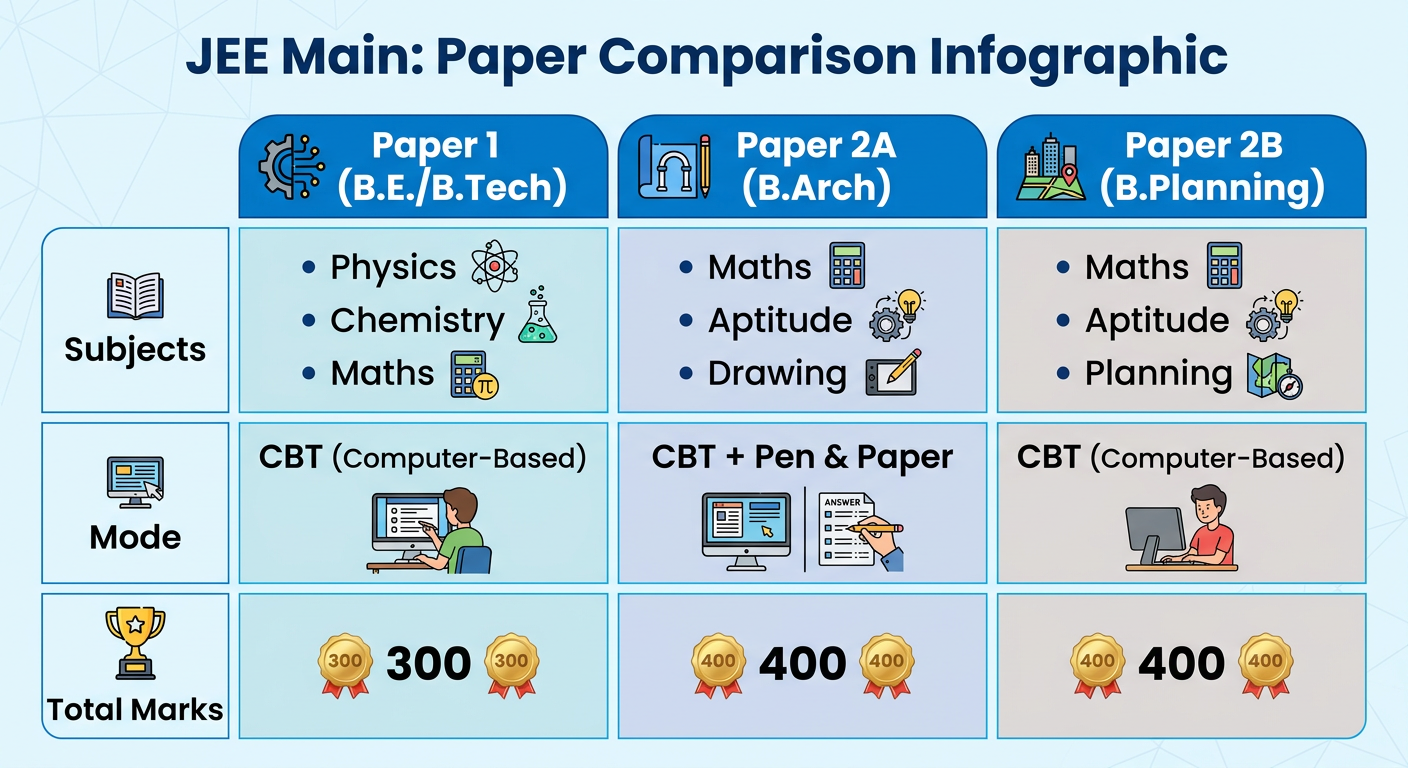
The JEE Main isn't a one-size-fits-all exam. It has different papers tailored for different undergraduate courses. Understanding the specific exam pattern for your target course is the foundation of a smart preparation strategy. Let's look at the structure of each paper.
Paper 1 (B.E./B.Tech): The Core Battle
This is the most popular paper, taken by lakhs of aspiring engineers. It is conducted entirely as a Computer-Based Test (CBT).
- Subjects: Physics, Chemistry, and Mathematics.
- Questions: Each subject has 30 questions (20 Multiple Choice Questions or MCQs, and 10 Numerical Answer Type or NAT questions). You only have to attempt any 5 of the 10 NAT questions.
- Marking Scheme: For MCQs, you get +4 marks for a correct answer and -1 for a wrong answer. For NAT questions, you get +4 for a correct answer and 0 marks for a wrong answer. There is no negative marking for NAT questions.
- Total Marks: The paper is for a total of 300 marks (100 per subject).
Paper 2A (B.Arch): Designing Your Future
For those who dream of designing buildings and spaces, this is the paper for you.
- Structure: It has three parts.
- Part I: Mathematics: 20 MCQs and 10 NAT questions (attempt any 5).
- Part II: Aptitude Test: 50 MCQs.
- Part III: Drawing Test: 2 questions.
- Mode: Part I and II are Computer-Based Tests. Part III is a pen-and-paper based test conducted on a drawing sheet.
- Total Marks: The paper is for a total of 400 marks.
Paper 2B (B.Planning): Shaping the World
This paper is for admission to Bachelor of Planning courses.
- Structure: It also has three parts.
- Part I: Mathematics: 20 MCQs and 10 NAT questions (attempt any 5).
- Part II: Aptitude Test: 50 MCQs.
- Part III: Planning-Based Questions: 25 MCQs.
- Mode: This entire paper is conducted as a Computer-Based Test.
- Total Marks: This paper is also for a total of 400 marks.
The Complete JEE Main Syllabus Breakdown
Knowing the syllabus is like having a map of the battlefield. The JEE Main syllabus is extensive, covering topics from both Class 11 and Class 12 CBSE curriculum. A thorough understanding of what to study (and what not to) is essential.
The syllabus for Paper 1 (B.E./B.Tech) is broadly divided into Physics, Chemistry, and Mathematics.
-
Physics: Major units include Mechanics, Electrodynamics, Optics, Thermodynamics, and Modern Physics. Questions are a mix of theoretical concepts and numerical problems, requiring a strong grasp of fundamentals.
-
Chemistry: The syllabus is split into Physical, Organic, and Inorganic Chemistry. You'll need to memorize reactions and properties in Inorganic, understand mechanisms in Organic, and be quick with formulas in Physical Chemistry.
-
Mathematics: This section tests your problem-solving skills across Calculus, Algebra, Coordinate Geometry, Trigonometry, and Vectors & 3D Geometry. Speed and accuracy are paramount.
For a detailed list of every topic and sub-topic, it's best to refer to the official documents. You can check the detailed JEE Main syllabus here on our resources page. The syllabus for the Aptitude and Drawing/Planning sections of Paper 2 is also specified by the NTA and focuses on awareness, visualization, and analytical skills.
The JEE Main Registration and Application Process
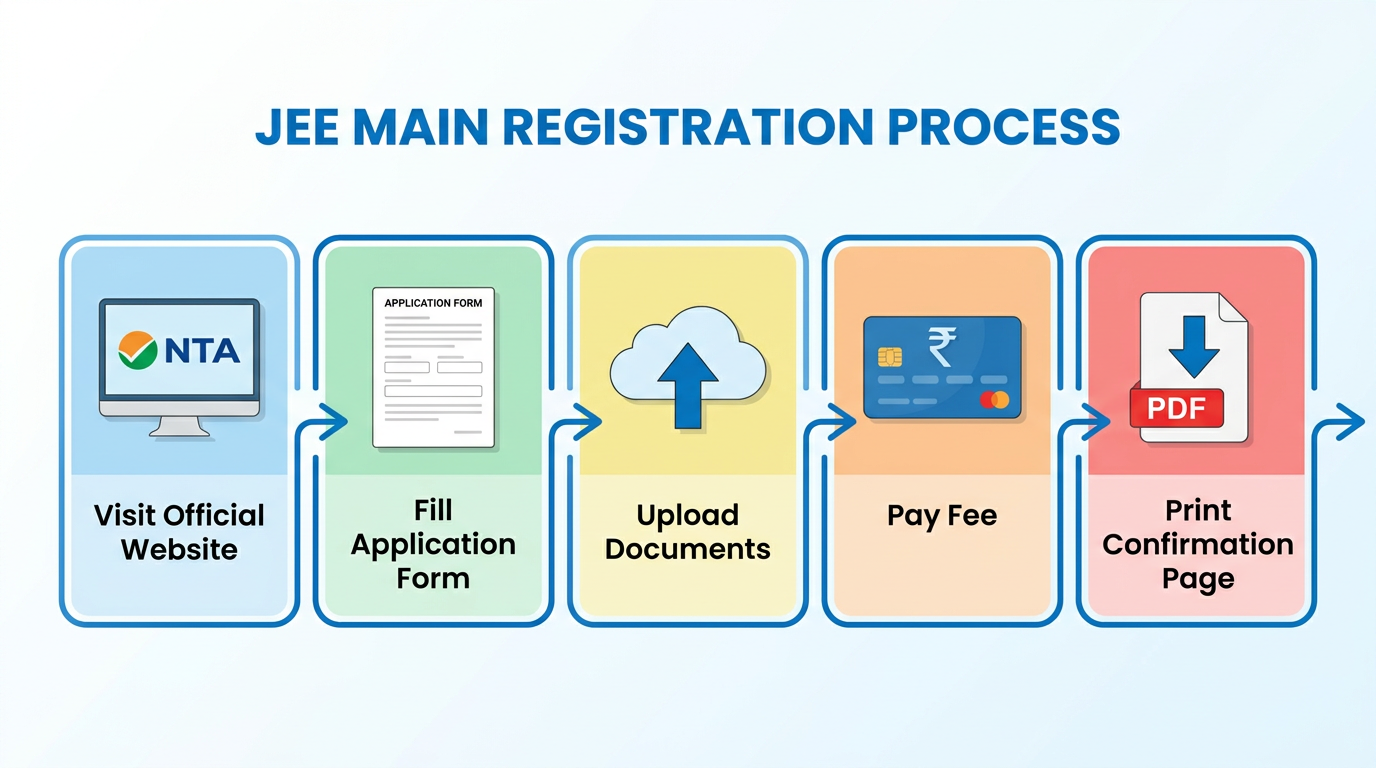
Filling out the JEE Main registration form correctly is the first official step in your exam journey. The process is entirely online and happens through the official NTA website. Follow these steps carefully to avoid any last-minute issues.
-
Visit the Official Website: Head to the official NTA JEE Main portal at https://jeemain.nta.nic.in/. This is the only authentic source for applications.
-
Register and Fill Details: Click on the 'New Candidate Registration' link. You'll create a login and password. Then, proceed to fill out the application form with your personal details, academic qualifications, and contact information. Be extremely careful and double-check every entry.
-
Upload Scanned Documents: You will be asked to upload recent, clear scanned copies of your photograph and signature. Make sure they meet the size and format specifications mentioned in the information bulletin.
-
Pay the Application Fee: The fee must be paid online via debit card, credit card, net banking, or UPI. The amount varies based on your category, gender, and the papers you choose to appear for.
-
Print Confirmation Page: After successful payment, a confirmation page will be generated. Download, save, and print this page for your records. It is proof that your application has been submitted.
From Admit Card to Exam Day
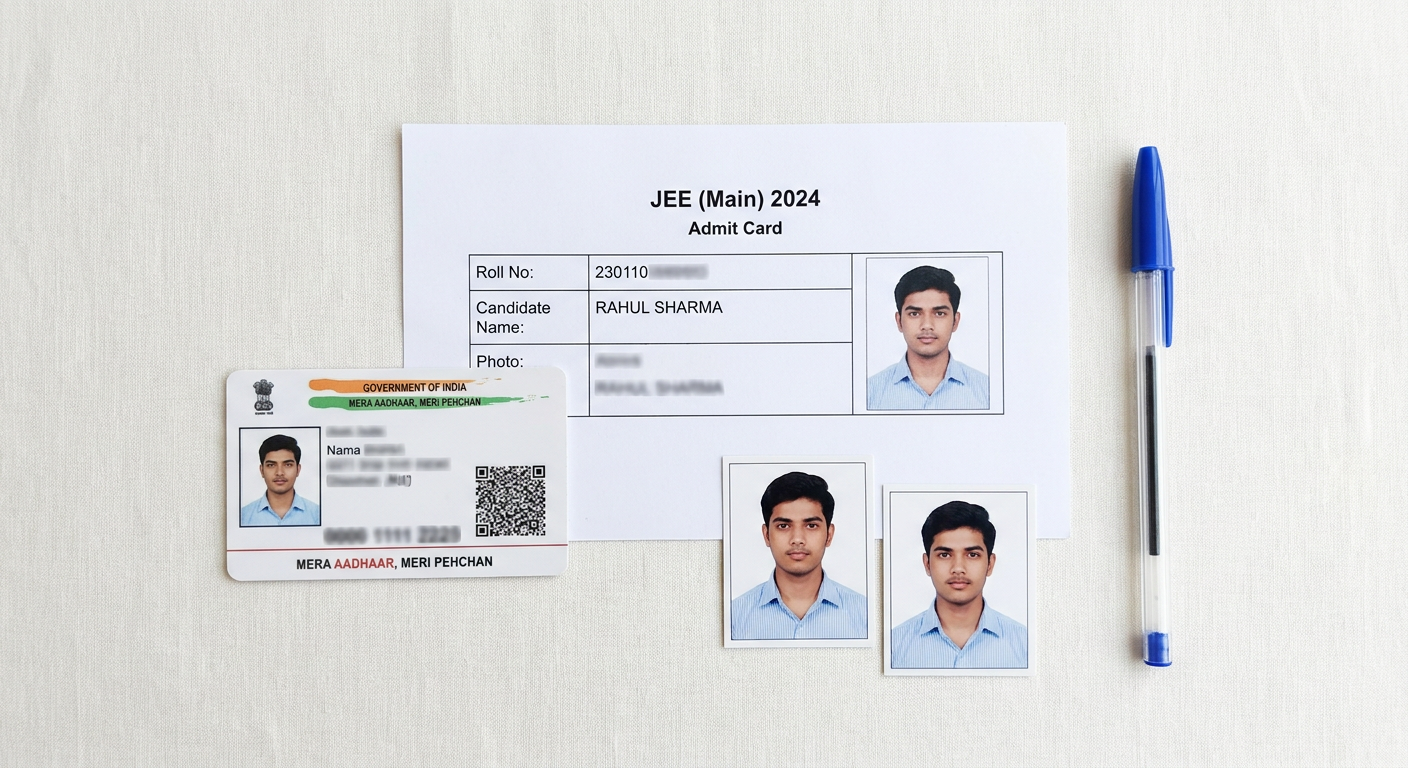
As the exam date approaches, the focus shifts from preparation to execution. A key document in this phase is your JEE Main admit card. It is your ticket into the examination hall.
The admit card is typically released on the NTA website a few days before the exam. You must download it, print it out (preferably in color), and check all the details: your name, photograph, signature, roll number, exam center address, date, and shift timing. Any discrepancy should be reported to the NTA immediately.
On exam day, plan to reach the center at least 90 minutes before the reporting time. This gives you a buffer for traffic and security checks. You must carry:
- A printed copy of your admit card.
- A valid original photo ID proof (Aadhaar, Passport, Voter ID, etc.).
- A passport-sized photograph (the same one you uploaded in the application).
Do not carry any electronic gadgets, bags, or study materials inside. Following the rules ensures a smooth and stress-free experience, letting you focus completely on the test.
Decoding Your JEE Main Result and Scorecard
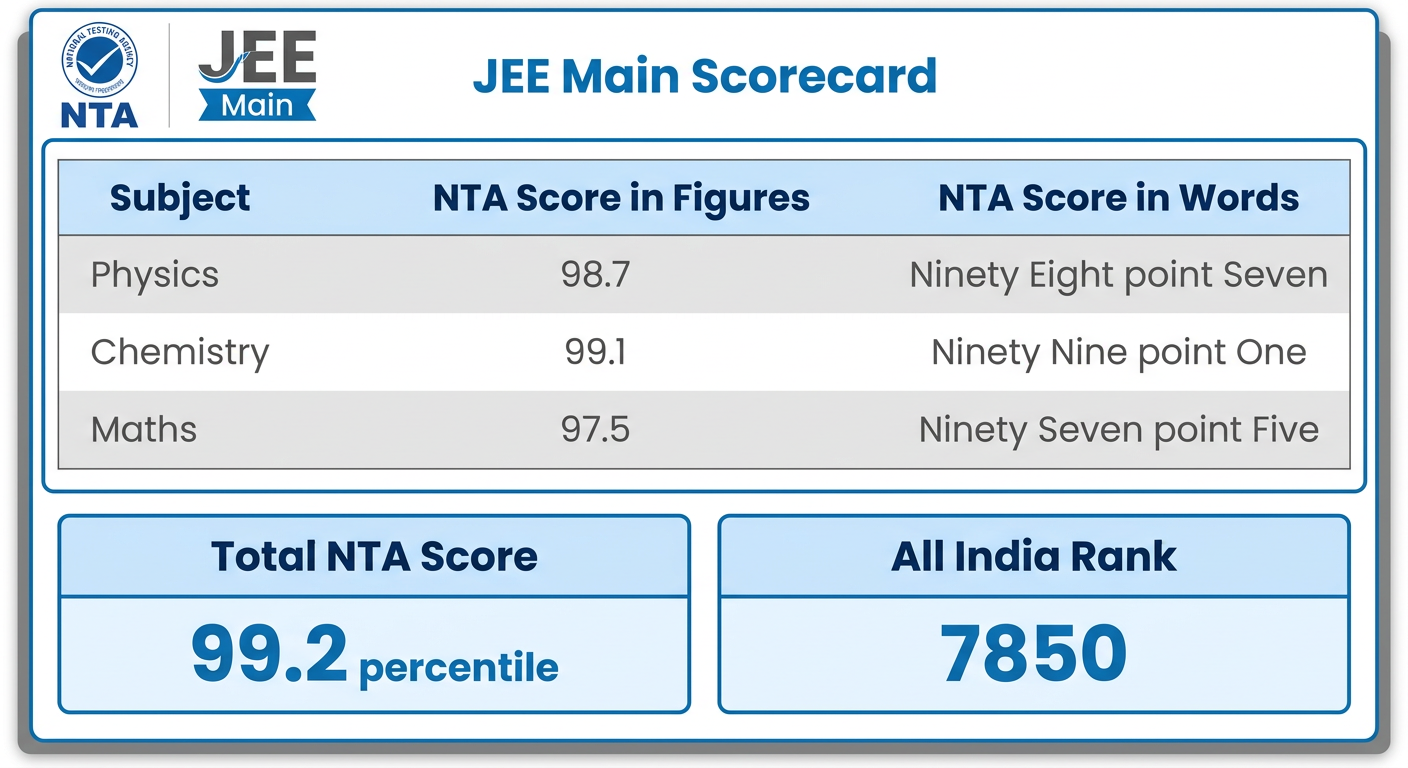
After weeks of anticipation, the NTA declares the JEE Main result. The result isn't just a set of marks; it's a detailed performance analysis presented as a scorecard. Understanding it is key to planning your next steps.
Your score is given as a percentile, not raw marks. This is called the NTA Score. A percentile score indicates the percentage of candidates that have scored equal to or below you. This method, called normalization, is used to ensure fairness because the exam is conducted in multiple shifts with slightly different difficulty levels. Your raw marks are converted into a percentile to provide a level playing field.
Your scorecard will show:
- Percentile scores for Physics, Chemistry, and Mathematics individually.
- A total NTA percentile score.
- Your All India Rank (AIR), which is declared after both sessions are complete.
You can check your results on the NTA website using your application number and date of birth. To get an idea of your potential rank even before the results are out, you can use tools like a JEE rank predictor tool.
What's Next? Counselling and Admission
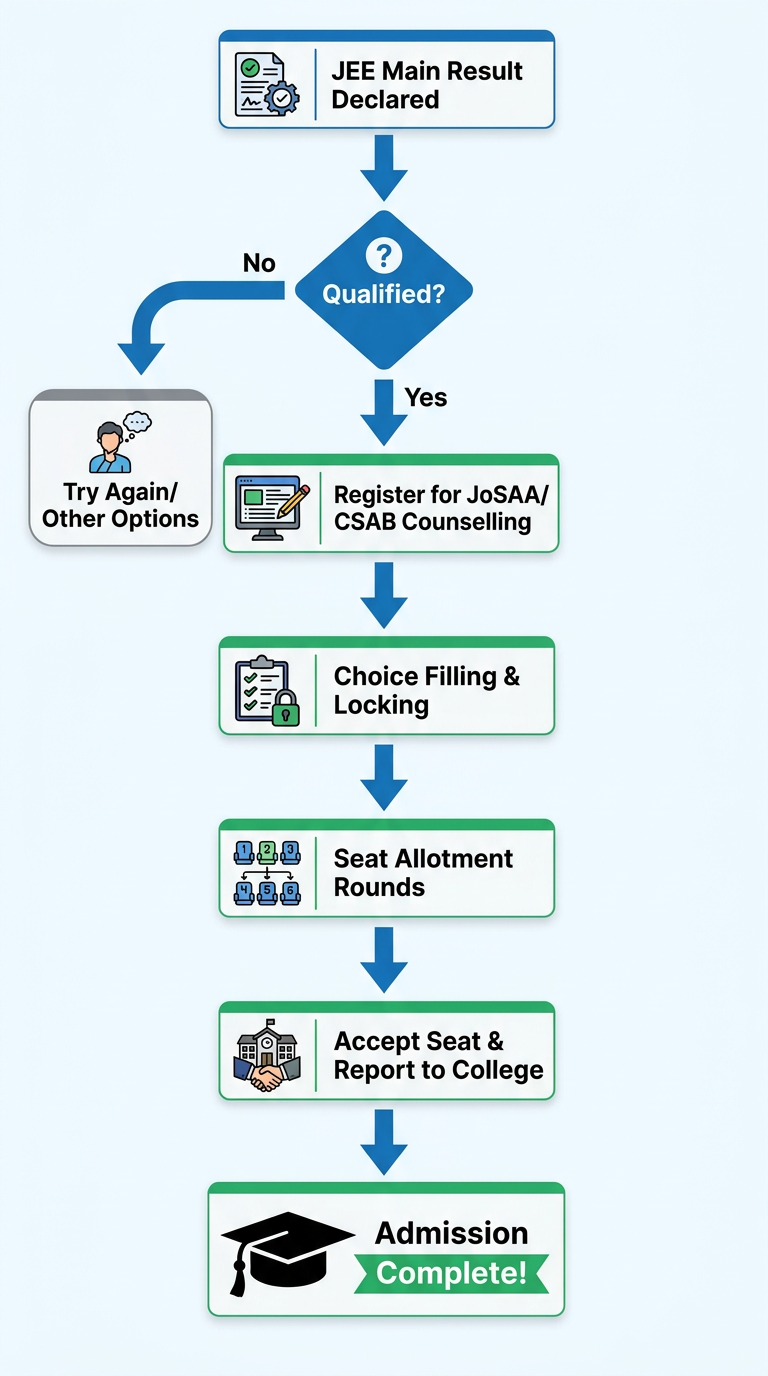
Scoring well in JEE Main is a huge achievement, but the journey isn't over. The next crucial phase is the counselling and seat allocation process, which determines which college and branch you get.
The main counselling body for NITs, IIITs, GFTIs, and even IITs is the Joint Seat Allocation Authority (JoSAA). If you have qualified for JEE Main (for NIT+ system) or both Main and Advanced (for IITs), you must register for JoSAA counselling. Students who qualify for JEE Advanced are eligible for admission to the prestigious IITs, and you can find more information on the official JEE Advanced site.
The JoSAA process involves several rounds:
- Registration: You register on the JoSAA portal.
- Choice Filling: This is the most critical step. You fill in your preferred choices of colleges and branches in descending order of priority.
- Seat Allotment: Based on your AIR, category, and filled choices, you will be allotted a seat in one of the rounds.
- Acceptance/Reporting: Once a seat is allotted, you must accept it online and report to the institute for document verification and admission confirmation.
After JoSAA rounds are complete, a separate Central Seat Allocation Board (CSAB) counselling is often held to fill any remaining vacant seats in the NIT+ system.
Effective Preparation Strategy for JEE Main
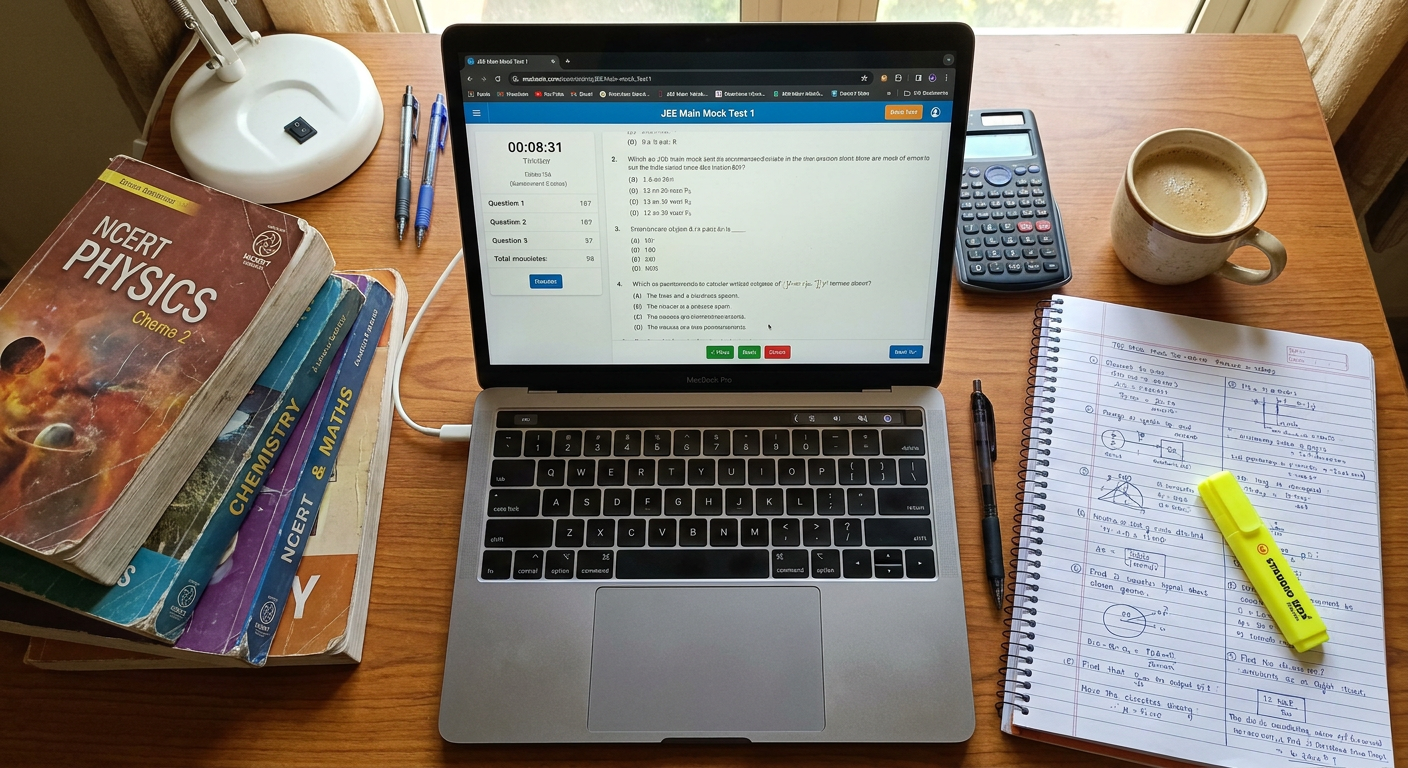
Every JEE topper has a unique story, but their strategies share common pillars. A disciplined approach, smart work, and consistency are what separate the successful from the rest. Here is a practical strategy to help you conquer JEE Main.
Master the Fundamentals
Before you jump to complex reference books, master your NCERT textbooks for Class 11 and 12. They form the bedrock of the JEE syllabus. A significant portion of questions in the exam, especially in Chemistry, are directly based on NCERT concepts.
Practice with Purpose
Theory is useless without application. Solve as many problems as you can, but do it with purpose. The best source for this is Previous Year Questions (PYQs). Analyzing and solving PYQs gives you the clearest picture of the exam pattern, important topics, and difficulty level. We have a great collection you can use to practice with PYQs.
The Power of Mock Tests
Mock tests are your dress rehearsal for the final exam. They help you build stamina, manage time effectively, and identify your weak areas. Take at least one full-length mock test every week in the final months of preparation. Analyze your performance after every test to understand your mistakes and work on improving them.
Revision is Key
With such a vast syllabus, you are bound to forget things. Regular revision is non-negotiable. Create short notes, mind maps, and formula sheets for quick review. Dedicate the last 1-2 months before the exam exclusively to revision and taking mock tests. Smart revision is what will help you recall information accurately under pressure.
FAQs
How many times can I attempt JEE Main?
A candidate can attempt the JEE Main exam for three consecutive years starting from the year they pass their Class 12 or equivalent examination.
Is there a 75% criteria in Class 12 for JEE Main?
For admission to NITs, IIITs, and GFTIs, candidates need to meet certain performance criteria in their Class 12 board exams. Historically, this has been 75% aggregate marks (65% for SC/ST). However, this rule is subject to change by the authorities, so always check the latest information bulletin on the official NTA website.
What is the difference between JEE Main and JEE Advanced?
JEE Main is the first level exam for admission to NITs, IIITs, and GFTIs. It also acts as the qualifying exam for JEE Advanced. JEE Advanced is the second level, more challenging exam, which is the sole basis for admission into the Indian Institutes of Technology (IITs).
Which paper should I choose: Paper 1, 2A, or 2B?
Choose the paper based on your career goals. If you want to pursue a B.E. or B.Tech degree, appear for Paper 1. If you are interested in Architecture, choose Paper 2A (B.Arch). If you wish to study Urban and Regional Planning, opt for Paper 2B (B.Planning).
Is NCERT enough for JEE Main preparation?
NCERT books are essential and form the foundation for JEE Main. For Chemistry, they are often considered sufficient. However, for Physics and Mathematics, while NCERT is crucial for building concepts, you will need to supplement it with other reference books and extensive problem-solving from PYQs and mock tests to achieve a top rank.
How is the NTA percentile score calculated?
The NTA Percentile Score is calculated using a formula that indicates the percentage of candidates who scored equal to or below a particular candidate in that session. The formula is: (100 * Number of candidates with raw score equal to or less than the candidate) / Total number of candidates who appeared in that session. This normalization ensures fairness across different exam shifts.