JEE Advanced 2026: Women's Qualification Rate Highest In Six Years, Above 10,000 Qualify - NDTV
Your complete guide to the JEE Advanced exam. Understand the paper pattern, syllabus, eligibility, cutoffs, and the ultimate strategy to secure a seat in an IIT.
19 min read
JEE Advanced: The Ultimate Guide to Cracking IIT
Think of your JEE journey like a video game. You've battled through the early levels, collected your power-ups in Class 11 and 12, and just defeated the mid-level boss: JEE Main. Now, you stand before the final stage. The music changes. This is the ultimate challenge, the one that separates the players from the champions. This is the JEE Advanced.
Only the top 2.5 lakh students who conquer JEE Main even get a ticket to this arena. It's the one and only gateway to a seat in the prestigious Indian Institutes of Technology (IITs). The questions are tougher, the competition is fiercer, and the stakes are higher than ever before.
But here's an inspiring thought. Every year, thousands of students just like you crack this exam. In fact, recent trends show an increasing number of female candidates qualifying, with over 10,000 clearing the exam in 2024, the highest in six years! This shows that with the right strategy and relentless effort, the IIT dream is achievable.
This guide is your complete map for that final level. We'll break down everything you need to know about the JEE Advanced, from the paper pattern and syllabus to the preparation strategy that will give you the winning edge.
What is the JEE Advanced Exam?
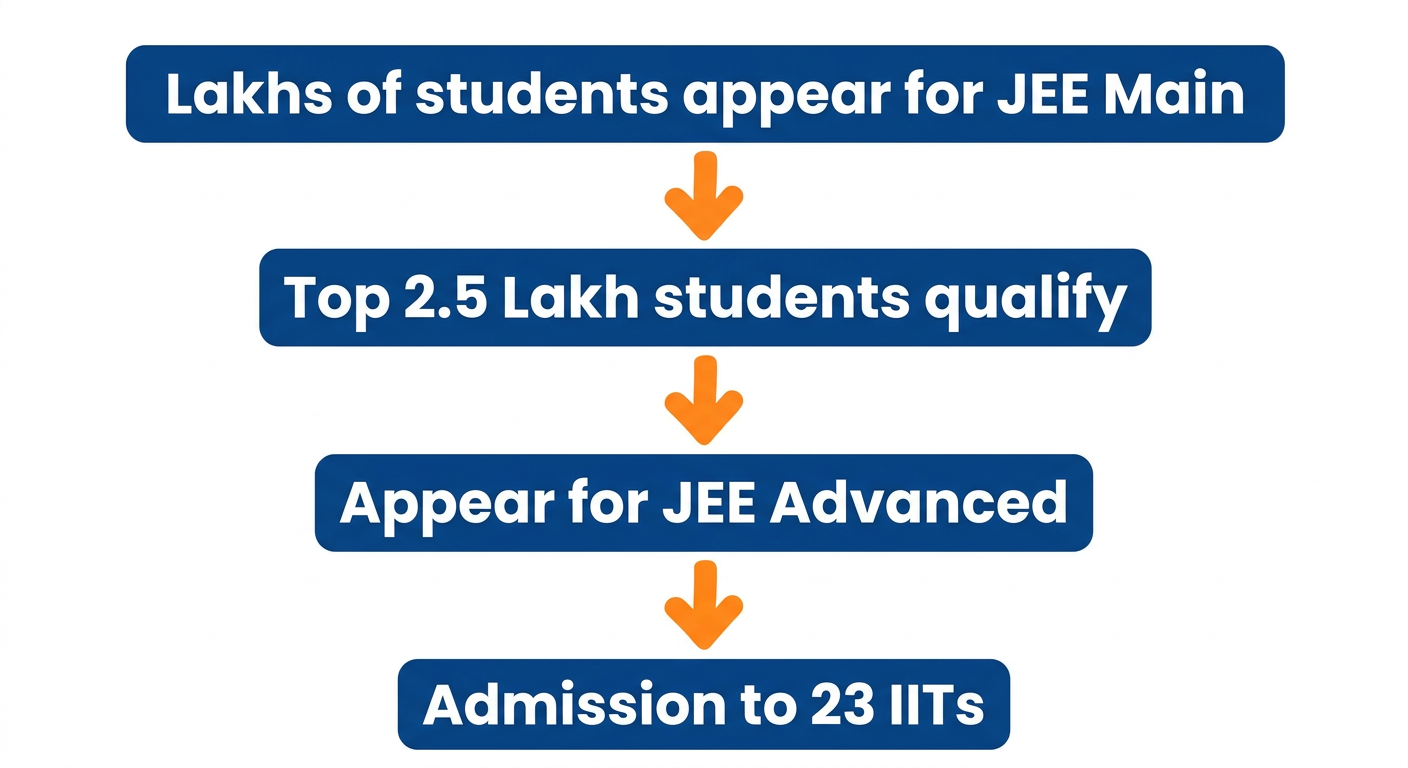
The JEE Advanced is the second and final stage of the Joint Entrance Examination. Its sole purpose is to select the brightest minds for admission into the undergraduate engineering, science, and architecture programs at the 23 IITs across India. It is one of the most challenging engineering entrance exams globally.
Unlike JEE Main, which is conducted by the National Testing Agency (NTA), the JEE Advanced is conducted by one of the seven zonal IITs (Kharagpur, Kanpur, Madras, Delhi, Bombay, Guwahati, or Roorkee) on a rotational basis. This rotation often brings subtle changes in the exam's flavour each year.
Think of the two exams this way: JEE Main tests your breadth of knowledge and speed across a wide syllabus. JEE Advanced tests the depth of your understanding. It's not about how much you know, but how well you can apply your concepts to solve complex, multi-layered problems you've likely never seen before.
Successfully clearing this exam opens the doors to a world-class education and an unparalleled learning environment. But before you can even think about the exam, you need to make sure you're eligible to write it.
JEE Advanced Eligibility Criteria: Are You in the Race?
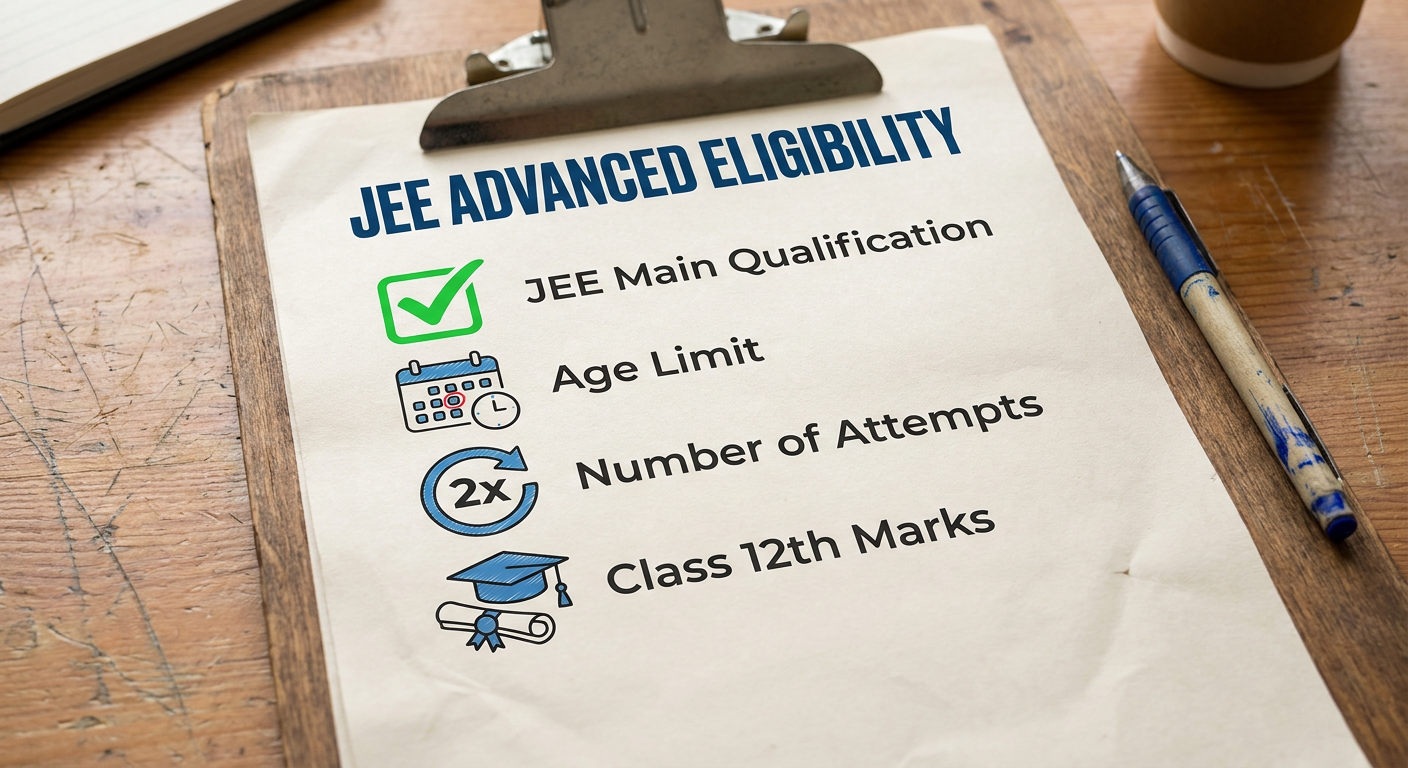
Getting a chance to sit for the JEE Advanced isn't a given. You have to earn it by clearing a specific set of eligibility criteria. Missing even one of these can mean waiting another year, so pay close attention.
Performance in JEE Main
This is the first and most important hurdle. You must be among the top 2,50,000 successful candidates (including all categories) in Paper 1 of the JEE Main exam. This cutoff is decided by the NTA and includes a specific number of candidates from each category (General, EWS, OBC-NCL, SC, ST, and PwD).
Keep a close eye on the official JEE Main NTA website for the exact cutoff marks after the results are declared. This is your entry pass.
Age Limit
There's an age limit for appearing in the exam. Candidates should have been born on or after October 1, 1999. For SC, ST, and PwD candidates, there is a five-year relaxation, meaning their birth date should be on or after October 1, 1994. Make sure you check the official information bulletin for the specific year you are appearing.
Number of Attempts
This is a strict rule. A candidate can attempt the JEE Advanced a maximum of two times in two consecutive years. This means if you are appearing for your Class 12th board exams this year, you have this attempt and the next one. That's it. This makes each attempt incredibly valuable.
Class 12th Performance
Along with your entrance exam performance, your board exam marks matter. A candidate must have appeared for the Class 12 (or equivalent) examination for the first time in either the previous year or the current year.
Furthermore, you need to satisfy one of two conditions for admission to IITs:
- You must have secured at least 75% aggregate marks in your Class 12 board exam (65% for SC, ST, and PwD candidates).
- You must be within the top 20 percentile of successful candidates in your respective Class 12 board.
This rule was relaxed during the pandemic years but has been reinstated. Always check the latest official JEE Advanced brochure for the most current information regarding this criterion.
Understanding the JEE Advanced Paper Pattern
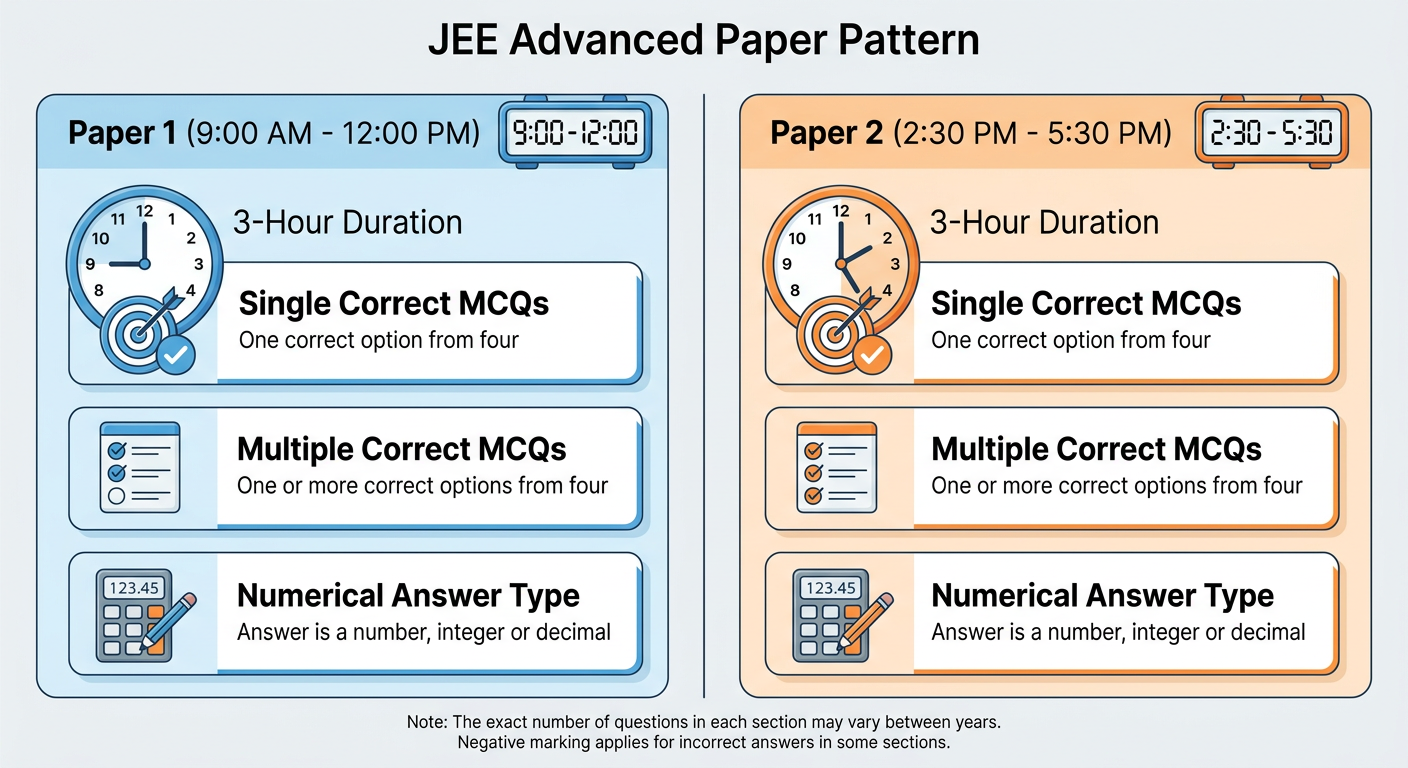
Brace yourself, because the JEE Advanced paper pattern is designed to be unpredictable. It changes almost every year, testing your adaptability as much as your knowledge. However, the core structure remains consistent.
The exam consists of two compulsory papers: Paper 1 and Paper 2. Both papers are three hours long and are usually held on the same day with a break in between. You must appear for both papers; if you miss one, your result will not be evaluated. Each paper covers all three subjects: Physics, Chemistry, and Mathematics.
The real challenge lies in the types of questions. The organizing IIT has complete freedom to introduce new question formats, change the marking scheme, and vary the number of questions. This unpredictability is a key feature of the exam.
Types of Questions You Will Face
While new formats can appear, some question types are quite common. Mastering the strategy for each is crucial.
-
Single Correct Option (MCQs): The classic multiple-choice question where only one option is correct. These are generally the most straightforward but can still be tricky. Negative marking is common here.
-
Multiple Correct Options (MCQs): These are the real rank-deciders. A question can have one or more correct options, and you get full marks only if you select all the correct options and no incorrect ones. Partial marking schemes are often used, but they can be complex and come with negative marking for wrong choices.
-
Numerical Answer Type (NAT): For these questions, you won't have any options. You have to solve the problem and enter a numerical value as your answer, often rounded to a certain decimal place. The best part? There's usually no negative marking for these, making them a scoring opportunity if you are confident in your calculation.
-
Paragraph/Comprehension Based Questions: A paragraph describing a scenario is given, followed by two or three questions based on it. These test your ability to comprehend and apply concepts in a given context.
-
Matrix Match (Match the Following): These questions require you to match items in one column with items in another. They can be simple one-to-one matches or more complex one-to-many matches.
The marking scheme is as variable as the question types. Pay close attention to the instructions on your screen at the start of each section. Misunderstanding the negative marking rules can cost you dearly.
The AAT (Architecture Aptitude Test)
For students aspiring to join the Bachelor of Architecture (B.Arch) program at IIT Kharagpur, IIT Roorkee, or IIT (BHU) Varanasi, there's one more step. You first need to qualify JEE Advanced and then appear for the Architecture Aptitude Test (AAT).
The AAT is a paper-based test that assesses your aptitude for architecture, including freehand drawing, geometrical drawing, and three-dimensional perception. It is a pass/fail test, and no separate rank list is prepared for it.
Decoding the JEE Advanced Syllabus: What to Study?
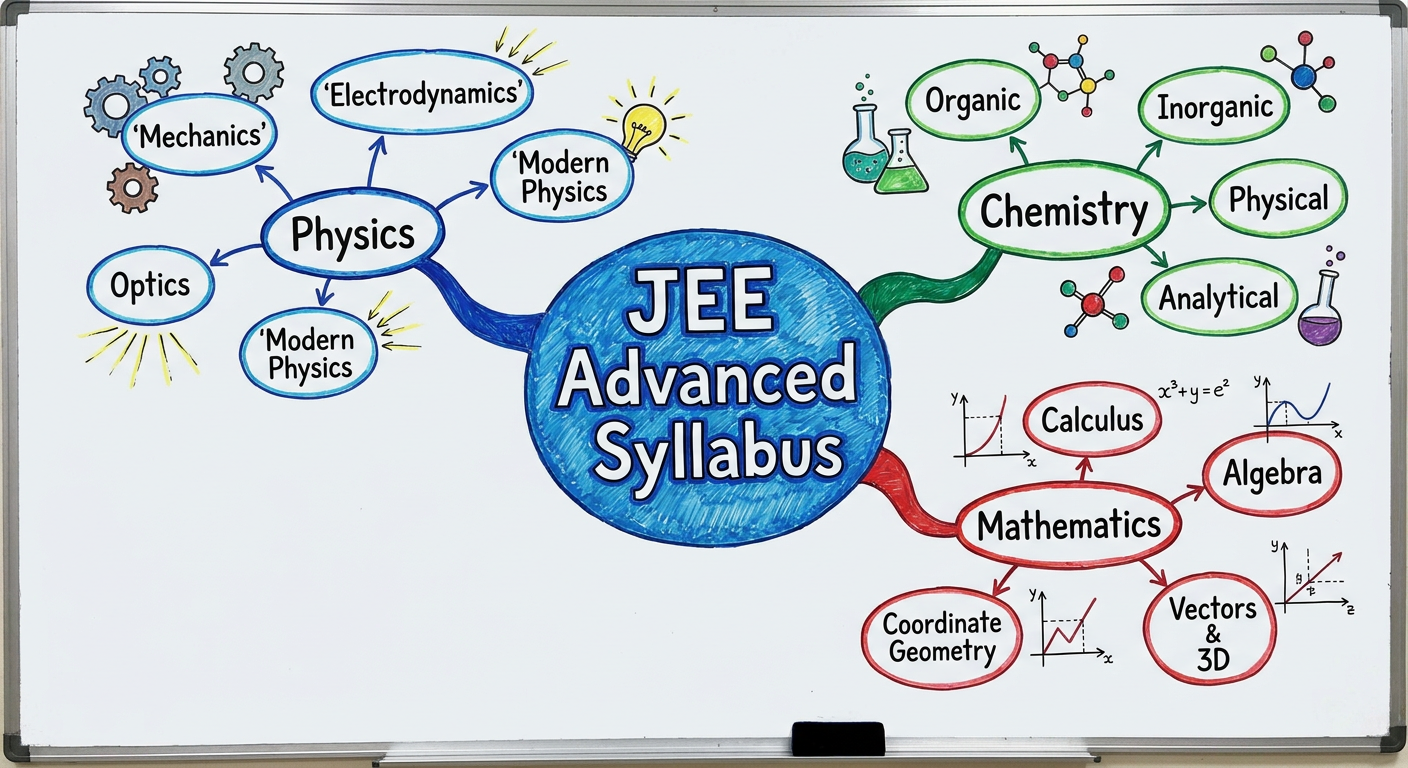
At first glance, the JEE Advanced syllabus looks very similar to the JEE Main syllabus. It's based on the same topics from Class 11 and 12 Physics, Chemistry, and Mathematics. But don't be fooled. The difference is in the depth and application.
JEE Advanced questions are rarely direct. They often mix concepts from two or more different chapters to create a unique problem. For example, a question in Physics might combine principles from both Electromagnetism and Mechanics. To succeed, you need a crystal-clear understanding of the fundamentals and the ability to see the connections between different topics.
While you should cover the entire syllabus, focusing on high-weightage topics is a smart strategy. You can find a detailed breakdown on our JEE syllabus page.
Physics Syllabus Highlights
Physics in JEE Advanced is all about application. Rote learning formulas won't get you far. You need to understand the 'why' behind every concept.
- Mechanics: This is the backbone of Physics. Topics like Rotational Motion, Work-Energy-Power, and Simple Harmonic Motion are extremely important. Expect complex problems involving multiple bodies and constraints.
- Electrodynamics: This is another massive, high-weightage unit. From Electrostatics and Current Electricity to Magnetism and EMI, the concepts are vast and often tested in combination.
- Optics: Both Geometrical and Wave Optics are crucial. Questions are often conceptually tricky and require strong visualization skills.
- Modern Physics: Topics like Dual Nature of Matter, Atoms, and Nuclei are relatively easier to score in. The questions are often formula-based but can be twisted.
- Thermodynamics & KTG: A very important section. Questions can be both numerical and theoretical, testing your understanding of laws and processes.
Chemistry Syllabus Highlights
Chemistry is often considered the most scoring subject in JEE Advanced, provided you have a balanced preparation across all three sections.
-
Physical Chemistry: This section is calculation-intensive. Chapters like Chemical Equilibrium, Ionic Equilibrium, Electrochemistry, and Chemical Kinetics are perennial favorites. Accuracy in calculations is key.
-
Organic Chemistry: This requires deep understanding, not just memorization. Focus on General Organic Chemistry (GOC), reaction mechanisms, and named reactions. Questions often test the application of these mechanisms on unfamiliar substrates.
-
Inorganic Chemistry: Many students fear this section, but it can be a goldmine of marks. NCERT is your bible here. Chapters like Chemical Bonding, p-Block Elements, and Coordination Compounds are extremely important. Regular revision is the only way to retain the vast amount of information.
Mathematics Syllabus Highlights
Maths in JEE Advanced is known for being lengthy and tough. It tests your problem-solving skills, patience, and ability to think out of the box.
- Calculus: This is the largest and most important unit. Differential and Integral Calculus, including their applications like Maxima-Minima and Area under Curves, form a huge chunk of the paper.
- Algebra: Chapters like Quadratic Equations, Complex Numbers, and Permutations & Combinations are fundamental. Probability questions are often tricky and require careful reading.
- Coordinate Geometry: Conic Sections (Parabola, Ellipse, Hyperbola) and Straight Lines are very important. The questions are often lengthy and require a strong command of standard properties.
- Vectors & 3D Geometry: This is a very scoring topic. The concepts are limited, and with enough practice, you can solve most questions accurately.
- Trigonometry: While direct questions are fewer, the formulas and properties of trigonometry are used extensively in Calculus and other topics.
Crafting Your Preparation Strategy for JEE Advanced
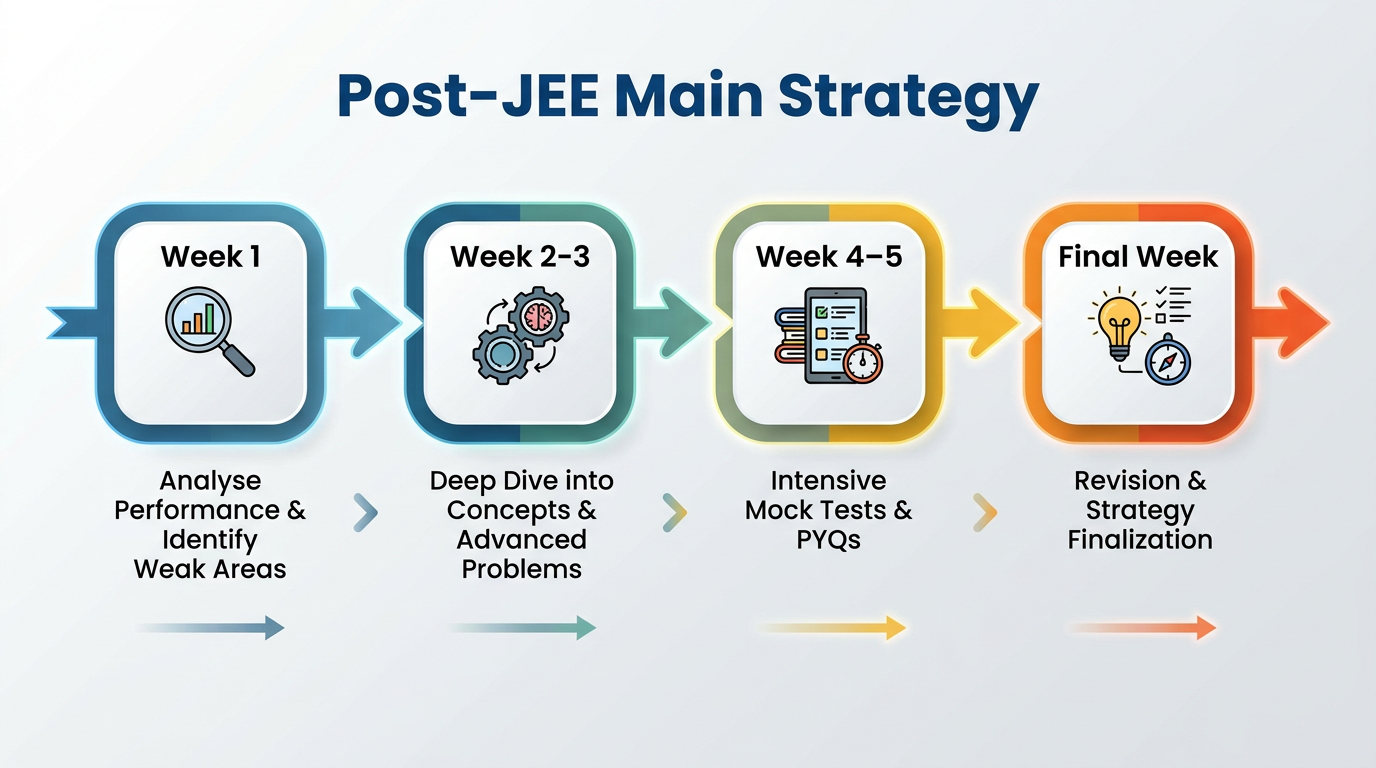
Preparation for JEE Advanced is a marathon, not a sprint. It requires a different mindset compared to JEE Main. The time between your JEE Main result and the JEE Advanced exam is crucial, and how you use it can make all the difference.
From JEE Main to JEE Advanced: Shifting Gears
Your preparation must evolve. While JEE Main rewards speed and accuracy across a broad range of questions, JEE Advanced rewards depth, patience, and analytical thinking.
First, take a deep breath and analyze your JEE Main performance. Identify your weak topics and conceptual gaps. The JEE Advanced will exploit these weaknesses mercilessly. Your goal is not to learn new topics from scratch but to deepen your understanding of the ones you already know.
Shift your problem-solving approach. Instead of trying to solve 30 questions in an hour, focus on solving 10 really good questions in that same hour. Quality trumps quantity now. Pick problems that force you to think and combine multiple concepts.
Subject-Wise Study Plan
A tailored approach for each subject will yield the best results.
-
Physics: Focus on building impeccable conceptual clarity. Read a standard textbook like H.C. Verma or Resnick-Halliday not just for the formulas but for the explanations. After reading a chapter, try to derive all the important formulas yourself. Solve a variety of problems, starting from basic applications to complex, multi-concept questions.
-
Chemistry: For Physical Chemistry, practice is paramount. Solve as many numerical problems as you can to improve your speed and accuracy. For Organic, create a notebook of all reaction mechanisms and named reactions. Don't just memorize them; understand how the electrons move. For Inorganic, make NCERT your best friend. Read it multiple times and make short notes for quick revision.
-
Mathematics: Practice is the only mantra for Maths. The more problems you solve, the better you get at recognizing patterns and choosing the right approach. Focus on solving problems from standard books like Cengage or Arihant series. Time yourself while solving to simulate exam conditions.
The Power of Mock Tests and PYQs
This is perhaps the most critical part of your preparation. Mock tests and Previous Year Questions (PYQs) are your best tools for understanding the exam's reality.
Start taking full-length mock tests designed for the JEE Advanced level. Take at least one test every 3-4 days. This builds stamina for the two 3-hour papers on a single day. After each test, spend more time analyzing your performance than you spent writing the test. Ask yourself: Which topics am I weak in? Did I make conceptual errors or silly calculation mistakes? Did I manage my time well?
Solving previous year questions is non-negotiable. It gives you the most authentic feel of the exam's difficulty level and question style. Try to solve the last 10-15 years of papers in a timed environment. This will build your confidence and help you develop a sound exam-taking strategy.
Recommended Books for IIT JEE Preparation
While your coaching material is important, referring to standard textbooks can build a strong foundation. Here are a few classics:
- Physics: Concepts of Physics by H.C. Verma, Fundamentals of Physics by Halliday, Resnick, and Walker, Problems in General Physics by I.E. Irodov (for advanced problem practice).
- Chemistry: NCERT textbooks (especially for Inorganic), Physical Chemistry by O.P. Tandon, Organic Chemistry by Morrison and Boyd or Solomon & Fryhle, Concise Inorganic Chemistry by J.D. Lee.
- Mathematics: Objective Mathematics by R.D. Sharma, Mathematics for JEE Main & Advanced series by Cengage/Arihant, Higher Algebra by Hall and Knight.
JEE Advanced Cutoff and Ranking System Explained
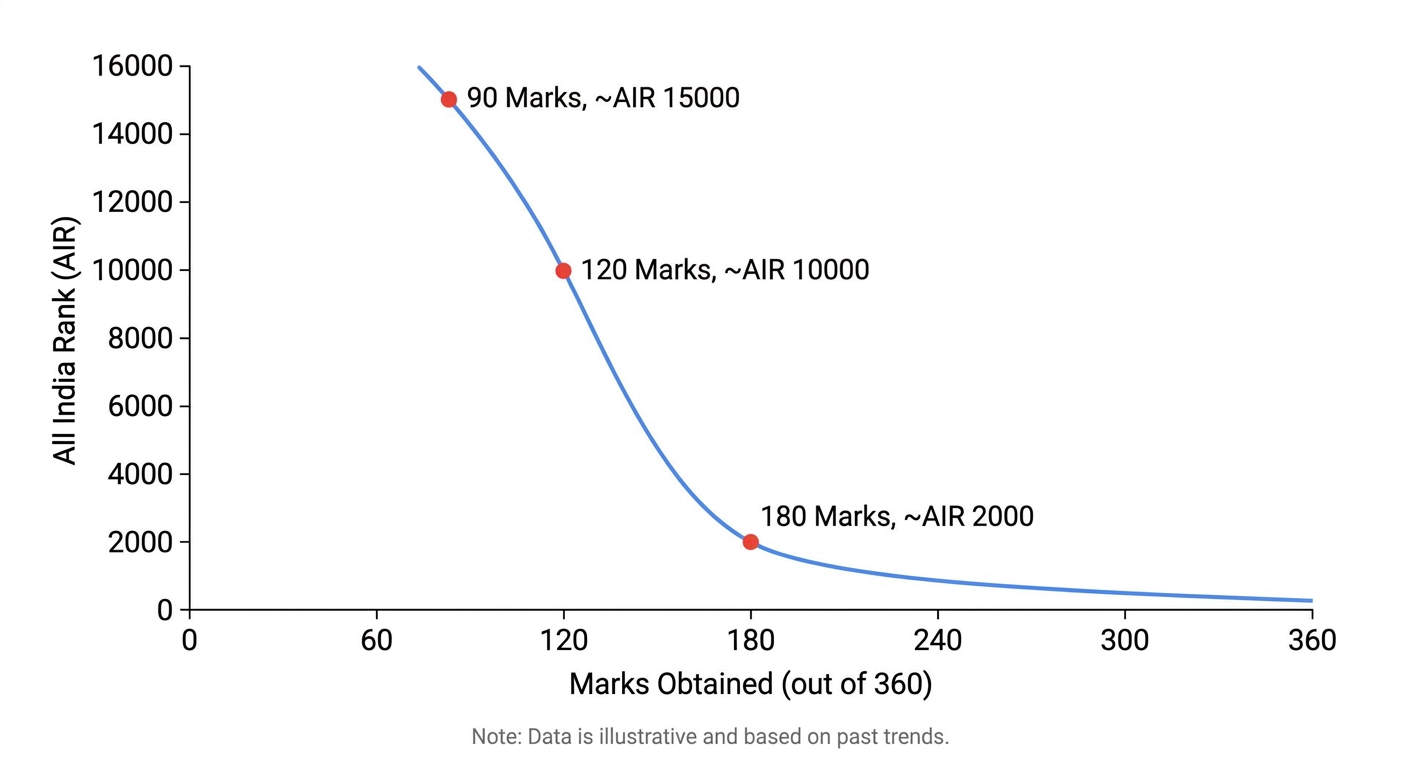
Understanding how you are evaluated is just as important as preparing for the exam. The JEE Advanced ranking system has a few layers to it, including qualifying cutoffs and admission cutoffs.
First, to even be included in a rank list, you need to clear the qualifying cutoffs. There are two types:
- Subject-wise Cutoff: You must score a minimum percentage of marks in each of the three subjects (Physics, Chemistry, and Mathematics).
- Aggregate Cutoff: You must also score a minimum percentage of total marks across all three subjects.
These minimum percentages are declared after the exam along with the results. Failing to clear even one of these cutoffs means you won't get a rank, regardless of your total score.
How is the Rank List Prepared?
Once you clear the qualifying cutoffs, your rank is determined. The aggregate marks are calculated by summing the marks obtained in Physics, Chemistry, and Mathematics in both Paper 1 and Paper 2. Candidates are then ranked based on this total aggregate score.
If two candidates get the same total marks, a tie-breaking policy comes into play. Typically, the candidate with higher marks in Mathematics gets a better rank. If the tie still persists, marks in Physics are considered.
Separate rank lists are prepared for different categories: a Common Rank List (CRL) and category-specific lists for GEN-EWS, OBC-NCL, SC, ST, and PwD candidates.
What is a Good Score in JEE Advanced?
This is a common question, and the answer is surprising for many. Due to the high difficulty level, you don't need to score 90% to get a top rank. The total marks for the exam vary each year, but let's consider a hypothetical total of 360 marks.
- Scoring above 50% (180/360) is generally an excellent score and can land you a rank under AIR 2000, good enough for a seat in one of the top IITs.
- Scoring in the 35-40% range (125-145/360) can often secure a rank that gets you into an IIT, possibly in a newer branch or a newer IIT.
- Even a score around 25-30% might be enough to qualify and get a rank, making you eligible for counselling.
These are just estimates based on past trends. The actual rank vs. marks depends heavily on the difficulty of the paper in that particular year. You can use a JEE rank predictor tool to get a better idea based on your expected score.
The Counselling Process: JoSAA and Beyond
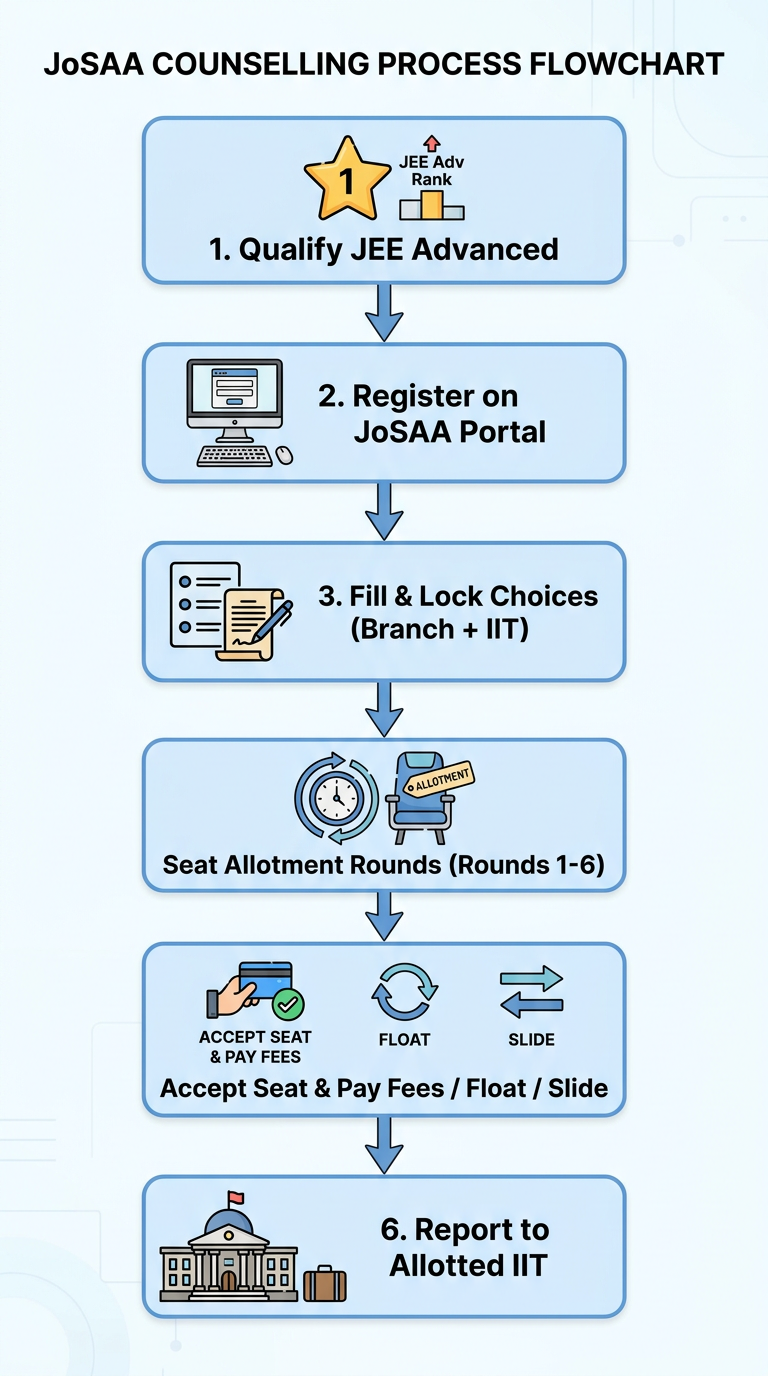
Clearing the JEE Advanced is a massive achievement, but there's one final step before you land in an IIT: the joint counselling process conducted by the Joint Seat Allocation Authority (JoSAA).
JoSAA is the single platform for counselling and seat allocation for admissions to not just the 23 IITs, but also NITs, IIITs, and other Government Funded Technical Institutes (GFTIs). All candidates who get a rank in JEE Advanced are eligible to participate.
The process is conducted online over several rounds and involves a few key steps:
- Registration: You begin by registering on the JoSAA portal using your JEE Advanced roll number and password.
- Choice Filling: This is the most critical step. You have to fill in your choices of institutes and branches in order of your preference. You can fill in as many choices as you want. Be very careful and thoughtful here. Research the different IITs and branches.
- Mock Allotments: Before the actual rounds, JoSAA usually conducts a couple of mock allotment rounds. This gives you an idea of where you might land based on your current choices and helps you refine your list.
- Seat Allotment: Based on your rank, category, and filled choices, a seat is allotted to you in one of the rounds. You then have three options:
Freeze(accept the seat and not participate in further rounds),Float(accept the seat but remain open to getting a higher preference in the next round), orSlide(accept the seat but remain open to a higher preference within the same institute). - Reporting: Once you accept a seat, you need to pay the seat acceptance fee and upload the required documents. After the final round, you have to report to the allotted institute for final admission.
Life at IIT: Is It Worth the Grind?

After years of relentless hard work, long nights of study, and countless sacrifices, you might wonder: is it all worth it? The answer, from millions of alumni, is a resounding yes.
Life at an IIT is not just about tough academics and brilliant professors. It's an experience that transforms you. You will be surrounded by some of the most intelligent and passionate people you will ever meet. The peer group itself is one of the biggest learning resources.
The academic flexibility, cutting-edge research opportunities, and state-of-the-art labs will challenge you to push your boundaries. But it's not all work. The vibrant campus life, with its plethora of technical clubs, cultural festivals, sports competitions, and student-run bodies, ensures your holistic development.
The IIT tag opens doors to incredible opportunities, be it in corporate jobs, research, entrepreneurship, or civil services. But more than that, the problem-solving skills, the resilience, and the friendships you build during these four years will stay with you for a lifetime.
The path through JEE Advanced is undoubtedly one of the toughest. But the destination is truly extraordinary. So keep your head down, work hard, and keep your eyes on the prize. Your dream is waiting for you.
FAQs
How many times can I attempt JEE Advanced?
You can attempt the JEE Advanced a maximum of two times, and they must be in two consecutive years. For instance, you can attempt it in the year you appear for your Class 12 board exams and the very next year.
Is 75% in boards necessary for JEE Advanced?
To be eligible for admission into an IIT, you must either have secured at least 75% aggregate marks in your Class 12th board exam (65% for SC/ST/PwD) or be in the top 20 percentile of your board. While this rule was relaxed during the COVID-19 pandemic, it has been brought back. Always check the official information bulletin for the most current rules.
Which IIT conducts JEE Advanced this year?
The responsibility of conducting the JEE Advanced is rotated among the seven zonal IITs: Bombay, Delhi, Guwahati, Kanpur, Kharagpur, Madras, and Roorkee. To find out which IIT is the organizing institute for the current year, you should check the official JEE Advanced website.
What is the difference between JEE Main and JEE Advanced?
JEE Main is the qualifying exam for JEE Advanced and also serves as the entrance exam for NITs, IIITs, and other GFTIs. It tests a broader range of topics with a focus on speed and accuracy. JEE Advanced is the exclusive entrance exam for the 23 IITs. It is significantly more difficult, focusing on in-depth conceptual understanding and complex problem-solving skills.
Can I get into an IIT without clearing JEE Advanced?
No. Admission to the undergraduate engineering and science courses (B.Tech, B.S, Dual Degree) in any of the 23 IITs is strictly through the JEE Advanced rank list. There is no other way.
How many students qualify for JEE Advanced?
Every year, the top 2,50,000 candidates from the JEE Main exam become eligible to appear for the JEE Advanced. After the exam, the number of candidates who actually qualify (i.e., clear the minimum cutoffs) is much smaller, typically around 40,000 to 50,000, from which admissions are made based on rank and available seats.