JEE Advanced 2026: More qualifiers despite slower seat growth; CSE dominates | India News - Hindustan Times
Everything you need to know about the JEE Advanced exam, from eligibility and paper pattern to the detailed syllabus and effective preparation strategies for getting into an IIT.
18 min read
JEE Advanced: The Ultimate Guide to Cracking the IIT Dream
Think of your JEE journey like a video game. You've spent two years levelling up, collecting skills, and you've just defeated the first major boss: JEE Main. It was tough, but you made it. Now, you stand before the final gate, and behind it waits the ultimate boss. This final challenge is the JEE Advanced.
This isn't just another exam. It's the exclusive gateway to the 23 Indian Institutes of Technology (IITs), the most prestigious engineering colleges in the country. Clearing JEE Main gets you into the arena, but winning here gets you the crown. The questions are trickier, the competition is fiercer, and the stakes are infinitely higher.
But don't let that scare you. The final boss is beatable. It just requires a different strategy, deeper knowledge, and a warrior's mindset. This guide is your complete strategy book. We'll break down everything from eligibility and the ever-changing paper pattern to the detailed syllabus and a battle-tested preparation plan. Let's get you ready for the final fight.
What Exactly is the JEE Advanced Exam?
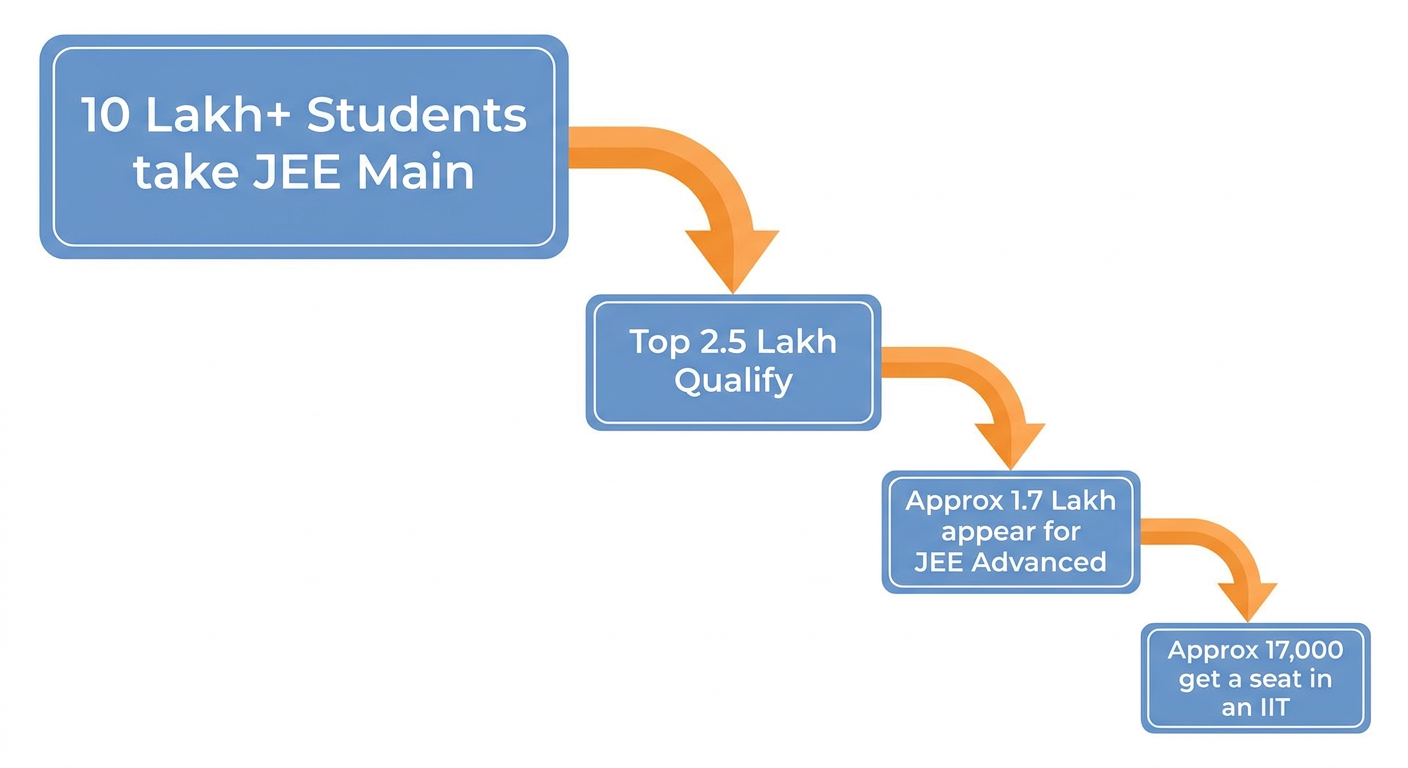
The Joint Entrance Examination – Advanced, or JEE Advanced, is the second and final stage of the joint entrance examination for engineering admissions. Its sole purpose is to select the brightest minds for admission into the undergraduate programs offered by the IITs. Think of it as the gold standard for engineering entrance exams in India.
Unlike JEE Main, which is conducted by the National Testing Agency (NTA), the JEE Advanced is conducted by one of the seven zonal IITs on a rotational basis. These include IIT Kharagpur, IIT Kanpur, IIT Madras, IIT Delhi, IIT Bombay, IIT Guwahati, and IIT Roorkee. This rotation is one reason why the paper's flavour and nuances can subtly change each year.
While JEE Main qualifies you for NITs, IIITs, and other Government-Funded Technical Institutes (GFTIs), it's only the top 2.5 lakh candidates from JEE Main who are invited to even sit for JEE Advanced. Your All India Rank in this exam is the only number that matters for securing a seat in an IIT, as well as in other top-tier institutes like the Indian Institute of Science (IISc), Bangalore, and the Indian Institutes of Science Education and Research (IISERs).
Are You Eligible for JEE Advanced? The Complete Checklist
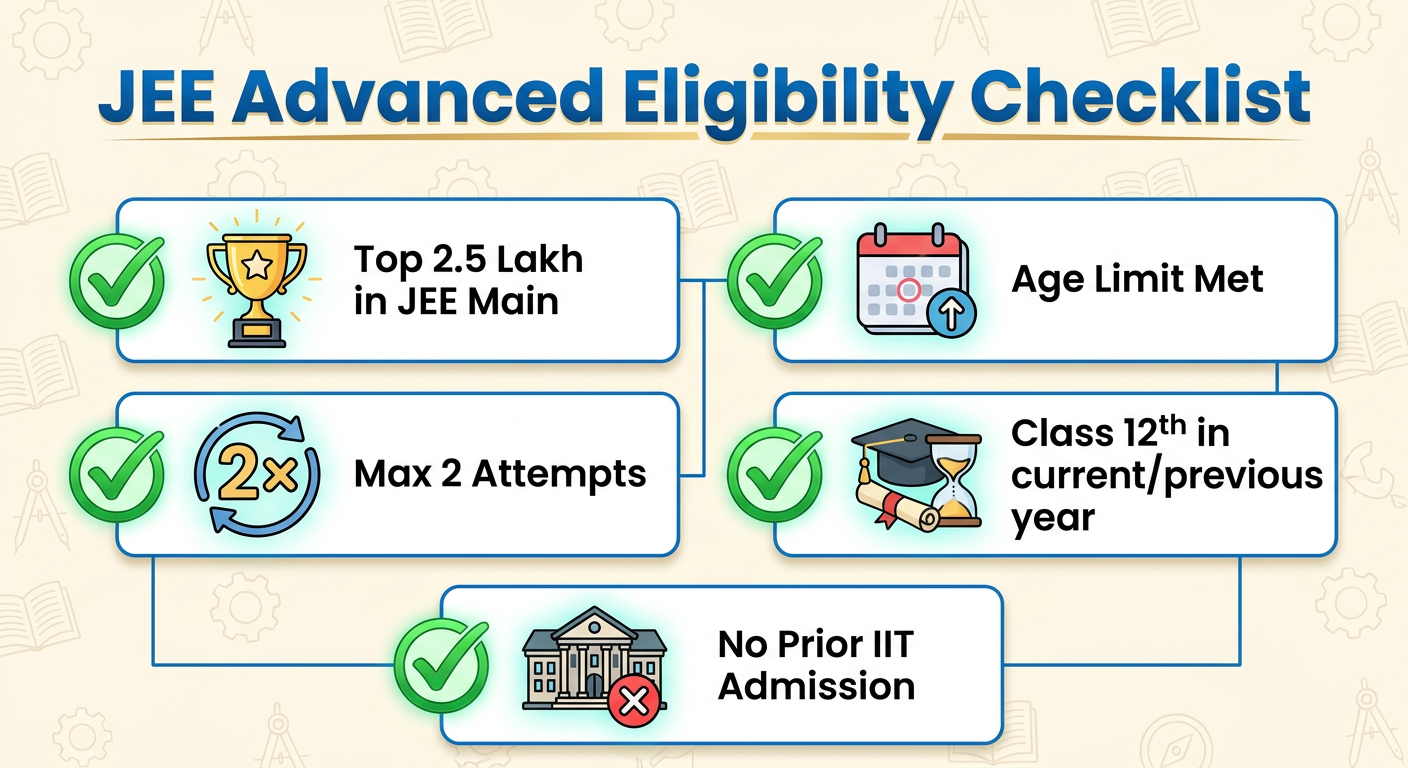
Before you dream of an IIT campus, you must first cross the eligibility barrier. The criteria for JEE Advanced are strict and non-negotiable. Missing even one of these can disqualify you, so read this section very carefully. Here's a breakdown of the five main checkpoints you must clear.
Criterion 1: Performance in JEE Main
This is the very first filter. You must be among the top 2,50,000 successful candidates (including all categories) in Paper 1 of JEE Main. The NTA declares the category-wise cutoffs along with the JEE Main result.
The distribution for these qualifying slots is based on reservation policies. For example, the typical breakdown is: 10% for GEN-EWS, 27% for OBC-NCL, 15% for SC, 7.5% for ST, and the remaining 40.5% for the General or Open category. A 5% horizontal reservation is also maintained for PwD candidates.
Criterion 2: Age Limit
There is a strict age limit for appearing in the exam. A candidate should have been born on or after October 1 of a specific year (for example, 1999 for the 2024 exam). This date is specified in the official information brochure each year.
However, there is a relaxation in this criterion for candidates belonging to SC, ST, and PwD categories. They are given a five-year relaxation, meaning they can be older than the general category limit. Always check the latest brochure on the official JEE Advanced site for the exact date.
Criterion 3: Number of Attempts
This is a very important rule. You can attempt the JEE Advanced a maximum of two times in two consecutive years. That’s it. There is no third attempt, no matter the circumstances.
For instance, if you appeared for your Class 12 board exams for the first time in 2024, you are eligible for JEE Advanced in 2024 and 2025, provided you meet all other criteria. You cannot appear in 2026. This limited number of attempts makes each one incredibly valuable.
Criterion 4: Appearance in Class 12th (or Equivalent) Exam
Your Class 12th board exam status is critical. A candidate should have appeared for the Class 12 (or equivalent) examination for the first time in either the same year as the exam or the year immediately preceding it.
For example, to appear for JEE Advanced 2025, you must have taken your Class 12 board exams for the first time in either 2024 or 2025. Students who appeared for their boards in 2023 or earlier are not eligible for the 2025 exam.
Criterion 5: Earlier Admission to an IIT
This rule catches many students by surprise. A candidate who has already been admitted to an IIT, regardless of whether they continued their studies or not, is NOT eligible to appear for JEE Advanced again. This includes preparatory courses at an IIT.
If your seat was cancelled after joining an IIT, you are still barred from reappearing. So, if you get an IIT seat, you must decide carefully whether to take it, because you won't get another shot at the exam.
Understanding the JEE Advanced Paper Pattern
The one constant about the JEE Advanced paper pattern is that it is constantly changing. The organizing IIT has the freedom to change the structure, question types, and marking scheme every single year. This unpredictability is a core feature of the exam, designed to test your adaptability and presence of mind.
Despite the variations, some elements generally remain consistent. The exam always consists of two papers: Paper 1 and Paper 2. Both are three hours long and held on the same day with a break in between. It is compulsory to appear for both papers; if you miss one, your result will not be evaluated.
Each paper covers all three subjects: Physics, Chemistry, and Mathematics. The questions are mixed, testing your ability to switch between subjects quickly.
Types of Questions You Will Face
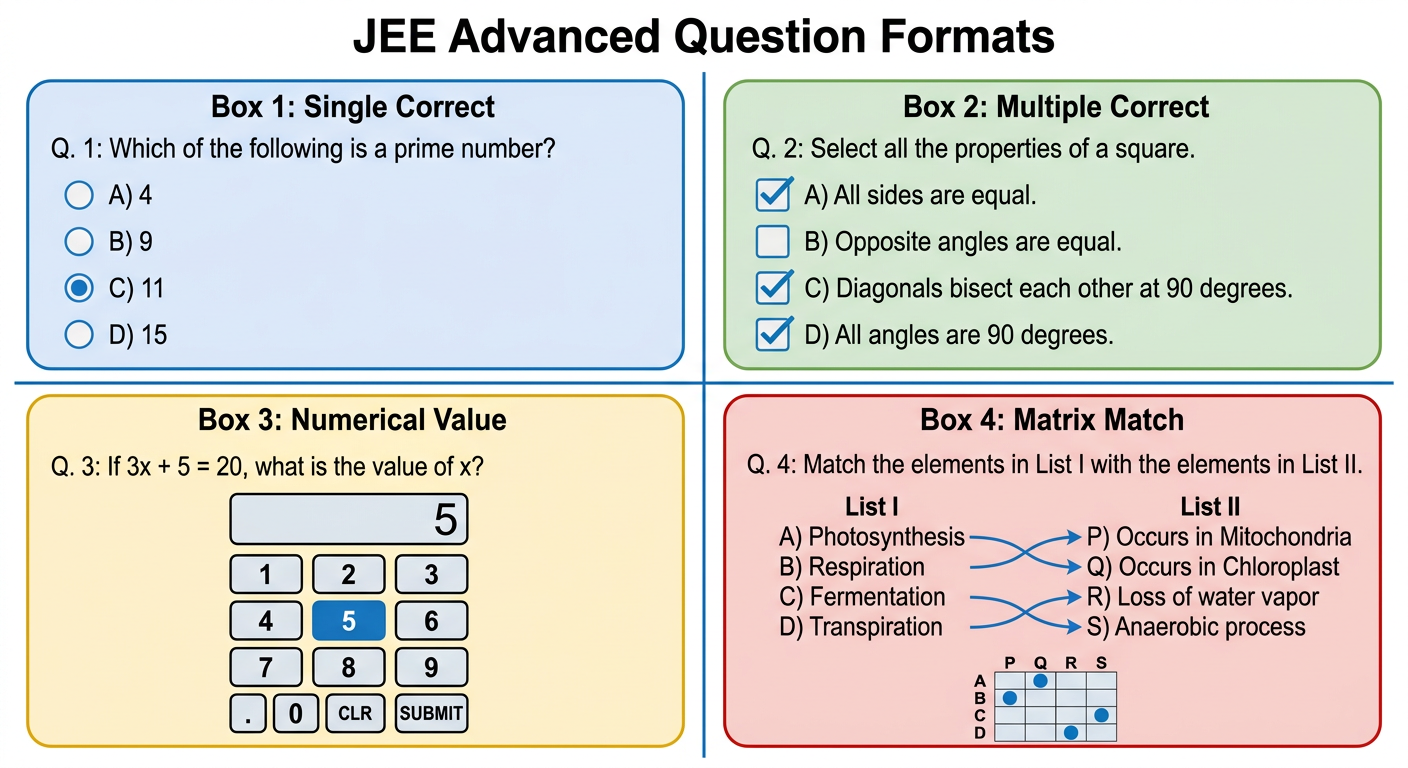
Unlike JEE Main, which primarily uses single-choice MCQs and a few numerical questions, JEE Advanced throws a variety of formats at you. Mastering these is key to a good score.
- Single Correct Choice (MCQ): The classic format with one correct answer out of four options. These often carry negative marks for wrong answers.
- Multiple Correct Choices (MCQ): These are the trickiest. One or more options can be correct. You get full marks only if you select all the correct options and none of the incorrect ones. Partial marks are often awarded, but selecting even one wrong option usually results in negative marks.
- Numerical Value Answer: You need to solve the problem and enter a numerical answer (integer or decimal) using the on-screen keyboard. These usually do not have negative marking, making them a great scoring opportunity.
- Paragraph/Comprehension Based: A paragraph of information is given, followed by two or three questions based on it. These test your reading comprehension and ability to apply concepts from the given data.
- Matrix Match (Match the Following): You'll be given two columns and have to match the entries from one column to the other. This could be a one-to-one or one-to-many matching.
The Infamous Negative Marking Scheme
Negative marking in JEE Advanced is far more complex than in JEE Main. It's not a simple '-1' for every wrong answer. The scheme is different for different sections and question types, and it is crucial to read the on-screen instructions at the beginning of each section very carefully.
For example, a multiple-correct question might have a marking scheme like: +4 for all correct options, +3 for three out of four correct, +1 for one correct, and -2 for selecting any incorrect option. A single-correct question might be +3 for correct and -1 for incorrect. A numerical question might be +4 for correct and 0 for incorrect. This variability demands a careful strategy about which questions to attempt and which to leave.
The JEE Advanced Syllabus: What to Study?
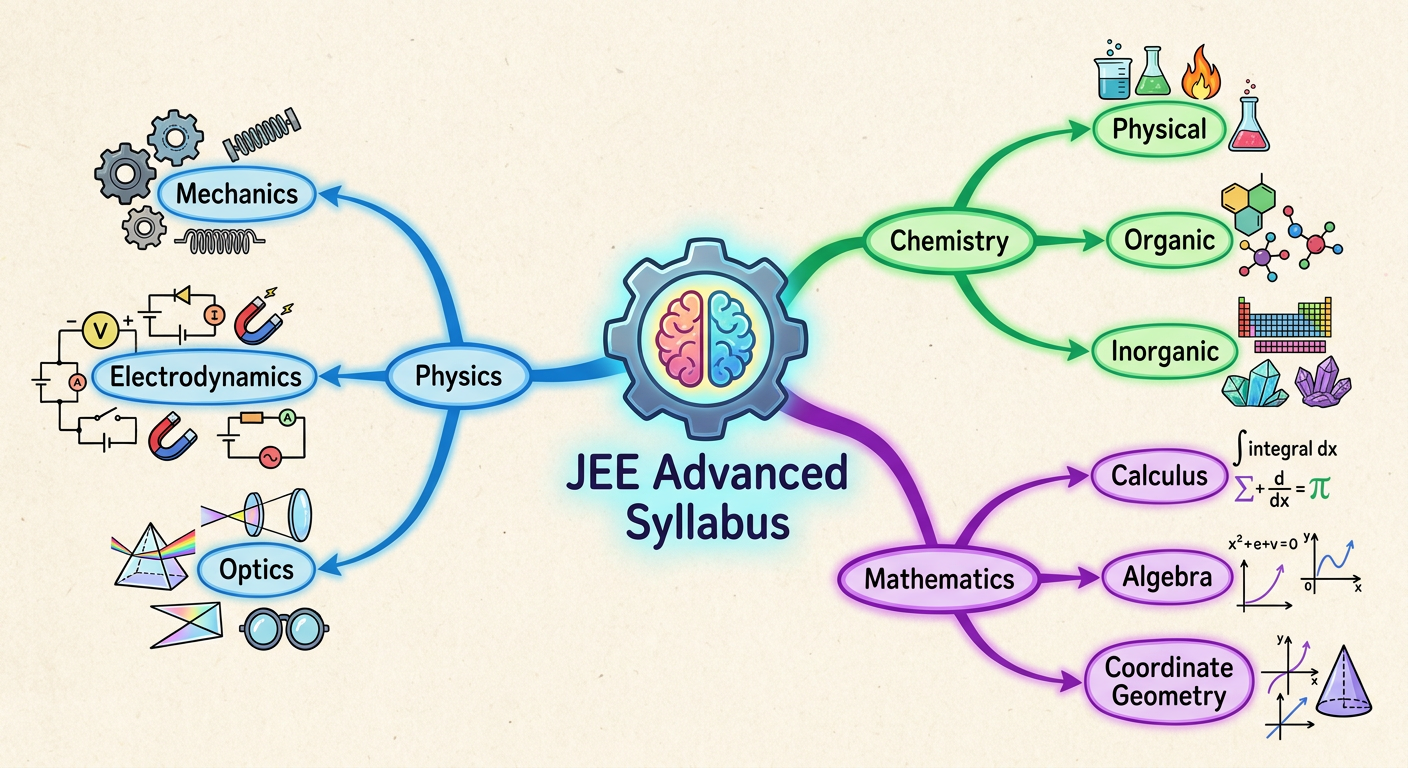
The JEE Advanced syllabus is broadly based on the topics covered in Class 11 and Class 12 CBSE curriculum, but the depth and application required are on another level. The official syllabus doesn't just list topics; it expects you to understand the intricate connections between them. Rote memorization of formulas is useless here; you need to understand the 'why' behind every concept.
While the core topics overlap with JEE Main, the Advanced syllabus often includes a few extra sub-topics and demands a much more rigorous, in-depth understanding. The questions are designed to be multi-conceptual, often blending ideas from two or three different chapters into a single problem. For a detailed chapter-wise breakdown, you can always refer to our JEE Advanced syllabus breakdown page.
Physics Syllabus Highlights
Physics in JEE Advanced is all about concepts. The questions are designed to test your fundamental understanding and problem-solving skills rather than your memory.
- Mechanics: This is the largest and arguably most important unit. Topics like Rotational Motion, Work-Energy-Power, and Simple Harmonic Motion are perennial favourites. Problems are often complex and require a strong command of vectors and calculus.
- Electrodynamics: This includes Electrostatics, Current Electricity, and Magnetism. Expect challenging problems involving circuits, magnetic effects of current, and electromagnetic induction. Gauss's Law and Ampere's Law are critical.
- Optics: Both Geometrical and Wave Optics are important. Questions on interference, diffraction, and polarization of light are common and require a clear conceptual grasp.
- Thermodynamics & Kinetic Theory of Gases: This is a high-weightage topic. Understanding the laws of thermodynamics and their applications is crucial.
- Modern Physics: Topics like Dual Nature of Matter, Atoms, and Nuclei are relatively easier and more formula-based, making them a scoring area.
Chemistry Syllabus Highlights
Chemistry is often considered the most scoring subject in JEE Advanced if prepared well. It's a balanced mix of conceptual understanding, reaction memorization, and numerical problem-solving.
- Physical Chemistry: This is the numerical-heavy part of Chemistry. Key chapters include Chemical Kinetics, Chemical and Ionic Equilibrium, Electrochemistry, and Thermodynamics. A strong hold on the mole concept is the foundation for everything.
- Inorganic Chemistry: Often feared for its vastness, but a systematic approach can make it a rank-booster. Focus on Coordination Compounds, Chemical Bonding, and Metallurgy. Block Chemistry (s, p, d, and f blocks) is crucial, and questions are often directly from NCERT lines, but twisted.
- Organic Chemistry: This section tests your understanding of reaction mechanisms. General Organic Chemistry (GOC) is the absolute backbone. Master topics like Stereoisomerism, and be thorough with all named reactions and their mechanisms. You cannot afford to skip any part of it.
Mathematics Syllabus Highlights
Mathematics in JEE Advanced is known for being lengthy and tough. It rewards students who are not only accurate but also fast and have a deep bag of problem-solving tricks.
- Calculus: This is the heart of the math paper. Both Differential and Integral Calculus are extremely important. Questions often test your understanding of functions, limits, continuity, and the application of derivatives and integrals in unconventional ways.
- Algebra: This is a vast section including Complex Numbers, Quadratic Equations, Progressions, Permutations & Combinations, and Probability. These chapters are frequently mixed with calculus or other topics.
- Coordinate Geometry: This includes Straight Lines, Circles, and all three Conic Sections (Parabola, Ellipse, Hyperbola). The problems are often lengthy and require meticulous calculation.
- Vectors & 3D Geometry: This is a very important and relatively high-scoring topic. Questions test your spatial visualization skills.
- Trigonometry: While direct questions are less common, the formulas and properties of trigonometric functions are used extensively across all other topics, especially calculus and complex numbers.
To master tricky concepts in Integral Calculus, like Integration by Parts, a clear method is essential. The ILATE rule is a fantastic mnemonic for this. Watch this short video to see how it works:
Strategy: How to Prepare for JEE Advanced?
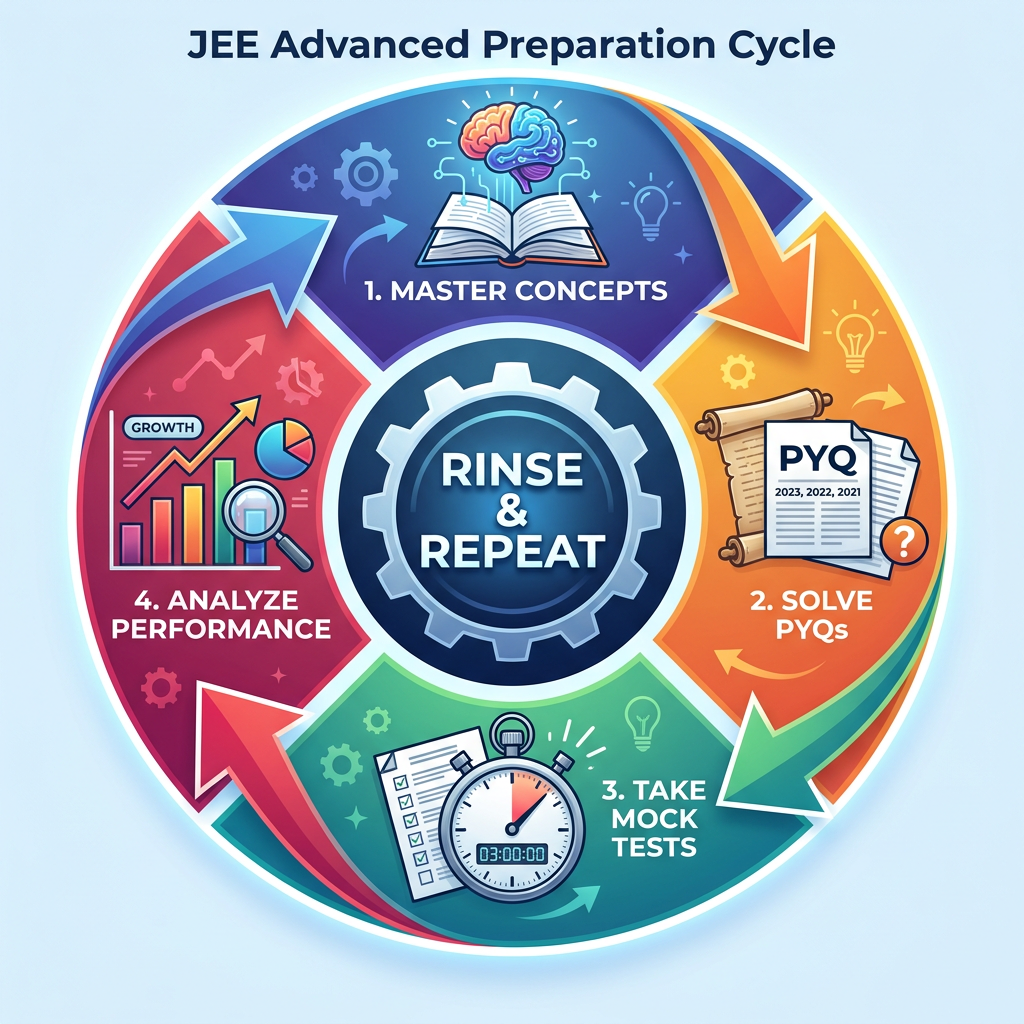
Knowing the syllabus is one thing; conquering it is another. The preparation for JEE Advanced requires a shift in mindset from the speed-based approach of JEE Main to a depth-based approach. Here’s a strategic blueprint to guide your preparation.
Mastering the Concepts, Not Just Formulas
JEE Advanced does not reward formula-plugging. It tests your first principles. If a question involves a block on an inclined plane, you need to be able to draw the free-body diagram and derive the equations from scratch, not just remember a special-case formula. Your first step should always be to build a rock-solid conceptual foundation using standard textbooks. Start with NCERT to get the basics right, then move on to advanced-level books for each subject. Don't forget to maintain a neat sheet of all the important concepts and formulas for quick revision.
The Power of Previous Year Questions (PYQs)
If there is one holy grail for JEE Advanced preparation, it is the collection of JEE Advanced previous year questions. Solving PYQs is non-negotiable. They are the only reliable source to understand the exam's true nature, the depth of concepts tested, and the way topics are interlinked.
Don't just solve them like a mock test. Analyze them. When you solve a question, ask yourself: What concept did it test? Could it have been solved another way? What trick was involved? This analytical approach will train your brain to think like the paper-setters. You can find a vast collection of JEE Advanced PYQs on our resources page to get started.
Mock Tests: Your Best Friend and Harshest Critic
Consistency in giving full-syllabus mock tests is what separates the toppers from the rest. Mock tests simulate the high-pressure environment of the actual exam. They help you build stamina for the 6-hour-long exam day, improve your time management, and teach you the crucial art of question selection.
The real work starts after the test is over. Spend more time analyzing your performance than you spent writing the test. Identify your weak areas, conceptual gaps, silly calculation mistakes, and time management errors. Work on these weaknesses before you take the next test. This iterative process of testing and improving is the key to a great rank.
Choosing the Right Books
In the sea of preparation books, it's easy to get lost. The key is to choose one or two standard, highly-recommended books per subject and stick to them. Trying to study from too many sources will only lead to confusion and incomplete preparation.
For Physics, books like H.C. Verma and I.E. Irodov are classics. For Organic Chemistry, many toppers swear by Morrison & Boyd or Solomon & Fryhle. For Mathematics, books from authors like S.L. Loney or the Cengage series are excellent for building problem-solving skills. The goal is to solve one book completely rather than solving a few chapters from five different books.
What are the Cutoffs for JEE Advanced?
[image: A conceptual bar chart showing the difference between a lower 'Qualifying Cutoff' and a much higher 'Admission Cutoff' for a top branch at an IIT.]
Understanding the JEE Advanced cutoff can be confusing because there isn't just one cutoff. There are two distinct types you need to know about: the qualifying cutoff and the admission cutoff. They serve very different purposes.
1. Qualifying Cutoff: This is the minimum percentage of marks you need to score in each subject and in aggregate to be included in the rank list. If you don't clear these minimums, you won't get a rank, even if your total score is decent. The organizing IIT decides these cutoffs after the exam, based on the paper's difficulty.
For example, in a particular year, the qualifying cutoff for the general category might be 10% in each subject and 35% in aggregate. This means you need to score at least 10% of the total marks in Physics, Chemistry, and Math individually, AND your overall total must be at least 35% of the grand total. These percentages are lower for reserved categories. This cutoff only makes you eligible for counseling; it does not guarantee a seat.
2. Admission Cutoff (Closing Rank): This is the rank of the last student who was admitted to a specific course at a specific IIT. This is the cutoff that really matters for admissions. These closing ranks are determined during the JoSAA (Joint Seat Allocation Authority) counseling process based on students' choices and rank order.
Admission cutoffs vary enormously. The closing rank for Computer Science at IIT Bombay might be under 100, while the closing rank for a less sought-after branch at a newer IIT might be over 10,000. These cutoffs change every year based on the number of seats, the number of applicants, and student preferences. You can check the closing ranks from previous years on the JoSAA website to get a realistic idea of the rank you need to target for your dream branch.
Seat Matrix and Top Institutes
[image: A map of India highlighting the locations of the 23 IITs, with prominent icons for the top 7 old IITs.]
Clearing JEE Advanced opens the doors to the 23 IITs spread across the country. The total number of IIT seats is approximately 17,000, including seats reserved for female candidates under the supernumerary quota. This number tends to increase slightly each year with the introduction of new courses or expansion in existing IITs.
The IITs are broadly categorized into old and new. The older, more established IITs are generally ranked higher and are more sought after by top-rankers. These include:
- IIT Bombay (IITB)
- IIT Delhi (IITD)
- IIT Madras (IITM)
- IIT Kanpur (IITK)
- IIT Kharagpur (IITKGP)
- IIT Roorkee (IITR)
- IIT Guwahati (IITG)
While these seven are often considered the top tier, the newer IITs are also rapidly growing in terms of infrastructure, faculty, and research output. An IIT tag, regardless of the specific campus, carries immense value.
Beyond the IITs, your JEE Advanced rank is also your ticket to some of India's other elite science and technology institutes. These include:
- Indian Institute of Science (IISc), Bangalore: Admits students to its four-year Bachelor of Science (Research) program.
- Indian Institutes of Science Education and Research (IISERs): Located in Berhampur, Bhopal, Kolkata, Mohali, Pune, Thiruvananthapuram, and Tirupati.
- Indian Institute of Space Science and Technology (IIST), Thiruvananthapuram: For students passionate about space science and technology.
- Rajiv Gandhi Institute of Petroleum Technology (RGIPT), Rae Bareli.
This widens the opportunities available, making a good rank in JEE Advanced even more valuable.
FAQs
What is the difference between JEE Main and JEE Advanced?
JEE Main is the first stage, qualifying over 2 lakh candidates for the second stage. It is also the entrance exam for NITs, IIITs, and GFTIs. JEE Advanced is the second and final stage, exclusively for admission to the IITs. Advanced is significantly tougher, more conceptual, and has a more complex and unpredictable paper pattern.
How many students appear for JEE Advanced?
Only the top 2.5 lakh candidates from JEE Main are eligible to appear for JEE Advanced. However, typically around 1.5 to 1.7 lakh students actually register and sit for the exam, making the competition incredibly intense.
Is NCERT enough for JEE Advanced?
No. While NCERT is excellent for building a strong foundation and is indispensable for Inorganic Chemistry, it is not sufficient for the depth and complexity of problems asked in JEE Advanced Physics, Physical Chemistry, and Mathematics. You must supplement it with advanced-level reference books and extensive problem-solving.
What is a good rank in JEE Advanced?
A rank under 10,000 can get you a seat in one of the IITs, though it might be in a newer IIT or a less sought-after branch. A rank under 5,000 gives you more options in older IITs. To secure a top branch like Computer Science in one of the top 5 IITs, you typically need a rank under 500.
Can I crack JEE Advanced in one year?
It is extremely challenging but not impossible, especially for students who have a very strong conceptual foundation from their Class 11 and 12 studies. It requires immense dedication, a smart study plan, and 12-14 hours of focused effort daily. Most successful candidates begin their preparation in Class 11.
Is there negative marking in JEE Advanced?
Yes, absolutely. The negative marking scheme is one of the trickiest aspects of the exam. It varies for different question types (single choice, multiple choice, etc.) and can even change from year to year. It is crucial to read the instructions for each section carefully during the exam. Some question types, like numerical answer questions, often have no negative marking.