Who Can Appear for JEE Main 2027? Check Eligibility, Drop-Year Rules and More - Shiksha.com
Your complete guide to the JEE Advanced exam. Understand the eligibility criteria, paper pattern, syllabus, cutoffs, and the ultimate strategy to get into an IIT.
15 min read
Remember that scene in 3 Idiots? The one where Virus Sahasrabuddhe explains the harsh reality of the engineering race. It might be a movie, but it captures the spirit of a challenge that lakhs of Indian students face every year. The final boss of this challenge, the ultimate gateway to the prestigious Indian Institutes of Technology (IITs), is the Joint Entrance Examination Advanced, better known as JEE Advanced.
This isn't just another exam. It's a test of your concepts, your analytical skills, and your temperament. If you've conquered JEE Main and have your eyes set on that coveted IIT seat, you're in the right place. This guide will break down everything you need to know about the JEE Advanced exam. We will cover eligibility, the tricky paper pattern, the vast syllabus, and how to build a strategy that works.
What Exactly is the JEE Advanced Exam?
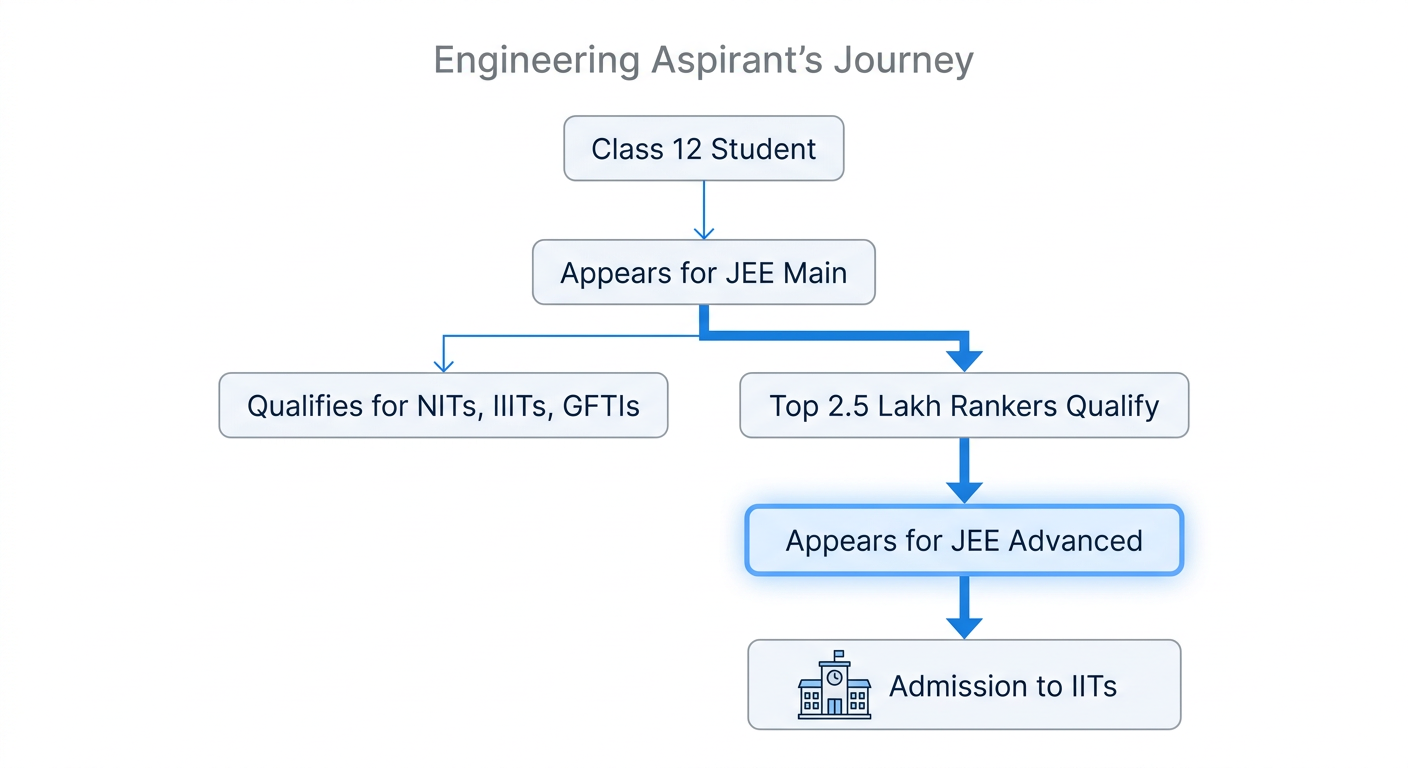
Think of the engineering entrance system as a two-stage rocket. The first stage is the JEE Main, which gets you off the ground and qualifies you for admission into NITs, IIITs, and other Government Funded Technical Institutes (GFTIs). It also serves as the screening test for the second, more powerful stage: the JEE Advanced.
JEE Advanced is the one and only examination that grants admission to the undergraduate programs across all 23 IITs in the country. It is designed to test the comprehensive understanding and application of scientific concepts. In simple terms, while JEE Main checks if you know the formula, JEE Advanced checks if you can derive the formula and apply it to a problem you've never seen before.
This exam isn't conducted by the NTA like JEE Main. Instead, the responsibility is rotated annually among the seven zonal IITs: IIT Kharagpur, IIT Kanpur, IIT Madras, IIT Delhi, IIT Bombay, IIT Guwahati, and IIT Roorkee. This rotation often brings subtle changes in the paper's flavour and focus each year, keeping aspirants on their toes.
Are You Eligible for JEE Advanced? Key Criteria Explained
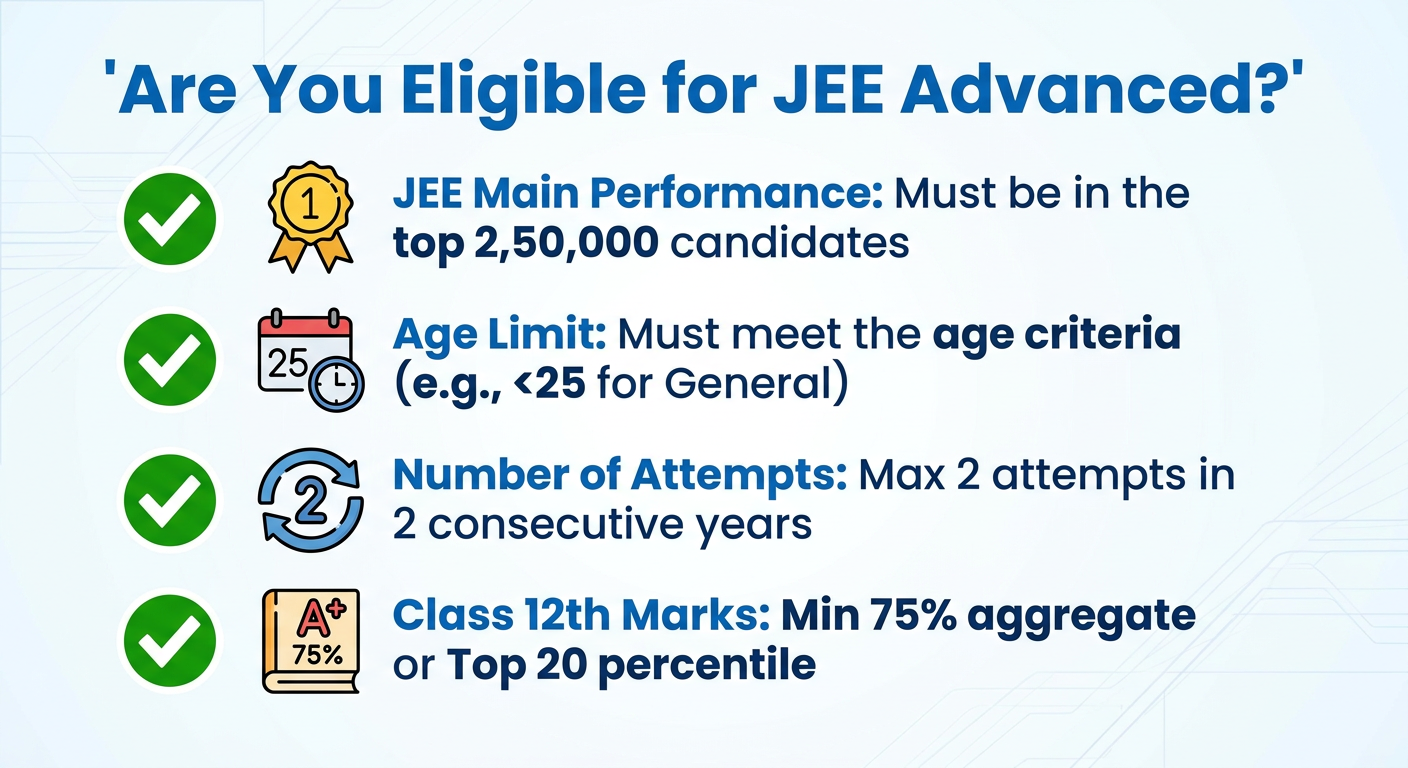
Before you even dream of an IIT, you must clear the bouncer at the gate. The eligibility criteria for JEE Advanced are strict and non-negotiable. Missing even one of these can disqualify you, so pay close attention. There are four main pillars of eligibility you must satisfy.
Criterion 1: Performance in JEE Main
This is the very first filter. You must appear for JEE Main Paper 1 (the B.E./B.Tech paper) and secure a rank among the top candidates who qualify. For the year 2024, this number was set at the top 2,50,000 students across all categories.
This doesn't mean you need a rank under 2.5 lakh in the Common Rank List (CRL). The cut-offs are applied category-wise (GEN, EWS, OBC-NCL, SC, ST, PwD) to select the total number of students. For instance, the qualifying percentile for General category might be around 90, while for SC/ST it would be lower. Your goal is to clear the specific JEE Main cutoff for your category to become eligible to even register for JEE Advanced.
Criterion 2: Age Limit
There's an age cap for aspirants. For the general category, a candidate must be born on or after a specific date set for that year's exam. For JEE Advanced 2024, the date was October 1, 1999. This date is updated each year, but the principle remains the same. Essentially, you should be under 25 years of age.
There is a relaxation for candidates from reserved categories. Students belonging to SC, ST, and PwD categories get a five-year relaxation in the age limit. They must have been born on or after October 1, 1994 (for the 2024 exam).
Criterion 3: Number of Attempts
This is perhaps the most critical and often misunderstood rule. You can attempt the JEE Advanced a maximum of two times and that too in two consecutive years.
Let's break this down. Your first attempt is the year you appear for your Class 12 (or equivalent) examination. Your second and final attempt is the very next year. That's it. There is no third attempt. If you take a two-year drop after Class 12, you will no longer be eligible for JEE Advanced. This makes every attempt incredibly valuable.
Criterion 4: Class 12th (or Equivalent) Examination
A candidate must have appeared for the Class 12 or an equivalent exam for the first time in either the current year or the previous year. For example, for JEE Advanced 2024, you must have appeared for your Class 12 board exams for the first time in either 2023 or 2024.
Furthermore, there's a performance criterion in your board exams. A candidate must either:
- Secure at least 75% aggregate marks in the Class 12 (or equivalent) board examination. (This is 65% for SC, ST, and PwD candidates).
- Be within the top 20 percentile of successful candidates in their respective Class 12 board.
This rule was temporarily relaxed during the COVID-19 pandemic but has since been reinstated. Always check the latest information bulletin on the official JEE Advanced website for the most current rules.
Understanding the JEE Advanced Paper Pattern
The JEE Advanced exam pattern is famous for being unpredictable. While the broad structure remains the same, the types of questions and the marking scheme can change every single year. This is done deliberately to test a student's adaptability and discourage rote learning.
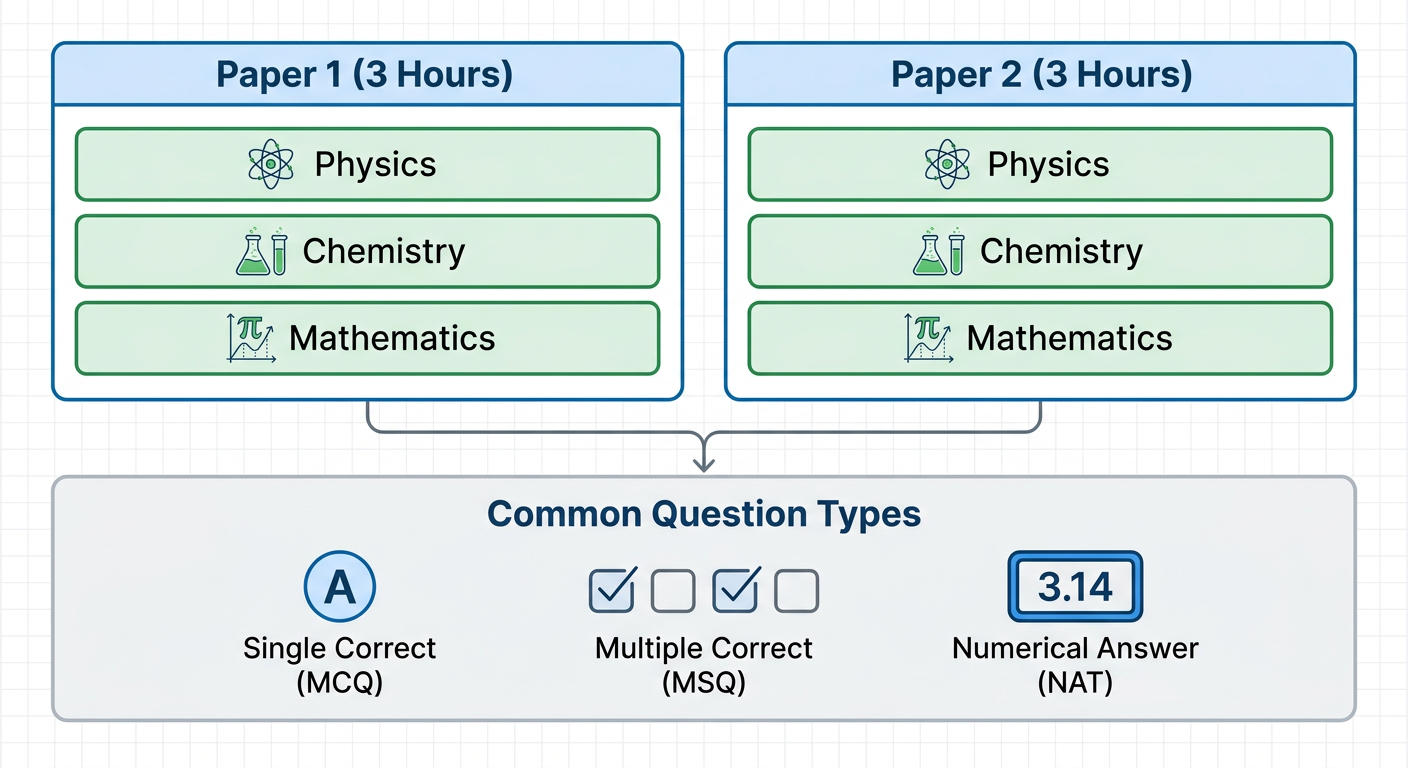
The exam is a Computer Based Test (CBT) and consists of two compulsory papers: Paper 1 and Paper 2. Both papers are three hours long and are usually held on the same day with a break in between. You must attempt both papers; your final score is the aggregate of your marks in both.
Each paper is divided into three sections: Physics, Chemistry, and Mathematics. The total marks for JEE Advanced can vary each year. For instance, in 2023, the total marks were 360, while in 2022, they were also 360. You must always read the instructions displayed on your screen at the start of the exam very carefully.
Types of Questions You Will Face
The beauty and challenge of JEE Advanced lie in its variety of question formats. You will encounter more than just simple multiple-choice questions.
- Single Correct Option (MCQ): The classic format. You are given four options, and only one is correct. These usually carry positive marks for a correct answer and negative marks for a wrong one.
- Multiple Correct Options (MSQ): These are the real rank-deciders. You are given four options, and one or more of them can be correct. You get full marks only if you select all the correct options and no incorrect ones. Partial marks may be awarded if you select some, but not all, of the correct options. These questions often have negative marking, making them a high-risk, high-reward section.
- Numerical Answer Type (NAT): Here, no options are provided. You have to solve the problem and enter a numerical answer using the on-screen keyboard. These questions usually do not have negative marking, making them a must-attempt section. The answer could be an integer or a decimal up to a certain number of places.
- List Match Sets / Matrix Match: These questions involve matching items from one column to another. They can be single or multiple-matching types.
- Paragraph/Comprehension Based: A paragraph of information is given, followed by a couple of questions based on it. These test your ability to comprehend and apply information from the given context.
The Marking Scheme: A Game of Accuracy
This is where things get really interesting. The marking scheme is not uniform across the paper. One section might have a +3/-1 scheme (3 marks for correct, -1 for incorrect), while another might have a +4/0 scheme. The MSQ questions often have complex partial marking schemes. For example, +4 if all correct options are chosen, +3 for three out of four correct, and so on, with -2 for selecting any incorrect option.
Because of this, your strategy must be dynamic. It's not just about solving the question; it's about deciding whether to attempt it at all based on the marking scheme and your confidence level. Blind guessing is a recipe for disaster in JEE Advanced.
The Complete JEE Advanced Syllabus: What to Study
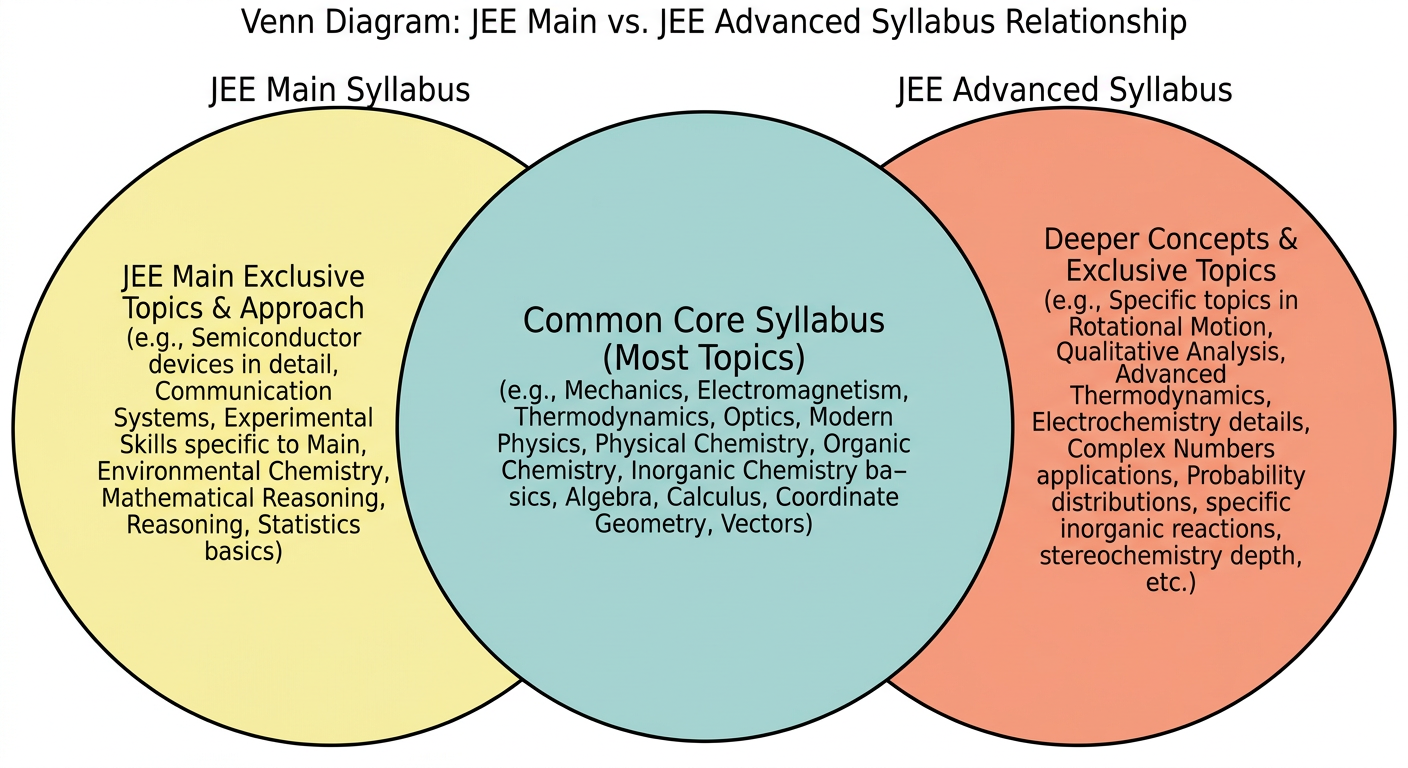
The syllabus for JEE Advanced is extensive and requires deep, conceptual knowledge. While it is largely based on the Class 11 and 12 CBSE curriculum, it delves much deeper into every topic. There are also a few topics that are part of the JEE Advanced syllabus but have been removed from the JEE Main syllabus, making them exclusive to this exam.
Your preparation cannot be superficial. You need to understand the 'why' behind every concept, not just the 'what'. You can find detailed breakdowns in our JEE syllabus resources, but here's a high-level overview.
Physics Syllabus Highlights
Physics in JEE Advanced is known for its tricky questions that often mix concepts from multiple chapters. A single question on mechanics might also involve concepts of electrostatics.
- Key Areas: Mechanics (from Kinematics to Rotational Motion), Electromagnetism, Optics, Thermodynamics, and Modern Physics.
- Advanced Topics: Emphasis on rotational dynamics of rigid bodies, detailed electromagnetic induction, and complex AC circuits. Wave optics (like Polarization and Diffraction) is also very important.
Chemistry Syllabus Highlights
Chemistry is often considered the most scoring subject if prepared well. It's a balanced mix of conceptual understanding, reaction memorization, and numerical problem-solving.
- Physical Chemistry: Involves numericals from chapters like Chemical Equilibrium, Thermodynamics, and Electrochemistry. The questions are application-based.
- Organic Chemistry: Requires a thorough understanding of reaction mechanisms (SN1, SN2, E1, E2, etc.), stereochemistry, and named reactions. It's less about memorizing reactions and more about predicting products based on mechanisms.
- Inorganic Chemistry: Chapters like p-block, d-block elements, and Coordination Compounds carry significant weight. While it involves some memorization, many questions are based on conceptual trends and structures (like VSEPR theory).
Mathematics Syllabus Highlights
Mathematics in JEE Advanced is all about problem-solving ability. The questions are often lengthy and require clever thinking and multiple steps.
- Key Areas: Calculus (very high weightage), Coordinate Geometry, Algebra (especially Quadratic Equations, Complex Numbers, Permutations & Combinations), Vectors & 3D Geometry, and Trigonometry.
- Advanced Topics: Questions often test obscure properties of functions, complex geometric interpretations of algebraic equations, and intricate series and sequences. Mastering integration is key, and understanding rules like integration by parts is fundamental.
To master these topics, consistent practice is non-negotiable. Solving previous year questions is the best way to understand the depth and pattern of the exam.
Is JEE Advanced Really That Tough? Decoding the Difficulty Level
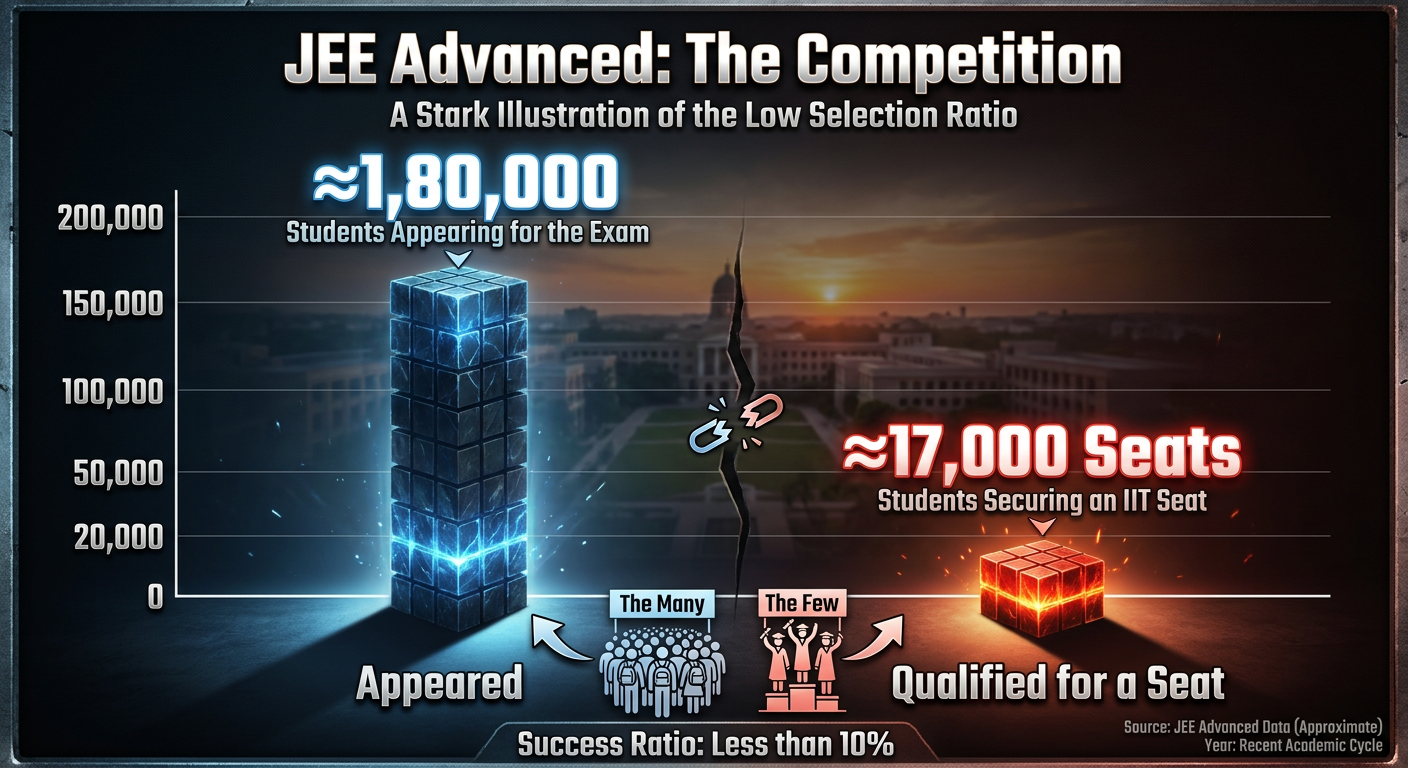
Let's be direct: yes, JEE Advanced is an extremely tough examination. It is consistently ranked among the most challenging undergraduate entrance exams in the world. But 'tough' doesn't mean 'impossible'. Understanding why it's tough is the first step to conquering it.
The difficulty comes from several factors:
- Conceptual Depth: The exam tests your core understanding. Rote learning will get you nowhere.
- Problem-Solving Skills: It's not about applying a formula directly. It’s about adapting your knowledge to solve new, unseen problems.
- Low Selection Ratio: Every year, about 2.5 lakh students qualify to write JEE Advanced, but there are only about 17,000 seats available in the 23 IITs. This intense competition means even small mistakes can cause a big drop in rank.
- Exam Temperament: The length of the exam (6 hours in a day), the unpredictable pattern, and the negative marking all test your mental endurance and decision-making skills under pressure.
To put it in perspective, qualifying for JEE Advanced (i.e., being included in a rank list) often requires just 25-35% of the total marks, depending on the year's difficulty. This shows that the paper is designed so that no one can score close to full marks. The goal is to maximize your score, not to attempt every question.
Crafting a Winning Preparation Strategy
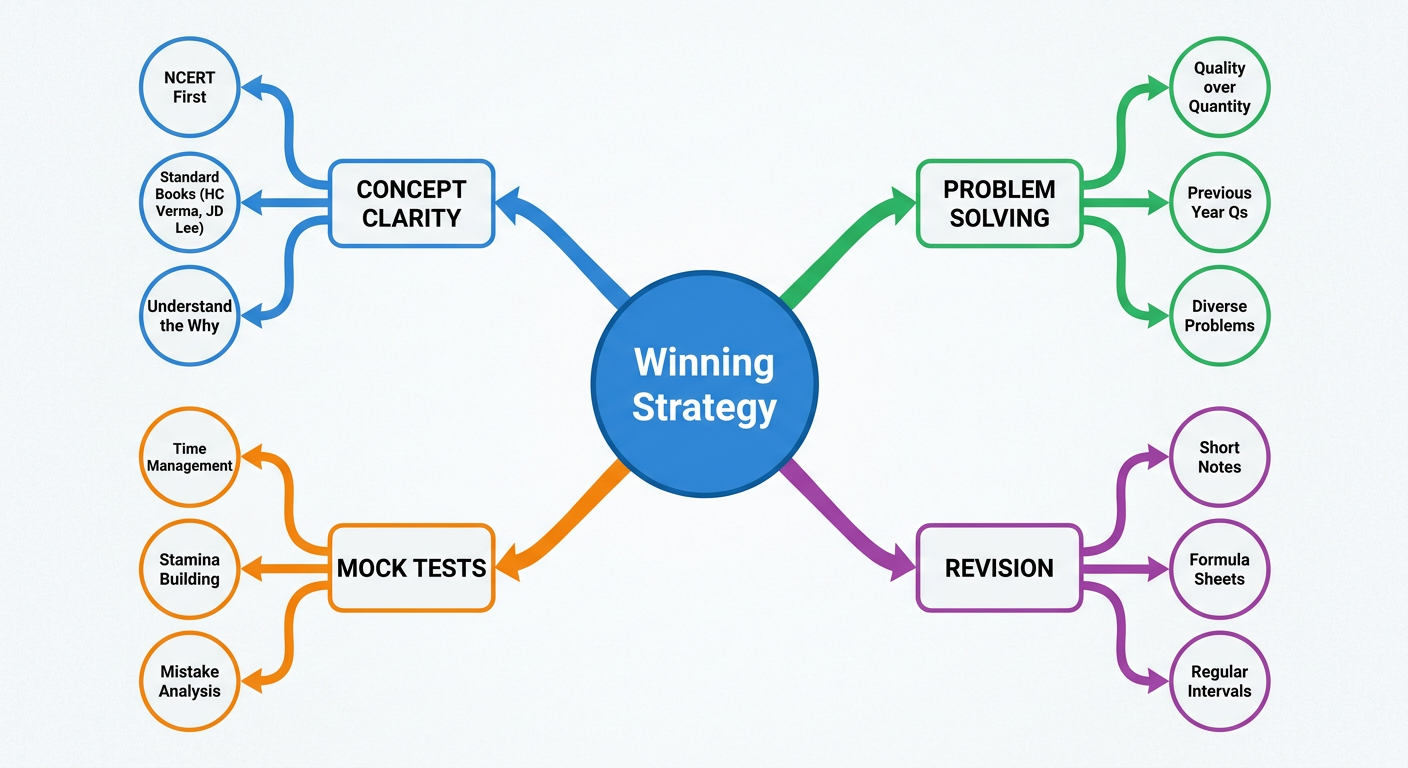
Knowing the syllabus and pattern is just the first step. A disciplined and smart preparation strategy is what separates the toppers from the rest. Your approach for Advanced needs to be a step up from your JEE Main preparation.
Building a Rock-Solid Foundation
Your journey must start with clearing your fundamental concepts. Use your Class 11 and 12 NCERT books to build this base. But don't stop there. You need to move on to advanced-level reference books.
- Physics: H.C. Verma's 'Concepts of Physics' is a must for concept building, followed by problem books like I.E. Irodov.
- Chemistry: For Physical, refer to P. Bahadur. For Organic, Morrison and Boyd or Solomon & Fryhle are excellent. For Inorganic, J.D. Lee is the standard reference.
- Mathematics: Books by S.L. Loney for Trigonometry and Coordinate Geometry, Hall & Knight for Higher Algebra, and Arihant or Cengage series for overall practice are highly recommended.
The Power of Problem Solving and Mock Tests
Theory is useless without application. You must spend a majority of your preparation time solving problems. Start with solved examples to understand the approach, then move to unsolved exercises. Focus on quality, not quantity. It's better to solve one tough question by spending an hour on it than to solve 20 formula-based questions in the same time.
Mock tests are your best friend in the final months. They help you:
- Build Stamina: Sitting for two 3-hour papers in a day is exhausting. Mocks train you for it.
- Manage Time: You learn to quickly identify easy, moderate, and difficult questions and decide what to attempt and what to skip.
- Analyze Mistakes: After every mock, spend hours analyzing your performance. Where did you lose marks? Was it a conceptual error, a silly calculation mistake, or a time management issue?
Should You Join a Coaching Institute?
The question of coaching is a personal one. Coaching institutes provide a structured environment, experienced faculty, curated study material, and a competitive peer group, which can be immensely helpful.
However, they can also be expensive and create a high-pressure environment. With the rise of online learning, there are now more flexible and affordable options. Platforms like JEEcrackers offer a wealth of free resources, including notes, formula sheets, and masterclasses, allowing you to supplement your learning effectively. The key is to find what works for you and be consistent with it.
After the Exam: Understanding Ranks and AAT
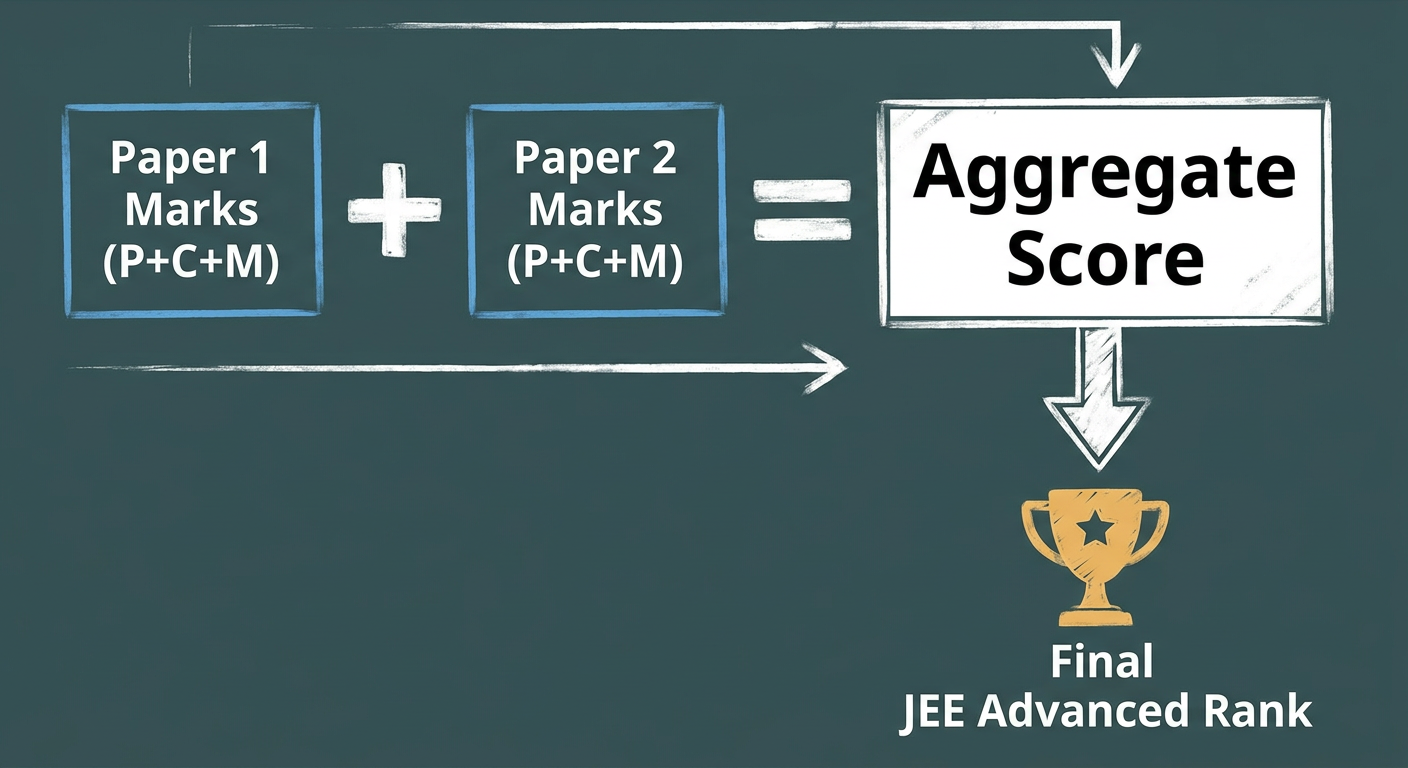
Once the exam is over and the results are out, the final ranks are declared. Your rank is not based on your performance in just one paper. The marks obtained in Physics, Chemistry, and Mathematics from both Paper 1 and Paper 2 are summed up to get your aggregate score. Based on this aggregate score, the final rank lists are prepared.
There isn't just one rank list. Separate rank lists are prepared for different categories: the Common Rank List (CRL), GEN-EWS rank list, OBC-NCL rank list, SC rank list, ST rank list, and various PwD rank lists. Your admission and choice of branch/IIT will depend on your rank in your respective category list.
For students with a creative bent and an interest in architecture, there's another step. To be eligible for admission to the Bachelor of Architecture (B.Arch) program at IIT (BHU) Varanasi, IIT Kharagpur, and IIT Roorkee, candidates must first qualify JEE Advanced and then appear for the Architecture Aptitude Test (AAT). The AAT is a separate paper that tests your sketching, visualization, and aesthetic sensitivity. You are only declared 'pass' or 'fail' in AAT; no separate rank is given.
FAQs
What is the 75% criteria for JEE Advanced?
The 75% criteria means a candidate must have scored at least 75% aggregate marks in their Class 12 board exams to be eligible for admission to an IIT. For SC, ST, and PwD candidates, this criterion is relaxed to 65%. Alternatively, being in the top 20 percentile of your board also makes you eligible.
How many times can I attempt JEE Advanced?
You can attempt the JEE Advanced a maximum of two times in two consecutive years. The first attempt is in the year you take your Class 12 board exam, and the second is in the immediate next year.
Is JEE Advanced harder than JEE Main?
Yes, significantly harder. JEE Main tests your knowledge and speed on a wider, but shallower, syllabus. JEE Advanced tests your deep conceptual understanding, analytical abilities, and problem-solving skills on a more focused but deeper syllabus.
Can I get into an IIT without clearing JEE Advanced?
No. The Joint Entrance Examination (Advanced) is the one and only gateway for admission to undergraduate engineering, science, or architecture programs in any of the 23 IITs. There is no other way.
Which IIT conducts the exam each year?
The exam is conducted by one of the seven zonal IITs on a rotational basis. These are IIT Bombay, IIT Delhi, IIT Guwahati, IIT Kanpur, IIT Kharagpur, IIT Madras, and IIT Roorkee. For example, IIT Madras conducted it in 2024, and IIT Guwahati conducted it in 2023.
What is a good rank in JEE Advanced?
This depends on your goal. To get a seat in any of the IITs in any branch, a rank under 15,000-17,000 is usually required. For popular branches like Computer Science in the top 5-7 IITs, you would typically need a rank under 500. A rank under 5,000 can get you a good branch in one of the top IITs.