JEE Advanced 2026 female topper Arohi Deshpande: AIR 77, 280 marks, preparation strategy and success story - Education Times
Your complete A-to-Z guide on the JEE Advanced exam. We cover eligibility, exam pattern, syllabus, cutoffs, and a winning preparation strategy for IIT aspirants.
19 min read
JEE Advanced: The Ultimate Guide to Cracking the IIT Dream
Think of your JEE preparation like a video game. You've spent two years grinding, leveling up your skills in Physics, Chemistry, and Maths. The JEE Main exam was like a tough but predictable mini-boss. You cleared it. But now, you face the final boss: the JEE Advanced. It's the level everyone talks about in hushed, respectful tones. It's the one that guards the ultimate prize: a seat in one of the legendary Indian Institutes of Technology (IITs).
But what really is this exam? Is it just a harder version of JEE Main, or a completely different beast? Spoiler alert: it's a different beast.
The JEE Advanced is the second and final stage of the Joint Entrance Examination, the gateway for admission into the 23 IITs. Unlike Main, which tests your speed and breadth of knowledge, Advanced tests your depth, your analytical power, and your ability to handle pressure when faced with completely new types of problems.
This is your one-stop, comprehensive guide. We will break down everything you need to know, from the nitty-gritty of eligibility rules to the winning strategies that toppers use. By the end of this post, the final boss won't seem so scary anymore.
What is the JEE Advanced Exam, Really?
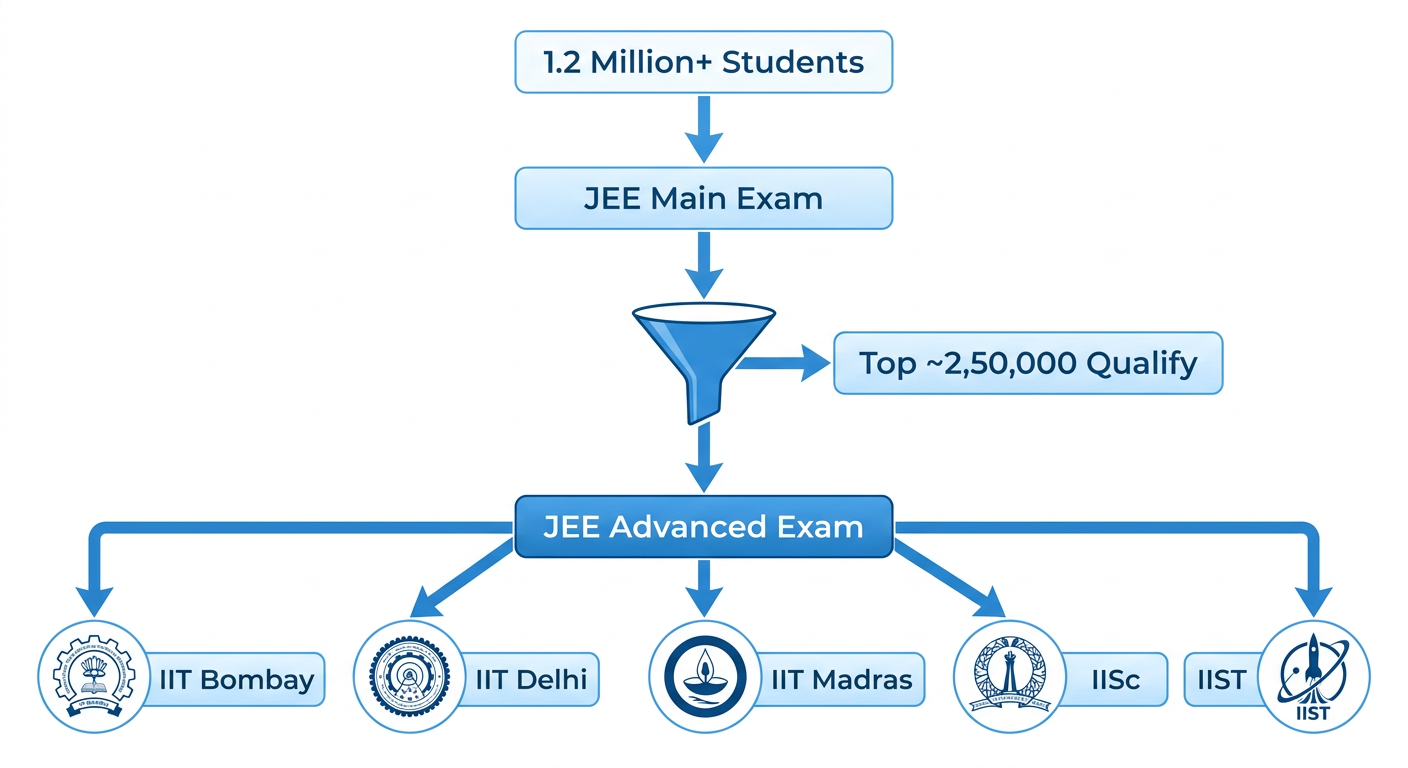 The JEE Advanced exam is your exclusive ticket to the undergraduate engineering, science, and architecture programs at the prestigious IITs. It's not an exam you can just decide to write. You have to earn the right to sit for it by performing exceptionally well in JEE Main.
Think of it this way: JEE Main is a screening test for the entire country. JEE Advanced is the main event, reserved for the top performers from that screening. Approximately the top 2,50,000 candidates from JEE Main (Paper 1) are eligible to appear for Advanced. This exam is conducted by one of the seven zonal IITs (Bombay, Delhi, Guwahati, Kanpur, Kharagpur, Madras, and Roorkee) on a rotational basis.
Its purpose is not just to test what you know, but how you think. The questions are designed to be multi-conceptual, requiring you to pull ideas from different chapters and sometimes even different subjects to find a solution. This is why it’s considered one of the toughest undergraduate entrance exams in the world. Success here isn't just about getting into a college; it's a statement about your problem-solving abilities.
Are You Eligible? Decoding the JEE Advanced Eligibility Criteria
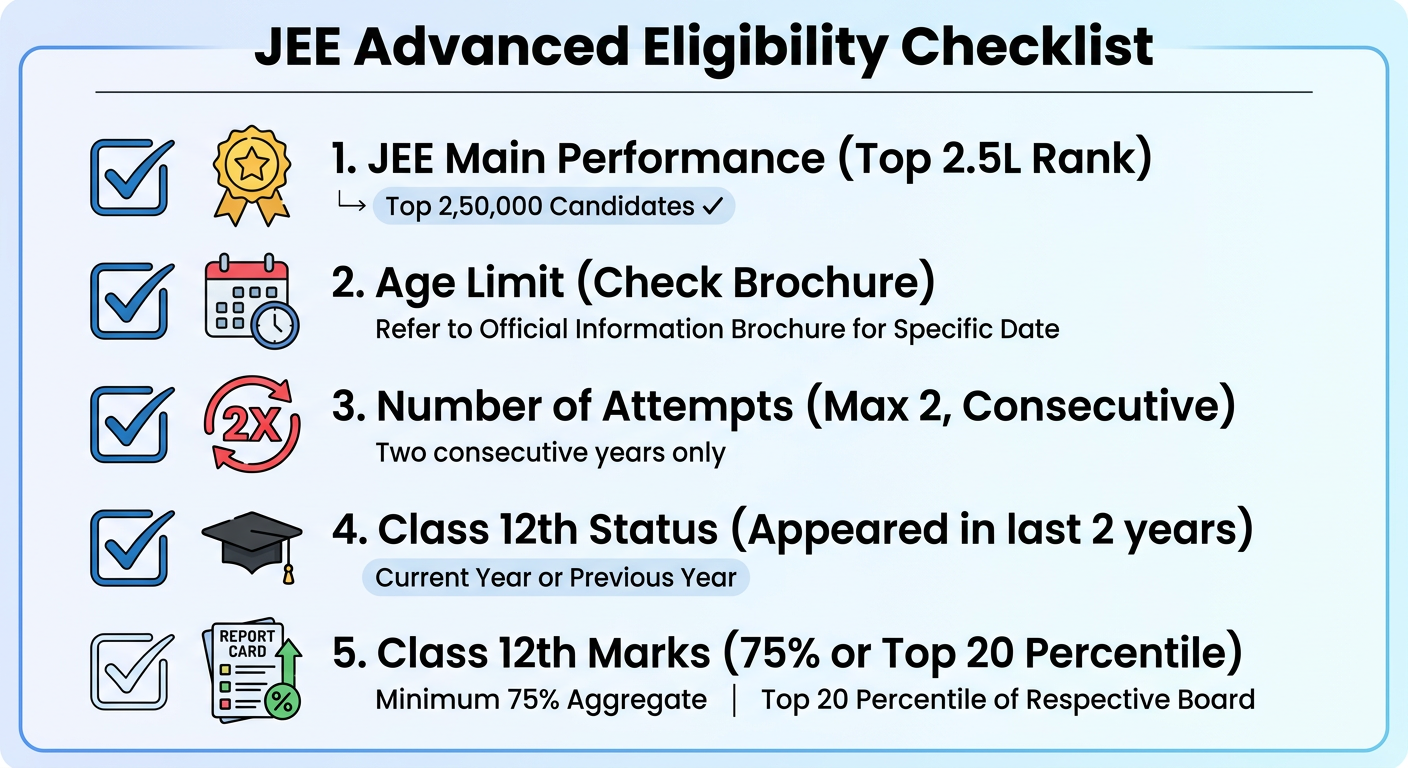 Before you even dream of an IIT, you need to clear the bouncer at the door. The
JEE Advanced eligibility criteria are strict and non-negotiable. Missing even one of these can disqualify you, so pay close attention. Let's break down the five critical hurdles you must clear.
Criterion 1: Performance in JEE Main
This is the first and most important filter. You must appear for JEE Main's Paper 1 and rank among the top 2,50,000 candidates across all categories. This shortlist is prepared by the NTA after the JEE Main results are declared.
The NTA publishes category-wise cutoffs (for GEN, EWS, OBC-NCL, SC, ST, PwD). If your All India Rank (AIR) in JEE Main is within this top group, you are eligible to register for the JEE Advanced. You can always check the latest cutoff information on the official JEE Main NTA website.
Criterion 2: Age Limit
There is a specific age limit for the exam. For instance, for JEE Advanced 2024, candidates had to be born on or after October 1, 1999. This date shifts every year.
As a general rule, you must be under a certain age to appear. There is a five-year relaxation for SC, ST, and PwD candidates. Always, always check the official Information Brochure for the current year on the JEE Advanced website for the exact date of birth requirement.
Criterion 3: Number of Attempts
This rule is simple but crucial. You can attempt the JEE Advanced a maximum of two times in two consecutive years. That's it. There is no third chance.
For example, if you are appearing for your Class 12 board exams for the first time in 2025, you are eligible to write JEE Advanced in 2025 and 2026. If you miss the 2026 attempt, you cannot appear in 2027. This limited number of tries makes each attempt incredibly valuable.
Criterion 4: 12th Class Examination Status
A candidate must have appeared for the Class 12 (or equivalent) board examination for the first time in either the year of the exam or the year immediately preceding it.
So, to be eligible for JEE Advanced 2025, you should have appeared for your Class 12 boards for the first time in either 2024 or 2025. You must also have taken Physics, Chemistry, and Mathematics as compulsory subjects in your 12th standard.
Criterion 5: Performance in 12th Board Exams
This is the infamous "75% rule," and it causes a lot of confusion. To be eligible for admission into an IIT, a candidate must satisfy at least one of two conditions:
- Have secured at least 75% aggregate marks in their Class 12 (or equivalent) board examination. For SC, ST, and PwD candidates, this threshold is relaxed to 65%.
- Be within the top 20 percentile of successful candidates in their respective Class 12 board exam.
Important Note: This criterion was temporarily relaxed during the COVID-19 pandemic. However, it has been reinstated. It is absolutely vital to check the latest Information Brochure for the year you are appearing to see if this rule is in effect and what the exact requirements are.
The Battle Plan: Understanding the JEE Advanced Exam Pattern
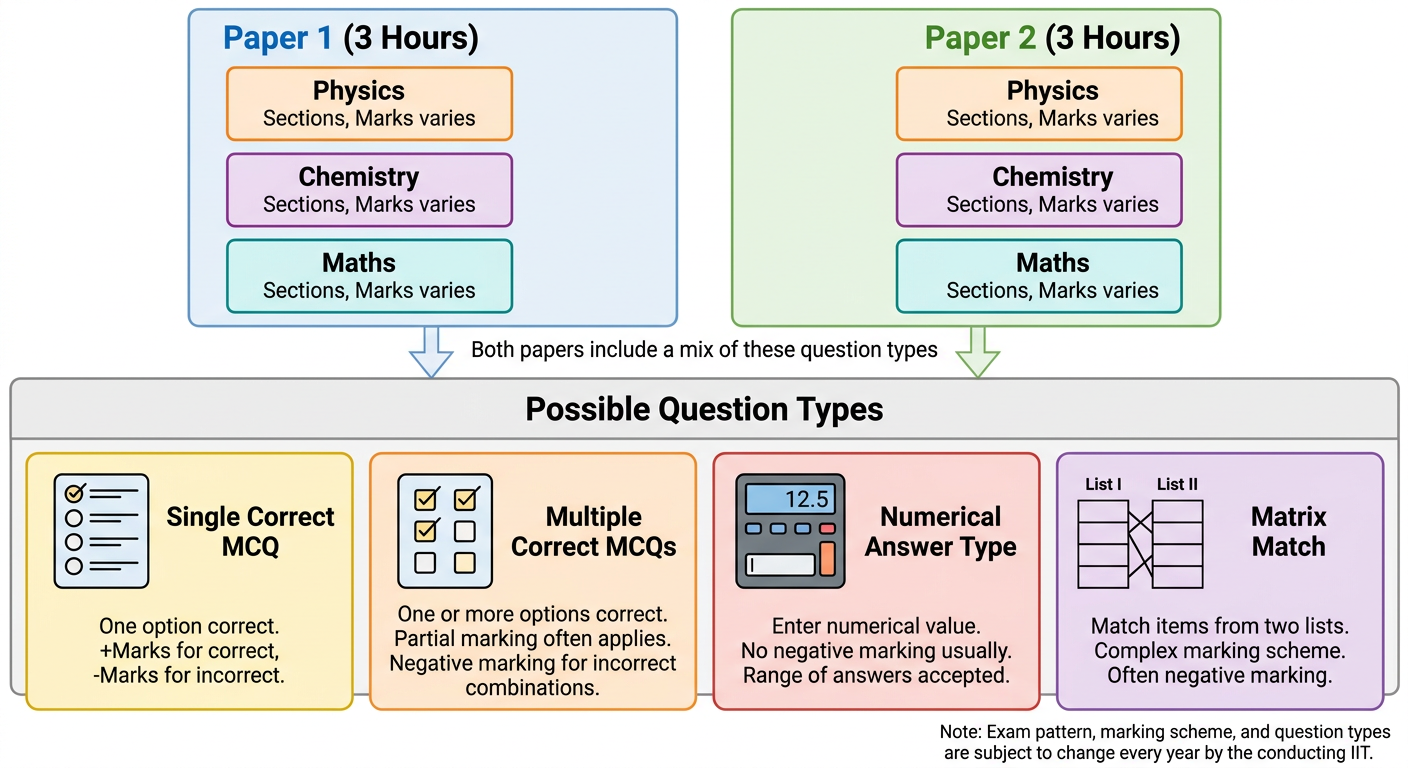 The
JEE Advanced exam pattern is designed to keep you on your toes. It is not fixed. While the broad structure remains the same, the types of questions and the marking scheme can change every single year. This uncertainty is part of the challenge.
The exam is a Computer Based Test (CBT) consisting of two compulsory papers: Paper 1 and Paper 2. Both papers are three hours long and are usually held on the same day with a break in between. You cannot skip either paper; attempting both is mandatory to be considered for a rank.
Each paper is divided into three sections: Physics, Chemistry, and Mathematics. The real complexity, however, lies in the questions themselves.
The Ever-Changing Question Types
Forget the simple, single-choice questions you're used to. JEE Advanced throws a variety of formats at you, each with its own set of rules and traps. You might encounter:
- Multiple Correct Choice Questions (MCQs): These questions have one or more correct options. You get full marks only if you select all the correct options and no incorrect ones. Some years, partial marks are awarded for selecting some of the correct options.
- Numerical Answer Type (NAT) Questions: For these, you must calculate a numerical value and enter it using the on-screen keypad. There are no options provided. These often do not have negative marking, making them good to attempt.
- Single Correct Choice Questions (MCQs): The classic format with one correct answer out of four options.
- Paragraph/Comprehension Based Questions: A passage of text is given, followed by two or three questions based on the information in it.
- Matrix Match (Match the Following): You have to match items in one column with items in another. These can be complex, with one-to-one or one-to-many mappings.
Because the format and marking can change, the single most important thing you can do on exam day is to carefully read the instructions for each section before you begin.
The Specter of Negative Marking
Negative marking is a core feature of the IIT JEE. It's what separates the brave from the reckless. For single-correct questions, you typically lose 1 mark for a wrong answer. For multiple-correct questions, the penalty can be harsher, sometimes -2 marks.
The genius of the exam is that the marking scheme isn't uniform. A section with numerical questions might have zero negative marking, while a multiple-correct section might have heavy penalties. This forces you to make strategic decisions. Which questions should you attempt? Which ones are better left alone? Mastering this risk-reward calculation is key to a good score.
Mastering the Battlefield: The Complete JEE Advanced Syllabus
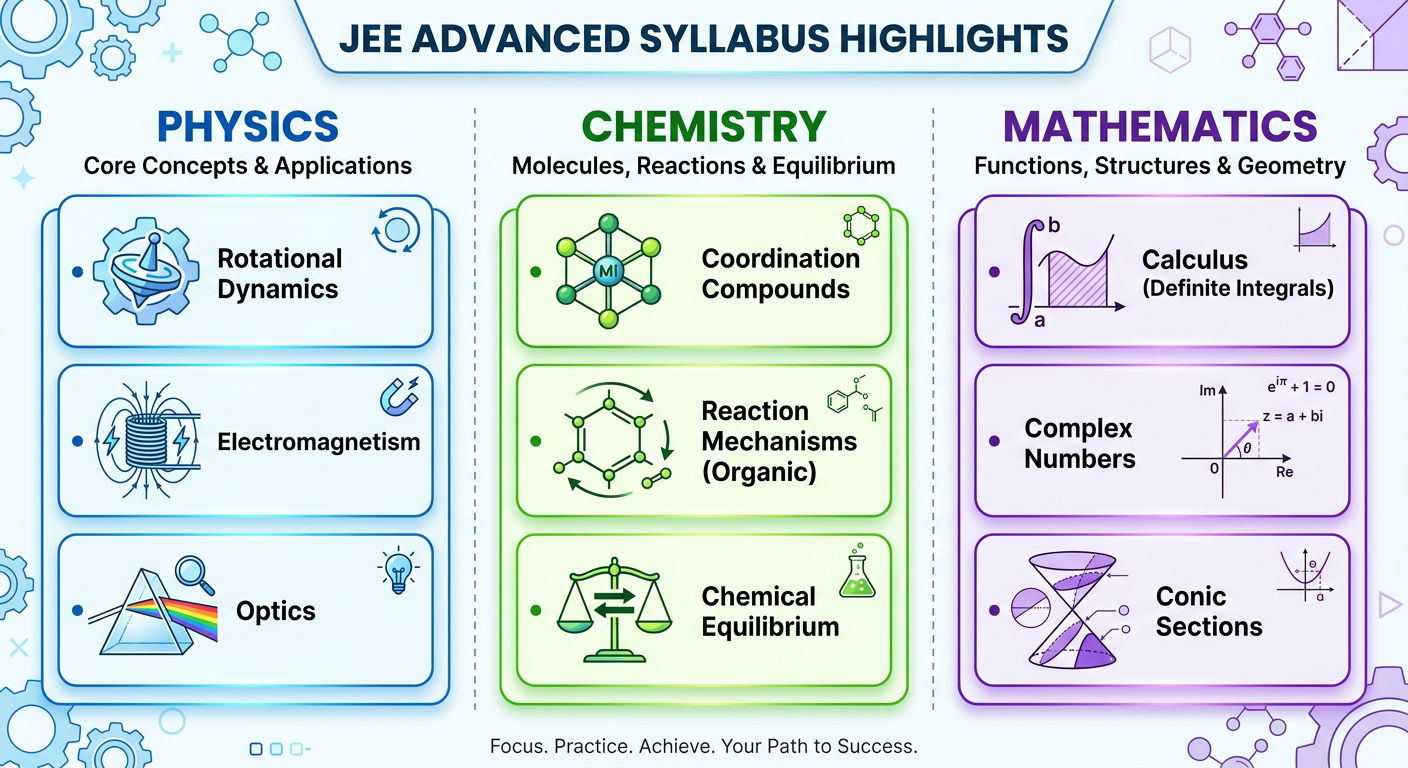 The
JEE Advanced syllabus largely overlaps with the JEE Main syllabus, but with a few key differences and a huge jump in expected depth. It's not about learning more topics; it's about learning the same topics at a much deeper, more fundamental level.
Simply mugging up formulas won't work here. You are expected to understand where the formulas come from and how to apply them in unfamiliar situations. The official syllabus is released each year and is the definitive guide to what you need to study. You can find a detailed breakdown on our JEE syllabus page, but let's look at the highlights for each subject.
Physics Syllabus Highlights
Physics in JEE Advanced is all about concept integration. A single question on mechanics might also require concepts from electromagnetism. High-weightage areas include:
- Mechanics: The foundation of everything. Topics like Rotational Dynamics are particularly important and complex.
- Electromagnetism: A vast and critical unit, from Electrostatics and Current Electricity to a deep understanding of Magnetic Effects of Current and Electromagnetic Induction.
- Optics: Both geometrical and wave optics are tested with problems that require strong visualization skills.
- Thermodynamics: Questions often link concepts from Kinetic Theory of Gases and heat transfer.
- Modern Physics: While seeming formula-based, the questions test a genuine understanding of topics like the photoelectric effect, Bohr's model, and radioactivity.
Chemistry Syllabus Highlights
Chemistry is often the most scoring subject in JEE Advanced if prepared well. It's a balanced mix of understanding, memorization, and application.
- Physical Chemistry: Demands strong numerical problem-solving skills, especially in chapters like Chemical Equilibrium, Ionic Equilibrium, Electrochemistry, and Chemical Kinetics.
- Organic Chemistry: This is all about reaction mechanisms. You can't just memorize reactions; you must understand why they happen. General Organic Chemistry (GOC) is the absolute backbone.
- Inorganic Chemistry: Often feared, but very high-yielding. Deep knowledge of the p-block, d-block elements, and especially Coordination Compounds and Chemical Bonding is essential.
Mathematics Syllabus Highlights
Mathematics in JEE Advanced is the ultimate test of your analytical and creative thinking. Problems are often lengthy and require a clever approach to solve within the time limit.
- Calculus: The biggest chunk of the paper. Differential and Integral calculus are tested extensively, with a focus on applications.
- Coordinate Geometry: Conic sections (parabola, ellipse, hyperbola) and straight lines are perennial favorites.
- Algebra: Complex Numbers, Permutations and Combinations, and Probability are chapters where you can expect tricky, thought-provoking questions.
- Vectors and 3D Geometry: These topics are highly scoring if your visualization is strong and you are comfortable with the formulas and their applications.
The Final Countdown: Registration, Dates, and Key Milestones
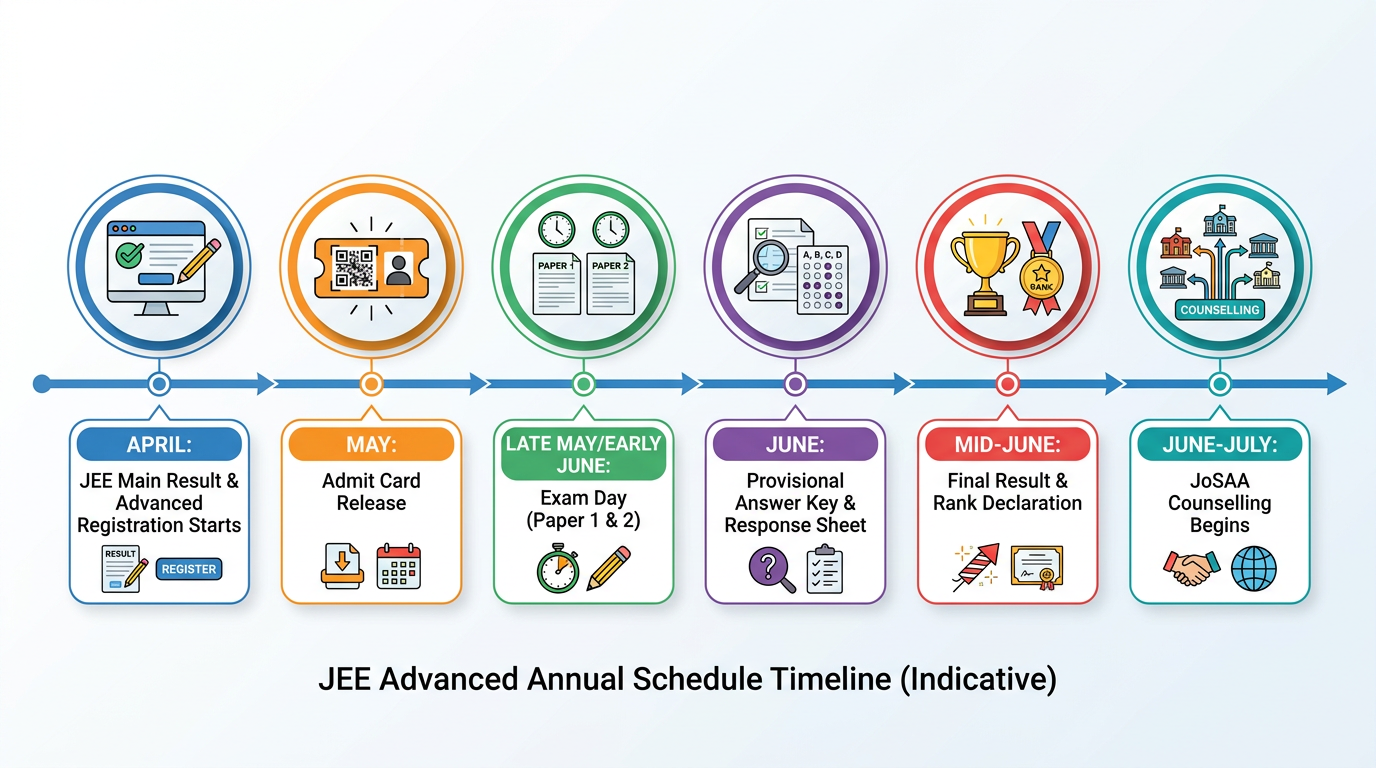 Understanding the annual timeline of the
IIT JEE helps you plan your preparation and reduces last-minute stress. While exact dates change every year, the sequence of events is fairly consistent.
JEE Main Performance & Advanced Registration
The process begins right after the final JEE Main results are announced, typically in April. The NTA releases the list of the top 2,50,000 eligible candidates. Soon after, the registration window for JEE Advanced opens on its official portal.
You'll need to fill out the form and upload scanned copies of required documents, which usually include your photograph, signature, Class 10th certificate (for date of birth), Class 12th marksheet, and any category certificates (OBC-NCL, EWS, SC, ST) if applicable. Pay the registration fee, and you are officially in the race.
Admit Card and Exam Day
About a week to ten days before the exam, the JEE Advanced admit card is released for download. This is your hall ticket. Download it, print a copy, and check every single detail: your name, roll number, photo, signature, exam center, and exam timings. Any discrepancy must be reported immediately.
On exam day, you will have Paper 1 in the morning (usually 9 AM to 12 PM) and Paper 2 in the afternoon (usually 2:30 PM to 5:30 PM). The break in between is crucial for relaxing and regrouping. Don't discuss Paper 1; focus on being fresh for Paper 2.
Post-Exam Timeline: Answer Key, Results, and JoSAA Counselling
After the exam, the journey is still not over. A few days later, the official conducting IIT releases the candidate response sheets and provisional answer keys. You get a short window to challenge the provisional keys if you believe there's an error.
Finally, the moment of truth arrives. The final answer keys and the JEE Advanced results, including your All India Rank, are declared. This usually happens in mid-June. If you have secured a rank, the final step is to participate in the JoSAA (Joint Seat Allocation Authority) counselling process, where you fill in your choices of IITs and branches, and seats are allocated based on your rank.
What Does It Take to Win? Decoding JEE Advanced Cutoff
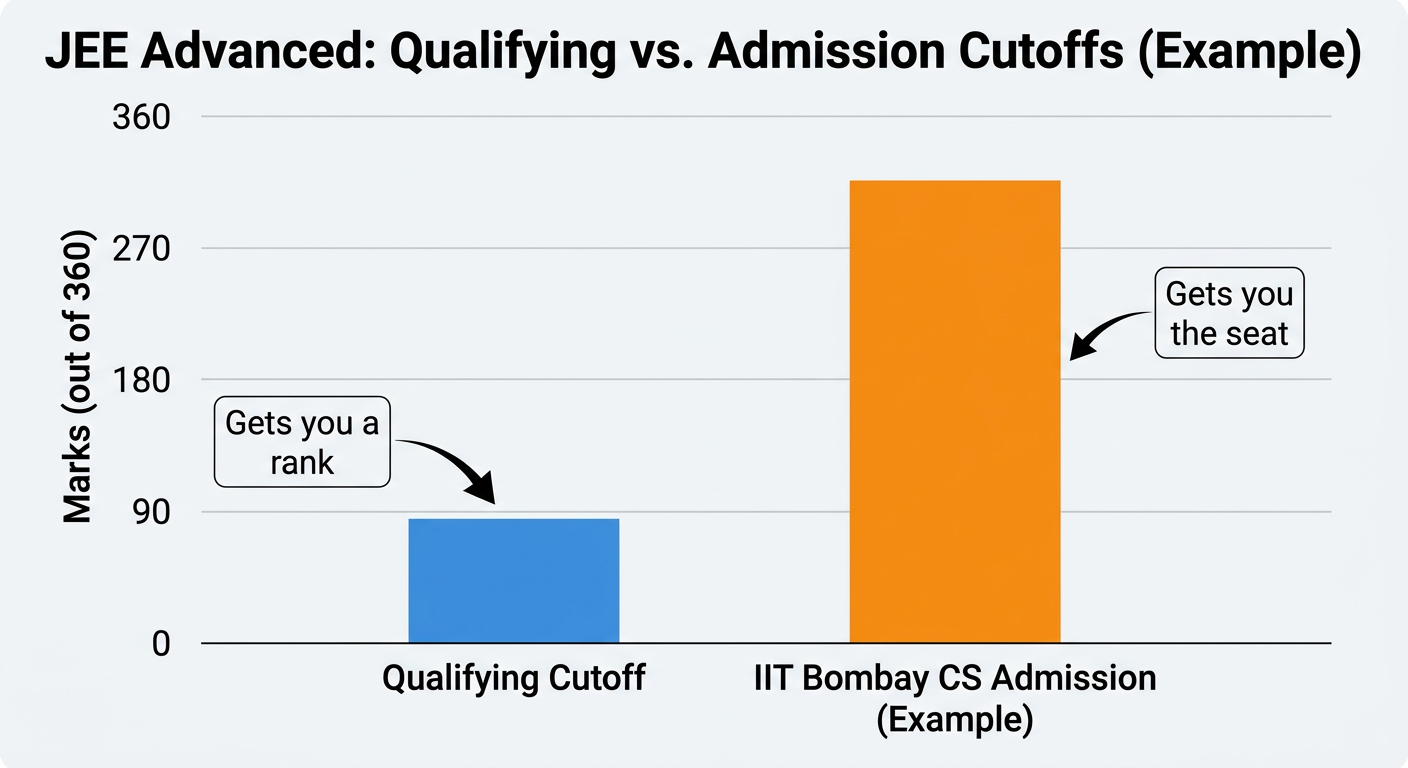 This is one of the most misunderstood aspects of the exam. Students often hear about a
JEE Advanced cutoff and get confused. It's because there are actually two different types of cutoffs, and they mean very different things.
Qualifying Cutoff vs. Admission Cutoff
Let's clear this up once and for all. They are not the same.
Qualifying Cutoff: This is the minimum percentage of marks you need to score to be included in a rank list. It is decided by the IITs after the exam and depends on the paper's difficulty. This cutoff has two components: a minimum score required in each subject (Physics, Chemistry, Maths) and a minimum total aggregate score. Surprisingly, this cutoff can be quite low. In some years, scoring just 25% of the total marks was enough to qualify and get a rank!
Admission Cutoff: This is the rank (not marks) that was the last to get a seat in a particular branch of a particular IIT. This is what truly matters for admission and is determined by the demand and supply during JoSAA counselling. For example, the closing rank for Computer Science at IIT Bombay might be under 100, while the closing rank for a different branch at a newer IIT might be over 10,000.
So, qualifying the exam gets you a rank. But having a good enough rank gets you a seat. Your goal is not just to clear the qualifying cutoff, but to score high enough to get a rank that will land you in your dream college and branch.
A Look at Past Year Cutoffs (For Perspective)
To give you a realistic picture, let's look at some numbers. In a typical year, the aggregate qualifying cutoff for a general category student might be around 90-100 marks out of 360. This is just about 25-28%.
However, to get into a top-5 IIT in a decent branch, you'd likely need a rank under 2000-3000, which could correspond to a score well above 50% of the total marks. These numbers change drastically every year based on difficulty, so don't fixate on a specific target score. Instead, focus on maximizing your performance relative to others.
Using a JEE rank predictor tool after your JEE Main can give you a rough idea of your standing and help you gauge the competition before the final exam.
The Ultimate Strategy: How to Prepare for JEE Advanced
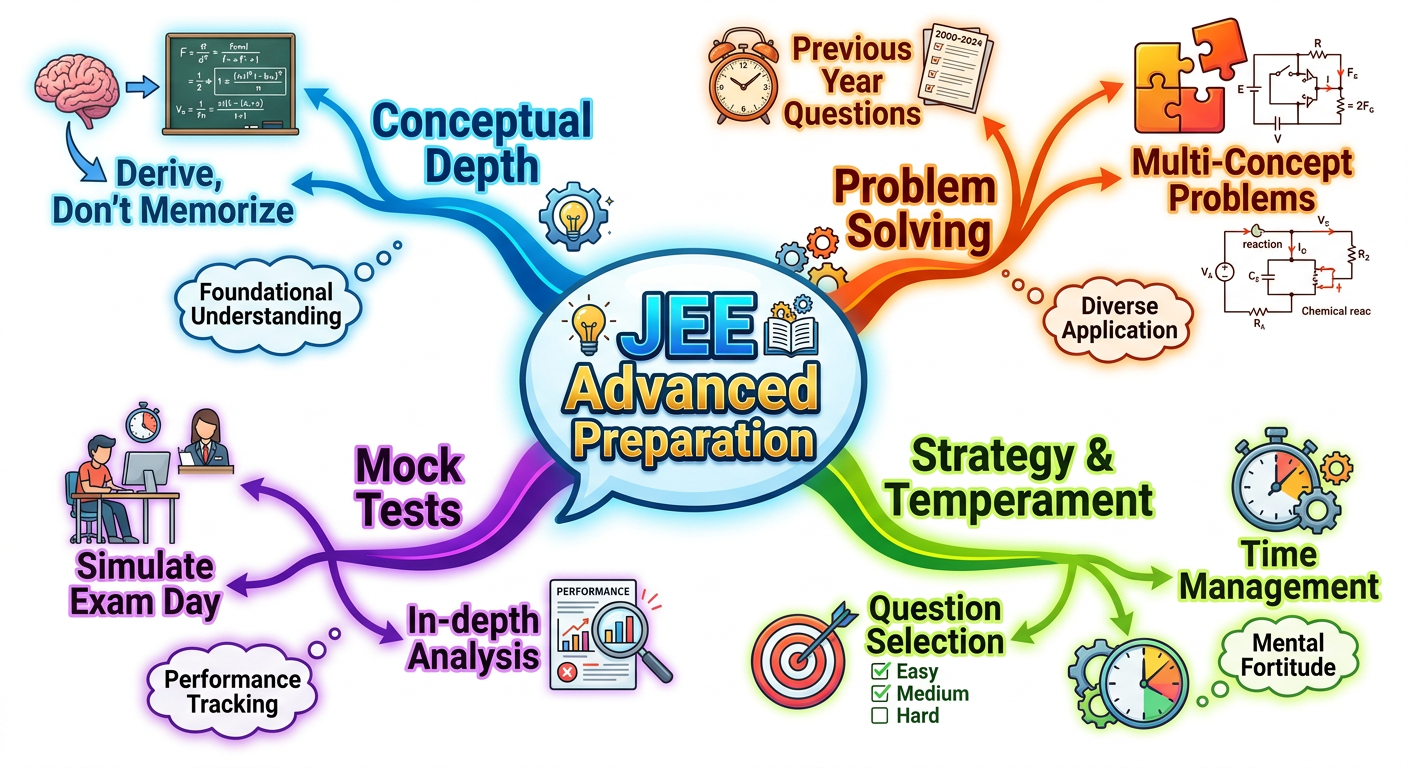 Great, you know the rules, the pattern, and the syllabus. But how do you actually prepare? Your
JEE Advanced preparation tips need to be different from your JEE Main strategy. It's time to switch gears from a sprint to a marathon that requires deep thinking.
Shift Your Mindset: From Main to Advanced
JEE Main is a game of speed. You need to solve a large number of relatively standard questions quickly. The focus is on covering the entire syllabus and being accurate with formulas.
JEE Advanced is a game of depth and patience. You will face fewer questions, but they will be much harder and more complex. You need to be able to sit with a problem, dissect it, and build a solution from scratch. Rote memorization will fail you; conceptual clarity is everything.
The Right Study Material
Don't hoard books. Stick to a few standard reference books for each subject and solve them thoroughly. More important than any book, however, are the previous year's papers.
Solving JEE Advanced previous year questions is the single most effective preparation method. It tunes your brain to the pattern, difficulty, and style of the actual exam. It's like practicing against the final boss's previous avatars.
The Power of Mock Tests
You cannot go into this battle without a proper simulation. Taking mock tests is non-negotiable. But just taking them is not enough; analyzing them is what counts.
Take full-length mock tests in a realistic exam environment: two 3-hour papers with a break in between. After every test, spend hours analyzing your performance. Why did you get a question wrong? Was it a concept gap, a silly calculation error, or a wrong choice in a multiple-correct question? Which questions did you spend too much time on? This analysis helps you build a robust exam-taking strategy and temperament.
Subject-Specific Preparation Tips
- Physics: Don't just learn formulas; derive them. Understand the conditions under which they apply. Practice problems that combine concepts, like a question involving both rotation and electromagnetism.
- Chemistry: For Organic, master the reaction mechanisms. Don't just memorize named reactions. For Inorganic, make concise notes for block chemistry and revise them repeatedly. For Physical, practice a wide variety of numerical problems to improve your calculation speed and accuracy.
- Mathematics: This subject is all about practice. The more diverse problems you solve, the better your problem-solving intuition becomes. Focus on developing multiple approaches to solve the same problem. This flexibility is invaluable in the exam hall.
Is Dropping a Year for IIT JEE a Good Idea?
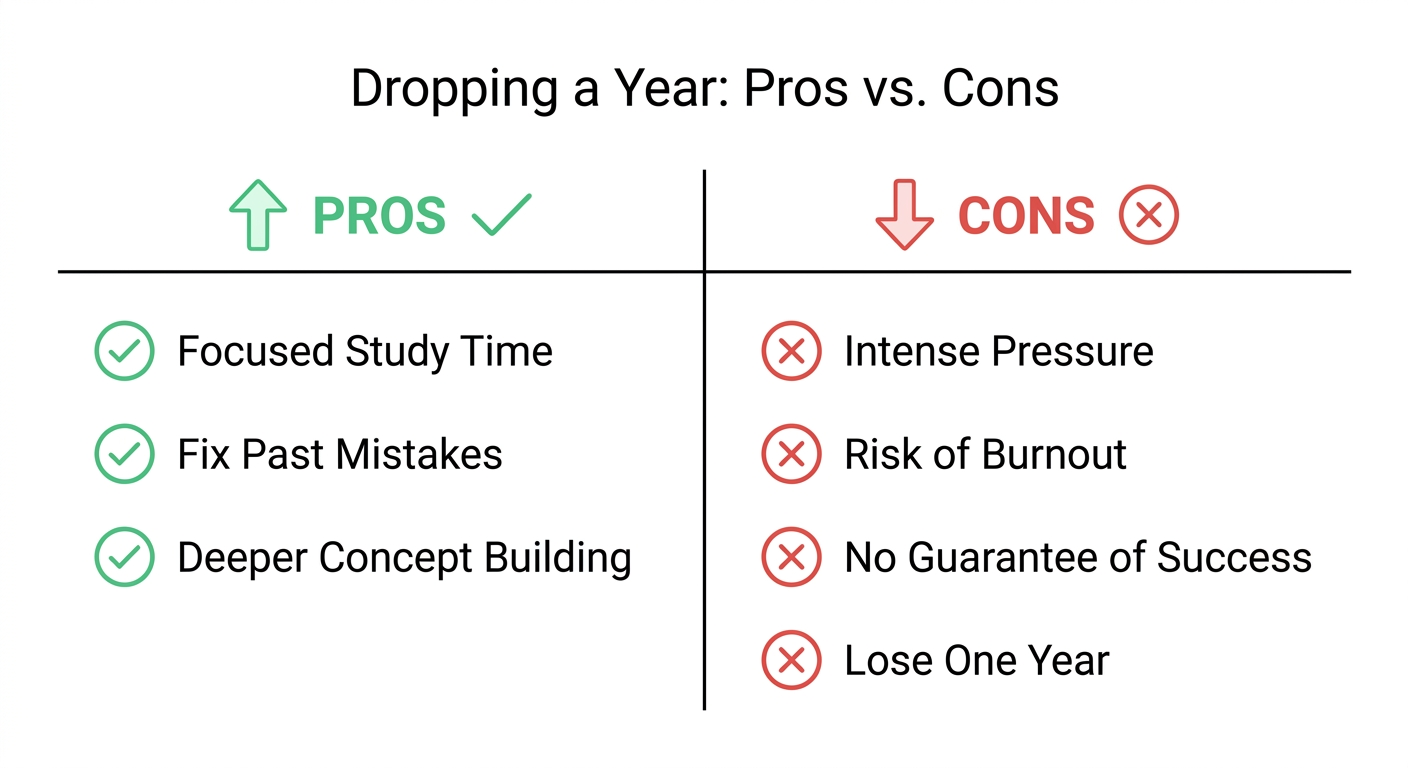 This is a question that haunts thousands of students every year. You've given it your all, but your rank isn't what you hoped for. Should you take a drop and try again?
It's a tough decision with no easy answer. Let's look at it logically.
The Pros of Dropping:
- Focused Time: You have an entire year dedicated solely to JEE preparation without the pressure of board exams.
- Rectify Mistakes: You can analyze your first attempt, identify your weaknesses, and work specifically on them.
- Deeper Understanding: You have more time to go deeper into concepts, which is crucial for JEE Advanced.
The Cons of Dropping:
- High Pressure: The pressure to succeed in the second (and final) attempt is immense. There are no more excuses.
- Burnout and Monotony: Studying the same syllabus for another year can be mentally exhausting and lead to burnout.
- No Guarantee: A drop year does not guarantee a better rank. Many students find their rank stagnates or even drops due to the intense pressure.
- The Opportunity Cost: You are one year behind your peers who join college. This can have long-term career implications.
Before you decide, do an honest self-assessment. How close were you this time? What was the reason for your low score: lack of time, silly mistakes, or major concept gaps? Are you mentally prepared for another year of the same rigorous routine? Talk to your parents, teachers, and seniors before making this life-altering choice.
FAQs
How many times can I attempt JEE Advanced?
You can attempt the JEE Advanced a maximum of two times, and these must be in two consecutive years. For example, if your first attempt is in 2025, your second and final attempt must be in 2026.
What is the 75% criteria for JEE Advanced?
To be eligible for admission to an IIT, you must have either scored at least 75% aggregate marks in your Class 12 board exams (65% for SC/ST/PwD) OR be in the top 20 percentile of your specific board. This rule can sometimes be changed, so always check the official information brochure for the year you are appearing.
Is JEE Advanced harder than JEE Main?
Yes, significantly. JEE Main tests a wide range of topics with a focus on speed and accuracy. JEE Advanced tests a similar syllabus but with much greater depth, requiring strong analytical skills, creative problem-solving, and the ability to handle complex, multi-concept questions.
Can I get into an IIT without qualifying JEE Advanced?
No. Qualifying JEE Advanced by securing a rank is the only way to get admission to any undergraduate engineering, science, or architecture program in any of the 23 IITs.
What is a good score in JEE Advanced?
This varies every year based on the paper's difficulty. There's no fixed "good score." However, historically, a score above 50% of the total marks is considered excellent and can secure a top-2000 rank. Even scores in the 35-40% range can often be enough to get a seat in one of the IITs.
Which IIT will conduct JEE Advanced next year?
The exam is conducted by one of the seven zonal IITs (Bombay, Delhi, Guwahati, Kanpur, Kharagpur, Madras, Roorkee) on a rotational basis. The specific IIT responsible for conducting the exam in a particular year is announced on the official JEE Advanced website well in advance.