Over 10,000 women qualify JEE Advanced for the first time in six years - The Times of India
Get the complete guide to JEE Advanced 2025, including the latest syllabus, exam pattern, eligibility, cutoff, and a winning preparation strategy to crack the IIT entrance.
15 min read
JEE Advanced: Your Ultimate Guide to Cracking the IIT Exam
In 2024, history was made. For the first time, over 10,000 young women qualified in the JEE Advanced exam. This isn't just a statistic. It's a signal of the intense, ever-growing competition and the burning ambition of students across India to walk through the hallowed gates of an IIT.
But what does it really take to conquer this mountain? The journey from JEE Main to an IIT seat goes through one of the toughest, most prestigious exams in the world: the JEE Advanced.
Feeling overwhelmed? Don't be. This guide is your roadmap. We'll break down everything you need to know, from eligibility and exam patterns to a winning strategy that will turn your IIT dream into a reality. Let's get started.
What is the JEE Advanced Exam, Really?
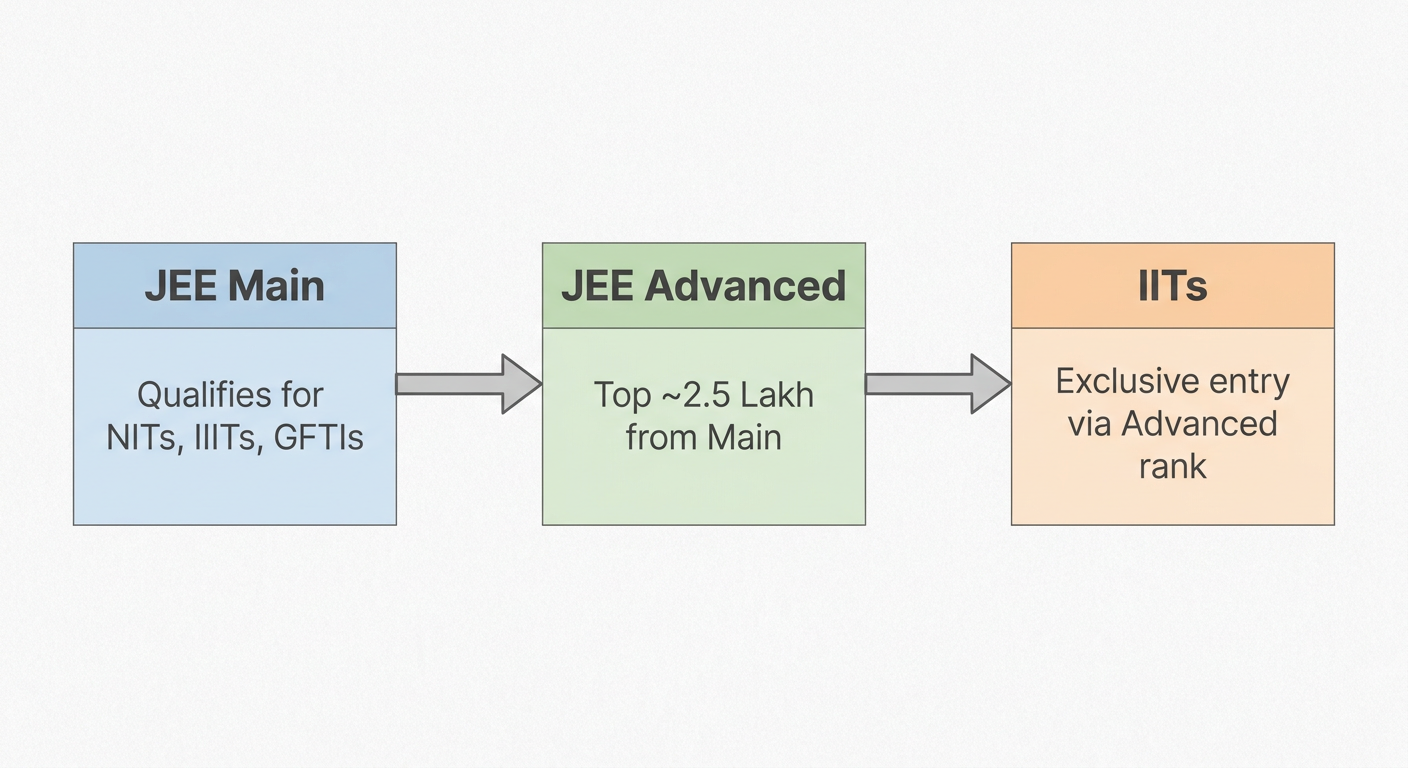
Think of the JEE exam system as a two-stage rocket. The first stage is JEE Main, which gets you off the ground and qualifies you for a range of engineering colleges like NITs, IIITs, and other GFTIs. But to reach the final orbit, the Indian Institutes of Technology (IITs), you need to fire the second stage: the JEE Advanced.
Simply put, JEE Advanced is the exclusive entrance examination for admission into undergraduate engineering (B.Tech), science (B.S.), and architecture (B.Arch.) programs at all 23 IITs. It's the only way in. No other score or exam will get you a seat in an IIT for these courses.
Unlike JEE Main, which is conducted by the National Testing Agency (NTA), the JEE Advanced exam is conducted by one of the seven zonal IITs (like IIT Bombay, IIT Delhi, IIT Madras, etc.) on a rotational basis under the guidance of the Joint Admission Board (JAB). This rotational system brings a subtle flavour change to the paper each year, something seasoned aspirants always keep in mind.
JEE Advanced Eligibility Criteria: Are You In?
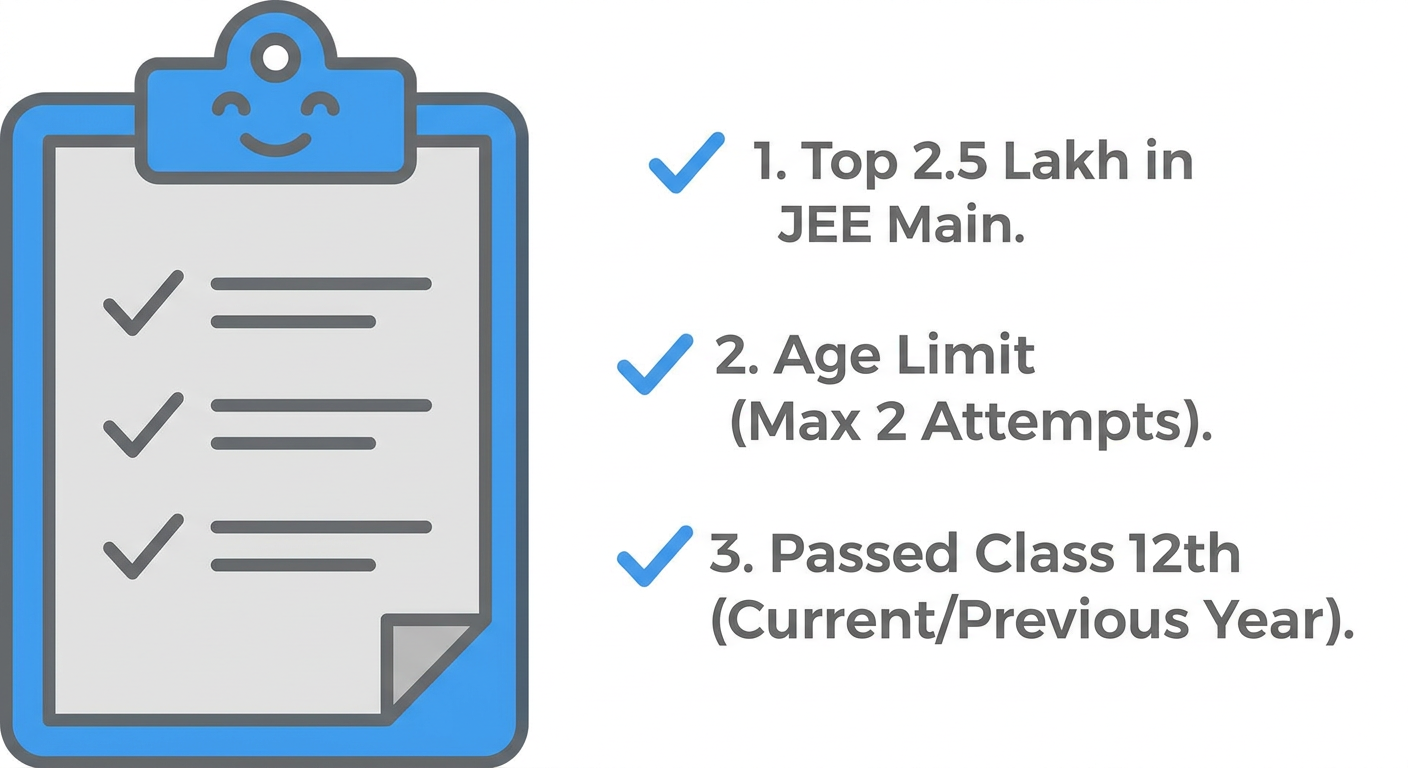
Before you even start dreaming about which IIT campus you want, you have to pass the gatekeeper: the eligibility criteria. These rules are strict and non-negotiable, so pay close attention. Missing even one can disqualify you, no matter how well you've prepared.
Performance in JEE Main
This is the very first hurdle. You must be among the top candidates who clear the JEE Main cutoff for JEE Advanced. For the 2024 exam, this was approximately the top 2,50,000 candidates across all categories from the JEE Main Paper 1 rank list.
This isn't a single number for everyone. The NTA sets category-wise cutoffs. For example, the cutoff score for General category will be different from EWS, OBC-NCL, SC, ST, and PwD categories. You must clear your respective category's cutoff to be eligible to register for JEE Advanced.
Age Limit
There is a strict age limit. For the 2024 exam, candidates had to be born on or after October 1, 1999. This date shifts by one year for every subsequent exam. So for JEE Advanced 2025, you'll likely need to be born on or after October 1, 2000.
There is a five-year age relaxation for Scheduled Caste (SC), Scheduled Tribe (ST), and Person with Disability (PwD) candidates. This means for the 2024 exam, they must have been born on or after October 1, 1994. Always check the official information brochure on the JEE Advanced website for the exact dates for the year you are appearing.
Number of Attempts
A candidate can attempt the JEE Advanced a maximum of two times in two consecutive years. That's it. Only two shots at the big league. For example, if you appear for your Class 12th board exams in 2024, you can attempt JEE Advanced in 2024 and 2025. You cannot skip a year and try again in 2026.
This rule makes every attempt incredibly valuable. There's no 'trial run' or 'gap year' luxury here. You have to be at your best on both your chances.
Class 12th Examination Status
To be eligible, you must have appeared for the Class 12 (or equivalent) examination for the first time in either the current year or the immediately preceding year. For instance, for JEE Advanced 2025, you must have appeared for your Class 12 boards for the first time in either 2024 or 2025.
Furthermore, for admission to IITs, a candidate must either secure at least 75% aggregate marks in their Class 12 board exam (65% for SC, ST, PwD) or be within the top 20 percentile of successful candidates in their respective board. This rule was temporarily relaxed during the pandemic but has been reinstated. It's a crucial final check for IIT admission, even after you've cleared JEE Advanced.
Understanding the JEE Advanced Exam Pattern
If JEE Main tests your knowledge, JEE Advanced tests your temperament, analytical skills, and ability to perform under pressure. The exam pattern is designed to be challenging and unpredictable, a true test of an engineering aspirant's mettle.
The exam consists of two papers: Paper 1 and Paper 2. Both are compulsory. You cannot skip one and expect to be ranked. Both papers are typically held on the same day in two shifts, a morning session and an afternoon session, each with a duration of three hours (four hours for PwD candidates).
The total marks for JEE Advanced can change every year. It's not fixed like JEE Main. The organizing IIT has the freedom to set the number of questions and the marking scheme, which adds a layer of suspense. However, the core structure remains focused on assessing deep conceptual knowledge.
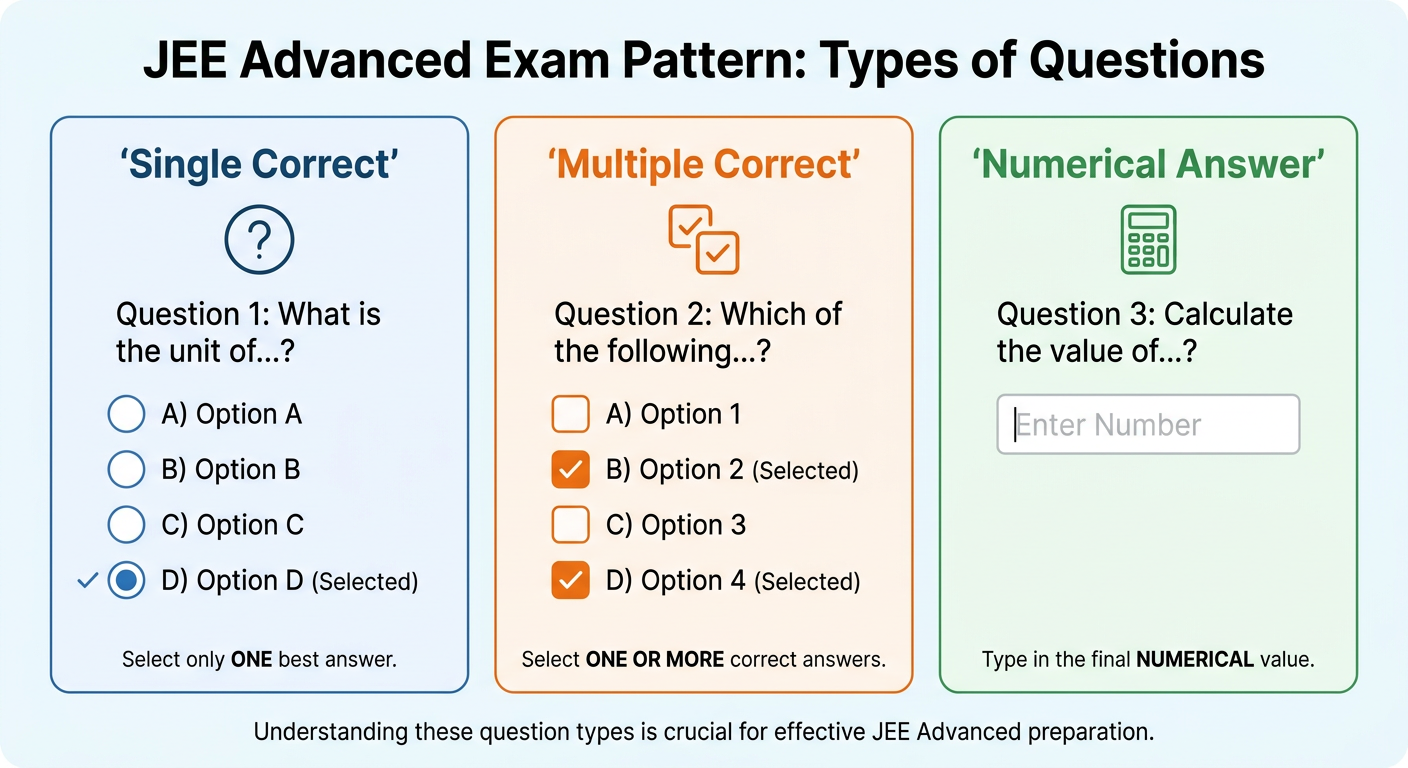
The most distinctive feature is the variety of question types. You will encounter:
- Single Correct Option MCQs: The classic format where only one out of four options is correct.
- Multiple Correct Options MCQs: These are tricky. One or more options can be correct, and you only get full marks if you identify all the correct ones. Some years feature partial marking for identifying some of the correct options.
- Numerical Answer Type (NAT) Questions: There are no options provided. You have to solve the problem and enter the numerical answer (an integer or a decimal) using the on-screen keyboard. These questions usually have no negative marking, making them a good scoring opportunity if you are confident.
- List-Match Sets / Matrix Match: You might be asked to match entries from one column to another.
Negative marking is a crucial part of the JEE Advanced exam pattern. For single-correct questions, you typically get -1 for a wrong answer. For multiple-correct questions, the scheme can be more complex. Understanding the specific marking scheme for each section, as mentioned in the instructions on exam day, is absolutely vital to your strategy.
The JEE Advanced Syllabus: What to Study

At first glance, the JEE Advanced syllabus looks very similar to the JEE Main syllabus, covering the standard Physics, Chemistry, and Mathematics topics from Class 11 and 12. But this is a classic illusion. The difference isn't in what you study, but in the depth you need to achieve.
JEE Advanced questions are famous for mixing concepts from multiple chapters. A single question in Mechanics might also require an application of Calculus. A question in Organic Chemistry might test your knowledge of Stereoisomerism, Reaction Mechanisms, and Spectroscopy all at once. Rote memorization will get you nowhere. You need to build a web of interconnected knowledge. For a detailed topic-wise breakdown, you can always check our JEE syllabus page.
Physics Syllabus Highlights
Physics in JEE Advanced is heavily skewed towards conceptual understanding and problem-solving. Key areas include:
- Mechanics: This is the foundation. From Kinematics to Rotational Motion and Fluid Mechanics, your concepts must be crystal clear.
- Electromagnetism: A vast and important unit, covering everything from Electrostatics and Current Electricity to Magnetism and a deep dive into Electromagnetic Induction.
- Thermodynamics & KTG: Questions are often application-based, testing your understanding of laws and processes.
- Optics: Both Geometrical and Wave Optics are important, often with questions that combine principles from both.
- Modern Physics: This is generally considered a scoring section, but questions can be tricky. Topics include the Photoelectric effect, Bohr’s model, X-rays, and Radioactivity.
Chemistry Syllabus Highlights
Chemistry is often the rank-deciding subject. It's a balanced mix of Physical, Organic, and Inorganic chemistry.
- Physical Chemistry: Topics like Chemical Equilibrium, Ionic Equilibrium, Thermodynamics, and Electrochemistry are calculation-intensive and require precise application of formulas.
- Organic Chemistry: This is all about concepts. General Organic Chemistry (GOC), Isomerism, and Reaction Mechanisms are the backbone. Expect questions that test your understanding of multi-step reactions.
- Inorganic Chemistry: While some memorization is needed (especially for p-block and d-block elements), the focus is on conceptual topics like Chemical Bonding, Coordination Compounds, and Qualitative Analysis.
Mathematics Syllabus Highlights
Mathematics in JEE Advanced is arguably the toughest section for many. It demands rigorous practice and a high level of mathematical maturity.
- Calculus: Both Differential and Integral Calculus form a huge chunk of the paper. Application of Derivatives and Definite Integrals are particularly important.
- Algebra: Complex Numbers, Quadratic Equations, Permutations & Combinations, and Probability are perennial favourites. Questions are rarely straightforward.
- Coordinate Geometry: Straight Lines, Circles, and Conic Sections (Parabola, Ellipse, Hyperbola) are extremely important. A strong command of standard properties is essential.
- Vectors and 3D Geometry: This is another high-weightage area where questions often test the visualization of geometric situations.
Decoding JEE Advanced Cutoff Marks
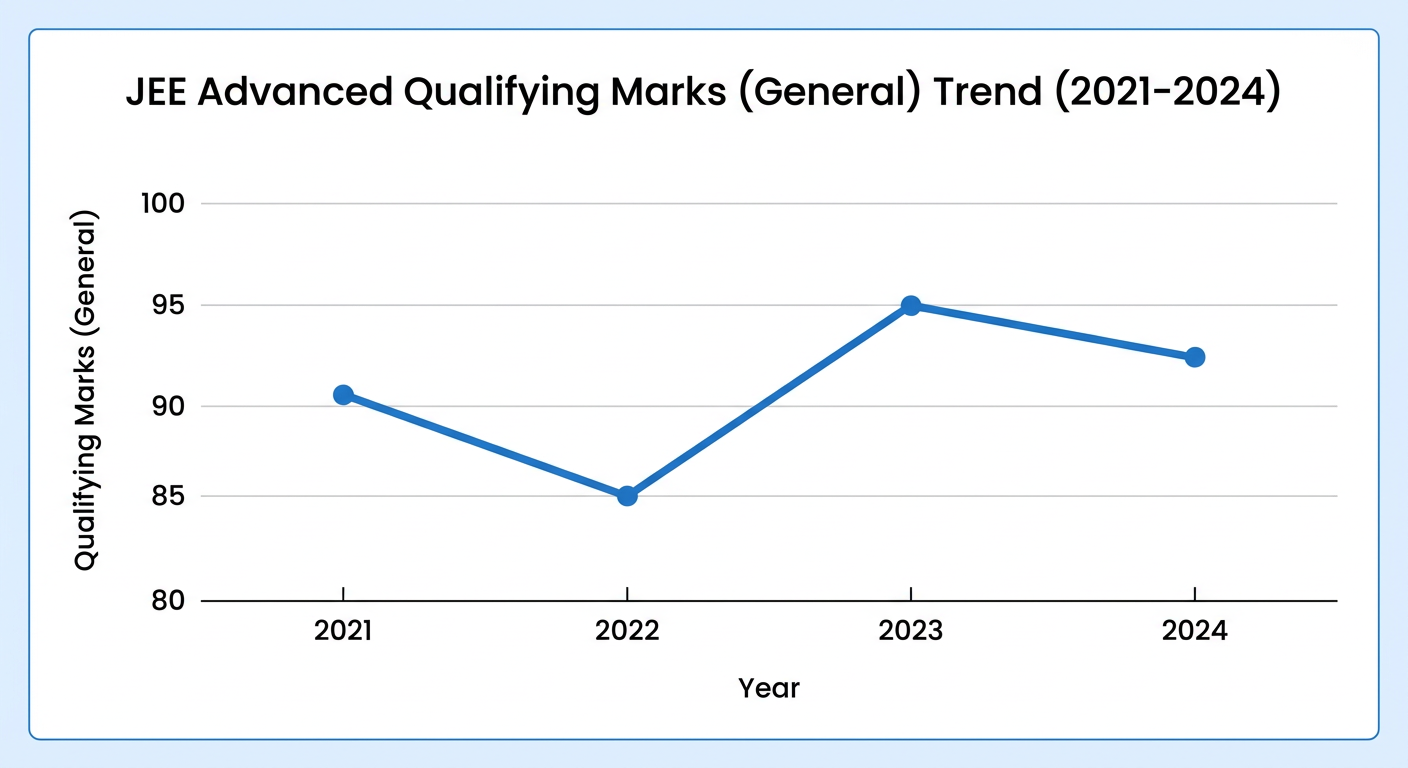
Understanding the JEE Advanced cutoff is crucial, but it can also be confusing because there are two different kinds of cutoffs you need to know about.
First is the Qualifying Cutoff. This is the minimum percentage of marks a candidate needs to score in each subject (Physics, Chemistry, Maths) and in aggregate to be included in the rank list. If you don't clear these minimums, you won't get a rank, even if your total score is decent. These cutoffs are usually quite low and are announced after the results. Their purpose is to ensure a candidate has a basic proficiency in all three subjects.
Second, and more important for your goal, is the Admission Cutoff. This isn't a predefined score but rather the closing rank at which a particular seat in a particular IIT and branch was filled in the previous year. For example, the closing rank for Computer Science at IIT Bombay might be AIR 60, while for Civil Engineering at a newer IIT, it might be AIR 8000. These closing ranks are the real benchmark you should be looking at to set a realistic target.
These cutoffs change every year. They depend on factors like:
- The difficulty level of the exam paper.
- The number of candidates who appeared.
- The total number of seats available.
- The performance of all the candidates.
A tougher paper generally leads to lower marks and lower cutoffs, while an easier paper has the opposite effect. Don't get fixated on a specific score like '300+' or '250+'. Instead, focus on maximizing your rank. You can use tools like a JEE rank predictor after the exam to get an idea of your potential standing based on your estimated score.
A Winning Preparation Strategy for JEE Advanced
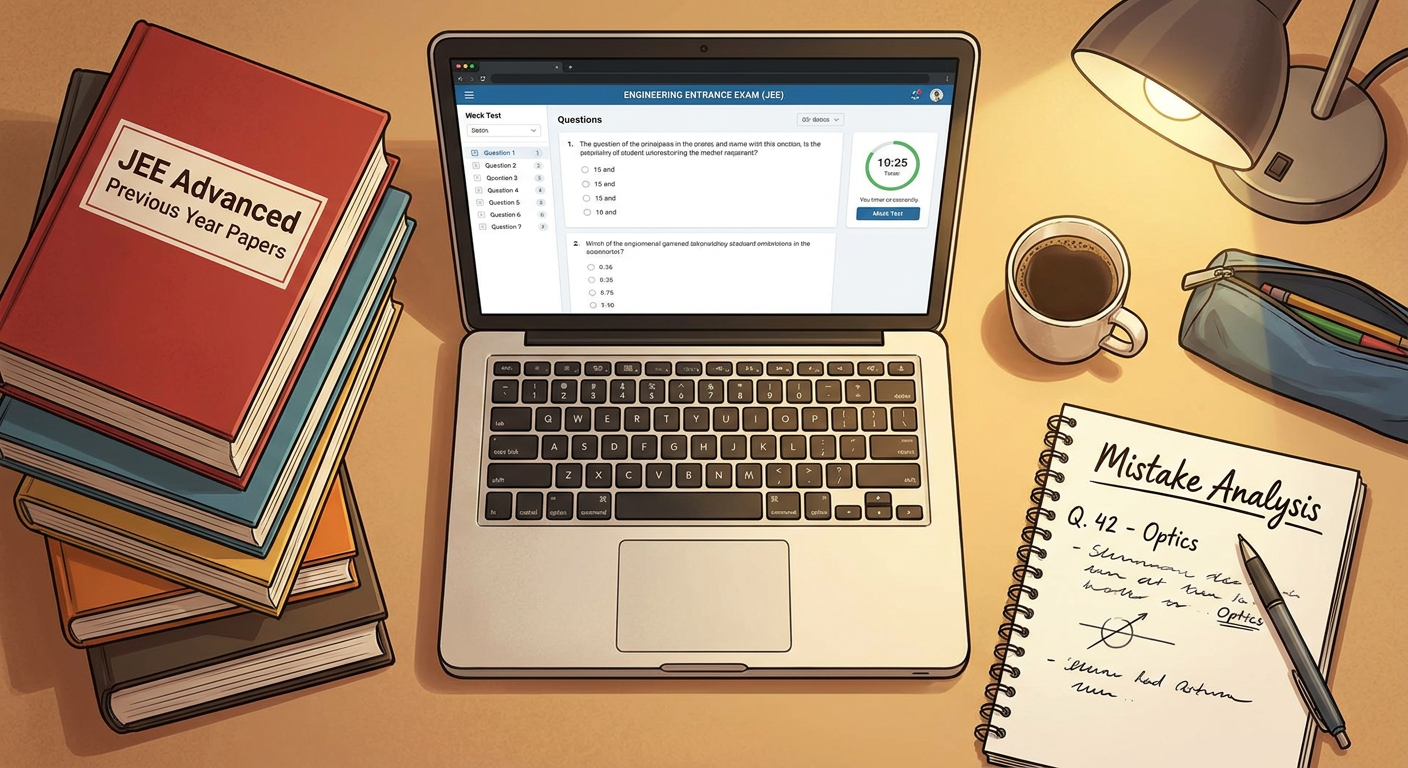
Cracking JEE Advanced is a marathon, not a sprint. It requires consistent effort, smart work, and a bulletproof strategy. Here’s how you can build one.
Master the Concepts, Don't Just Memorize
This cannot be stressed enough. Unlike JEE Main, where some formula-based questions might appear, JEE Advanced is all about the 'why' and 'how'. If you don't understand the first principles of a concept, you won't be able to solve the multi-concept questions that are a hallmark of this exam. Spend time building a strong foundation. Don't rush through topics.
The Power of Previous Year Papers (PYQs)
Your single most important resource for preparation is the collection of JEE Advanced previous year papers. Solving PYQs gives you the most authentic feel of the exam's level, the types of questions asked, and the way concepts are blended.
Don't just solve them like a test. Analyze each question. Understand the logic, the traps, and the concepts involved. Many times, concepts from old PYQs are repeated in a new form. Aim to solve at least the last 10-15 years of papers. We have a great collection of free PYQs to get you started.
Mock Tests are Your Best Friend
Appearing for two 3-hour papers on the same day is mentally and physically draining. You need to build stamina, and the only way to do that is through regular mock tests. Take full-length mock tests in a simulated exam environment: timed, without breaks, and in two sessions.
But just taking the test is not enough. The most crucial part is the post-test analysis. Spend 3-4 hours analyzing your performance. Where did you lose marks? Was it a silly calculation error, a conceptual gap, or poor time management? This analysis is what will help you improve.
Choosing the Right Books and Resources
While there are hundreds of books, focus on a few standard ones and master them. For Physics, H.C. Verma is a must for concepts, followed by a book for advanced problem-solving like I.E. Irodov. For Chemistry, stick to your NCERT for Inorganic, and use standard authors like R.C. Mukherjee (Physical) and Solomon & Fryhle (Organic). For Maths, authors like S.L. Loney and Hall & Knight are classics, supplemented by problem-solving books from Cengage or Arihant.
Beyond books, leverage quality online content. Our free resources hub offers formula sheets, notes, and masterclasses that can supplement your learning and help you revise effectively.
Life After JEE Advanced: The IIT Admission Process (JoSAA)
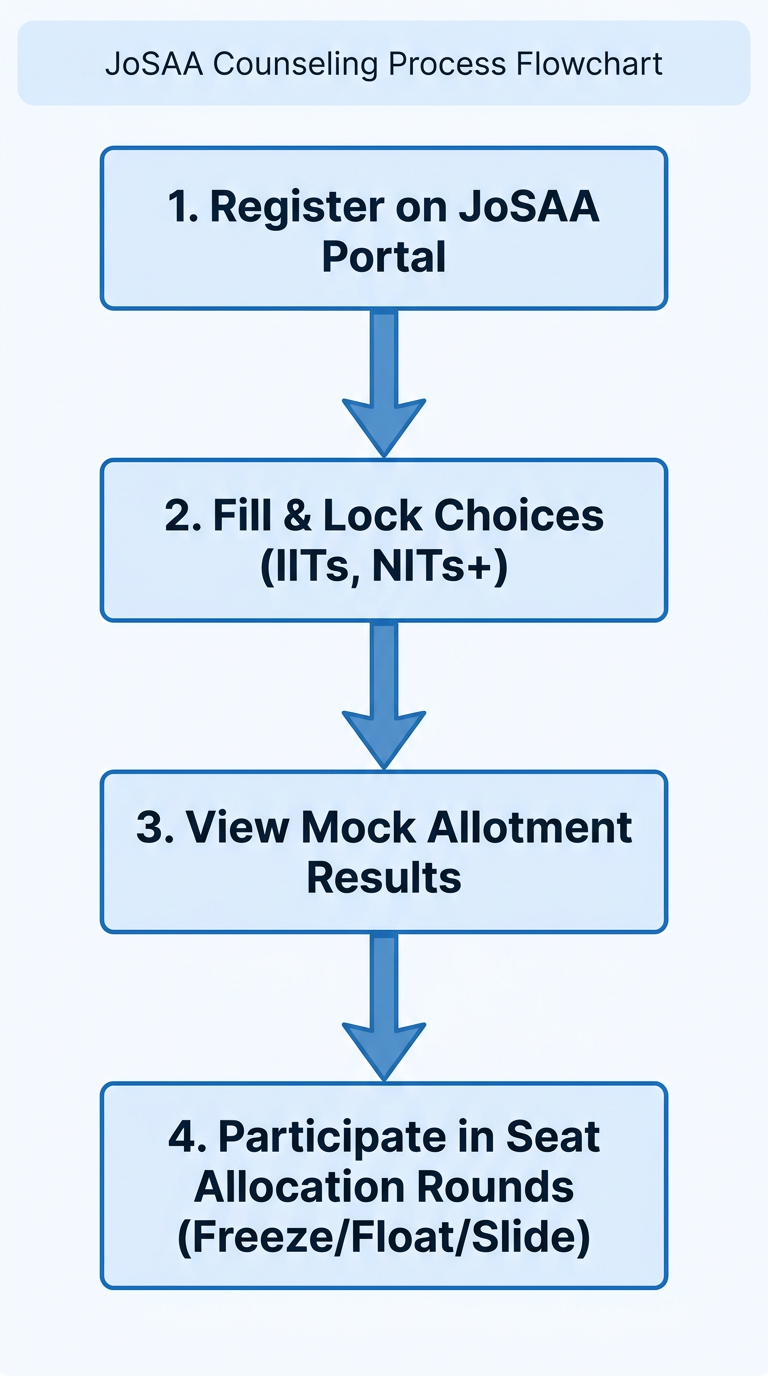
Congratulations, you've cleared the JEE Advanced! But the journey isn't over just yet. Now comes the crucial phase of securing your seat through the joint counseling process, managed by the Joint Seat Allocation Authority (JoSAA).
JoSAA is the single platform for counseling and seat allocation for not just the 23 IITs, but also the NITs, IIITs, and other Government-Funded Technical Institutes (GFTIs). Your JEE Advanced rank is used for IITs, while your JEE Main rank is used for the others.
The process broadly involves these steps:
- Registration: All qualified candidates must register on the JoSAA portal.
- Choice Filling: This is the most critical step. You have to fill in your preferred choices of institutes and branches in decreasing order of priority. You can fill in as many choices as you want. Be very careful and strategic here, considering your rank and interests.
- Mock Allotments: JoSAA conducts a few rounds of mock allotments before the actual rounds. This helps you see your probable seat based on your current choices and allows you to make changes if needed.
- Seat Allocation Rounds: Several rounds of seat allocation are conducted. In each round, you might be allotted a seat based on your rank and the choices you filled. You then have the option to 'Freeze' (accept the seat), 'Float' (accept the seat but be open to higher preferences in next rounds), or 'Slide' (accept the seat but be open to a better branch in the same institute).
This process can seem complex, so it's vital to read the JoSAA business rules carefully when they are released. Keep an eye on the official JEE Advanced website for all announcements regarding counseling schedules and procedures.
FAQs
How many attempts are there for JEE Advanced?
You can attempt the JEE Advanced a maximum of two times, and they must be in two consecutive years. For example, if your first attempt is in 2025, your second and final attempt must be in 2026.
Is there negative marking in JEE Advanced?
Yes, negative marking is a key feature of JEE Advanced. The exact scheme can vary each year and for different types of questions (single-correct, multiple-correct). It's crucial to read the instructions at the start of the exam carefully.
Can I get into an IIT with only my JEE Main score?
No. Admission to all undergraduate courses at the 23 IITs is solely through the JEE Advanced rank list. A good JEE Main score is only the eligibility ticket to appear for JEE Advanced.
What is the 75% criteria for IITs?
To be admitted to an IIT, a candidate must have secured at least 75% aggregate marks in their Class 12 (or equivalent) board exam. For SC, ST, and PwD candidates, this criterion is 65%. Alternatively, the candidate must be in the top 20 percentile of their respective board.
What is the difference between JEE Main and JEE Advanced?
JEE Main is the qualifying exam for JEE Advanced and also the entrance test for NITs, IIITs, and other GFTIs. JEE Advanced is the exclusive entrance test for admission to the 23 IITs. Generally, JEE Advanced is considered conceptually deeper and has a more complex and challenging question pattern.
Which IIT will conduct JEE Advanced 2025?
The responsibility of conducting JEE Advanced is rotated among the seven zonal IITs. The organizing institute for JEE Advanced 2025 will be officially announced by the Joint Admission Board (JAB) in due course. For example, IIT Madras conducted the 2024 exam.