CBSE Date Sheet 2026 released for special exams; check complete schedule - Business Standard
The ultimate guide to the CBSE board exam for Class 10 & 12. Understand the exam pattern, syllabus, marking scheme, and preparation strategy for JEE/NEET aspirants.
15 min read
Remember that scene in 3 Idiots where the pressure of final exams felt like a literal pressure cooker about to explode? For millions of students across India, the CBSE board exam can feel exactly like that. It’s built up to be the biggest challenge of your school life, the final boss battle before you step into the world of college and careers.
But here’s the secret: it doesn't have to be so scary. The board exam is a challenge, yes, but it’s a predictable one. It has a set pattern, a defined syllabus, and a clear set of rules. Understanding this system is the first and most important step to conquering it.
This guide is your complete roadmap. We'll break down everything you need to know about the CBSE board exam, from the structure of Class 10 and Class 12 papers to the best strategies for scoring above 95%. Whether you're a student feeling overwhelmed or a parent trying to support your child, this is for you. Let's defuse that pressure cooker, one step at a time.
What Exactly is the CBSE Board Exam? (And Why It Matters)
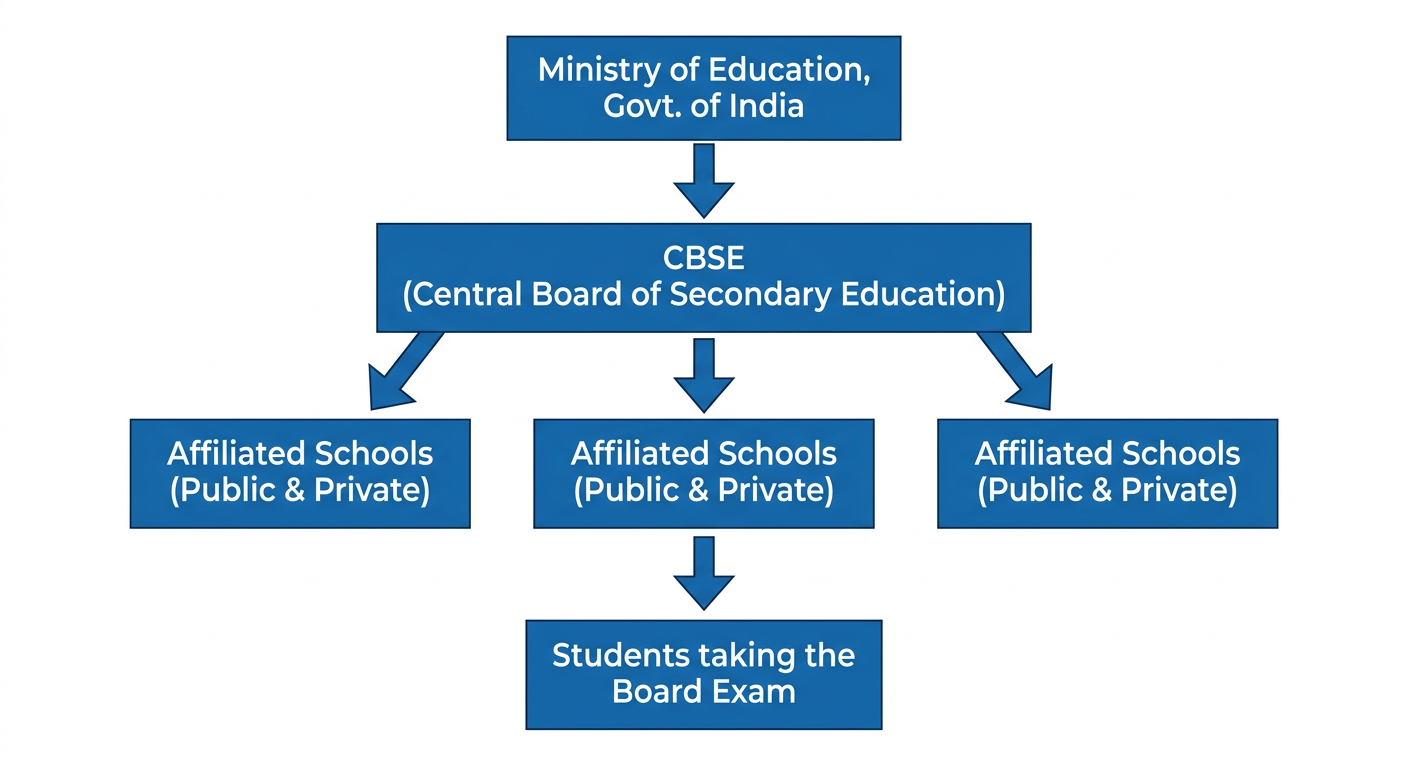
The CBSE board exam is more than just a series of tests; it's a national benchmark for school education in India. CBSE stands for the Central Board of Secondary Education. It’s a government-managed board that oversees the curriculum and examinations for thousands of public and private schools, both in India and abroad.
Think of it as the great equalizer. Its primary goal, since its formation, has been to provide a standardized, high-quality curriculum that is consistent across the country. This ensures that a student in Kochi has access to the same core education as a student in Chandigarh.
But why does it carry so much weight? Your CBSE certificate is a nationally and internationally recognized proof of your secondary education. More importantly for you, a JEE or NEET aspirant, it’s the foundation upon which your competitive exam preparation is built. A strong performance in boards is often the first major indicator of future success. Plus, it plays a direct role in college admissions, including the famous 75% eligibility criteria for top engineering colleges.
Decoding the CBSE Class 10 Board Exam
The Class 10 board exam is your first encounter with a national-level public examination. It’s designed to test your foundational knowledge across a broad range of subjects and helps you, your parents, and your teachers decide which academic stream is the right fit for you in Classes 11 and 12.
Subject Structure and Combination
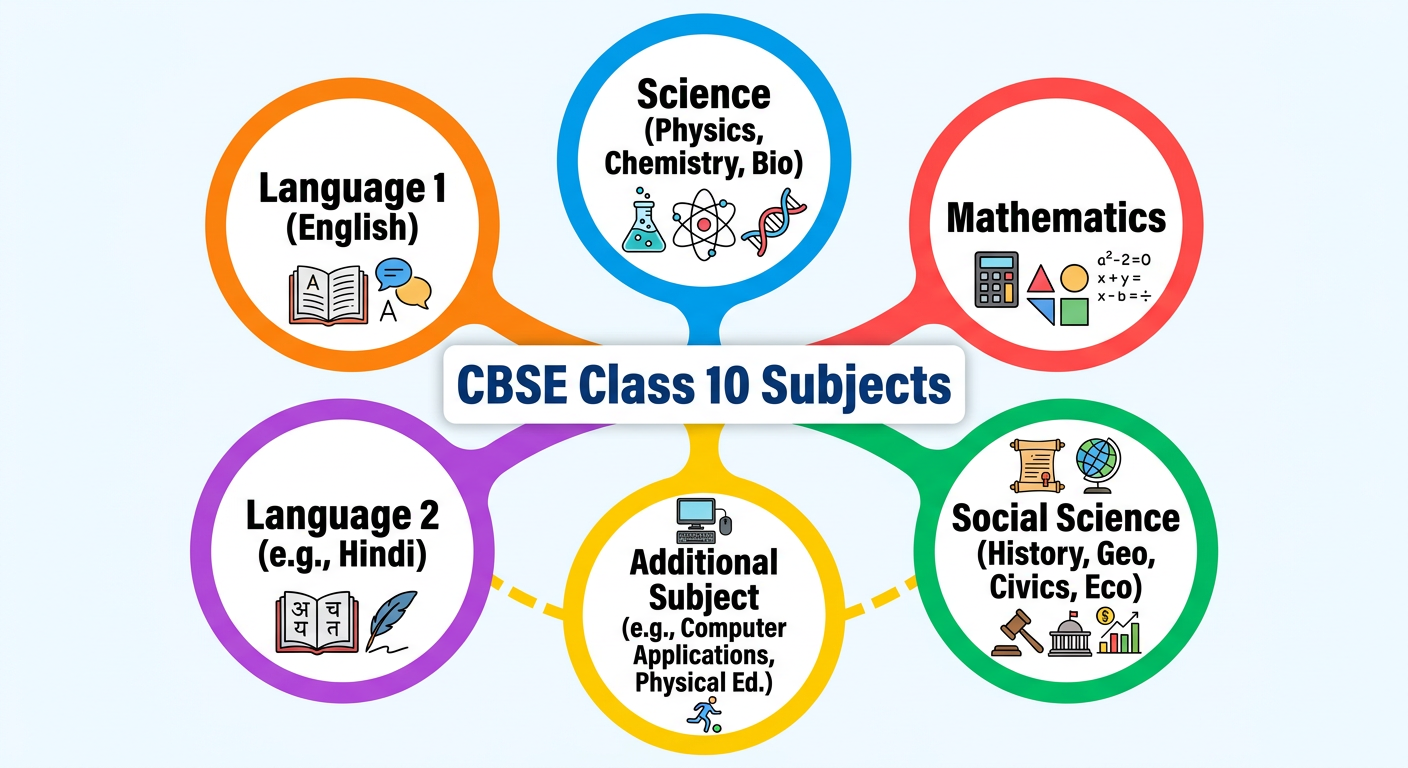
For most students, the structure is straightforward. You will have five main subjects. These are typically Science (covering Physics, Chemistry, and Biology), Mathematics, Social Science (History, Geography, Civics, Economics), and two languages. Language 1 is usually English, while Language 2 can be Hindi, Sanskrit, or a regional language offered by your school.
Beyond these five, CBSE also requires students to take up a sixth skill-based or academic subject. This could be anything from Computer Applications and Information Technology to Painting or a third language. While the marks from this subject are often considered secondary, doing well in it can sometimes help your overall percentage if you underperform in one of the main subjects.
Exam Pattern and Marking Scheme
The pattern for the CBSE Class 10 main subjects is consistent. The final score is split into two parts: 80 marks for the theory paper (the final board exam you write) and 20 marks for Internal Assessment.
The 80-mark theory paper isn't just about writing long answers anymore. CBSE has introduced a variety of question types to test different skills. You can expect Multiple Choice Questions (MCQs), assertion-reason questions, very short answer, short answer, and long answer questions. A significant portion of the paper is now dedicated to competency-based questions. These are questions that test your ability to apply concepts to real-world scenarios, often presented as case studies or source-based problems. They check if you've understood the 'why' behind the 'what'.
The 20 marks for Internal Assessment are calculated by your school throughout the year. This includes marks from periodic tests, a portfolio of your work, and subject enrichment activities like lab work or projects. Taking these internal tests and assignments seriously is crucial; they are 20 guaranteed marks if you are consistent.
The Importance of Class 10 Results
Your Class 10 result is a pivotal document. It serves as your official date of birth proof for almost all future applications. Academically, it’s the primary factor that determines which stream—Science, Commerce, or Arts—you'll be eligible for in Class 11.
A good score here is a massive confidence booster. It validates your hard work and sets a positive tone for the even bigger challenge ahead: the Class 12 boards and competitive exams. It's the perfect training ground for the high-stakes environment of JEE and NEET.
Mastering the CBSE Class 12 Board Exam: The Gateway to Your Future
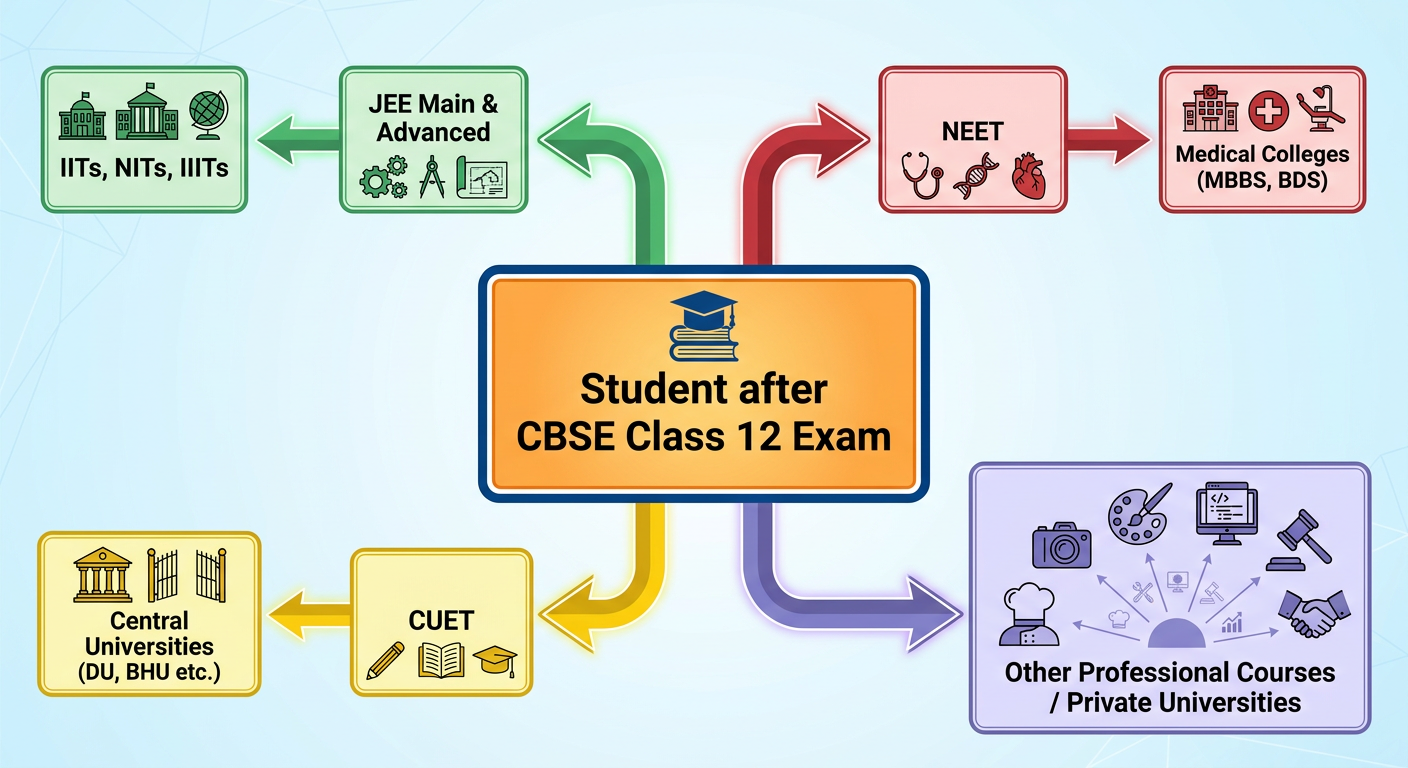
If Class 10 was the semi-final, the CBSE Class 12 board exam is the grand finale of your school life. This is the exam that directly impacts your college admissions and career path. For science students, the stakes are even higher, as these scores are closely linked to eligibility for premier engineering and medical institutions.
Choosing Your Stream: Science, Commerce, and Arts
By the time you reach Class 12, you've already chosen your stream. For future engineers and doctors, this is the Science stream. It primarily breaks down into two groups:
- PCM (Physics, Chemistry, Mathematics): The essential combination for aspiring engineers aiming for JEE Main and Advanced.
- PCB (Physics, Chemistry, Biology): The required combination for medical aspirants targeting NEET.
- PCMB (Physics, Chemistry, Mathematics, Biology): For students who want to keep both engineering and medical options open.
Along with these core subjects, English is compulsory. You will also have a fifth optional subject, which could be Computer Science, Physical Education, Economics, or another subject offered by your school.
The Class 12 Exam Pattern Demystified
The CBSE exam pattern for Class 12 is more nuanced than in Class 10 because of practicals. The subject-wise breakdown is key:
- For subjects with practicals (Physics, Chemistry, Biology, Computer Science): The exam is split into 70 marks for the theory paper and 30 marks for the practical exam.
- For subjects without major practicals (Mathematics, English): The exam is split into 80 marks for theory and 20 marks for internal assessment.
Question papers in Class 12 are designed to be more analytical. You'll find a mix of MCQs, case-study questions, and short and long answer questions that require deep conceptual understanding. Internal choices are provided within sections, meaning you might have to attempt 4 out of 5 given questions. This requires a smart strategy during the exam to pick the questions you're most confident about.
Understanding Practical Exams and Internal Assessments
Don't ever underestimate the 30 marks for practicals or the 20 marks for internal assessments. These are a significant chunk of your final score! A practical exam typically involves performing an experiment, maintaining a practical file or project report, and a viva voce (oral examination) with an external examiner.
For subjects like English, the 20 internal marks are often based on an Assessment of Speaking and Listening (ASL) skills. Being prepared for these components is the easiest way to boost your percentage. Treat them with the same seriousness as your theory papers.
The CBSE Syllabus and Study Resources
Knowing what to study is just as important as knowing how to study. The resources you use will define your preparation. For the CBSE board exam, the formula is surprisingly simple.
NCERT Books: Your Bible for Boards
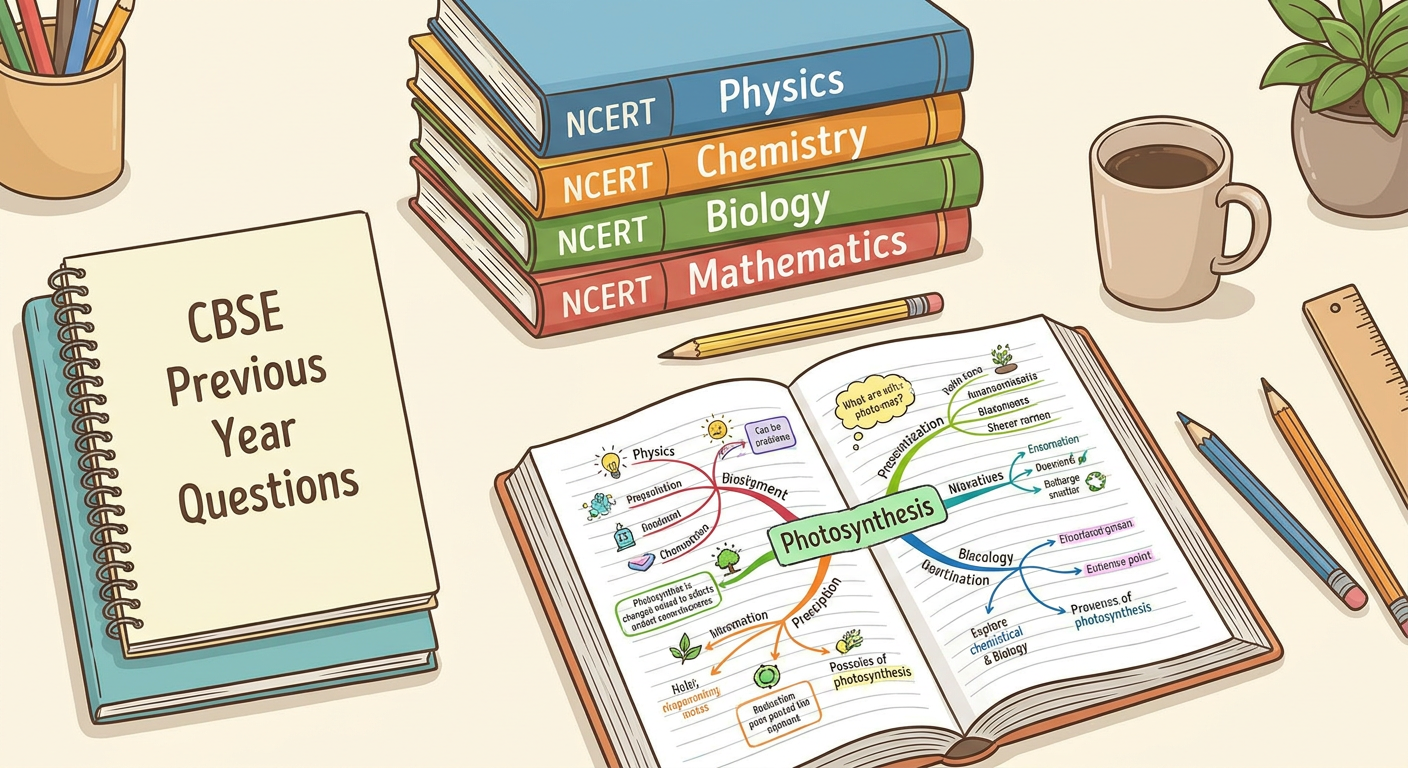
Let’s make this crystal clear: the NCERT textbook is the single most important book for your board exam preparation. Every single question in the CBSE paper is framed from the concepts, lines, and examples given in the NCERT books. You must treat it as your primary, and often, your only source for theory.
Read every chapter line by line. Solve every single 'in-text' question, solved example, and back-of-the-chapter exercise. For subjects like Chemistry, a significant portion of the JEE Main paper also comes directly from NCERT, making it a double win.
Navigating the Official Syllabus
Before you start, always download the latest syllabus from the official CBSE website. The curriculum is sometimes updated, with certain topics added or removed. Knowing the exact CBSE syllabus is crucial to focus your efforts.
The syllabus document also provides a unit-wise breakdown of marks. This is a goldmine of information! It tells you which chapters carry the most weight, helping you prioritize your study plan. You can allocate more time to high-weightage units to maximize your score.
Beyond NCERT: Reference Books and Practice Papers
While NCERT is king, reference books can be useful for extra practice, especially for subjects like Physics and Mathematics where you need to solve a wide variety of problems. However, use them as supplements, not replacements.
The real game-changer in your preparation is solving sample papers and previous year questions (PYQs). This is non-negotiable. Solving PYQs helps you understand the exact pattern, language, and difficulty level of the questions asked. It's the best way to train your brain for the actual exam and master time management.
Strategic Preparation: How to Score 95%+ in Your Board Exam

Scoring above 95% in the CBSE board exam is not about studying 18 hours a day. It's about studying smart. It requires a well-thought-out strategy, consistent effort, and excellent presentation skills.
Crafting the Perfect Study Timetable
Your timetable is your personal battle plan. The biggest challenge for many is balancing board exam preparation with JEE/NEET coaching. An integrated approach works best.
When you study a chapter for your competitive exam, finish the NCERT part of it on the same day. Solve the NCERT exercises and make board-specific notes. This ensures you aren't leaving board preparation for the last two months. Your timetable should include daily goals, a dedicated day for weekly revision, and buffer time for unexpected delays. Consistency is far more powerful than intensity.
The Art of Note-Making and Revision
Passive reading is not studying. Active recall is. The best way to achieve this is by making your own notes. When you write things down in your own words, you process and retain the information much better.
Use techniques like flowcharts for processes, mind maps for interconnected concepts, and dedicated formula sheets for quick revision. Revision shouldn't be a last-minute activity. Use the principle of spaced repetition: revise a new topic after 1 day, then after 3 days, then after a week, and so on. This moves information from your short-term to your long-term memory.
Answer Writing Skills for Maximum Marks
In board exams, how you present your answer is as important as the answer itself. An examiner checks hundreds of papers a day; make their job easy. A well-presented answer sheet immediately creates a good impression.
Here are some killer tips:
- Underline Keywords: Use a pencil to underline the most important terms in your answer.
- Use Diagrams and Flowcharts: A picture is worth a thousand words. Especially in Science, draw neat, labeled diagrams wherever possible.
- Write in Points: For long answers, break down your explanation into bullet points or numbered lists. It makes the answer more readable.
- Manage Your Space: Leave a line or two after each answer to keep the sheet looking clean and organized.
Understanding the CBSE Grading and Promotion Policy
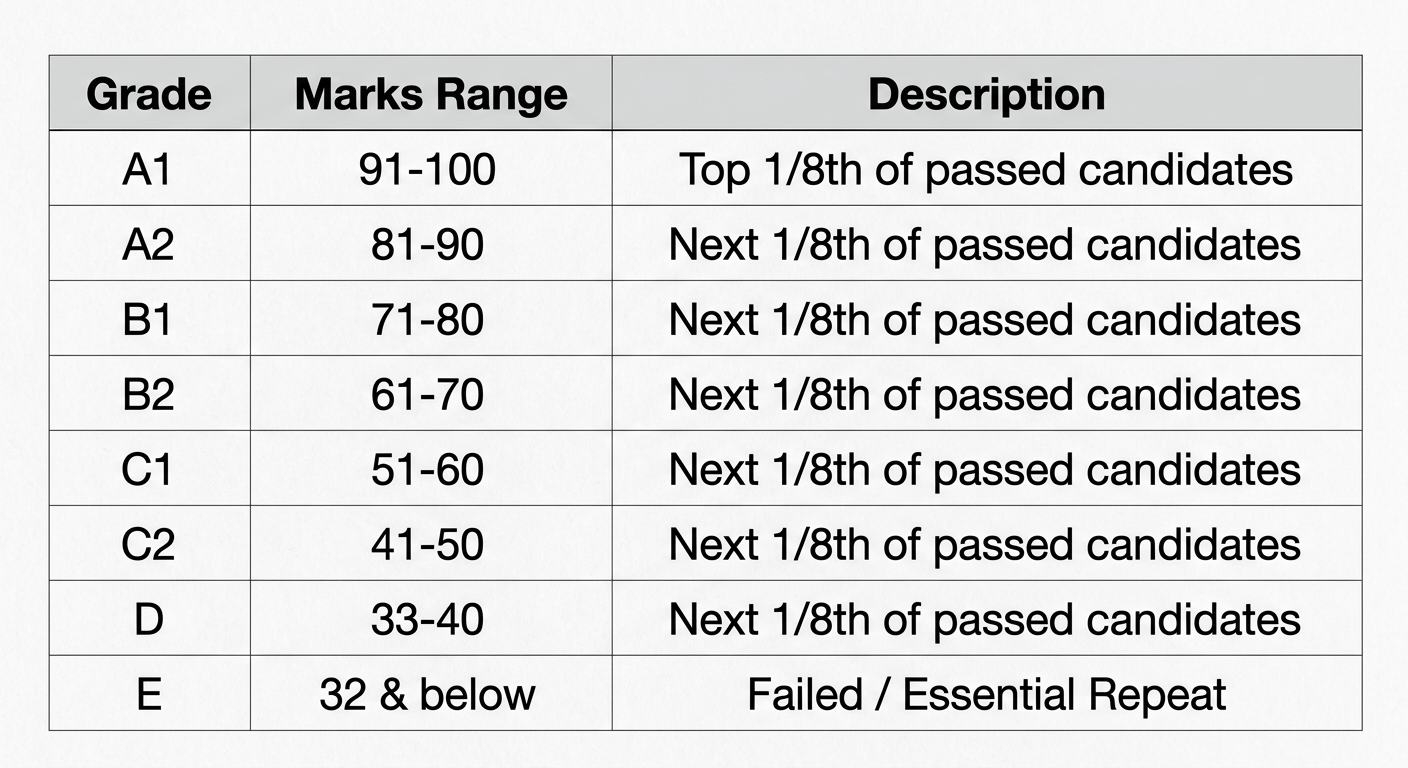
Understanding the evaluation criteria can help you set realistic targets and know exactly what you need to do to pass or excel. The system has some specific rules that every student should be aware of.
From Marks to Grades: How It Works
For Class 10, while you get absolute marks, your report card also features grades on a 9-point scale. A1 is for the top 1/8th of students, followed by A2 for the next 1/8th, and so on. For Class 12, the focus is primarily on absolute marks and the final percentage, as these numbers are used for college admissions.
The CBSE marking scheme is quite detailed and is provided to examiners to ensure uniformity in checking. For step-wise problems in Maths or Physics, you get marks for each correct step, even if your final answer is wrong. This is why it's important to write down every step of your solution.
Passing Criteria Explained
This is a critical rule that many students misunderstand. To pass a subject, you need to score a minimum of 33% marks. However, for subjects with practicals, you must score 33% in theory AND 33% in practicals separately. You also need 33% in the subject overall.
For example, in Physics (70 theory + 30 practical), you need at least 23/70 in theory and 10/30 in practicals to pass. Just getting a high score in practicals won't save you if you fail the theory paper.
Compartment, Improvement, and Re-evaluation
CBSE provides a safety net for students who have a bad day.
- Compartment Exam: If you fail in one or two subjects, you can appear for the compartment exam, held a couple of months after the results. This gives you a chance to clear the year without wasting it.
- Improvement Exam: If you have passed all subjects but are unhappy with your score in one, you can appear for an improvement exam in the subsequent year to try and score better.
- Verification & Re-evaluation: If you strongly believe there has been an error in the totaling of your marks or the evaluation of your answers, you can apply for verification or re-evaluation by paying a nominal fee. This process is done online through the CBSE portal.
After the Exam: What Happens Next?
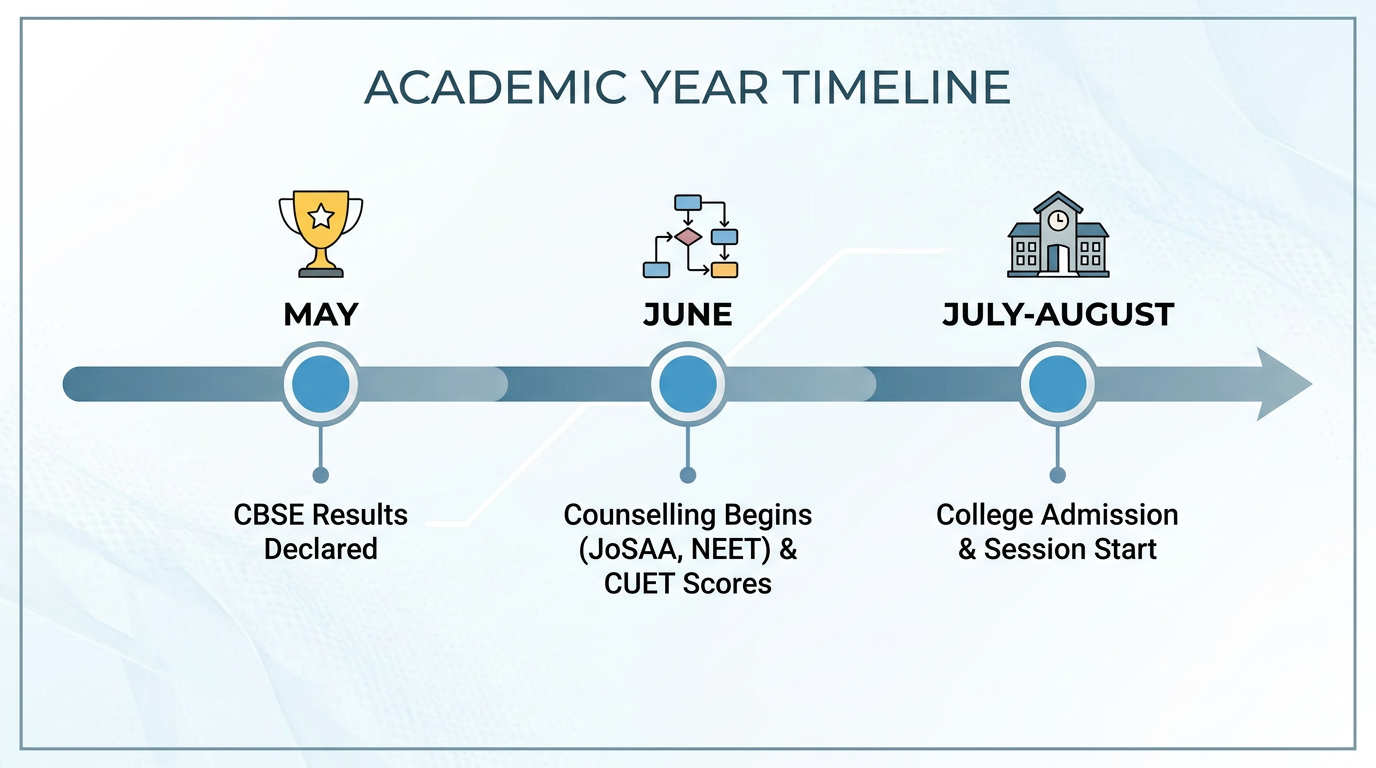
The period after the board exam is filled with anticipation and planning. The results open up the doors to the next phase of your academic journey.
The Result Declaration Process
CBSE results for both Class 10 and 12 are typically announced in the month of May. The official announcement is made on the CBSE official website, which is the most reliable source of information. You can check your results using your roll number, school number, and admit card ID.
Results are also made available on platforms like DigiLocker, from where you can download your official digital marksheet. It's natural to feel anxious on result day, but remember that this is just one exam. It doesn't define your potential or your future.
The 75% Criteria and Its Impact on JEE Aspirants
For JEE aspirants, the Class 12 board percentage holds special significance. To be eligible for admission into NITs, IIITs, and other Centrally Funded Technical Institutes (CFTIs), a candidate must have scored at least 75% aggregate marks in their Class 12 board exam (or be in the top 20 percentile of their board).
While this rule has been relaxed occasionally (like during the COVID-19 pandemic), you should always aim to clear this benchmark. A good board percentage acts as a crucial safety net, ensuring your high JEE rank is not wasted due to an eligibility issue. You can use tools like a JEE rank predictor to see how ranks translate to college seats, but eligibility is the first door you must unlock.
Leveraging Your Board Score for University Admissions
Beyond engineering and medical, your board score is key to many other opportunities. With the introduction of the Common University Entrance Test (CUET) for admission into central universities like Delhi University, the importance of subject knowledge has increased. A thorough board exam preparation provides the strong foundation needed to ace CUET.
Many private universities and state-level colleges also grant admission based on Class 12 percentages. A high score keeps a wide range of options open for you.
FAQs
When will the CBSE board exam date sheet be released?
CBSE typically releases the date sheet for Class 10 and 12 board exams in December for the exams to be held in February/March of the next year. Always check the official CBSE website for the most accurate information.
What is the passing criteria for CBSE Class 12?
To pass a subject, you need to secure at least 33% marks overall. For subjects with practicals, you must get 33% in the theory component and 33% in the practical component separately.
Can I appear for improvement exams if I am not happy with my score?
Yes, if you have passed the exam, you can appear for the improvement exam in one or more subjects in the next academic year to improve your score. Only the better of the two scores will be considered.
How important are CBSE board exam marks for JEE or NEET?
While your JEE or NEET rank is the primary factor for admission, your board marks are crucial for eligibility. For admission to NITs/IIITs, you generally need at least 75% in your Class 12 boards. A strong understanding of board-level concepts also builds the foundation for these competitive exams.
Are competency-based questions difficult?
Competency-based questions are not necessarily more difficult, but they are different. Instead of asking for a direct definition, they present a scenario and ask you to apply a concept. Regular practice with sample papers is the best way to get comfortable with them.
Can I pass the board exam by only studying in the last month?
While not impossible, it is extremely difficult and stressful. A consistent, year-long preparation strategy is the most effective way to score well without burnout. The syllabus is vast and requires regular revision.