CBSE Class 9 Syllabus: Complete Guide 2026 - Global Indian International School
Get the complete and updated CBSE Class 9 Syllabus for 2025-26. Understand the subject-wise breakdown for Maths, Science, and SST to build a strong foundation for JEE and NEET.
14 min read
CBSE Class 9 Syllabus 2025-26: Your Foundation for JEE/NEET
Think of your journey to IIT or a top medical college like a movie. Classes 11 and 12 are the climax, the final battle. But Class 9? This is your training montage. It’s where you build the strength, skills, and discipline that will decide the final outcome. Many students make the mistake of taking Class 9 lightly, but this is where the real preparation for JEE and NEET begins. Your success in these tough exams is built on the foundation you lay right now.
Understanding the official CBSE syllabus for Class 9 is the first and most critical step. It’s your map, your guide, your strategic plan. Without knowing the syllabus inside and out, you’re just studying blindly. This guide will break down the complete CBSE Class 9 syllabus for the 2025-26 session, subject by subject, and show you exactly how it connects to your ultimate goal of cracking competitive exams.
Understanding the New CBSE Syllabus for Class 9

The jump from Class 8 to Class 9 is significant. The subjects become more detailed, the concepts more complex, and the style of assessment changes. The CBSE syllabus is designed to transition you from middle school learning to the more rigorous academic framework required for the board exams and beyond. It’s no longer just about memorizing facts; it’s about understanding concepts.
For the 2025-26 academic year, the structure remains focused on building a strong conceptual base. The assessment is divided into two parts: an 80-mark annual examination and a 20-mark internal assessment. This pattern mirrors what you will face in the Class 10 boards, making Class 9 the perfect practice ground.
Every chapter you study this year is a stepping stone. The laws of motion in Physics, the study of atoms in Chemistry, and the algebraic identities in Maths are not just for your school exams. They are the fundamental building blocks for the advanced topics you will tackle in Classes 11 and 12 for JEE and NEET.
Detailed CBSE Class 9 Maths Syllabus
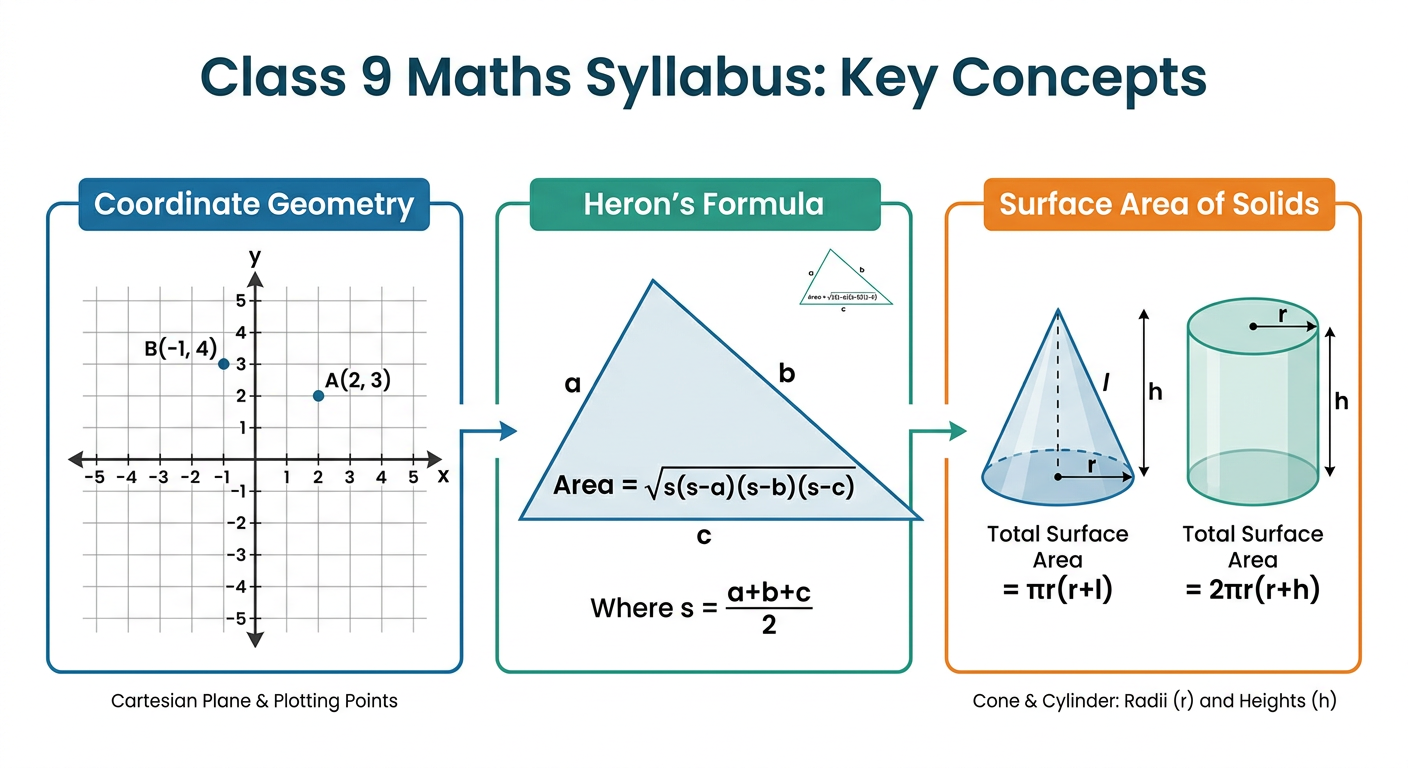 Maths in Class 9 lays the groundwork for nearly 60% of the JEE Maths paper. Ignore this at your own peril! Each unit is designed to build your logical reasoning and problem-solving skills. Here’s a look at the Class 9 Maths syllabus and why each part is so important.
Unit I: Number Systems
This unit starts with a review of rational numbers and dives deep into irrational numbers. You'll learn to represent real numbers on the number line and understand laws of exponents for real numbers. It seems basic, but a rock-solid understanding of the number system is crucial for all of Maths.
Unit II: Algebra
Get ready for Polynomials and Linear Equations in Two Variables. You will learn about degrees of polynomials, zeroes, and the Remainder and Factor theorems. These concepts are the absolute backbone of algebra in JEE. Linear Equations introduce you to graphical representation, a skill you will use constantly in coordinate geometry and calculus.
Unit III: Coordinate Geometry
This is where your journey into 2D and 3D geometry for competitive exams truly begins. In Class 9, you'll learn the basics of the Cartesian plane, coordinates of a point, and plotting points. It might seem simple, but mastering this is non-negotiable for understanding Straight Lines, Circles, and Conic Sections in Class 11.
Unit IV: Geometry
This is a large and important unit covering Lines and Angles, Triangles, Quadrilaterals, Circles, and Constructions. The theorems and properties you learn here, especially regarding congruent and similar triangles, are applied everywhere in advanced geometry problems. The logical deduction skills you build while writing proofs are invaluable.
Unit V: Mensuration
This unit deals with Areas of Parallelograms and Triangles, and Surface Areas and Volumes of cubes, cuboids, spheres, cylinders, and cones. These formulas form the basis for many application-based problems in both JEE Main and Advanced, often mixed with calculus or other topics.
Unit VI: Statistics & Probability
Here, you'll be introduced to the collection and presentation of data using bar graphs, histograms, and frequency polygons. The Probability section provides the elementary foundation for the much more complex probability theorems you'll encounter in Class 12. Don't underestimate this unit; it's a scoring area in competitive exams.
Unpacking the CBSE Class 9 Science Syllabus
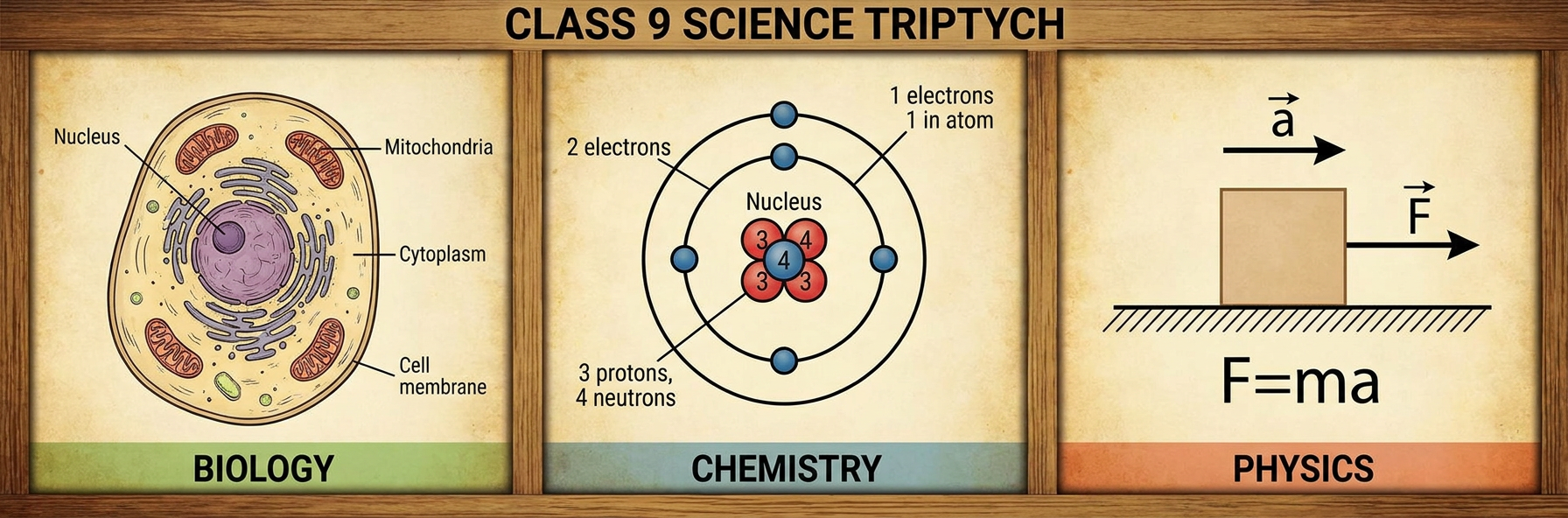 For every NEET and JEE aspirant, Class 9 Science is chapter one of your story. The Class 9 Science syllabus is neatly divided into Physics, Chemistry, and Biology, with each part introducing you to the core principles of the subject. Let's break it down.
Physics: The Study of How Things Work
Physics in Class 9 moves from observation to calculation. You will be introduced to the mathematical side of the physical world.
- Motion: This is the language of mechanics. You'll learn about distance, displacement, velocity, acceleration, and the three equations of motion. Mastering this chapter is the first step to conquering Mechanics, a huge part of the JEE Physics syllabus.
- Force and Laws of Motion: Here you'll meet Newton's three laws of motion, inertia, momentum, and the concept of conservation of momentum. These principles are fundamental to all of classical physics.
- Gravitation: This chapter introduces the Universal Law of Gravitation, acceleration due to gravity (g), and the concepts of mass and weight. You'll also learn about flotation, buoyancy, and Archimedes' principle.
- Work, Energy, and Power: Learn the definitions of work, kinetic energy, and potential energy, and the Law of Conservation of Energy. These concepts are universal and appear in almost every branch of physics.
- Sound: You'll explore the nature of sound, its propagation, and characteristics like pitch and loudness. This provides a base for the more detailed study of Waves in Class 11.
Chemistry: The Science of Matter
Class 9 Chemistry takes you inside the material world, from the particles that make up matter to the structure of the atom itself.
- Matter in Our Surroundings: This chapter defines matter and its states (solid, liquid, gas) based on particle nature and forces of attraction. Concepts like melting point, boiling point, and latent heat are introduced.
- Is Matter Around Us Pure?: You'll learn the difference between mixtures and pure substances, solutions, suspensions, and colloids. Techniques for separating mixtures are also covered, which builds practical chemical knowledge.
- Atoms and Molecules: This is a cornerstone chapter. You'll study the laws of chemical combination, Dalton's atomic theory, and the concepts of mole, molecular mass, and Avogadro constant. A strong grip on the mole concept from this stage is a superpower for Physical Chemistry in JEE and NEET.
- Structure of the Atom: Discover the subatomic particles (protons, neutrons, electrons) and learn about various atomic models like Thomson's, Rutherford's, and Bohr's. This is your first formal introduction to atomic structure, a high-weightage topic later on.
Biology: The Science of Life
For future doctors, this is where it all begins. The NEET syllabus is vast, and the foundation is laid right here.
- The Fundamental Unit of Life: This chapter is all about the cell. You'll study the cell theory, the structure of prokaryotic and eukaryotic cells, and the functions of various cell organelles. It is the basis of all Biology.
- Tissues: From single cells, you move to tissues. You'll learn about plant tissues (meristematic, permanent) and animal tissues (epithelial, connective, muscular, nervous). This is fundamental to understanding the anatomy and physiology of organisms.
- Improvement in Food Resources: This chapter covers practical biology related to crop production, animal husbandry, and sustainable agriculture. While less theoretical, it's part of the NEET syllabus under 'Biology in Human Welfare'.
- Why Do We Fall Ill?: An introduction to health, disease, and its causes. You'll learn about infectious and non-infectious diseases, and principles of treatment and prevention. This connects directly to the 'Human Health and Disease' unit in Class 12.
- Natural Resources: This chapter, often studied under Environmental Science, deals with the balance in nature and biogeochemical cycles like water, nitrogen, carbon, and oxygen cycles.
CBSE Class 9 Social Science Syllabus Explained
 While Social Science isn't a part of the JEE or NEET syllabus, don't make the mistake of ignoring it. The Class 9 Social Science syllabus is designed to develop your analytical and critical thinking skills. It teaches you how to read dense texts, connect different ideas, and form a coherent argument—skills that are incredibly useful in cracking the comprehension-based questions that are becoming more common in competitive exams.
History: India and the Contemporary World – I
This section focuses on world history, covering major events like the French Revolution, Socialism in Europe and the Russian Revolution, and Nazism and the Rise of Hitler. Understanding these events helps build a worldview and improves your ability to analyze cause-and-effect relationships.
Geography: Contemporary India – I
Here you'll study the geography of India in detail: its size and location, physical features, drainage systems, climate, natural vegetation, and population. This knowledge is not only important for general awareness but also for exams like NTSE and other Olympiads.
Political Science (Civics): Democratic Politics – I
This subject introduces you to the core concepts of democracy. You'll learn 'What is Democracy?', 'Why Democracy?', Constitutional Design, Electoral Politics, Working of Institutions, and Democratic Rights. It helps you become an informed citizen and sharpens your logical reasoning skills.
Economics
Class 9 is your first formal introduction to Economics. You'll study foundational concepts through chapters like 'The Story of Village Palampur', 'People as Resource', 'Poverty as a Challenge', and 'Food Security in India'. This provides a basic understanding of how economies work, which is a valuable life skill.
English and Second Language: The Scoring Subjects
 Your overall percentage in Class 9 and 10 matters. It builds confidence and, in some cases, can be a factor in college admissions abroad or for certain scholarships. English and your second language (like Hindi, Sanskrit, or a regional language) are subjects where you can score very high with consistent effort.
The CBSE syllabus for English focuses on four key skills: reading comprehension, writing skills with grammar, and literature. The literature section includes two books: 'Beehive' and 'Moments'. The goal is not just to understand the stories but to develop an appreciation for literature and improve your vocabulary and expression.
Treat these subjects seriously. Dedicate a few hours each week to practicing grammar, writing essays or letters, and reading your literature chapters. Good communication skills are an asset for life, and a high score here can significantly boost your aggregate percentage.
Class 9 Exam Pattern and Marking Scheme (2025-26)
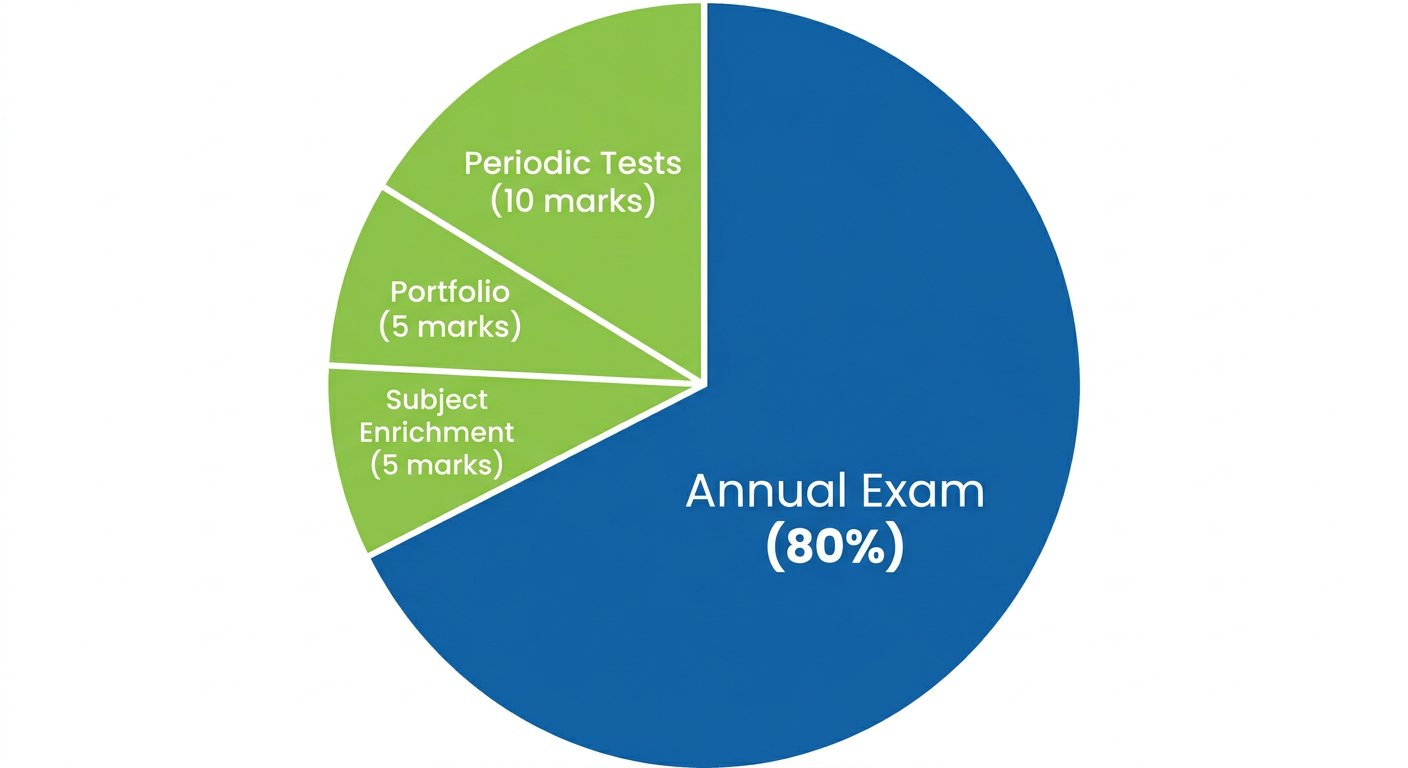 Understanding the exam pattern is as crucial as knowing the syllabus. The CBSE exam pattern for Class 9 is designed to test you throughout the year, not just in one final exam. The total marks for each subject are 100, broken down as follows:
Annual Examination (80 Marks): This is the final theory paper conducted at the end of the academic year. The question paper will cover the entire syllabus prescribed for Class 9. The paper format will include a mix of objective type questions (MCQs), very short answer questions, short answer questions, and long answer questions. This variety tests your memory, understanding, and application skills.
Internal Assessment (20 Marks): These 20 marks are in your hands and can be scored with regular effort throughout the year. The breakdown is as follows:
- Periodic Tests (10 Marks): Schools conduct three periodic tests, and the average of the best two is taken. This ensures you study consistently.
- Portfolio (5 Marks): This includes classwork, homework, and other creative work you do. Keep your notebooks neat, complete, and well-indexed. It's an easy way to score.
- Subject Enrichment Activities (5 Marks): These are practicals, projects, listening and speaking skills tests, or other activities specific to the subject. For Science, this means performing lab experiments. For Maths, it could be a lab activity. For languages, it's an assessment of your speaking and listening skills.
To see the official circulars and detailed curriculum, you can always refer to the CBSE academic website.
How to Master the Class 9 Syllabus for JEE/NEET Success
 Knowing the syllabus is half the battle; conquering it is the other half. Here is a practical strategy to use the CBSE Class 9 syllabus as a launchpad for your competitive exam preparation.
Start with NCERT, Always
NCERT textbooks are your bible. For both school exams and competitive exams like JEE and NEET, the foundation is always NCERT. Read every chapter thoroughly, solve every in-text question and back exercise. For NEET, a significant portion of the biology paper comes directly from NCERT lines. For JEE, NCERT helps build the core concepts before you move to advanced problem-solving.
Build a Strong Conceptual Foundation
Don't just memorize formulas or facts. Ask 'why' and 'how'. Why does the law of conservation of momentum work? How is a polynomial different from an equation? When you focus on understanding the core concept, you'll be able to solve any type of question, whether it's a straightforward one in your school exam or a twisted, application-based one in JEE Advanced.
Don't Ignore School Exams
The periodic tests and the final exam are not obstacles; they are milestones. Use them as opportunities to test your preparation. The pressure of an exam helps you consolidate your learning and manage your time effectively. Aim to top your class – this builds the winning habit you need for the bigger battles ahead. To help with your preparation, you can find a wealth of notes and question banks in our free resources section.
Connect with Peers and Seniors
Studying doesn't have to be a solo journey. Discussing difficult concepts with classmates can provide new perspectives. Joining a community of fellow aspirants can keep you motivated and updated. You can connect with thousands of other students on the same journey in our JEEcrackers student communities.
Use Smart Resources Wisely
Once you have mastered your NCERT books, you can supplement your learning with other resources. This could include reference books for advanced problems or online platforms that provide structured learning. For a complete breakdown of what to study, you can always check the detailed JEE/NEET syllabus on our platform to see how the Class 9 topics evolve in higher classes.
FAQs
What are the main subjects in CBSE Class 9?
The five main subjects are: 1) Science (including Physics, Chemistry, Biology), 2) Mathematics, 3) Social Science (including History, Geography, Civics, Economics), 4) English, and 5) a Second Language (such as Hindi, Sanskrit, French, etc.). Additionally, there's a sixth optional subject related to skill education.
Is the Class 9 final exam a board exam?
No, the Class 9 final examination is a school-level exam. The question papers are set by the school based on the guidelines and syllabus provided by the CBSE. However, the pattern and style are meant to prepare you for the Class 10 board exam.
How important is the Class 9 syllabus for JEE and NEET?
It is extremely important. The CBSE Class 9 syllabus for Science and Maths covers the fundamental concepts that form the basis for about 30-40% of the entire JEE and NEET syllabus. A weak foundation in Class 9 will make it very difficult to cope with the advanced topics in Classes 11 and 12.
Where can I find the official CBSE Class 9 syllabus PDF?
You can find the official and most updated syllabus on the CBSE's official academic website: https://www.cbse.gov.in/. It's always best to download it from the official source to ensure you have the correct version for the 2025-26 session.
What is the passing criteria for Class 9?
To pass Class 9, a student must secure a minimum of 33% marks in each of the five main subjects. This 33% is calculated on the total of the annual exam (out of 80) and the internal assessment (out of 20) combined.