CBSE Board Exam Timetable 2027 @cbse.gov.in: Class 10, 12 Date Sheet Expected This Week - Shiksha.com
Your ultimate guide to the CBSE board exam for Class 10 & 12. Understand the exam pattern, passing criteria, syllabus, marking scheme, and its role in JEE/NEET prep.
16 min read
A Complete Guide to the CBSE Board Exam (Class 10 & 12)
Remember that scene in '3 Idiots' where Virus talks about the pressure of the race? Life might not be a race, but for millions of students across India, the CBSE board exam often feels like the most important one of their lives. It’s a milestone. A turning point. The very mention of 'boards' can bring a mix of anxiety, excitement, and a whole lot of questions.
What is the exact pattern? How are marks calculated? What does it take to pass? And most importantly for aspiring engineers and doctors, how does it connect to your JEE and NEET preparation? It’s easy to get lost in a sea of information, rumours, and advice from everyone.
But don't worry. We're here to clear the confusion. This guide is your single source of truth for everything related to the CBSE board exam. We will break down every aspect, from the history of the board to the latest changes under the NEP, in simple, easy-to-understand language. Let's get started.
What Exactly is the CBSE Board Exam?
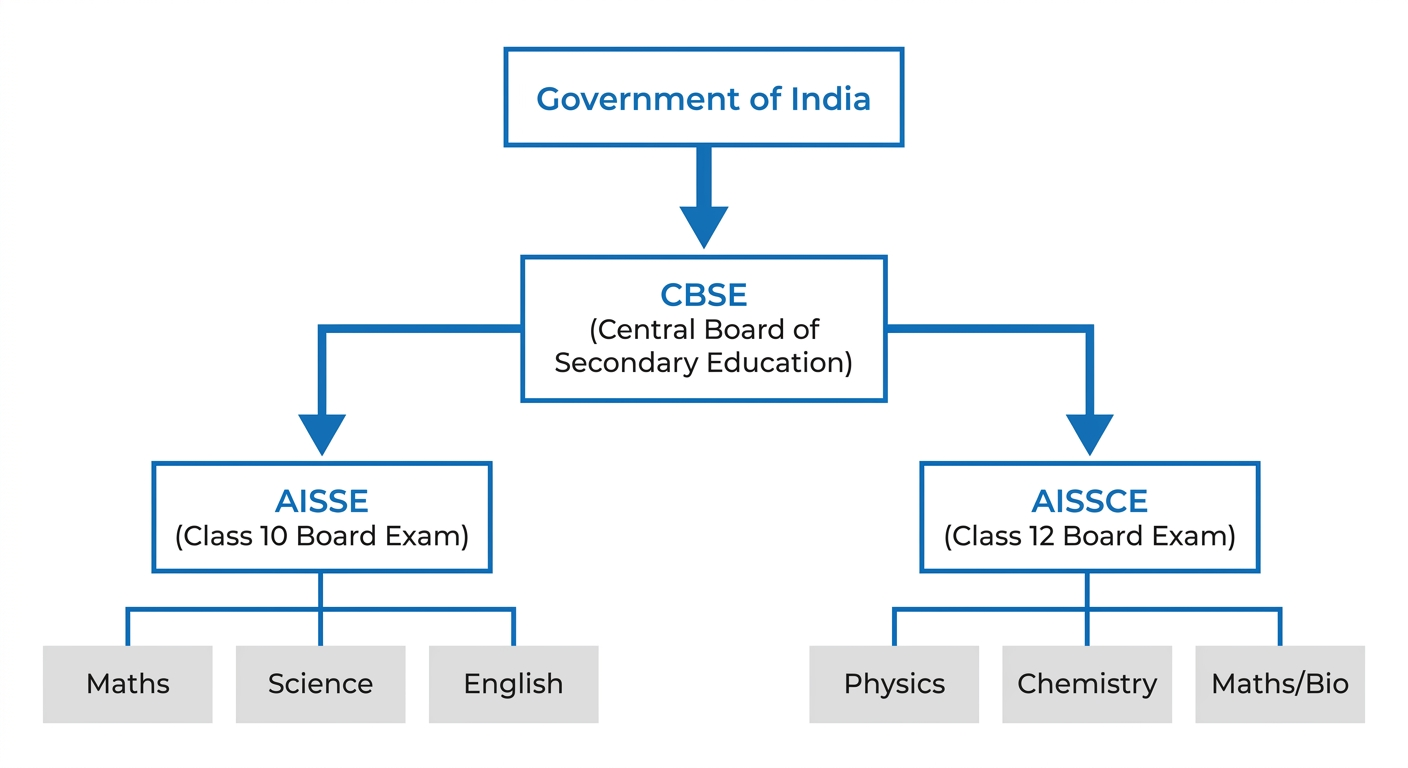
The Central Board of Secondary Education, or CBSE, is the national-level board of education in India for public and private schools. It's managed and controlled by the Government of India. Think of it as the framework that sets the curriculum, conduct examinations, and provides certifications for millions of students.
The CBSE board exam refers to the two major public examinations conducted by the board: the All India Secondary School Examination (AISSE) for Class 10 and the All India Senior School Certificate Examination (AISSCE) for Class 12. These exams aren't just about getting a marksheet. They are a standardized assessment of a student's learning over a year, or even two years in the case of Class 12.
For students aiming for top engineering and medical colleges, the CBSE board exam holds special significance. The syllabus for competitive exams like JEE Main and NEET is largely based on the CBSE curriculum for Classes 11 and 12. A strong foundation in your board subjects is the first, and perhaps most crucial, step towards cracking these tough entrance tests. Your performance in Class 12 boards can also be a tie-breaker or eligibility criterion for some institutions.
A Brief History of the CBSE
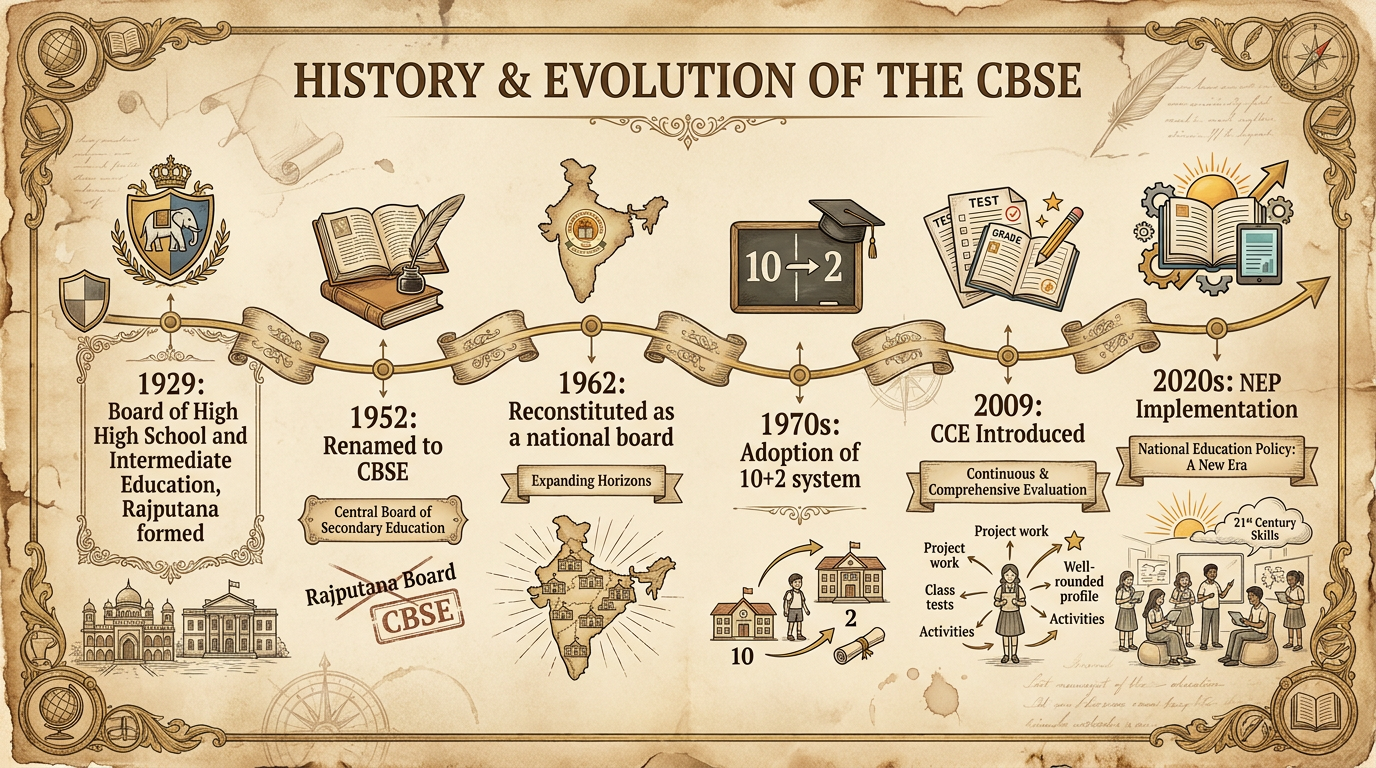
To understand the board today, it helps to know where it came from. The CBSE wasn't born overnight. Its roots go back to 1929, when the Government of India set up the 'Board of High School and Intermediate Education, Rajputana'. It was initially meant for a specific region.
Over time, its jurisdiction expanded. In 1952, the board was given its current name: the Central Board of Secondary Education. This was a major step. It marked the board's transition into a truly national body, tasked with serving the educational needs of students whose parents were in transferable Central Government jobs.
A significant milestone came in 1962 when the board was reconstituted. This allowed it to affiliate schools from all over the country and even abroad. This is why you see CBSE-affiliated schools in countries like the UAE, Singapore, and Japan today. It provides a uniform curriculum, making it easier for students to adapt if they move.
The famous 10+2 system of education, which is the backbone of our school structure, was a recommendation of the Education Commission in 1966 and was adopted by CBSE. This structured the school journey into 10 years of general education followed by 2 years of specialized senior secondary education. The board has constantly evolved, introducing changes like Continuous and Comprehensive Evaluation (CCE), then discontinuing it, and now adapting to the new National Education Policy (NEP) 2020. It's a journey of continuous refinement to meet the changing needs of education.
Understanding the CBSE Class 10 Exam Structure
The Class 10 board exam, or AISSE, is the first major academic hurdle for a student. It's a significant exam because it lays the foundation for your future academic stream selection in Class 11. A good score here can open up more choices, whether you want to pursue Science, Commerce, or Arts.
The structure is designed to provide a broad-based education, giving students a taste of various subjects before they choose to specialize. It’s a mix of compulsory subjects that everyone must study and a few optional ones.
Key Subjects and Syllabus for Class 10
The CBSE Class 10 exam primarily revolves around five compulsory subjects. These are:
- Language I: Usually English (either Course A or B).
- Language II: Hindi or any other scheduled Indian language, or a foreign language.
- Mathematics: Offered at two levels, Standard and Basic, to cater to different aptitude levels.
- Science: Covers Physics, Chemistry, and Biology.
- Social Science: Includes History, Geography, Political Science, and Economics.
Besides these five, students often take a sixth optional subject, which could be a vocational subject like Information Technology or Artificial Intelligence, or another language. The detailed JEE/NEET syllabus breakdown we offer can help you see how these foundational topics connect to higher studies.
The syllabus for these subjects is prescribed by the NCERT. The NCERT textbooks are the bible for the CBSE board exam. Sticking to them is the most reliable strategy for scoring well.
CBSE Class 10 Exam Pattern and Marking Scheme
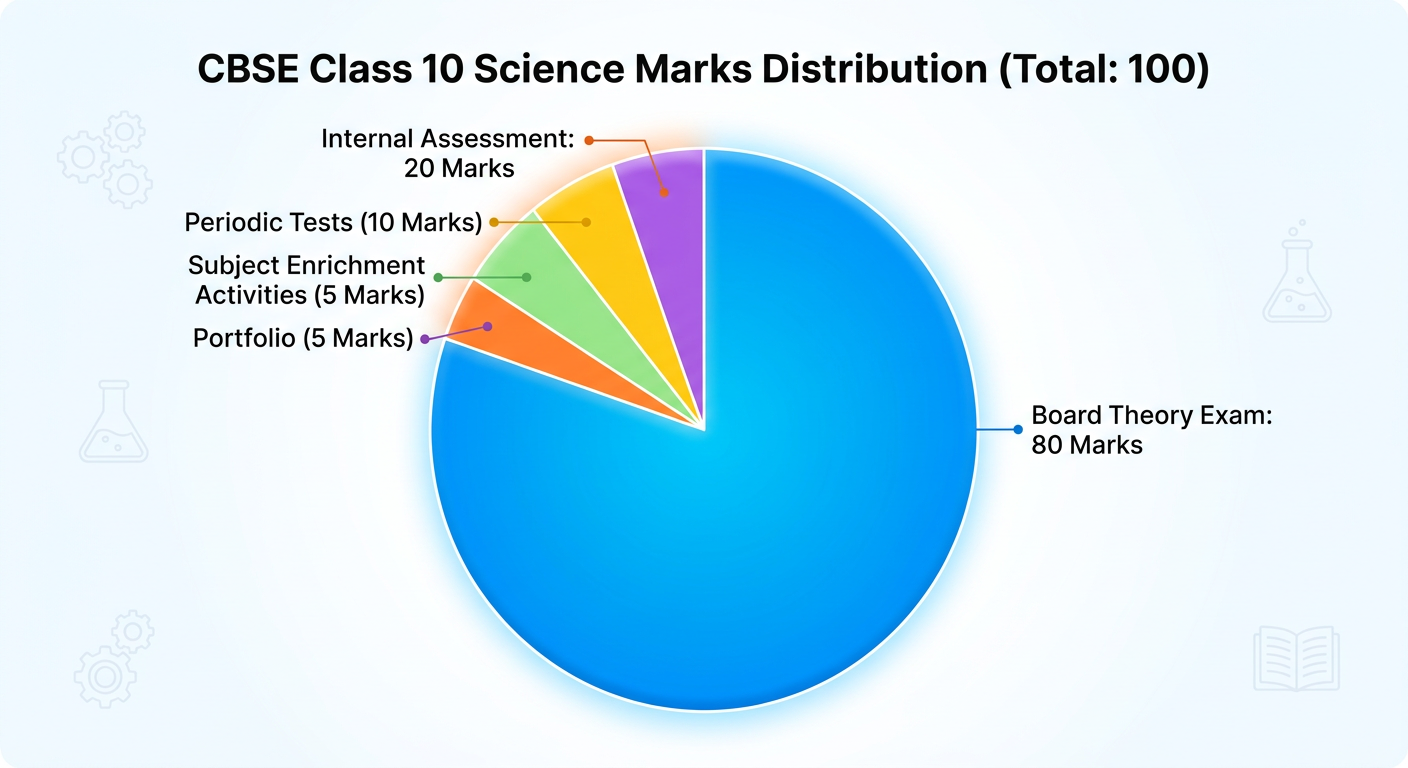
For most of the main subjects, the evaluation is split into two parts: an 80-mark theory paper (the main board exam) and a 20-mark internal assessment.
The 80-mark theory paper is a pen-and-paper exam conducted at an external centre. The question paper format has been evolving. Now, it includes a mix of:
- Objective Type Questions: Multiple Choice Questions (MCQs), fill in the blanks, etc.
- Short Answer Questions: Requiring brief, to-the-point answers.
- Long Answer Questions: Requiring detailed, comprehensive answers.
- Competency-Based Questions: These include case studies, source-based questions, and assertion-reasoning questions. They are designed to test analytical skills, not just rote memorization.
The 20 marks for internal assessment are calculated by the school based on your performance throughout the year. This includes periodic tests, multiple assessments, portfolio, and subject enrichment activities. This system ensures that your year-long effort counts, not just a single three-hour exam.
Cracking the CBSE Class 12 Exam: The Gateway to Higher Education

If Class 10 is the foundation, the CBSE Class 12 exam, or AISSCE, is the launchpad. This is the exam that directly impacts your college admissions and career path. Your Class 12 percentage is a key eligibility criterion for many universities, and the syllabus is the bedrock for all major competitive entrance exams like JEE, NEET, CUET, and CLAT.
The Class 12 curriculum is specialized. After Class 10, students choose one of three major streams: Science, Commerce, or Arts (Humanities). This choice dictates the subjects they study in Classes 11 and 12 and the career options available to them later.
Subject Combinations in Science, Commerce, and Arts
Each stream has a set of core subjects and some electives. The choices are vast, but here are the most common combinations:
- Science Stream: This is the most popular choice for aspiring engineers and doctors. The main combinations are:
- PCM (Non-Medical): Physics, Chemistry, and Mathematics, along with English and an optional subject.
- PCB (Medical): Physics, Chemistry, and Biology, with English and an optional subject.
- PCMB: For students who want to keep both engineering and medical options open.
- Commerce Stream: For those interested in business, finance, and economics. Common combinations include:
- With Maths: Accountancy, Business Studies, Economics, English, and Mathematics.
- Without Maths: Accountancy, Business Studies, Economics, English, and an optional subject like Informatics Practices, Physical Education, or Entrepreneurship.
- Arts/Humanities Stream: This stream offers the widest range of subjects, including History, Political Science, Geography, Sociology, Psychology, and Economics.
The Detailed CBSE Class 12 Exam Pattern
The exam pattern for the CBSE Class 12 exam is more varied than Class 10 because of the nature of the subjects. The total marks for each subject are 100, but the split between theory and practical/internal assessment differs.
-
For subjects without practicals: (e.g., Mathematics, English, Accountancy, History) The board exam is a 100-mark theory paper. Sometimes, 20 marks are reserved for internal assessment conducted by the school, making the theory paper 80 marks. You must check the latest scheme from CBSE.
-
For subjects with practicals: (e.g., Physics, Chemistry, Biology, Computer Science) The split is typically 70 marks for the theory paper and 30 marks for the practical exam. The practical exam is conducted at the school but is supervised by an external examiner appointed by the board.
The question paper design is similar to Class 10, with a mix of MCQs, short answer, and long answer questions. There's a strong emphasis on competency-based and application-based questions, especially in Science subjects. To master this pattern, practicing with previous year questions is absolutely essential.
The Role of Practical Exams and Internal Assessments

Many students tend to focus entirely on the theory papers and neglect the practical exams and internal assessments. This is a big mistake. These components can significantly boost your overall percentage and are crucial for a holistic understanding of the subject.
The CBSE practical exam is not just about scoring marks; it's about applying the concepts you learned in the classroom. In subjects like Physics, Chemistry, and Biology, the 30 marks are usually divided among experiments, a project file, a viva voce (oral test), and a written test. The external examiner's role is to ensure a fair and standardized evaluation.
Internal assessments, which carry a weightage of 20 marks in many subjects, are the school's way of rewarding consistent effort. These marks are compiled from unit tests, half-yearly exams, projects, and assignments done throughout the academic year. Performing well in your school exams, therefore, has a direct impact on your final board score.
Don't take them lightly. A good score in practicals and internals can provide a safety cushion, especially if a theory paper doesn't go as well as planned. It reflects your year-long dedication, not just your performance on a single day.
CBSE Passing Criteria: What Does it Take to Clear?
This is one of the most frequently asked questions, and there's often a lot of confusion around it. Let's break down the CBSE passing marks criteria clearly. The magic number is 33%.
But it's not as simple as getting 33 out of 100 overall. The rule is more nuanced, especially for subjects that have both theory and practical components.
For Class 10: A student must secure an overall 33% (in both theory and internal assessment combined) in each of the five main subjects to pass.
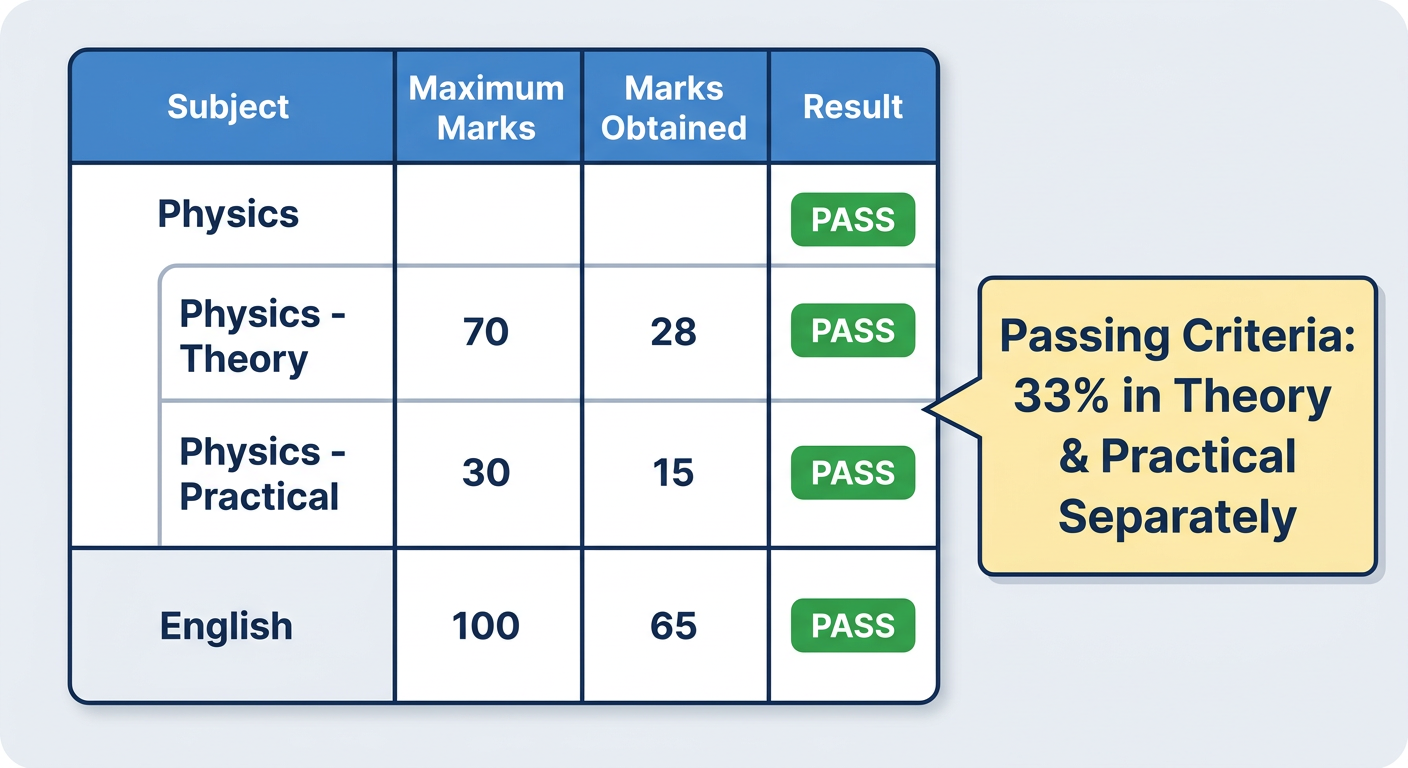
For Class 12: The criteria are stricter. A student must secure 33% marks separately in the theory component and 33% marks separately in the practical/internal assessment component. In addition, they must also secure 33% marks in aggregate for that subject.
Let's take an example for Class 12 Physics. The theory paper is for 70 marks and the practical is for 30. To pass, you need:
- At least 33% of 70 in theory (which is 23.1, so effectively 24 marks).
- At least 33% of 30 in practicals (which is 9.9, so effectively 10 marks).
If you score 30 in theory but only 8 in practicals, you will not pass in Physics, even though your total might be above 33. This rule ensures that students have a minimum competency in both theoretical knowledge and practical skills.
In case a student fails to meet these criteria in one or two subjects, CBSE provides the option of appearing for a compartment exam (now called the supplementary exam), giving them a second chance to clear the exam in the same year.
Grading System and How to Interpret Your CBSE Result
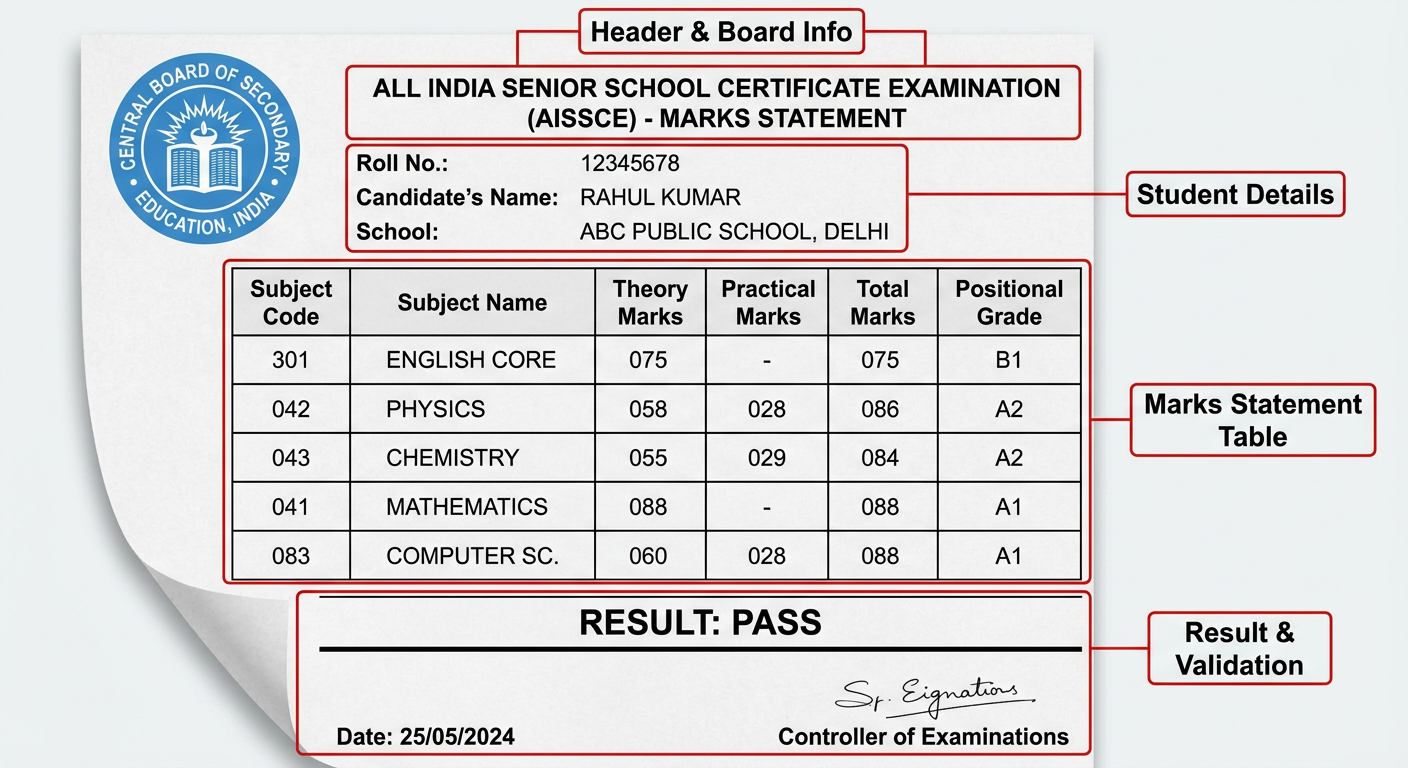
After months of hard work, the day the CBSE result is declared is filled with anticipation. The results are typically announced in May or June and can be accessed online through the official CBSE websites or services like DigiLocker.
Your marksheet is a comprehensive document. It will list your marks in each subject, broken down into theory and practical/internal assessment components. It will also show the total marks and your final result: PASS, FAIL, or COMPARTMENT. The concept of 'grades' (like A1, B2) which was part of the CCE system is no longer the primary reporting method. The focus is now on absolute marks and percentages.
Calculating your percentage is straightforward. Add the marks obtained in your five main subjects and divide by the total maximum marks (which is usually 500). Then, multiply by 100. If you have a sixth optional subject, some universities may consider the best-of-five score.
It's important to download and save a copy of your online marksheet. The original physical marksheet and passing certificate will be issued by the board and distributed through your school a few weeks later. These are extremely important documents for all future admissions and job applications. Always check the details on your marksheet, like your name and date of birth, for any errors. For official announcements, always refer to the official CBSE site.
How CBSE Prepares You for JEE Main and NEET
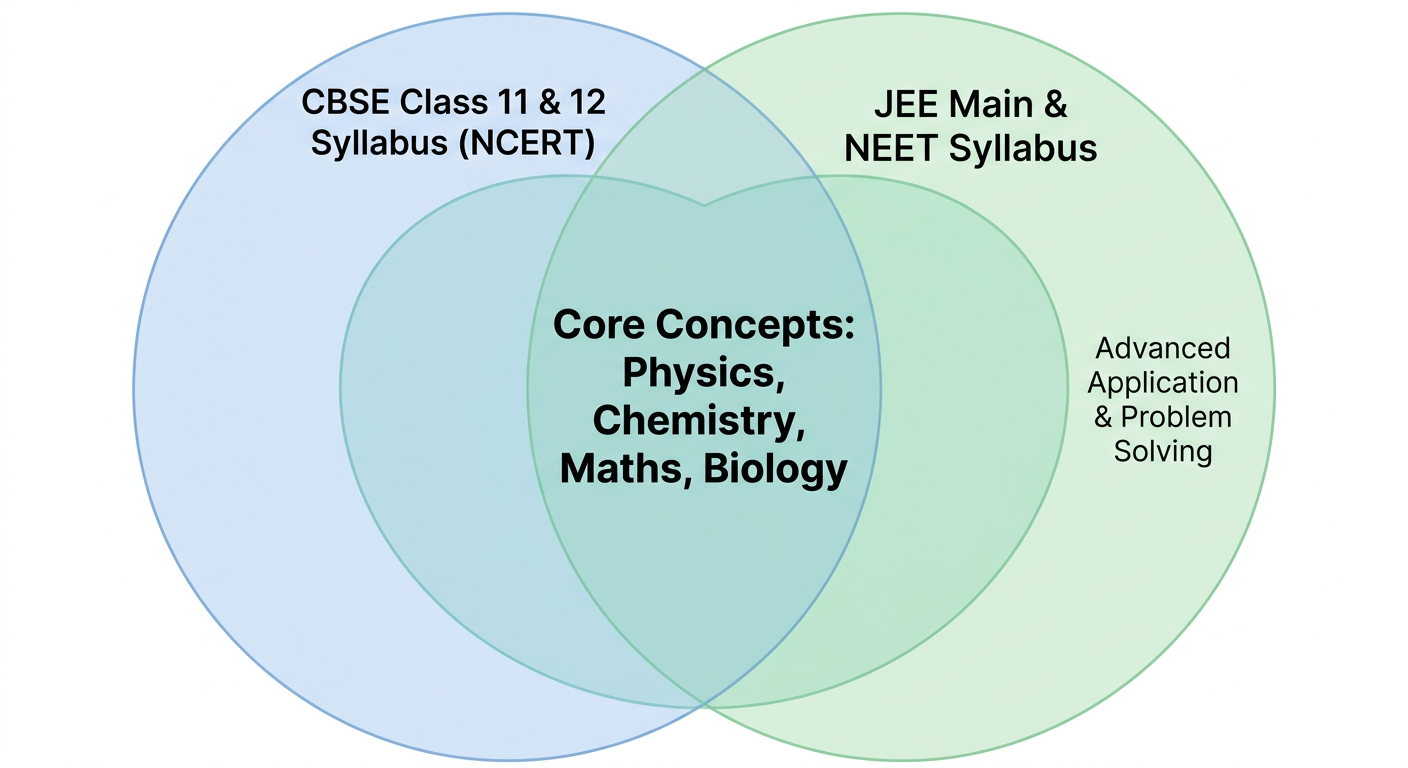
This is the most critical section for our JEEcrackers audience. Many students make the mistake of treating their board preparation and competitive exam preparation as two separate, isolated tasks. This is not just inefficient; it's wrong.
The truth is, your CBSE board exam preparation is the foundation of your JEE or NEET success. The syllabus for these entrance exams is almost entirely derived from the CBSE curriculum for Classes 11 and 12. The NCERT textbooks, which are essential for boards, are the single most important resource for building the fundamental concepts required for JEE and NEET.
Think about it. You cannot solve a complex JEE Advanced problem on Rotational Motion if you don't understand the basic principles of torque and angular momentum from your NCERT book. You cannot answer a tricky NEET question on genetics if your concepts from the Class 12 Biology textbook are weak.
The recent shift in the CBSE exam pattern towards competency-based and analytical questions is actually a blessing in disguise. It forces you to think critically and apply concepts, which is exactly the skill set needed for competitive exams. Rote learning won't get you far in either boards or entrance tests anymore.
Our advice is simple: integrate your preparation. When you study a chapter for your boards, study it with the depth required for JEE/NEET. Solve the NCERT exercises first, then move on to MCQs from question banks. This integrated approach saves time, strengthens concepts, and reduces pressure. After your exams, you can use our JEE rank predictor tool to get an idea of where you stand.
Recent Changes and Future Trends in the CBSE Board Exam
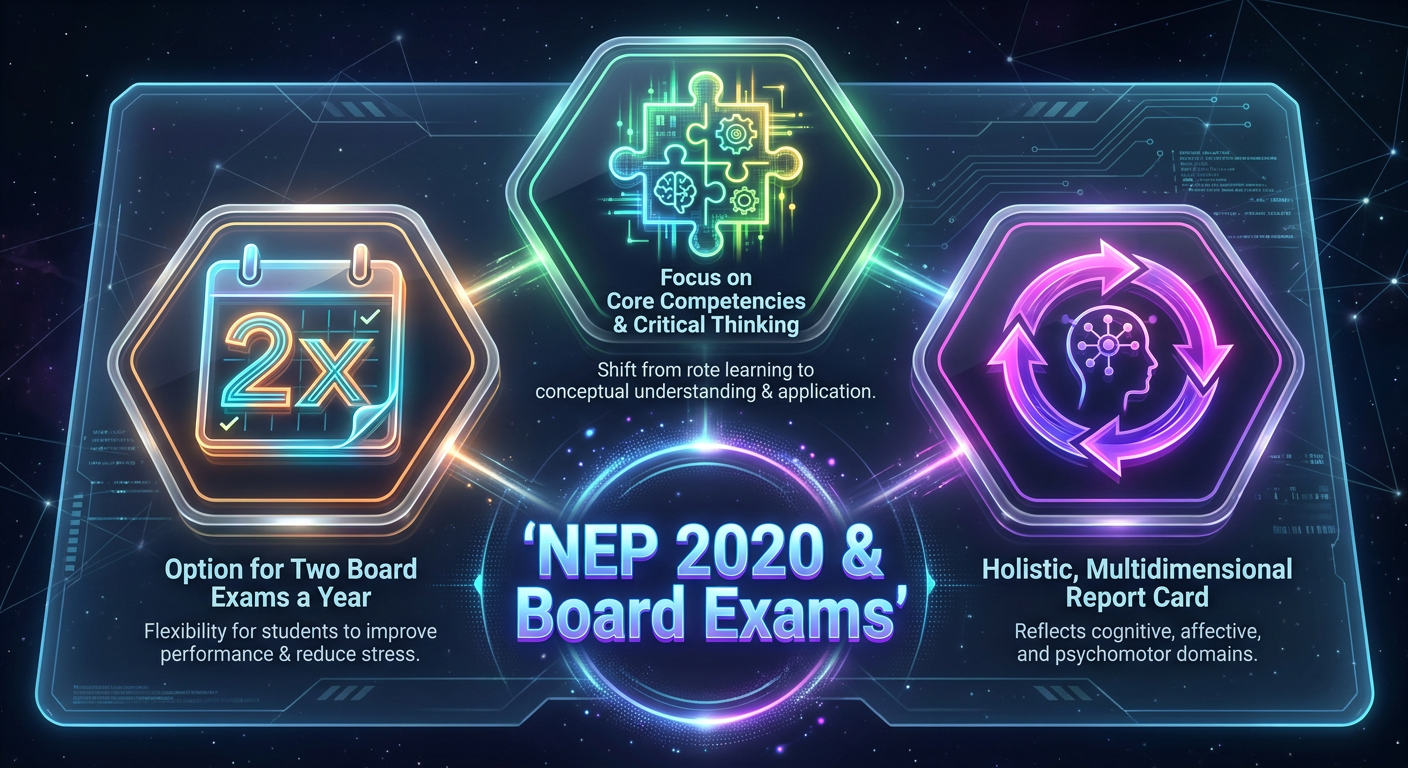
The world of education is changing, and CBSE is adapting to it. The National Education Policy (NEP) 2020 is the driving force behind many of these changes. The goal is to make board exams less stressful and more focused on testing real understanding rather than memory.
One of the biggest proposals under NEP is to conduct board exams twice a year. This would give students a chance to improve their scores and reduce the high-stakes pressure of a single exam. While this is not yet fully implemented for all classes, it is a direction the board is actively exploring.
Another major trend is the increasing weightage of competency-focused questions. These include case-based MCQs, source-based integrated questions, and other formats that require you to analyze a situation and apply your knowledge. The board has been steadily increasing the percentage of these questions in the papers, moving away from simple recall-based questions.
There is also a push towards a more holistic, 360-degree assessment, which might see the inclusion of self-assessment and peer-assessment in the future. The idea is to create a more comprehensive report card that reflects a student's overall development, not just their academic performance in a few subjects.
Staying updated with these changes is important. Always follow official circulars from the CBSE website. These transformations are designed to make learning more meaningful and prepare you better for the challenges of higher education and your future career.
FAQs
When is the CBSE board exam usually conducted?
The CBSE board exams for both Class 10 and 12 are typically conducted annually between February and April. The exact date sheet is usually released by the board a few months prior to the examination.
What is the minimum passing mark for the CBSE board exam?
A student needs to secure a minimum of 33% marks to pass. For Class 12, this 33% must be achieved separately in both theory and practical/internal assessment components of a subject, as well as in aggregate.
Can I improve my score after the CBSE result is declared?
Yes, CBSE provides an opportunity for students to appear for an improvement exam. Students who have passed the exam but wish to improve their score in one or more subjects can take these exams, which are usually held along with the compartment/supplementary exams.
How important are pre-board exams?
Pre-board exams conducted by schools are extremely important. They are a dress rehearsal for the final board exam, helping you to manage time, understand the paper pattern, and identify your weak areas. A good performance in pre-boards also boosts your confidence significantly.
Is the CBSE syllabus enough to crack JEE or NEET?
The CBSE syllabus (especially from NCERT books) forms the core foundation for JEE and NEET. While it is absolutely essential, cracking these top-tier exams requires an extra layer of problem-solving practice and a deeper understanding of advanced concepts. So, the syllabus is necessary but may not be sufficient on its own. You'll need supplementary materials and mock tests.
Where can I find the official CBSE date sheet?
The official date sheet and any other authentic information regarding the CBSE board exam are always published on the official CBSE website, which is https://www.cbse.gov.in/. You should always rely on the official website for announcements to avoid misinformation.